买手制

Search documents
安踏或将再收获一个IPO
Guan Cha Zhe Wang· 2025-12-15 10:13
Core Insights - Musinsa, a South Korean fashion retailer, has opened its first flagship store in Shanghai, marking its entry into the Chinese market and the beginning of its global expansion [1] - Anta Sports has acquired a 1.7% stake in Musinsa for 50 billion KRW, indicating a strategic partnership aimed at exploring the intersection of sports and fashion [5] - Musinsa is preparing for an IPO, potentially valuing the company at 10 trillion KRW (approximately 6.8 billion USD), a significant increase from its previous valuation of 3.5 trillion KRW [3][4] Company Expansion - The flagship store spans approximately 1,421 square meters and is located in a prime shopping area in Shanghai, which sees daily foot traffic of around 500,000 [5] - Musinsa plans to open over 100 stores in China within the next five years, aiming for total revenue exceeding 1 trillion KRW (approximately 4.78 billion RMB) by 2030 [11] - The company has also launched its e-commerce presence on platforms like Tmall and Douyin, achieving impressive sales figures shortly after opening [12][13] Market Positioning - Musinsa's product pricing for down jackets ranges from 439 to 965 RMB, positioning it slightly higher than Uniqlo's offerings [11] - The brand emphasizes local adaptation, offering exclusive products tailored to Chinese consumer preferences, while maintaining its Korean identity [9][30] - Musinsa's strategy includes leveraging Anta's resources to enhance its operational capabilities while allowing for independent brand management [5][23] Competitive Landscape - The entry of Musinsa into China coincides with a growing interest in Korean fashion brands, as several others have also expanded into the market [18] - The brand's unique selling proposition lies in its ability to attract younger consumers seeking a distinct "Korean vibe" and shopping experience, contrasting with the standardized offerings of competitors like Uniqlo [30] - Challenges remain for Musinsa, particularly in competing with established brands and adapting its supply chain to meet local demands [27][30] Future Outlook - Musinsa's IPO is anticipated to occur in 2026, with potential listings in Seoul or New York, which would further solidify its market presence [3][30] - The partnership with Anta is seen as a critical step in building a comprehensive fashion portfolio, enhancing both companies' market positions [4][23] - The success of Musinsa in China will depend on its ability to effectively replicate its business model and adapt to the complexities of the local market [30]


确认不再续签 连卡佛成都国际金融中心店将于明年2月关闭
Sou Hu Cai Jing· 2025-12-12 09:47
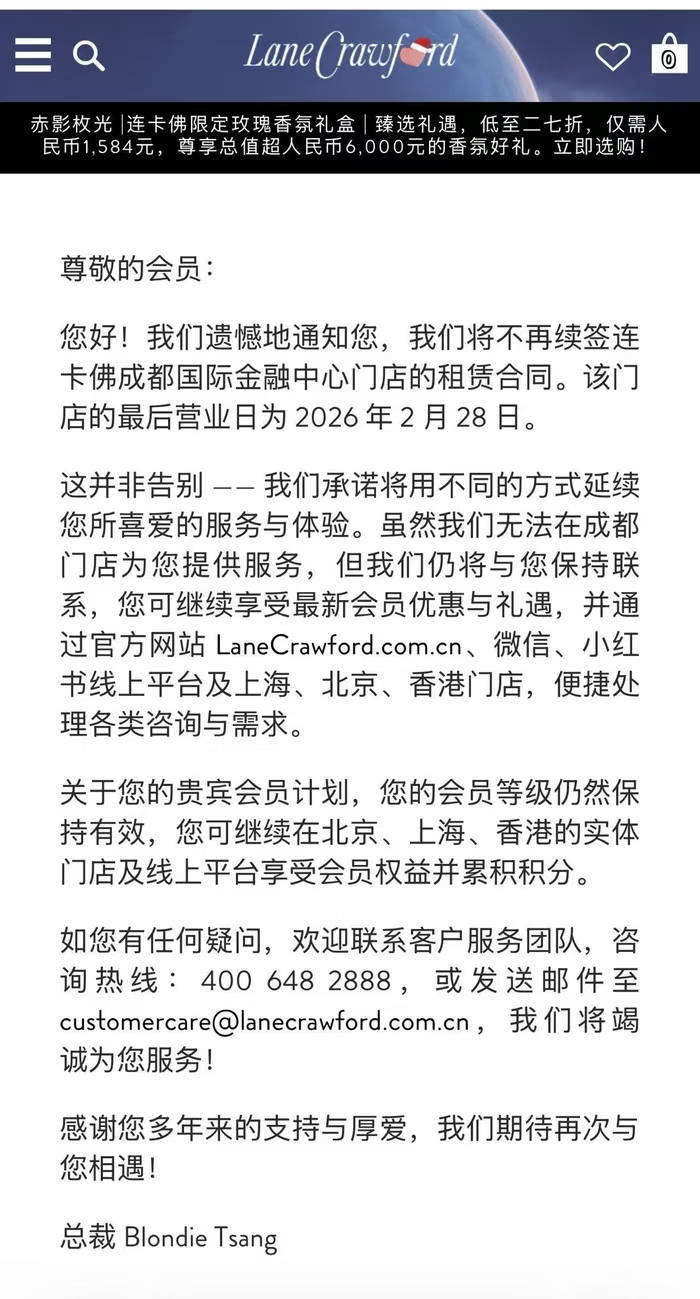
Core Viewpoint - Lane Crawford, a high-end retail brand established in 1850, will close its Chengdu International Financial Center store by February 28, 2026, marking the second closure in mainland China after shutting down its Beijing store in 2021. The brand is shifting focus from physical stores to online channels while maintaining customer engagement through various digital platforms [1][4][11]. Group 1: Store Closure Details - The Chengdu store, which opened in 2015 and spans approximately 7,600 square meters, will not renew its lease, with the last operating day confirmed as February 28, 2026 [1][3]. - Customers can still access membership benefits and redeem points through other locations and online platforms after the Chengdu store closes [1][4]. Group 2: Business Model and Market Position - Lane Crawford is known for its "buying agent" model, which has introduced many international niche brands to the mainland market. The Chengdu store was considered a strategic location due to the growing high-consumption demographic in the area [4][11]. - Following the closure of the Chengdu store, Lane Crawford will only have two remaining boutique stores in mainland China, located in Beijing and Shanghai, while also operating discount outlets in various locations [4][8]. Group 3: Competitive Landscape and Adjustments - The closure reflects broader challenges faced by high-end retailers in prime urban locations, where rising rental costs and intense competition from new luxury brands have made it difficult to maintain profitability [8][11]. - Lane Crawford has also made adjustments to its Shanghai flagship store, including changes in product offerings and layout, indicating a strategic shift in response to market dynamics [8][9]. Group 4: Online Expansion Efforts - The company is actively expanding its online presence through platforms like WeChat and Xiaohongshu, aiming to enhance brand communication and customer engagement in the digital space [9][11]. - Personal accounts operated by store employees on social media platforms are being utilized to connect with consumers and share brand-related content, reflecting a move towards more personalized marketing strategies [9].
中国富人正在抛弃买手百货:连卡佛确认关闭成都店
Guan Cha Zhe Wang· 2025-12-10 08:59
Core Viewpoint - Lane Crawford, a high-end department store, will close its Chengdu IFS location on February 28, 2026, due to a decision not to renew the lease, reflecting changes in the Chinese consumer market and long-term strategic evaluations [2]. Company Summary - The closure of the Chengdu store marks a contraction in Lane Crawford's operations in mainland China, following the previous closure of its Beijing store in 2021 and adjustments in its Shanghai store [4]. - Lane Crawford operates under a "buying team" model, which differentiates it from traditional department stores by allowing for unique product offerings through global procurement [4]. - The Chengdu store featured over 300 international brands, with approximately 120 brands making their debut in the Chengdu market and 40% of the brands being exclusive to Lane Crawford [3]. Industry Summary - The traditional buying model faces challenges due to shifts in luxury consumption patterns, rising rental costs in high-end malls, and competition from e-commerce and live-streaming channels [5]. - Many luxury brands are now opting for direct sales or independent stores rather than entering through buying teams, as seen with new high-end brands opening in Chengdu [6]. - The closure of Lane Crawford's Chengdu store may be a strategic move to optimize its network and concentrate resources, but its future in the Chinese market will depend on its ability to connect with a new generation of consumers while maintaining its buying team essence [15].
孩子王(301078):归母净利同增79% 多业务并行打造新增长极
Xin Lang Cai Jing· 2025-08-21 10:36
Core Insights - The company reported a revenue increase of 9% year-on-year for the first half of 2025, reaching 4.9 billion yuan, with a net profit growth of 79% to 140 million yuan [1] - The company is expanding its store network, surpassing 1,300 locations, and has launched its first Ultra store, integrating various innovative elements [4] - The company is enhancing its supply chain through self-operated products and has successfully launched AI smart toys [5] - The integration of the hair care brand, Silky, is expected to boost profits and create synergies with the company's core business [6] - The company is projected to achieve significant revenue and profit growth over the next three years, with a stable market position and strong digital supply chain capabilities [7] Financial Performance - For the first half of 2025, the gross margin was 27.7%, down by 2 percentage points, while the net profit margin increased by 1 percentage point to 2.9% [3] - In Q2 2025, revenue was 2.5 billion yuan, reflecting an 8% year-on-year increase, with net profit rising 65% to 110 million yuan [2] Expansion and Innovation - The company is focusing on both direct and franchise expansion, with over 500 self-operated stores and 540 franchise stores as of the first half of 2025 [4] - The company aims to open 500 franchise stores by the end of 2025, with significant revenue contribution from franchise operations [4] Supply Chain and Product Development - The company is implementing a "short chain + self-operated" model to optimize costs and enhance brand uniqueness, with self-owned brand revenue contributing 3.4 billion yuan [5] - The introduction of AI smart toys is part of the company's strategy to innovate within its product offerings [5] Strategic Partnerships - The collaboration with Silky is expected to enhance store traffic and product offerings, leveraging the company's extensive distribution channels [6]
「店王」SKP的惊人流水为何换不来资本信心?
36氪· 2025-05-08 09:49
Core Viewpoint - The acquisition of a stake in Beijing SKP by Boyu Capital is seen as a strategic move amidst a cooling luxury market, with implications for both the seller, Beijing Hualian, and the buyer, Boyu Capital [4][5][17]. Group 1: Transaction Details - Boyu Capital, through its affiliates, plans to acquire 42%-45% of Beijing SKP's shares, previously held by Beijing Hualian and Radiance Investment Holdings [4]. - The overall value of Beijing SKP's management and operations is estimated between $4 billion to $5 billion, approximately 290 billion to 364 billion RMB [5]. - The transaction is interpreted as Beijing Hualian's attempt to divest from a declining luxury market, leading to a significant drop in its stock price [5]. Group 2: Beijing SKP's Performance - Beijing SKP has achieved remarkable sales, with a record revenue of 26.5 billion RMB in 2023, maintaining its position as the top-performing single-store shopping center in China for ten consecutive years [9][10]. - The store's sales peaked at 10.1 billion RMB in a single day in 2017, showcasing its strong market presence [9]. - Despite its success, the luxury retail environment is shifting, with forecasts suggesting a 17% revenue decline for SKP in 2024, potentially dropping to 22 billion RMB [18]. Group 3: Market Trends and Strategic Shifts - The luxury market is experiencing a contraction, with brands focusing on strategic placements in second- and new-tier cities, leading to a more cautious expansion approach [14]. - The operational model of SKP, which combines high-end retail with experiential offerings, is under scrutiny as consumer preferences evolve towards more engaging shopping experiences [18]. - The shift towards experience-driven retail is evident as luxury brands diversify into services beyond traditional shopping, indicating a broader trend in consumer expectations [18]. Group 4: Financial Context of Beijing Hualian - Beijing Hualian reported a total revenue of 1.398 billion RMB in the past year, ranking 32nd among its peers, with a net profit decline of 26.28% [15]. - The company’s asset-liability ratio increased to 45.56%, indicating financial pressures that may have influenced the decision to sell SKP [15]. - The strategic divestment aligns with Hualian's focus on core business operations and asset optimization, as evidenced by the recent separation of its community retail segment [15][16]. Group 5: Boyu Capital's Investment Strategy - Boyu Capital's interest in acquiring SKP is part of a broader strategy to enhance its high-end consumer ecosystem, complementing its existing investments in various sectors [17]. - The acquisition could enable Boyu Capital to establish a comprehensive presence in the luxury retail market, integrating online and offline consumer experiences [17].
SKP的惊人流水为何换不来资本信心?
3 6 Ke· 2025-05-08 01:56
Core Viewpoint - The acquisition of a stake in Beijing SKP by Boyu Capital is seen as a strategic move amidst a cooling luxury market, with implications for both the seller, Hualian, and the buyer, Boyu Capital [1][2][10]. Company Overview - Beijing SKP, originally known as Shin Kong Place, opened in 2007 and quickly became a premier destination for luxury shopping in Beijing, attracting over 700 luxury brands [2][3]. - The mall has consistently achieved high sales performance, with a record single-day sales of 1.01 billion yuan in 2017 and total sales reaching 26.5 billion yuan in 2023 [3][10]. Transaction Details - Boyu Capital, through its affiliates, is set to acquire 42%-45% of Beijing SKP's equity, previously held by Hualian and Radiance Investment Holdings [1]. - The overall value of the management and operational business of Beijing SKP is estimated between 4 billion to 5 billion USD (approximately 29 billion to 36.4 billion yuan) [1]. Market Context - The luxury goods market in China is experiencing a downturn, prompting Hualian to divest from SKP, which may be interpreted as shedding a burden [1][2]. - Hualian's financial performance has been declining, with a reported revenue of 1.398 billion yuan and a net profit drop of 26.28% year-on-year [8]. Strategic Implications - The acquisition aligns with Boyu Capital's strategy to build a comprehensive high-end consumer ecosystem, complementing its existing investments in various sectors [10]. - The shift in luxury retail dynamics, with brands focusing on second-tier and new first-tier cities, indicates a changing landscape for high-end retail [7]. Future Outlook - Projections suggest that Beijing SKP's revenue may decline by 17% in 2024, potentially falling to 22 billion yuan, as competition from other high-end malls increases [10]. - The evolving consumer preferences towards experiential retail and personalized services will challenge traditional luxury retail models, necessitating strategic adjustments from Beijing SKP [11].

「店王」SKP的惊人流水为何换不来资本信心?
36氪未来消费· 2025-05-07 09:32
Core Viewpoint - The acquisition of a stake in Beijing SKP by Boyu Capital is seen as a strategic move amidst a cooling luxury market, with implications for both the seller, Beijing Hualian, and the buyer, Boyu Capital [3][4][12]. Group 1: Transaction Details - Boyu Capital, through its affiliates, plans to acquire 42%-45% of Beijing SKP's equity, previously held by Beijing Hualian and Radiance Investment Holdings [3]. - The overall value of Beijing SKP's management and operations is estimated between $4 billion to $5 billion, equivalent to approximately 290 billion to 364 billion RMB [3]. - The transaction is interpreted as Beijing Hualian's attempt to divest from a declining asset, as evidenced by a significant drop in its stock price following the announcement [3][4]. Group 2: Performance of Beijing SKP - Beijing SKP has achieved remarkable sales, with a record revenue of 26.5 billion RMB in 2023, maintaining its status as the top-performing single-store shopping mall in China for ten consecutive years [7][8]. - The mall's innovative approach, including the introduction of a buyer system and experiential retail, has contributed to its success, although a significant portion of its revenue still comes from rental income [9][10]. - Despite its past success, projections indicate a potential revenue decline of 17% in 2024, with expected earnings of 22 billion RMB [17]. Group 3: Market Context and Strategic Considerations - The luxury retail market in China is experiencing a contraction, with brands shifting focus to second-tier and new first-tier cities, indicating a strategic realignment in the industry [12]. - Beijing Hualian's decision to sell SKP aligns with its broader strategy to focus on core operations and optimize assets, as evidenced by its declining financial performance [13][14]. - Boyu Capital's interest in acquiring SKP is part of a larger strategy to create a comprehensive high-end consumer ecosystem, enhancing its investment portfolio across various sectors [15][16].