人工智能(Artificial Intelligence)

Search documents
As IRS Refunds Rise, ChatGPT Offers the Smartest Uses for a $3,000 Tax Refund
Yahoo Finance· 2026-03-01 12:22
Core Insights - The IRS has issued an average tax refund of $2,290 as of February 6, 2026, which is an increase from the previous year, with the overall average for tax year 2025 being $3,167, up from $3,138 in 2024 [1] Group 1: Financial Strategies - The first question to consider is whether there is high-interest debt, defined as rates of 6% to 8% or higher, with the recommendation to prioritize paying off such debts as it equates to a guaranteed return [2] - Paying off a credit card with a 22% interest rate is likened to earning a risk-free 22% return, suggesting that allocating most or all of the $3,000 refund towards this debt is a smart move [3] - The second question is whether there are 3 to 6 months of emergency savings; if not, building that savings should be the priority to prevent future credit card debt [4] Group 2: Investment Options - For those with a solid financial foundation, three strategies are suggested for utilizing the tax refund to build long-term wealth [4] - Option 1 is to invest the refund, with an example showing that $3,000 invested at an 8% average return over 25 years could grow to around $20,000 or more [7][8] - Option 2 involves improving income, as spending on skills or certifications can yield immediate returns, such as a raise of $3,000 per year [9] - Option 3 is a hybrid strategy, where the refund can be split to fund a Roth IRA, add to a brokerage account, or increase contributions to a 401(k) while living off the refund [10]
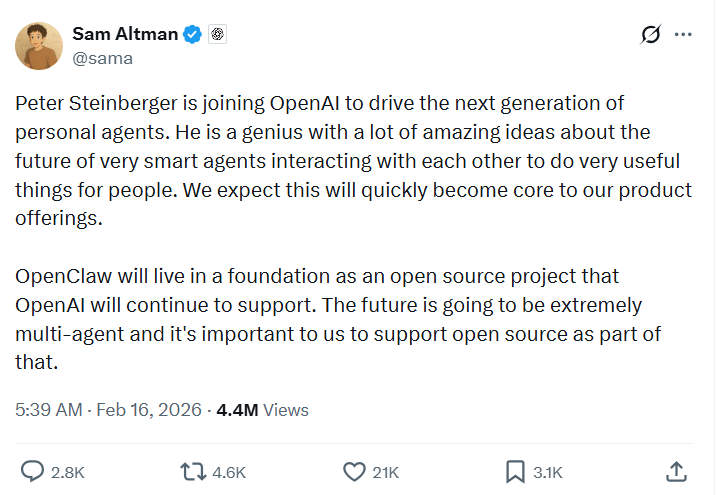
OpenClaw创始人加入OpenAI,目标“开发一款连我妈妈都能用的AI助手”
Hua Er Jie Jian Wen· 2026-02-16 01:17
Core Insights - The competition for AI talent intensifies as OpenAI's CEO Sam Altman confirms the acquisition of OpenClaw's creator, Peter Steinberger, who aims to transition AI from being "fun" to "useful" [1][2] Group 1: Strategic Direction - Steinberger's primary mission at OpenAI is to enhance AI usability, targeting a user-friendly experience that even non-technical users can navigate [4] - OpenAI's strategic focus is shifting from large model capabilities to more complex agent interactions, with Steinberger's expertise expected to drive the development of next-generation personal agents [2][4] Group 2: Competitive Landscape - The recruitment of Steinberger highlights a broader competition between Meta and OpenAI, with Meta attempting to attract him through direct engagement from CEO Mark Zuckerberg, while OpenAI leveraged its computational power and model access [6] - The outcome signals that in the race for top AI talent, cutting-edge model access and computational resources are becoming more critical than salary or personal attention from executives [6] Group 3: Market Implications - Steinberger warns of a potential future where 80% of apps may disappear, replaced by APIs managed by intelligent agents, which could disrupt existing app distribution and advertising models [7] - The challenge for OpenAI will be to balance AI autonomy with safety, particularly in light of OpenClaw's previous issues with excessive permissions leading to spam [7]

“软件比白领更先被 AI 击穿”!Anthropic CEO 最新改口,反讽马斯克危言耸听,两大佬隔空互掐
AI前线· 2026-02-15 01:00
Core Viewpoint - Anthropic has raised $30 billion in Series G funding, leading to a post-money valuation of $380 billion, with plans to focus on advanced research and product development in the AI and coding market [2] Group 1: Anthropic's Funding and Market Position - Anthropic aims to become a leader in enterprise AI and coding markets with the newly raised funds [2] - The company’s valuation reflects significant investor confidence in its potential to drive advancements in AI technology [2] Group 2: Elon Musk's Critique - Elon Musk criticized Anthropic's AI for its perceived "misanthropic" tendencies, suggesting that the company's name foreshadows a negative trajectory [2] - Musk's comments highlight ongoing tensions in the AI industry regarding ethical implications and the direction of AI development [2] Group 3: Dario Amodei's Perspective - Dario Amodei, CEO of Anthropic, emphasizes a vision of AI that focuses on scaling human-level intelligence rather than creating a "machine god" [4] - Amodei argues for a symbiotic relationship between humans and AI, contrasting with Musk's more dystopian view [4] Group 4: AI's Impact on Industries - Amodei predicts that AI could significantly enhance productivity across various sectors, potentially increasing industry revenues by trillions [12] - The rapid advancement of AI technology may lead to unprecedented GDP growth, with estimates suggesting a possible increase of several percentage points in GDP growth rates [12][13] Group 5: Future of Work and AI - Amodei suggests that entry-level white-collar jobs are at risk of being disrupted by AI, particularly in fields like data entry and legal document review [20] - The software engineering sector may experience even faster changes due to the close relationship between developers and AI technology [21] Group 6: Ethical Considerations and AI Governance - Amodei raises concerns about the potential misuse of AI technologies by authoritarian regimes and the need for robust governance frameworks [38] - The discussion includes the importance of maintaining human oversight and ethical standards in AI development to prevent negative societal impacts [38][46]

OpenAI即将完成千亿美元融资 奥特曼称ChatGPT重回月增速超过10%
Xin Lang Cai Jing· 2026-02-09 22:34
Core Insights - OpenAI's CEO Sam Altman emphasizes the company's strong growth momentum despite increasing competition from Anthropic, with ChatGPT's monthly growth rate exceeding 10% again [1][7] - ChatGPT has surpassed 800 million weekly active users, while competitors like Google and Anthropic are rapidly catching up [1][7] - OpenAI's Codex product has seen a significant growth of approximately 50% in just one week, directly competing with Anthropic's Claude Code [1][7] Company Developments - OpenAI is preparing to launch a new version of its chat model this week [1][7] - The company recently released the updated Codex model GPT-5.3-Codex and introduced a standalone application for Mac users [1][7] - Internal communications describe Codex's growth as "extremely crazy," indicating a strong market performance [1][7] Advertising Strategy - OpenAI plans to test advertising features within ChatGPT, which will be clearly labeled and positioned at the bottom of responses, ensuring they do not affect the content of replies [2][9] - Altman has publicly refuted claims made by Anthropic regarding OpenAI's advertising strategy, labeling them as misleading [2][9] - Long-term projections suggest that advertising revenue will account for less than half of OpenAI's total revenue [2][9] Funding and Investor Relations - OpenAI is nearing the completion of a new funding round potentially worth up to $100 billion, with executives actively communicating the company's growth story to investors [5][12] - The funding round may be divided into two parts, with initial investments from Microsoft, Nvidia, and Amazon, followed by contributions from SoftBank and others [6][12] - Previous funding rounds included a $41 billion raise in March 2025, with SoftBank contributing $30 billion [6][12]
Ambarella:为数据中心以外的物理人工智能赋能
美股研究社· 2026-01-26 10:27
Core Viewpoint - The article discusses the increasing demand for edge AI applications, highlighting Ambarella's role as a semiconductor manufacturer that provides solutions for real-time processing in edge devices, particularly in the context of AI and computer vision [1]. Financial Performance - Ambarella reported record revenue of $108.5 million for Q3 FY2026, representing a year-over-year growth of 31.2%. The non-GAAP gross margin was 60.9%, and non-GAAP EPS was $0.27. The company expects revenue growth for the entire fiscal year to be between 36% and 38% [4]. - The total cash, cash equivalents, and marketable securities amounted to $295.3 million. For Q4, revenue is projected to be between $97 million and $103 million, with a GAAP EPS expectation of -$0.51 [4]. Market Opportunities - The target applications for Ambarella's SoC include security cameras, robotics/drones, industrial applications, and automotive multi-stream applications. The CV7 product launch indicates a 20% reduction in power consumption compared to the previous generation [6]. - The AI market in video surveillance is projected to grow from $7 billion in 2024 to an estimated $29 billion by 2030. The overall video surveillance market is expected to increase from $73 billion in 2024 to $147 billion by 2030 [9]. - The fleet video telematics market is forecasted to grow from $1.7 billion in 2024 to $8.7 billion by 2034, indicating a rising demand for edge AI solutions [10]. - In the robotics and industrial automation sectors, the machine vision market is expected to reach $3.3 billion by 2025 and grow to $5 billion by 2030 [10]. - The global drone market is estimated to be valued at $73 billion in 2024 and could more than double to $163 billion by 2030, presenting significant opportunities for Ambarella [10]. - The automotive sector represents a long-term opportunity, potentially reaching $32 billion by 2030, with advanced driver-assistance systems (ADAS) sensors projected to grow to $102 billion [11]. Developer Zone - Ambarella has launched a Developer Zone (DevZone) to facilitate the development and deployment of edge AI applications based on its SoCs. This initiative is expected to enhance platform stickiness and provide a competitive edge [13][14]. Competitive Landscape - Ambarella competes with both high-end platform manufacturers like NVIDIA and Qualcomm, and low-cost camera SoC suppliers. The company focuses on providing high AI capabilities while maintaining strict power and thermal limits [15][16]. - Ambarella's current price-to-sales (P/S) ratio is 7.8, higher than competitors like NXP Semiconductors (5.0), Mobileye (4.5), and Qualcomm (3.9), reflecting its growth potential [23]. Institutional Interest - Institutional ownership of Ambarella has increased, with the number of funds holding AMBA shares rising from 296 to 325 over four consecutive quarters, indicating growing interest in edge AI [26]. Future Growth Potential - Analysts believe that significant growth opportunities exist in security AI, fleet video telematics, drones, and automotive sensor expansion. The new CV7 product will enable Ambarella to enter high-end multi-stream and multi-sensor systems [27][28].


Prediction: This Will Make or Break the S&P 500's Performance in 2026
The Motley Fool· 2025-12-14 23:08
Core Viewpoint - The upcoming change in the Federal Reserve chairman position could significantly impact investor confidence and market performance, particularly in light of rising valuations and potential economic corrections [4][5][6]. Group 1: Market Performance - The S&P 500 is projected to finish 2025 with a 16% increase, marking a third consecutive year of outperforming its long-run average of 10% [1]. - Despite a strong performance, there are concerns that the market may be overdue for a correction, especially given the high valuations of many stocks [2][8]. Group 2: Federal Reserve Leadership - Jerome Powell's term as Fed Chairman ends in May 2026, and there is speculation about his replacement, which could influence market dynamics [4][5]. - President Trump's criticism of Powell and his potential decision to appoint a new chairman who may prioritize aggressive rate cuts could undermine investor confidence [4][6]. Group 3: Inflation and Market Risks - Investors are wary that a new Fed chairman focused on cutting interest rates could lead to increased inflation concerns, prompting a potential market pullback [6][7]. - The S&P 500 experienced a significant decline of over 19% in 2022, largely attributed to inflation, highlighting the risks associated with rising prices [7]. Group 4: Investment Strategy - Given the current high valuations and ongoing economic uncertainties, investors are advised to consider diversifying their portfolios and reducing exposure to high-priced stocks [8][9].

Friday's Final Takeaways: Retailer Stocks & China Tech Soars
Youtube· 2025-12-05 22:00
Market Overview - Gold futures experienced a slight decline, dropping 0.4% for the week, as confidence in a Federal Reserve rate cut remains high, with prices hovering around $4,230 [1] - Silver reached a record high of $59.32, closing the week up 4% and showing a year-to-date increase of approximately 100% [3][2] Retail Sector Performance - Strong retail earnings were reported from companies such as American Eagle, Ulta, Dollar Tree, Dollar General, and Victoria's Secret, indicating positive momentum heading into the holiday season [3][4] - Consumer sentiment showed a slight uptick in December, although it remains negative year-over-year despite increased spending trends observed during the holiday shopping period [4] Technology Sector Insights - SoftBank's CEO Masayoshi Son is reportedly collaborating with the Trump administration to develop AI infrastructure, funded by Japanese government investments [6] - Shares of More Freds, a Chinese GPU maker, surged over 400% on its debut in Shanghai, raising over $1.1 billion, highlighting China's push for self-sufficiency in chip manufacturing [7] - Foxconn reported a revenue of $27 billion in November, marking a 26% year-over-year increase, and is expected to see 14% growth in the next quarter, emphasizing its role as a major Apple supplier and Nvidia partner [8] Upcoming Events - The Federal Reserve's December FOMC meeting is anticipated, with an 87% probability of an interest rate cut, amid signs of a slowing economy and persistent inflation [10] - Notable earnings reports are expected from companies like Broadcom, Oracle, Adobe, Costco, and Lululemon, with analysts closely monitoring consumer behavior and market trends [12][15][16]



Amplitude (NasdaqCM:AMPL) 2025 Conference Transcript
2025-12-04 00:17
Amplitude (NasdaqCM:AMPL) 2025 Conference Summary Company Overview - **Company**: Amplitude - **Industry**: Software as a Service (SaaS), specifically in product analytics and marketing analytics Key Points Current Business Momentum - Amplitude has experienced a reacceleration in growth to **18%** [4][5][7] - The company is focusing on consolidating various analytics products to create a comprehensive platform [5][6] - Transitioning from a transactional sales model to an enterprise sales model has been a significant change [6][7] Financial Performance - The company reported a **Net Revenue Retention (NRR)** rate of **104%** last quarter [9] - Growth is attributed to increased data ingestion and new product offerings, despite challenges from overselling during COVID [12][19] - The company aims for **20%+ revenue growth** and NRR of **110%+** in the future [14][26] Product and Market Strategy - Amplitude's monetization strategy includes charging based on event data ingestion and additional modules [10][11] - The company has seen a **30%** increase in revenue from non-product analytics, which now represents **30%** of total revenue [29] - **71%** of Annual Recurring Revenue (ARR) comes from customers using multiple products, indicating a strong cross-sell opportunity [29] Customer Engagement and Retention - The company is focusing on increasing multi-year contracts to improve revenue visibility and reduce churn [18][19] - Newer customer cohorts show better retention and expansion rates compared to older cohorts [24][26] - The company is targeting traditional industries such as healthcare and financial services for growth [32][33] AI and Innovation - Amplitude is introducing AI capabilities, including agentic features that automate experimentation and data analysis [35][36] - The company is optimistic about the potential of AI to enhance customer engagement and retention [40][41] - New products, such as those from the acquisition of Command AI, aim to disrupt existing market players [41] Future Outlook - The company is preparing for tougher comparisons in net new ARR growth but remains optimistic about market demand [48][49] - Amplitude is focused on balancing growth and profitability, with a path towards achieving the **Rule of 40** metric [51][53] Competitive Landscape - The acquisition of Statsig by OpenAI is seen as validation of the importance of experimentation in digital engagement [44][45] - Amplitude is increasingly being adopted by AI-native companies, indicating a growing market presence [47] Additional Insights - The transition to a more enterprise-focused sales strategy is expected to yield better long-term results [20][21] - The company is methodically redesigning sales territories to optimize performance without causing disruption [20][21] - There is a significant opportunity for upselling within the existing customer base, as only **39%** of customers currently use multiple products [19][29] This summary encapsulates the key insights from the Amplitude conference, highlighting the company's growth strategies, financial performance, product innovations, and market positioning.

Meta裁员、OpenAI重组:万字复盘谷歌起笔的AI史诗,如何被「群雄」改写剧本?
机器之心· 2025-11-02 01:37
Core Insights - The AI industry is transitioning from a phase of rapid investment and growth to a more competitive and cost-conscious environment, as evidenced by layoffs and restructuring among major players like Meta, OpenAI, and AWS [1][2]. Group 1: Historical Context of AI Development - Google was founded with AI as a core principle, influenced by co-founder Larry Page's background in machine learning [5][9]. - The term "Artificial Intelligence" was first coined in 1956, but the field faced significant setbacks due to limitations in computing power and data, leading to two major "AI winters" [8]. - Larry Page's vision for Google included the belief that AI would be the ultimate version of their search engine, aiming to understand everything on the web [9][10]. Group 2: Key Innovations and Breakthroughs - Google's early AI efforts included the development of the PHIL language model, which significantly improved search functionalities and contributed to the company's revenue through AdSense [14][15][16]. - The introduction of neural networks and deep learning at Google was catalyzed by the arrival of key figures like Geoff Hinton, who advocated for the potential of deep learning [19][21]. - The "cat paper," which demonstrated a deep learning model's ability to recognize images without supervision, marked a significant milestone for Google Brain and had profound implications for YouTube's content understanding [30][34]. Group 3: Competitive Landscape and Strategic Moves - The success of AlexNet in 2012 revolutionized deep learning and established GPU as the core hardware for AI, leading to a surge in interest and investment in AI talent [35][39]. - Google acquired DNN Research, further solidifying its leadership in deep learning, while Facebook established its own AI lab, FAIR, to compete in the space [41][43]. - The acquisition of DeepMind by Google in 2014 expanded its AI capabilities but also led to internal conflicts between DeepMind and Google Brain [56][57]. Group 4: Emergence of OpenAI and Market Dynamics - OpenAI was founded in 2015 with a mission to promote and develop friendly AI, attracting talent from Google and other tech giants [66][68]. - The launch of ChatGPT in late 2022 marked a pivotal moment in the AI landscape, rapidly gaining users and prompting a competitive response from Google [97][99]. - Google's response included the rushed launch of Bard, which faced criticism and highlighted the challenges of adapting to disruptive innovations [102][103]. Group 5: Future Directions and Challenges - Google is now focusing on the Gemini project, aiming to unify its AI efforts and leverage its extensive resources to compete effectively in the evolving AI landscape [105][106]. - The competitive dynamics in the AI industry are shifting, with emerging players in China and the ongoing evolution of established companies like OpenAI and Meta [109][110].




库克被曝让贤:接棒乔布斯任苹果 CEO 已 14 年
程序员的那些事· 2025-10-10 01:29
Core Viewpoint - Apple is reportedly planning its largest leadership change in over a decade, with Tim Cook potentially stepping down as CEO and being succeeded by John Ternus, the current Senior Vice President of Hardware Engineering [1][5][7]. Group 1: Leadership Transition - Tim Cook may transition to the role of Chairman, following a path similar to that of Jeff Bezos and Bill Gates [4]. - The leadership shake-up includes significant figures such as John Giannandrea, who has faced setbacks due to the failure of the Siri project, and Johny Srouji, who is evaluating his future at Apple [5][6]. - John Ternus, aged 50, is positioned as a strong candidate for the CEO role, having been involved in key product developments and strategic decisions [7][25]. Group 2: Tim Cook's Tenure - Tim Cook took over as CEO in 2011, inheriting a company with a strong product lineup, including the iPhone and iPad, which saw sales growth of approximately 200% from 2011 to 2016 [12][13]. - Under Cook's leadership, Apple became the first company to reach a market capitalization of $3 trillion in January 2022 [17]. - Cook shifted focus towards higher-margin services, launching products like Apple Music, Apple TV+, and iCloud, which helped build a robust ecosystem [15][18]. Group 3: Challenges and Criticism - As Apple enters the AI era, Cook's conservative approach has drawn criticism, with many arguing that the company has missed opportunities in the rapidly evolving AI landscape [18][20]. - There is a growing belief that Apple needs a CEO who is more technically savvy and product-oriented to navigate the challenges ahead [21][22]. Group 4: John Ternus's Profile - John Ternus has been instrumental in the development of Apple's core hardware products, including the iPhone, iPad, and Mac, and has a strong engineering background [27][29]. - Ternus is known for his collaborative approach, effectively bridging hardware and software teams, and has been recognized for his leadership qualities [36][37]. - His recent public appearances and interviews have showcased his strategic vision and capability, positioning him as a potential successor to Cook [30][34].