
人形机器人轻量化

Search documents
富春染织:25Q4拐点已现,26Q1前瞻乐观-20260331
HUAXI Securities· 2026-03-31 10:35
Investment Rating - The investment rating for the company is "Buy" [1] Core Insights - The company has shown a turning point in Q4 2025, with revenue and net profit growth driven by improved gross margins and investment income [2][4] - The company plans to distribute a cash dividend of 1.04 yuan per 10 shares, resulting in a dividend payout ratio of 26% and a dividend yield of 0.72% [2] Revenue and Profit Analysis - In 2025, the company's revenue, net profit attributable to the parent, net profit excluding non-recurring items, and operating cash flow are projected to be 3.409 billion, 77 million, 56 million, and 463 million yuan respectively, with year-on-year growth rates of 11.87%, -39.16%, -49.80%, and a turnaround from negative to positive [2] - For Q4 2025, the company reported revenue, net profit attributable to the parent, and net profit excluding non-recurring items of 1.002 billion, 53 million, and 44 million yuan respectively, with year-on-year growth rates of 17%, 139%, and 431% [2] Business Segments Performance - The revenue from color yarn, trade yarn, processing fees, and other businesses in 2025 is expected to be 2.812 billion, 253 million, 132 million, and 34 million yuan respectively, with year-on-year growth rates of 6.21%, 8.28%, 5.36%, and 42.87% [3] - The company has a production capacity of 132,000 spindles and a total sales volume of 115,500 tons, resulting in a capacity utilization rate of 87.5% [3] Margin and Cost Analysis - The company's gross margin for 2025 is projected to be 9.79%, a decrease of 2.47 percentage points year-on-year, with specific margins for color yarn, trade yarn, and processing fees at 10.64%, 6.27%, and 6.54% respectively [4] - In Q4 2025, the gross margin, net margin, and net margin excluding non-recurring items are expected to be 11.33%, 5.33%, and 4.39%, showing improvements of 2.6, 2.7, and 3.5 percentage points year-on-year [4] Inventory and Receivables - As of the end of 2025, the company's inventory is valued at 1.344 billion yuan, a decrease of 7.7% year-on-year, with a breakdown of raw materials, work in progress, and finished goods [5] - Accounts receivable decreased by 17% year-on-year to 29 million yuan, with an average turnover period of 3.38 days [5] Future Outlook - The company is expected to benefit from rising domestic cotton prices and low-cost raw material inventory, potentially leading to improved net profit per ton [6] - Revenue forecasts for 2026 and 2027 have been raised to 4.002 billion and 4.323 billion yuan respectively, with net profit forecasts adjusted to 200 million and 219 million yuan [7]

2025谁在“狂飙”?扫描A股十大“造富机器” | 刻度2025
Xin Lang Cai Jing· 2025-12-31 16:00
Core Insights - In 2025, nearly 80% of A-shares (4,230 stocks) experienced annual gains, with the Shanghai Composite Index rising by 18.41% and 2,921 stocks outperforming the market [1][4] - A total of 540 stocks doubled in price, and 10 stocks saw gains exceeding 500%, becoming "wealth creation machines" for investors [1][4] Top Gainers - The top gainer, Shangwei New Materials, surged by 1,820.29%, followed by Tianpu Co., which rose by 1,645.35%. Both companies benefited from restructuring and acquisition activities [2][5] - Shangwei New Materials had 16 trading halts, while Tianpu Co. had 33, indicating strong market interest [2][5] Controversial Stocks - *ST Yushun and *ST Yezhen, both under delisting risk warnings, achieved remarkable gains of 719% and 637%, respectively. This volatility is viewed as speculative behavior by investors [3][6] - *ST Yushun recorded 70 trading halts, the highest in A-shares, while *ST Yezhen had 65 [3][6] Other Notable Performers - The remaining stocks in the top 10, including Shenghong Technology, Feiwo Technology, Filinger, Ding Tai High-Tech, Hengbo Co., and Shunhao Co., saw annual gains between 500% and 600% [3][6] - Shenghong Technology's 586% increase was driven by the expansion of the AI server market, with a 324% rise in net profit for the first three quarters [3][6] - Feiwo Technology, a leader in wind power fasteners, benefited from the booming commercial aerospace and low-altitude economy, achieving a 581% increase [3][6] - Shunhao Co. entered the commercial aerospace sector through a 1.1 billion yuan acquisition, resulting in a 507% stock price increase [3][6] Industry Distribution - The top 10 gainers represented a diverse range of industries, including plastics, automotive parts, optical electronics, household goods, wind power equipment, and packaging [4][7]


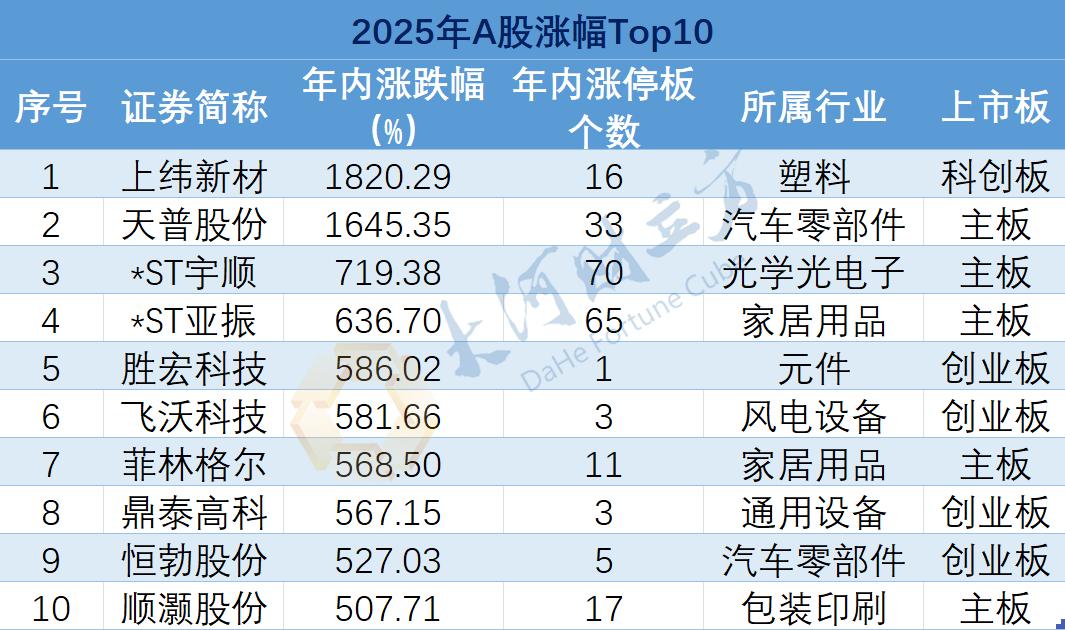
PEEK材料概念爆发!恒勃股份20CM涨停,人形机器人轻量化需求激增
Jin Rong Jie· 2025-12-29 03:13
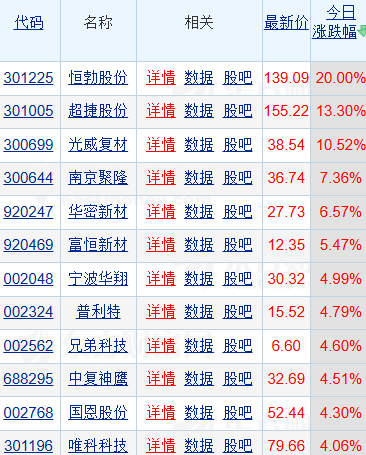
Core Viewpoint - The PEEK materials sector is experiencing significant market activity, driven by the promising applications in humanoid robots, which require lightweight and high-performance components [1][2]. Group 1: Market Performance - The PEEK materials concept sector showed active performance in the market, with notable stock movements including Hengbo Co., Ltd. reaching a 20% increase, Chaojie Co., Ltd. rising over 13%, and Guangwei Composite Materials increasing over 10% [1][2]. - Specific stock prices include Hengbo Co., Ltd. at 139.09 with a 20% increase, Chaojie Co., Ltd. at 155.22 with a 13.30% increase, and Guangwei Composite Materials at 38.54 with a 10.52% increase [2]. Group 2: Industry Analysis - The core logic behind the market speculation on PEEK materials is their extensive application potential in the lightweight sector of humanoid robots, characterized by excellent wear resistance, corrosion resistance, high strength, and lightweight properties [3]. - Industry estimates suggest that every 100,000 humanoid robots will generate a demand for 195 tons of PEEK, with the domestic PEEK market expected to reach 16.7 billion yuan by 2027, reflecting a compound annual growth rate of over 13% [3]. Group 3: Impacted Sectors - The PEEK materials production sector is set to benefit from the explosive demand in downstream fields such as humanoid robots and automotive industries, leading to increased capacity and order growth for relevant companies [3]. - The upstream raw materials sector, which includes essential materials like phenol, will also see benefits from increased demand, particularly for companies with established partnerships with leading PEEK manufacturers [3]. - The downstream application sector, particularly in humanoid robots and automotive lightweighting, will drive increased procurement of PEEK components, enhancing order growth and performance for related industry chain companies [3].


人形机器人的轻量化:镁合金与特种工程塑料(附50页PPT)
材料汇· 2025-11-05 15:57
Core Viewpoint - The article emphasizes the importance of material substitution as a key method for lightweighting in humanoid robots, while structural optimization is ideal but progresses slowly. This reflects the insufficient maturity of the industry chain, leading manufacturers to prefer readily available mature material solutions [4]. Group 1: Lightweighting in Humanoid Robots - Lightweighting is not just about weight reduction; it involves system-level optimization that directly relates to energy efficiency, thermal management, supply chain, and scenario adaptability [4]. - The reduction in weight leads to lower power requirements for motors and bearings, allowing for a broader selection of supply chain options [13]. - Enhanced dynamic stability through lightweighting can improve center of mass control, but materials must possess both lightness and high rigidity, necessitating upgrades in sensors and control algorithms [14]. Group 2: Material Trends - Aluminum alloys are currently the main materials for lightweight applications, while magnesium alloys are emerging as new contenders [38]. - The market for aluminum and magnesium alloys in humanoid robots is projected to reach 101 billion and 37 billion respectively by 2030, with a high CAGR of 130.2%, indicating explosive industry growth expectations [78]. - Magnesium alloys, despite having a market size only one-third that of aluminum alloys, may experience faster growth due to lower prices and increasing demand [79]. Group 3: Engineering Plastics and Material Substitution - The article discusses the ongoing trend of substituting plastics for steel in automotive applications, with a focus on lightweighting through the use of various engineering plastics [86]. - The development of thin-walled and high-performance engineering plastics is crucial for achieving lightweight goals in the automotive sector, with thickness targets decreasing from 2.3mm in 2020 to 1.6mm by 2035 [89]. - Special engineering plastics like PEEK, PPS, and LCP are highlighted for their superior properties, making them key materials for lightweighting in humanoid robots [100][104]. Group 4: Market Dynamics and Company Performance - Companies like Aikodi and Xuji Group are actively expanding their product lines to include aluminum and magnesium alloys for both automotive and robotics applications, indicating a dual-driven growth strategy [85]. - The lightweighting trend is supported by a clear policy direction, but the establishment of a low-cost manufacturing system remains a critical bottleneck [45]. - The article notes that while domestic companies are increasing production capacity for materials like PEEK, they still face challenges in achieving quality consistency compared to imported materials [134].

华鑫证券:人形机器人轻量化大势所趋 镁合金与特种工程塑料有望崛起
Zhi Tong Cai Jing· 2025-11-05 03:53
Core Insights - Material substitution is a key method for achieving lightweight design in humanoid robots, with major manufacturers already implementing this approach [1][3] - Aluminum alloy remains the primary material for lightweight applications in the automotive sector, while magnesium alloy is emerging as a new contender due to its superior performance and favorable price ratio [2] - High-end engineering plastics, particularly PEEK, PPS, and LCP, are increasingly replacing traditional metals in humanoid robots, contributing significantly to lightweight design [3] Industry Overview - Lightweight design can be achieved through structural optimization and material substitution, addressing four major pain points: enhancing battery life, optimizing energy efficiency, alleviating heat dissipation issues, and improving operational flexibility [1] - The injection molding market for engineering plastics shows promising prospects, with PEEK, PPS, and LCP being highlighted for their exceptional properties [3] Company Recommendations - Aikodi (600933): Expanding lightweight product categories and establishing a dual-driven development model [4] - Xingyuan Zhuomei (301398): Focusing on magnesium alloy die-casting core technology to drive lightweight growth [4] - Moulding Technology (000700): Targeting the lightweight path of substituting plastics for steel with high-quality customer resources [4] - Hengbo Co., Ltd. (301225): A national specialized small giant entering the PEEK lightweight sector through joint ventures [4]


人形机器人轻量化大势所趋,关注产业链投资机会 | 投研报告
Zhong Guo Neng Yuan Wang· 2025-08-18 02:54
Core Viewpoint - The trend of lightweight humanoid robots is becoming a core aspect of their commercialization process, driven by product iterations from leading domestic and international companies [1][4]. Market Review - From August 11 to August 15, the CSI 300 index rose by 2.4%, while the machinery sector increased by 3.1%, ranking 11th among all primary industries. The laser processing equipment sector saw the highest increase at 9.0%, whereas the engineering machinery sector experienced the largest decline at 0.4% [2]. Industry Insights - The lightweight humanoid robots offer advantages such as improved endurance, flexibility, reduced costs, and decreased safety risks associated with heavy machinery. For instance, Tesla's Optimus Gen2 reduced its weight from 73 kg to 63 kg, achieving a 10 kg reduction while enhancing walking speed by 30% and improving balance and overall control. Additionally, Unitree Technology's Unitree G1 weighs only 35 kg, utilizing a combination of aluminum alloy and engineering plastics to balance strength and lightweight design [4]. - The lightweight design of humanoid robots can be achieved through structural and material lightweighting. Structural lightweighting involves parameter optimization, topology optimization, morphological optimization, and integrated design. Material lightweighting focuses on replacing traditional metals with low-density, high-performance materials, such as magnesium alloys, PEEK, and carbon fiber, which meet mechanical strength, heat resistance, and corrosion resistance requirements while reducing weight [4]. - The industry recognizes that lightweighting significantly enhances the endurance, performance, and safety of humanoid robots, marking it as an important trend for future development. Investment opportunities in the related supply chain are recommended [4].

四冠!「宇树科技」助力产业链上市公司“齐飞”
Robot猎场备忘录· 2025-08-17 16:18
Core Viewpoint - The article highlights the success of Yushu Technology's humanoid robot H1 at the 2025 World Humanoid Robot Games, where it won multiple championships, solidifying its position as a top player in the humanoid robotics industry [2][12]. Group 1: Competition and Performance - Yushu Technology's H1 won championships in the 1500m and 400m races, and also secured victories in the 100m obstacle race and the 4x100m relay [2]. - The Tian Gong Ultra robot from Beijing Humanoid Robot Innovation achieved second place in both the 1500m and 400m races, notable for being the only robot to navigate autonomously without remote control [4]. - During the 1500m race, H1 collided with remote operators from other companies, indicating the competitive nature of the event [3]. Group 2: Future Developments and IPO - Yushu Technology's founder expressed intentions to transition H1 to autonomous navigation in future competitions, emphasizing the simplicity of achieving this goal [7]. - The company is in the process of preparing for an IPO, with a valuation expected to exceed 100 billion yuan, driven by strong market interest and performance [13]. - The stock market has reacted positively to Yushu Technology's developments, with related stocks experiencing significant gains following the announcement of the IPO [13][14]. Group 3: Market Trends and Supply Chains - The article discusses the emergence of three core supply chains in humanoid robotics: T chain (Tesla), H chain (Huawei), and Yushu chain, with Yushu chain gaining attention after the recent competitions [12]. - The humanoid robotics sector has seen substantial stock price increases for companies involved in the supply chain, particularly those linked to Yushu Technology and its competitors [12][14]. - The article notes that the market is closely watching the developments of Zhiyuan Robotics, which has recently acquired a key materials company, potentially reshaping the competitive landscape [12]. Group 4: Technological Innovations - The article mentions advancements in humanoid robotics technology, including lightweight materials and new manufacturing processes, which are expected to drive further growth in the sector [15][16]. - The introduction of Tesla's Optimus Gen3 is anticipated to catalyze market activity, with significant implications for related stocks and technologies [15][20].

港股异动 | 力劲科技(00558)涨幅扩大至70% 公司启动镁合金人形机器人联合研发项目 推动人形机器人轻量化
智通财经网· 2025-08-15 07:51
Group 1 - The core viewpoint of the article highlights the significant stock price increase of Lijian Technology (00558), which rose by 70% at the end of trading, with a current increase of 45.81% to HKD 6.78, and a trading volume of HKD 20.54 billion [1] - On July 27, Lijian Technology signed a strategic cooperation agreement with four companies specializing in magnesium alloy and humanoid robot development to officially launch a joint research project on magnesium alloy humanoid robots [1] - The project aims to overcome the traditional weight and strength limitations of robots, achieving a dual revolution in structural lightweighting and manufacturing efficiency [1] Group 2 - The five parties will jointly establish a "Humanoid Robot Body Component Joint Research Center," focusing on overcoming core technical challenges such as magnesium alloy shell forming, process optimization, and lightweight structural design [1] - Lijian Technology previously introduced the TPI magnesium alloy semi-solid die-casting technology, which features a modular transformation solution that successfully integrates high-precision and high-efficiency magnesium alloy thixotropic forming technology into traditional cold chamber die-casting machines [1] - The TPI technology has created a "stock + increment" dual-driven profit model, allowing for the rapid and low-cost production of magnesium alloys by reusing existing die-casting equipment, thus attracting customers to upgrade their old machines [1]
PEEK材料概念股再度爆发!中欣氟材5天4板
2 1 Shi Ji Jing Ji Bao Dao· 2025-08-11 08:37
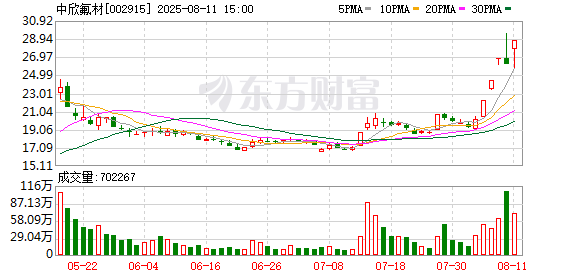
Group 1 - The A-share market experienced a strong upward trend on August 11, with both the Shanghai Composite Index and the Shenzhen Component Index reaching new highs for the year [2] - PEEK material concept stocks saw significant gains, with Zhongxin Fluorine Materials achieving a 4-day consecutive rise, and Huami New Materials increasing by over 22%, while Shuangyi Technology and Chaojie Co. both hit the 20% limit up [2] - PEEK materials are recognized for their wear resistance, heat resistance, corrosion resistance, and low density, positioning them as the "crown" of engineering plastics, with applications in automotive manufacturing, aerospace, industrial manufacturing, and healthcare [2] Group 2 - PEEK's outstanding specific strength makes it a core material for lightweight applications, with notable interest in humanoid robots as a significant downstream application area [2]

PEEK&MIM深度报告汇报及机器人观点更新
2025-08-11 01:21
Summary of Key Points from the Conference Call Industry Overview - The focus is on the humanoid robot industry, particularly the advancements in lightweight materials and manufacturing processes that enhance performance and reduce inertia [1][2][3]. Core Insights and Arguments - **Lightweighting Trends**: The humanoid robot industry is experiencing a significant shift towards lightweight materials, similar to trends in the automotive sector. This shift is crucial for improving battery life and overall performance [2]. - **Material Innovations**: - **Aluminum Alloys**: Widely used due to their maturity in lightweight applications, benefiting from supply-side reforms and increasing demand. The price is expected to rise, with a potential market increase of 3 to 4.8 billion RMB from a million units sold [1][9][10]. - **Magnesium Alloys**: Offer better weight reduction (20%-30%) and are currently priced at 80% of aluminum, presenting a significant opportunity if prices align. Potential market space could reach 1.2 to 4.8 billion RMB with a million units sold [1][11][13]. - **PEEK Materials**: Known for their lightweight and high strength, but currently expensive. Domestic production is improving, with costs potentially decreasing to 300,000 RMB per ton, allowing for a market size of 2 to 3 billion RMB with a million units sold [1][17][20][23]. Additional Important Content - **Manufacturing Techniques**: - **Powder Metallurgy (MIM)**: Efficient for high-precision small parts, significantly reducing manufacturing time. Companies like Figer AI are already utilizing this technology [3][24][26]. - **3D Printing**: Useful in the development phase for rapid prototyping but less effective for mass production [28]. - **Market Dynamics**: - The aluminum market is becoming more concentrated, with a projected growth from 100 billion RMB to 200 billion RMB due to increased demand from the automotive and robotics sectors [10]. - The magnesium market is expected to grow significantly, with a current size of approximately 27.8 billion RMB, projected to exceed 30 billion RMB by 2028 [13]. - **Investment Opportunities**: - Companies like Top Group and Hengli Hydraulic are highlighted as undervalued assets in the humanoid robot sector, with potential for significant returns [32]. - Zhejiang Rongtai is noted for its strong position in the micro four-bar linkage market, with a projected market value of 250 billion RMB [33]. - **Emerging Technologies**: The market is paying attention to new materials like PEEK and advancements in sensor technologies, which could significantly impact the industry [34][35]. This summary encapsulates the key points discussed in the conference call, focusing on the humanoid robot industry, material innovations, manufacturing techniques, market dynamics, and investment opportunities.