
估值折价

Search documents
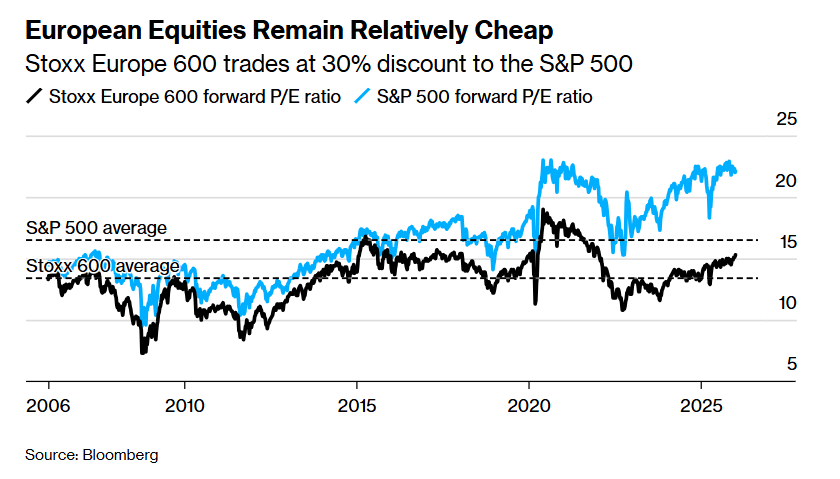
30%估值折价成“跨洋磁铁” 高盛预计美国投资者将涌向欧洲股市
Zhi Tong Cai Jing· 2026-01-06 13:13
Group 1 - The core viewpoint is that global investors are increasingly focusing on European stocks as the S&P 500 index is expected to underperform most international markets in 2025, marking a shift from the long-standing "American exceptionalism" narrative [1] - Goldman Sachs strategists have raised the year-end target for the European stock index, Stoxx 600, to 625 points, indicating a cautious outlook as this represents only a 4% increase from its recent record closing price [1] - The average forecast from Wall Street strategists for the Stoxx 600 index is 620 points, suggesting that Goldman Sachs is on the more optimistic side of this informal survey [1] Group 2 - The European stock market is currently about 30% cheaper compared to the S&P 500, despite its forward P/E ratio being above 15x, which is still lower than the S&P 500's forward P/E ratio of approximately 22x [3] - The anticipated improvement in European economic growth, driven by significant interest rate cuts from the European Central Bank, is expected to attract more funds to the region's stock market [3] - The influx of funds into European markets is often correlated with economic growth signals, indicating a significant rebound in European economic momentum [3] Group 3 - The European stock market's gains in 2025 have been primarily driven by large bank stocks and defense contractors, contrasting with the U.S. market where tech giants like Nvidia, Microsoft, and Google have dominated the gains [4] - Global fund positioning in European stocks remains light, as 2025 follows a period of net selling from 2022 to 2024, suggesting a tentative return of buying interest [4] - Unlike previous years, 2025 is expected to be a strong year for European small-cap stocks, benefiting from robust economic growth, stable interest rates, increased merger activity, a stronger euro, and declining oil and gas prices [4]


两融资金未大规模撤离,债券交易沪强深弱
China Post Securities· 2025-12-22 08:01
Investment Rating - The industry investment rating is Neutral, maintained [1] Core Insights - The macro liquidity environment is easing, alleviating funding pressure and providing a stable cost advantage for brokerages' capital-intensive businesses such as proprietary trading and margin financing. The sustained high trading volume in equity funds is expected to support brokerage commission income. The margin financing balance has remained above 2.4 trillion, indicating a transition from "incremental expansion" to "stock optimization" in the use of leverage in the A-share market, suggesting that the previously influxed leveraged funds have not significantly withdrawn but are instead showing a trend of "settling down" [4][6] - The bond market has shown a clear "strong in Shanghai, weak in Shenzhen" pattern, with Shanghai focusing on government bonds and policy financial bonds, which are more attractive for institutional funding due to their pledge financing convenience at year-end. This shift in funding between equity and bond markets may indicate subtle changes in current funding risk preferences [4][7] Industry Fundamentals Tracking - The SHIBOR 3M rate has stabilized at 1.60%, showing a recovery from previous lows and indicating alleviated funding pressure [5][14] - The average daily trading volume of equity funds for the week from December 12 to December 19 was approximately 220.29 billion, reflecting a slight decline from the previous week's average of 238.02 billion, but still indicating that a trillion-level transaction has become the new normal for the A-share market [5][15] - As of December 18, the margin financing balance in the Shanghai, Shenzhen, and Beijing markets was 2,499.366 billion, indicating a consolidation phase at high levels since September 2025, marking a transition in leverage use [6][18] - The China Bond New Comprehensive Index closed at 248.8624 points, currently stabilizing after a decline from November's peak, supported by a stable liquidity environment [6][19] - The brokerage sector's valuation has diverged significantly from the overall market, with the Shenwan brokerage index PE rising 5.63% year-to-date, compared to a 20.25% increase in the Shenwan A index, widening the gap to 14.62 percentage points [6][22] Market Review - Last week, the A-share Shenwan Securities II industry index increased by 1.01%, outperforming the CSI 300 index, which declined by 0.28%, with a relative outperformance of 1.29 percentage points [6][26] - For the year, the CSI 300 index has increased by 15.78%, while the brokerage sector has decreased by 0.11%, underperforming by 15.89 percentage points [6][26] - The A-share securities II sector ranked 14th among 31 Shenwan first-level industries last week, underperforming the non-bank financial sector [6][27]
“一加一减”间 金融支持经济年度答卷亮眼
Shang Hai Zheng Quan Bao· 2025-12-15 19:19
Core Insights - The financial system is implementing a "precision drip irrigation" strategy to support the economy, focusing on both enhancing financial services and reducing financing costs [1][2][3] - The year 2025 is marked by significant improvements in financial support for the real economy, characterized by longer loan terms, lower interest rates, and higher credit limits for technology enterprises [2][3] - Financial policies are shifting towards a more flexible and supportive stance, with a focus on maintaining liquidity and reducing costs for businesses [4][5] Group 1: Financial Support and Economic Empowerment - Financial support for technology companies is exemplified by the case of TeraCharge, which received a 20 billion yuan loan at a 2.85% annual interest rate to expand its charging network [1] - By the end of October, TeraCharge had established 280 smart charging stations, with a 15% increase in charging efficiency due to financial backing [1] - The financial sector's focus on "precision drip irrigation" has led to a significant increase in loans to key sectors, with a loan balance of 107.5 trillion yuan in the "five major articles" area, accounting for nearly 40% of total loans [2] Group 2: Cost Reduction and Financial Efficiency - The financial sector has successfully reduced financing costs, with a 10 basis point decrease in loan market quotation rates (LPR) and a weighted average interest rate for new corporate loans around 3.1% [3] - The implementation of interest subsidies for personal consumption loans has further alleviated financial burdens for consumers, enhancing market vitality [4] - Monetary policy has shifted to a moderately loose stance, with a 0.5 percentage point reserve requirement ratio cut, releasing approximately 1 trillion yuan in long-term liquidity [4] Group 3: Financial Market Stability and Risk Management - The financial market has shown resilience amid external pressures, with effective resource allocation and risk pricing mechanisms in place [5][6] - The central bank has provided ample liquidity to stabilize the capital market, enhancing investor confidence and improving the equity financing environment [6] - By the end of September, foreign institutions held over 10 trillion yuan in domestic stocks and bonds, reflecting increased international confidence in the Chinese market [6] Group 4: Financial Reform and Opening Up - Financial reforms have focused on systematic risk clearance, cautious opening up, and targeted financial transformation [8][9] - The number of financing platforms and the scale of operating financial debt have significantly decreased, indicating effective risk mitigation [8] - The financial market's opening has been deepened, with reduced entry barriers for foreign financial institutions and improved business environments, attracting global capital [9]
Energy Transfer(ET.US)获丰业银行“跑赢大盘”评级!资本支出支撑盈利增长 股价潜在涨幅达30%
智通财经网· 2025-09-03 06:43
Group 1 - The core viewpoint is that Energy Transfer has been rated "Outperform" by Canadian Imperial Bank of Commerce (CIBC) with a target price of $23, indicating nearly 30% upside potential from the current closing price of $17.7 [1] - Energy Transfer possesses a large and integrated asset base covering all segments of the midstream value chain, creating a comprehensive investment portfolio from wellhead to water [1] - The company is expected to benefit from sustained earnings growth driven by both short-term and future thematic demand, with projected average capital expenditures of approximately $4.9 billion from fiscal years 2026 to 2028 [1] Group 2 - Energy Transfer is highly active in mergers and acquisitions, maintaining a strong willingness to spend, which keeps its stock price relatively undervalued in the long term [2] - The company's complex corporate structure and somewhat complicated capital structure further contribute to its valuation challenges [2] - Although the current discount in valuation is not expected to disappear completely, it is anticipated to narrow to a more reasonable range compared to current levels [2]

“30年一遇”的估值洼地!Evercore ISI:美股医疗股正上演历史性熊市反弹 或是更大牛市前兆
贝塔投资智库· 2025-08-20 04:01
Core Viewpoint - The healthcare sector is showing initial signs of recovery after reaching a 30-year high in valuation discount relative to the S&P 500 index [1][2] Group 1: Market Performance - Since reaching a historical high on September 3, 2024, healthcare stocks have been in a "persistent downtrend," underperforming both in absolute terms and relative to the S&P 500 [1] - August is identified as a turning point for the sector, with healthcare stocks beginning to reverse their previous weak performance [1] Group 2: Economic Environment - The recovery is driven by a historically significant valuation gap and an economic backdrop characterized by GDP growth slowing to 1.5% or lower while inflation remains at 3% or higher, which historically favors the healthcare sector [1] - The dual effect of valuation discount and improved sentiment provides strong justification for including healthcare stocks in investment portfolios under the current economic conditions [2] Group 3: Investment Recommendations - Evercore ISI highlights several healthcare stocks with attractive valuations and sentiment, including Cencora (COR.US), BioMarin Pharmaceutical (BMRN.US), Cigna (CI.US), Cardinal Health (CAH.US), Humana (HUM.US), Incyte (INCY.US), LabCorp (LH.US), Pfizer (PFE.US), Quest Diagnostics (DGX.US), Teleflex (TFX.US), Tenet Healthcare (THC.US), Universal Health Services (UHS.US), and Viatris (VTRS.US) [2]




“30年一遇”的估值洼地!Evercore ISI:美股医疗股正上演历史性熊市反弹 或是更大牛市前兆
智通财经网· 2025-08-20 01:08
Group 1 - The healthcare sector is showing initial signs of recovery after reaching a 30-year high in valuation discount relative to the S&P 500 index [1][2] - Healthcare stocks have been in a "persistent downtrend" since reaching historical highs on September 3, 2024, missing out on market rebounds [1] - The recovery is driven by a historical valuation gap and a macroeconomic environment characterized by GDP growth slowing to 1.5% or lower while inflation remains at 3% or higher, which historically favors healthcare sector performance [1] Group 2 - The current price-to-earnings ratio of the overall market is 25.5 times, while healthcare stocks still present attractive investment options [2] - The potential recovery of healthcare stocks is described as part of "the fastest bear market rebound in history," indicating a larger bull market may extend until 2026 [2] - Evercore ISI recommends healthcare stocks with both valuation and sentiment appeal, including Cencora, BioMarin Pharmaceutical, Cigna, Cardinal Health, Humana, Incyte, Labcorp, Pfizer, Quest Diagnostics, Teleflex, Tenet Healthcare, Universal Health Services, and Viatris [2]