
债务扩张

Search documents
美国主导的科技繁荣本质是债务幻觉
Huafu Securities· 2026-03-13 07:10
Core Insights - The essence of the U.S.-led technological boom is a debt illusion, with global debt expansion being a macroeconomic response to long-term structural deflationary pressures caused by technological advancements [3][57] - The global economy has shifted from being productivity-driven to credit-driven, where the contribution of debt to demand consistently outweighs that of technology [3][57] - Debt creates nominal demand through fiscal stimulus, household and corporate leverage, central bank quantitative easing (QE) wealth effects, and the spillover of U.S. dollar liquidity, while technological progress primarily influences nominal demand indirectly and over the long term [3][57] Group 1: Debt Expansion and Its Mechanisms - Debt expansion directly boosts nominal demand through multiple channels, including increased government spending and transfer payments, which stimulate domestic demand and imports [18][22] - In a low-interest-rate environment, households and businesses increase leverage, leading to consumption expansion and higher asset prices [22][25] - Central bank QE elevates asset prices, creating a wealth effect that releases trillions of dollars in purchasing power [25][28] Group 2: Technological Progress and Its Impact - Technological advancements enhance production efficiency and create new products, leading to long-term increases in actual income and welfare [34][35] - New technologies generate new industries and consumption scenarios, driving investment cycles in technology and related capital goods [38][40] - However, the impact of technology on nominal demand is more indirect and long-term compared to the immediate effects of debt expansion [47][48] Group 3: U.S. and China Economic Divergence - The global division of labor may collapse, leading to a fundamental reversal in global supply and demand structures, with significant economic path divergence between the U.S. and China [89][90] - The U.S. may face a long-term stagnation dilemma due to manufacturing hollowing out and rising commodity prices, while China could transition to a moderate inflation path supported by its complete manufacturing system [89][90] - China's actual demand is expected to rise over the long term, supporting the intrinsic value of its assets, while the U.S. reliance on nominal demand expansion may lead to a revaluation of the yuan and Chinese assets [3][57]
CoreWeave(CRWV.US)计划融资约85亿美元 为Meta(META.US)扩建AI算力基础设施
智通财经网· 2026-02-24 22:25
Company Overview - CoreWeave (CRWV.US) is planning to raise approximately $8.5 billion from multiple banks to expand its cloud computing and computing power infrastructure for Meta Platforms (META.US) [1] - Major institutions involved in this financing include Morgan Stanley and MUFG [1] - The financing is structured as a delayed draw term loan, secured by a long-term service contract worth up to $14.2 billion signed with Meta [1] Financial Structure - CoreWeave has a current leverage ratio of approximately 6.9 times as of September 30, indicating significant debt expansion to meet the surging demand for AI computing power [2] - The company is expected to remain in a cash flow consumption state for at least the next 18 months due to high capital expenditure pressures [2] - As of last September, CoreWeave had an outstanding balance of about $8 billion under delayed draw loans, with total debt around $14 billion [3] Market Context - The total cost of AI infrastructure construction is conservatively estimated to exceed $3 trillion, making it challenging for even large cloud service providers to rely solely on cash flow for investments [3] - It is projected that AI-related companies and projects will raise at least $200 billion through the debt market by 2025, with actual figures likely higher due to many transactions being private [3] - The financing comes at a time when there is increasing scrutiny on the pace of AI investments and the sustainability of capital expenditures within the industry [3] Credit Rating Insights - Credit rating agencies are closely monitoring CoreWeave's evolving capital structure in response to its expanding capital expenditure needs [4] - Despite being rated at a speculative level, the loan is expected to achieve an investment-grade rating due to Meta's "blue-chip" credit quality, potentially lowering financing costs [1]


等你来投!《清华金融评论》2026年2月刊“全球债务持续高增长” 征稿启事
清华金融评论· 2025-12-25 10:22
Core Viewpoint - The article discusses the ongoing high growth of global debt, driven by a loose financial environment, a weakening dollar, and more accommodative policies from major central banks. It highlights the risks associated with debt growth outpacing economic output, leading to potential financial instability and a cycle of increasing concern among investors [2][4]. Group 1: Global Debt Growth - Global debt is experiencing sustained high growth, raising concerns about its sustainability and the potential for financial market turmoil [4]. - The rapid increase in debt compared to economic output can lead to a vicious cycle where high interest payments crowd out essential government spending on education, healthcare, and infrastructure [4]. - Emerging markets are identified as the most vulnerable segment within the global debt chain, facing significant risks from rising debt levels [4]. Group 2: Policy Responses and Implications - The article emphasizes the need for countries to seek a balance between growth, risk prevention, and maintaining livelihoods in the face of rising debt levels [4]. - It calls for an analysis of how different countries can respond to the challenges posed by high debt, particularly in a high-interest rate environment, which may lead to capital outflows and currency depreciation in emerging markets [4]. - The editorial team of Tsinghua Financial Review is inviting contributions to explore various aspects of global debt, including its impacts and potential policy measures [5][8]. Group 3: Submission Guidelines - The article outlines submission guidelines for contributions, including a word count of 4000 to 6000 words, originality, and a deadline for submissions by January 10, 2025 [9][11]. - Authors are encouraged to provide a brief biography, contact information, and an academic resume along with their submissions [11].


加仓!资金持续涌入
Zhong Guo Zheng Quan Bao· 2025-12-10 12:20
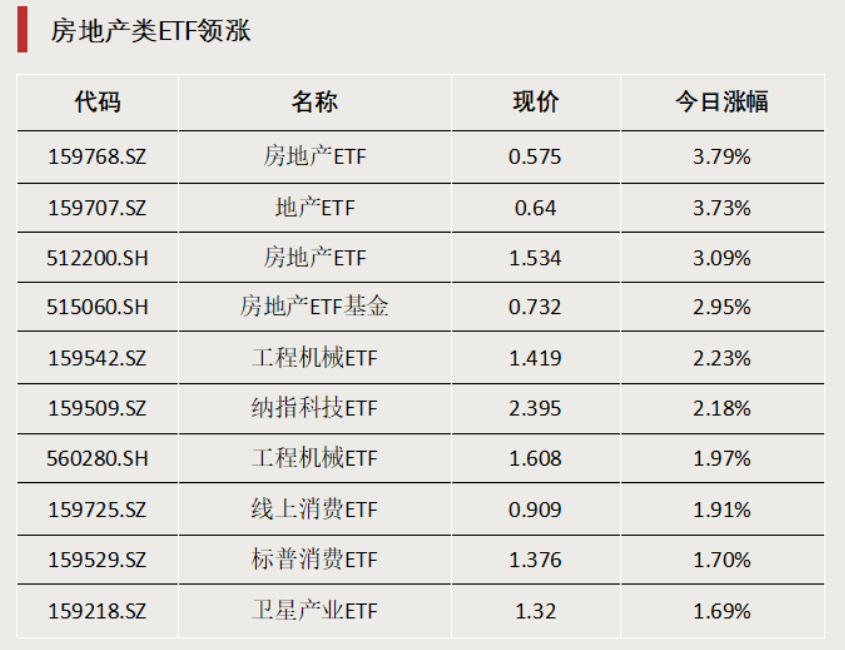
Group 1: Real Estate Sector - The real estate sector showed strong performance on December 10, with multiple stocks hitting the daily limit, leading real estate ETFs to rank high in the ETF market's gainers list [1][3] - Notable real estate ETFs included: - 159768.SZ Real Estate ETF with a price of 0.575 and a daily increase of 3.79% - 159707.SZ Real Estate ETF with a price of 0.64 and a daily increase of 3.73% - 512200.SH Real Estate ETF with a price of 1.534 and a daily increase of 3.09% [4] Group 2: Agriculture Sector - The agriculture sector performed well, with themes such as seed industry, land transfer, and aquatic products showing strong performance, leading agriculture-related ETFs to rank among the top gainers [2][5] - The sentiment in the seed industry has been notably boosted, with ongoing commercialization of biological breeding benefiting leading companies [5] Group 3: Technology Sector - Technology ETFs experienced significant inflows, with several ETFs seeing net inflows exceeding 1 billion yuan last week, and continued inflows in the first two trading days of this week [2][9] - The top net inflows for technology ETFs included: - 159352.OF Southern CSI A500 ETF with a net inflow of 15.66 billion yuan - 159600.OF Harvest CSI AAA Technology Innovation Corporate Bond ETF with a net inflow of 10.95 billion yuan [10] Group 4: Bond ETFs - Bond ETFs were actively traded, with several types such as Short-term Bond ETF, Benchmark Treasury Bond ETF, and Yinhua Daily Benefit ETF seeing transaction amounts exceeding 10 billion yuan [7][8] - The Short-term Bond ETF had a transaction amount of 401.12 billion yuan and a turnover rate of 54.79% [8] Group 5: Investment Recommendations - Institutions suggest focusing on gold and innovative pharmaceuticals as key investment directions, with gold expected to benefit from potential monetary easing and a shift in global credit dynamics [11] - The release of China's first commercial insurance innovative drug catalog is seen as a significant step for the innovative drug industry, potentially enhancing investment opportunities in the healthcare sector [11]
宏观经济专题研究:收入分配与政府支出结构如何催生通缩压力?
Guoxin Securities· 2025-10-10 10:34
Group 1: Economic Structure and Demand Gap - Income distribution is increasingly skewed towards capital, leading to a concentration of wealth among high-net-worth individuals with low marginal propensity to consume, while labor income shares shrink[1] - This structural imbalance creates a persistent "demand gap," as high-income groups do not consume enough to match their income, while low-income groups lack disposable income despite their higher consumption willingness[1] - The reliance on credit expansion to mitigate demand shortfalls is limited; if debt expansion among households, government, and net exports stalls, the demand gap will widen, resulting in deflationary pressures[1] Group 2: Debt Cycle and Economic Trends - From 1992 to 2009, China experienced alternating expansions of household debt and net exports to balance supply and demand[2] - Between 2009 and 2018, household leverage rose significantly, becoming the primary driver of demand, but from 2020 to 2024, household leverage plateaued while government leverage increased, failing to prevent deflation[2] - The capital income share in China has been on the rise since 2015, and the slowdown in service sector growth from 2021 to 2024 may further exacerbate income distribution issues, increasing the demand gap[2] Group 3: Policy Implications and Historical Context - The experience of price recovery in 2016-2017 is unlikely to be replicated due to the current plateau in household leverage and a significant demand gap[3] - Structural reforms in income distribution and government spending optimization are necessary to reduce the demand gap and enable future price recovery once households regain leverage capacity[3] - Risk factors include potential market volatility abroad and uncertainties in domestic policy execution, which could impact economic stability[4]
强于预期的“非农”数据打压纽约金价,3日收跌近1%
Xin Hua Cai Jing· 2025-07-04 00:57
Group 1 - The U.S. non-farm payroll data for June exceeded expectations, with an increase of 147,000 jobs, surpassing the market average forecast of 110,000 jobs, and the unemployment rate fell to 4.1%, lower than the predicted 4.3% [1] - Following the strong non-farm data, traders reduced bets on a potential interest rate cut by the Federal Reserve in July, with the probability of maintaining rates now at 95.3%, up from 74.7% the previous day [1] - The strong performance of the U.S. capital markets, with major stock indices reaching new closing highs, diminished the appeal of gold, while the U.S. dollar index rebounded from recent lows, further suppressing gold price momentum [1] Group 2 - The U.S. House of Representatives passed the "Big and Beautiful" tax and spending bill with a vote of 218 in favor and 214 against, which had already been approved by the Senate [2] - The bill is set to be signed by President Trump on July 4, coinciding with Independence Day, making it effective [2] Group 3 - The most actively traded September silver futures rose by 25 cents, closing at $37.040 per ounce, reflecting a gain of 0.68% [3]