储能系统(ESS)

Search documents
韩国重启两座新核电站项目
Shang Wu Bu Wang Zhan· 2026-02-15 15:45
Core Viewpoint - The South Korean government has decided to proceed with the construction of two new nuclear power plants as part of its 11th Basic Plan for Electricity Supply and Demand, despite initial plans for a comprehensive review and public consultation [1][2] Group 1: Government Plans and Policies - The Ministry of Climate, Energy and Environment has confirmed that new nuclear power construction will continue as planned due to the rapid increase in electricity demand from AI and data centers [1] - The 11th Basic Plan includes the construction of two nuclear power units with a total capacity of 2.8 GW, scheduled for completion in 2037 and 2038, along with a 0.7 GW small modular reactor (SMR) to be introduced before 2035 [1] - The government has reversed its stance on the nuclear power projects after discussions and polling indicated public support, emphasizing the need to reduce coal and LNG power generation to meet climate goals [1] Group 2: Industry Concerns and Requirements - The Korean Atomic Energy Society has indicated that to maintain a nuclear power share of 35% by 2038, an additional 20 large nuclear plants and 12 SMRs will need to be constructed by 2050 [1] - The new nuclear projects will be initiated by Korea Hydro & Nuclear Power, with the aim to secure approvals in the early 2030s and complete construction by 2037-2038, although there are concerns about potential delays due to policy changes [2] - The government plans to enhance energy storage systems (ESS) and pumped storage to address the intermittency of renewable energy while improving the operational flexibility of nuclear power units [1]
碳酸锂目标价18000美元!摩根大通对锂价极为乐观,上调所有纯锂矿商评级至“增持”
Hua Er Jie Jian Wen· 2025-12-18 02:42
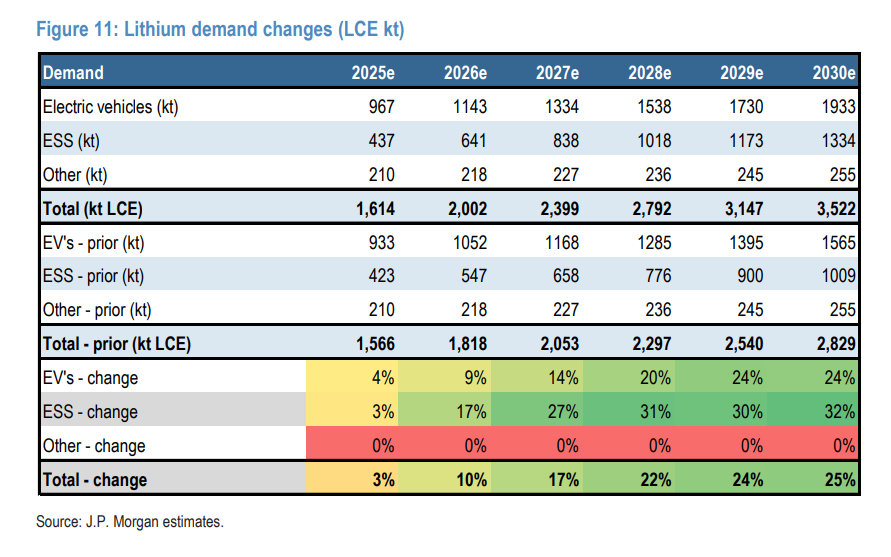
Core Viewpoint - The lithium market is facing a more severe supply shortage than previously anticipated due to a surge in demand, leading to significant price increases for lithium carbonate and spodumene [1][7][8]. Demand Dynamics - The growth in lithium demand is primarily driven by energy storage systems (ESS) and electric commercial vehicles (CV), with forecasts for global ESS production in 2026 raised by 17% to 900 GWh, and a projected increase in ESS's share of total lithium carbonate equivalent (LCE) demand from 32% in 2026 to 38% by 2030 [2][3]. - The demand for electric vehicle (EV) batteries, particularly in the commercial vehicle sector, has been significantly revised upwards, with projections for battery demand from 2026 to 2030 increased by 4% to 22% [2][3]. Supply Constraints - Despite anticipated supply growth from regions like China, Africa, and Australia, the report emphasizes that the response from the supply side is lagging behind the rapid demand increase, with supply expected to grow only 7% in 2026 and 14%-18% from 2027 to 2030 [6]. Price Forecast Adjustments - The supply-demand imbalance is projected to create a shortfall of 4% to 7% of total demand in the mid-term, necessitating higher prices to stimulate new supply [7]. - Price forecasts for lithium carbonate have been raised to $18,000 per ton and for spodumene to $2,000 per ton, reflecting the tightening market conditions [8][10]. Stock Ratings and Price Targets - Following the optimistic outlook for lithium prices, JPMorgan has upgraded all pure lithium mining stocks to "Overweight" and raised their price targets significantly, indicating substantial upside potential for these stocks [1][10].

大摩:铝需求激增叠加供应受限 上调中国宏桥目标价至44.7港元
Zhi Tong Cai Jing· 2025-11-21 01:05
Group 1: Industry Outlook - Morgan Stanley reports an improved outlook for the aluminum industry, driven by demand from energy storage systems (ESS) exceeding expectations and supply challenges due to power issues [1] - The demand for aluminum in China is expected to see significant growth due to ESS and other consumer electronics, with the share of ESS in China's overall battery installations increasing from 25% in June to over 40% [1] - Morgan Stanley estimates that every 100GWh of ESS will consume 160,000 tons of aluminum, projecting global ESS capacity to reach 350GWh in 2024 and 600GWh in 2025, with a further 50% growth expected by 2026 [1] Group 2: Supply Challenges - Supply is facing challenges, with global production expected to reach approximately 1.4 million tons by 2026, and Indonesia identified as a key new supply source [2] - Due to China's commitment to not build new coal-fired power plants abroad for carbon neutrality, local partnerships will be necessary for Chinese companies to secure power, which may delay production [2] - Morgan Stanley estimates that Indonesia's new supply will only add 700,000 tons by 2026, and global production interruptions this year have already resulted in a loss of about 700,000 tons of capacity [2] Group 3: Inventory and Price Support - Current aluminum inventory in China is low at 600,000 tons, which is relatively low compared to historical levels over the past five years [2] - The government encourages increasing the proportion of molten aluminum from approximately 77% to 90% by 2027, which may reduce the availability of deliverable aluminum ingots in the futures market, thereby supporting aluminum prices [2]
大摩:铝需求激增叠加供应受限 上调中国宏桥(01378)目标价至44.7港元
智通财经网· 2025-11-21 01:02
Group 1 - Morgan Stanley reports an improved outlook for the aluminum industry, driven by demand from energy storage systems (ESS) exceeding expectations and supply challenges due to power issues [1] - The firm has raised the target price for China Hongqiao (01378) from HKD 30.6 to HKD 44.7, maintaining it as a preferred stock with an "overweight" rating [1] - Demand for aluminum in China is expected to grow significantly due to ESS and other consumer electronics, with ESS's share of total battery installations in China increasing from 25% in June to over 40% [1] Group 2 - On the supply side, Morgan Stanley anticipates global aluminum production to reach approximately 1.4 million tons by 2026, with Indonesia being a key new supply source [2] - However, China's commitment to not build new coal-fired power plants abroad to achieve carbon neutrality poses challenges for new supply, potentially delaying power construction for 18 to 24 months [2] - Current aluminum inventory in China is low at 600,000 tons, which is relatively low compared to historical levels over the past five years, and government policies may further reduce available aluminum on the futures market [2]
SK Innovation 2025Q3 电池业务实现营收 1.81 万亿韩元,营业亏损 1248 亿韩元
HUAXI Securities· 2025-11-05 06:15
Investment Rating - The report recommends the industry [7] Core Insights - In Q3 2025, the company achieved revenue of 20.53 trillion KRW, a quarter-on-quarter increase of 1.23 trillion KRW and a year-on-year increase of 2.88 trillion KRW [3][20] - The operating profit reached 573.5 billion KRW, with a quarter-on-quarter increase of 991.1 billion KRW and a year-on-year increase of 996.8 billion KRW, primarily driven by the recovery in refining business and strong LNG power generation performance [3][20] - The battery business reported revenue of 1.81 trillion KRW with an operating loss of 124.8 billion KRW, although SK On achieved an operating profit of 17.9 billion KRW post-merger, marking the second consecutive quarter of profitability [9][20] Summary by Relevant Sections Overall Performance - Q3 2025 revenue was 20.53 trillion KRW, with a significant increase in operating profit to 573.5 billion KRW, attributed to improved refining margins and strong performance in energy and services [3][20] Business Segment Performance 1. **Refining Business** - Revenue of 12.44 trillion KRW and operating profit of 304.2 billion KRW, benefiting from higher refining margins and oil price increases [3][20] 2. **Petrochemical Business** - Revenue of 2.41 trillion KRW with an operating loss of 36.8 billion KRW, impacted by weak benzene and olefin markets [4][20] 3. **Lubricants Business** - Revenue of 980.5 billion KRW and operating profit of 170.6 billion KRW, driven by seasonal demand and inventory gains [5][20] 4. **Oil and Gas Exploration and Production** - Revenue of 320 billion KRW and operating profit of 89.3 billion KRW, affected by natural gas price declines [6][20] 5. **Battery Business** - Revenue of 1.81 trillion KRW with an operating loss of 124.8 billion KRW, but post-merger profitability was noted [9][20] 6. **Materials Division** - Revenue of 23.5 billion KRW with an operating loss of 50.1 billion KRW, showing a reduction in losses due to cost optimization [10][20] 7. **Energy and Services** - Revenue of 2.53 trillion KRW and operating profit of 255.4 billion KRW, benefiting from increased plant utilization [11][20] Outlook for Q4 2025 - The refining business may face downward pressure on oil prices due to OPEC+ production increases, but geopolitical uncertainties may support refining margins [12][20] - The petrochemical sector is expected to face challenges due to reduced supply and slow demand recovery [13][20] - The lubricants business may experience a weak market environment due to seasonal demand decline [14][20] - The battery business faces uncertainties from weak EV demand in the US and high initial costs of new plants [16][20] - The materials business aims to reduce losses through cost control and increased orders [17][20] - The energy and services division plans to maintain stable profitability through new gas field production [18][20]
电池巨头利润大增!
鑫椤锂电· 2025-07-28 07:51
Core Viewpoint - LG Energy Solution reported significant growth in operating profit for Q2 2023, driven by U.S. battery production subsidies and preemptive inventory accumulation by clients before potential tariffs [1][2] Group 1: Financial Performance - Operating profit for Q2 2023 increased by 152.4% year-on-year and 31.4% quarter-on-quarter, reaching 492.2 billion KRW, compared to 195 billion KRW in the same period last year [1] - Consolidated revenue decreased by 9.7% year-on-year and 11.2% quarter-on-quarter, totaling 5.565 trillion KRW [1] - Net profit reached 91 billion KRW, a turnaround from a net loss of 24 billion KRW in the previous year [1] Group 2: Production and Capacity Expansion - LG Energy Solution paused the construction of its ESS battery factory in Arizona, prioritizing existing capacity in Michigan and accelerating the production plan for lithium iron phosphate batteries for ESS by one year [1] - The company plans to expand its annual production capacity for ESS batteries to 17 GWh by the end of this year [1] Group 3: Strategic Partnerships and Market Outlook - LG Energy Solution signed a supply agreement with Chery for 8 GWh of cylindrical batteries for European electric vehicles, marking the first such contract between a Korean battery manufacturer and a Chinese automaker [2] - The company anticipates a slowdown in global electric vehicle demand in the short term but expects long-term growth driven by advancements in autonomous driving technology [2] - LG Energy Solution is optimistic about the growth opportunities in the global ESS market, particularly due to the rising demand from renewable energy projects and AI data centers [2] - Policy adjustments are expected to increase barriers for "restricted foreign entities" entering the U.S. market, enhancing the competitive advantage of companies with established local production and supply chains [2]