
全球化体系

Search documents
朗普明抢全球石油,美州长急眼:这是在把美国的未来卖给中国
Sou Hu Cai Jing· 2026-02-20 11:10
Group 1 - The article discusses the impact of President Trump's policies on global trade and U.S. credibility, highlighting his approach to a trade war and the revival of the Monroe Doctrine [1] - It mentions Trump's military actions in Venezuela and the buildup of forces around Iran, indicating a focus on regaining U.S. bargaining power over oil resources [3] - The article notes the criticism from U.S. officials regarding Trump's dealings with large corporations and his perceived alignment with China, suggesting a shift in leadership dynamics [6] Group 2 - The response from the Democratic Party, particularly California Governor Newsom, is highlighted as a significant challenge to Trump, indicating a potential shift in U.S. foreign policy direction [7] - The article contrasts the Democratic and Republican approaches to governance, with Democrats favoring globalization and cooperation with Europe, while Trump’s administration adopts a more isolationist and pragmatic stance [9] - It raises concerns about the potential for increased domestic conflict between the two parties, suggesting that escalating tensions could lead to severe consequences [9]

特朗普为何忌惮中国?俄方直言:中国唯一绕开美国,实现独立崛起
Sou Hu Cai Jing· 2025-12-19 08:09
Group 1 - The core concern for the U.S. is not that China is trying to disrupt the existing rules, but rather that China is effectively navigating and leveraging the rules set by the U.S. to enhance its own influence [1][6] - The initial expectation that tariffs would bring manufacturing back to the U.S. has proven flawed, as the country is no longer a low-cost manufacturing hub, leading to increased costs without the desired industrial return [3][4] - The U.S. is experiencing a paradox where, despite political rhetoric advocating for decoupling from China, the actual economic ties and dependencies have become more intricate and costly [11][19] Group 2 - China's entry into the WTO was initially perceived as a means to remain a low-end manufacturer, but it has instead utilized the rules to advance its industrial capabilities and technological innovation [7][16] - The solar energy sector exemplifies the U.S.'s reliance on China, with over 80% of photovoltaic components sourced from Chinese manufacturers, highlighting the challenge of altering this dependency through political means [15] - The electric vehicle market has seen a significant shift, with BYD surpassing Tesla in sales, indicating a broader trend of Chinese companies gaining substantial market share and establishing a robust industrial ecosystem [16][18] Group 3 - The U.S. is struggling to adapt to a new global landscape where rules are being redefined rather than overturned, leading to a multi-node system rather than a single dominant center [19] - The complexities of global supply chains mean that attempts to isolate China may inadvertently increase costs and risks for U.S. companies, as they remain reliant on Chinese components and materials [9][11] - The political and economic dynamics suggest that the U.S. must confront the reality of a restructured global order, where traditional methods of maintaining dominance are becoming less effective [19]

迈克尔·斯宾塞:实行剔除美国之外的全球化体系是可能的
Cai Jing Wang· 2025-05-18 08:06
Group 1 - Michael Spence highlighted that the U.S. withdrawal from the WHO and climate agreements indicates a retreat from sustainable development agendas, leading to three potential scenarios for the future [1] - The most likely scenario is a mixed one, where a multilateral system is supported by Europe, China, and other major emerging markets, as the economic weight of emerging markets is gradually increasing [1] - Spence noted that the trade negotiations are showing positive changes, with the negative effects on consumer confidence in the U.S. economy being a significant concern [3] Group 2 - The uncertainty in the Federal Reserve's monetary policy is emphasized, with current inflationary pressures easing but ongoing tariff policies raising questions about necessary countermeasures [3] - Spence mentioned that the recent developments in AI technology, particularly the rise of open-source AI models, are having a positive impact on the global economy [3] - The report from Stanford indicates that the gap between the U.S. and China in AI technology is rapidly narrowing, with both countries focusing on smaller models that are more cost-effective [3]
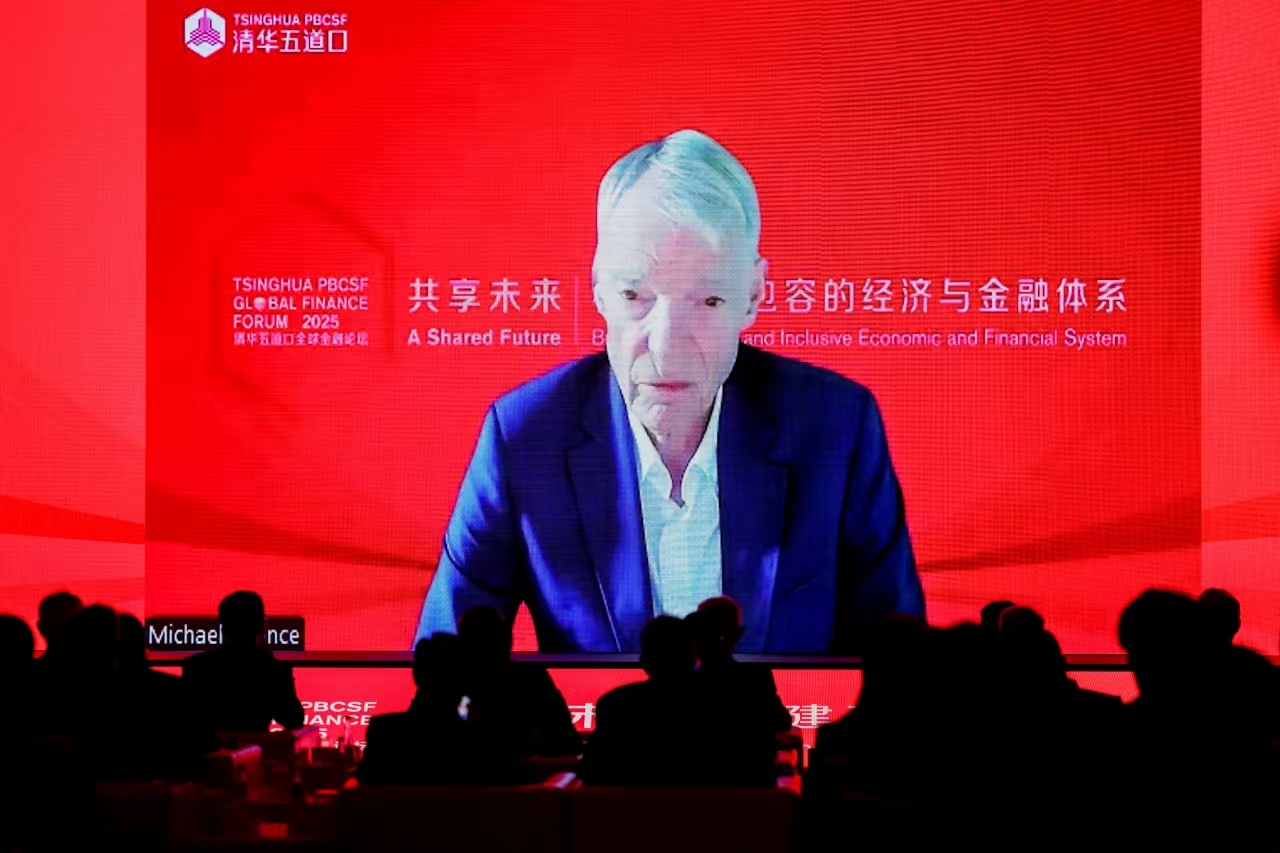
清华五道口全球金融论坛开幕 百位专家学者齐聚深圳共谋开放新局
Sou Hu Cai Jing· 2025-05-17 13:23
Group 1 - The 2025 Tsinghua Wudaokou Global Financial Forum opened in Shenzhen, focusing on themes such as global economic fragmentation, monetary system reconstruction, the Guangdong-Hong Kong-Macau Greater Bay Area strategy, and the AI revolution [1] - Keynote speakers included Nobel laureate Michael Spence and former Polish Prime Minister Marek Belka, addressing structural contradictions and policy dilemmas in the current global economy [3] - Tsinghua University emphasized its role in providing a "certainty anchor" for global economic development through high-quality growth and financial technology breakthroughs [3] Group 2 - Michael Spence highlighted the ongoing geopolitical tensions affecting the global trade system, suggesting that a multilateral system is still possible despite current challenges [3] - Marek Belka pointed out the imbalances and instabilities in the global economy, particularly in the U.S., attributing chronic trade deficits to domestic economic issues [4] - Experts at the forum noted a trend towards a diversified international monetary system, although the dominance of the U.S. dollar is unlikely to change in the short term [4]