再融资政策

Search documents
非银金融行业周报(2026/2/22-2026/2/28):2月股基成交保持活跃-20260302
Hua Yuan Zheng Quan· 2026-03-02 10:00
Investment Rating - The investment rating for the non-bank financial sector is "Positive" (maintained) [1] Core Insights - The report highlights that the insurance sector has shown strong performance, with over 50 insurance asset management products achieving an annualized return exceeding 100% since the beginning of 2026. This reflects the excellent investment research capabilities of insurance companies in a structural market environment [5] - The stock investment balance of the insurance industry reached 3.73 trillion yuan at the end of 2025, a year-on-year increase of 53.8%, indicating a significant increase in equity allocation [5] - The report anticipates that the net profit elasticity of insurance companies will continue to improve in a "slow bull" market environment for equities [5] Summary by Sections Securities Industry Data - In February 2026, the average daily trading volume of A-shares was 2.83 trillion yuan, a year-on-year increase of 34.00% but a month-on-month decrease of 22.47% [12] - The margin trading balance at the end of February 2026 was 2.67 trillion yuan, up 40.50% year-on-year but down 1.78% month-on-month, indicating sustained participation of leveraged funds [13] - The report notes a significant year-on-year increase in IPO and refinancing funds raised in February 2026, with IPOs raising 60.76 billion yuan (up 4642.56%) and refinancing raising 342.82 billion yuan (up 439.99%) [13] - The issuance of new public funds in February 2026 was 17.847 billion units, a year-on-year decrease of 79.86% and a month-on-month decrease of 88.92% [13] Key Company Announcements - Zhejiang Securities announced a change in its president, with Qian Wenhai resigning and Cheng Jingdong appointed as the new president [20] - Founder Securities reported that its major shareholder, China Cinda, did not execute its share reduction plan as scheduled [21]
再融资政策松绑,量化数据辨识加仓动作
Sou Hu Cai Jing· 2026-02-17 10:43
Group 1 - The core viewpoint of the news is that recent refinancing optimization measures by the Shanghai and Shenzhen stock exchanges aim to support high-quality and technology-driven companies, particularly by shortening the refinancing interval for unprofitable tech firms from 18 months to 6 months [1] - The measures also include allowing competitive private placements and convertible bonds for companies that have experienced a decline in share price but are operating in a compliant manner, thereby broadening financing channels [1] - The policy is expected to benefit related sectors, but historical market performance shows significant individual stock differentiation even within popular sectors, indicating that relying solely on policy or market trends can lead to subjective errors [1][4] Group 2 - The underlying logic of stock differentiation in response to policy catalysts is that institutional trading characteristics play a crucial role in determining stock performance, rather than just the policy benefits [4] - Quantitative data can objectively capture the differences in institutional participation, which is essential for understanding market dynamics and avoiding subjective assumptions [4][6] - The "institutional inventory" data reflects the level of institutional trading activity, indicating whether large funds are actively participating in the market, which can be a key signal for investors [6][8] Group 3 - Stocks that show early and sustained institutional inventory data are likely to perform better, as they indicate proactive participation from large funds, while stocks with only brief institutional interest may struggle despite being in popular sectors [8][10] - Investors often misinterpret stock performance by focusing solely on price movements, which can lead to poor decision-making if they do not consider underlying trading behaviors [10][12] - Establishing a sustainable investment perspective based on quantitative data can help investors avoid the pitfalls of following short-term trends and instead focus on stocks with consistent institutional support [12]

中小盘策略专题:再融资政策多措并举,科创再融资大有可为
KAIYUAN SECURITIES· 2026-02-10 13:43
Group 1 - The core viewpoint of the report emphasizes the comprehensive measures introduced by the Shanghai, Shenzhen, and Beijing stock exchanges to optimize refinancing policies, focusing on enhancing support for quality listed companies and improving the flexibility and convenience of refinancing mechanisms [2][3]. - The new refinancing regulations clarify the principle of "supporting the strong and limiting the weak," simplifying the review process for stable and transparent companies while controlling misleading refinancing and blind cross-industry investments [3][4]. - The report highlights the importance of supporting technology innovation, addressing the financing challenges faced by innovative enterprises, and establishing a refinancing service system tailored to new productive forces [4][5]. Group 2 - The refinancing regulations optimize the review process, allowing companies to disclose previous fundraising usage at the time of application, thus enabling timely submissions to seize market opportunities [5]. - The simplification of application materials and the introduction of a negative list for simplified procedures aim to reduce the burden on companies, enhancing the efficiency of the refinancing process while maintaining regulatory quality [5]. - Overall, the report indicates a shift in the refinancing market from focusing on financing efficiency and scale to prioritizing financing quality and market stability, marking a new phase of high-quality development [3][4].
未知机构:沪深北交易所宣布优化再融资一揽子措施我们认为这或许也有利于转债供给的回归-20260210
未知机构· 2026-02-10 01:55
Summary of Conference Call Notes Industry Overview - The conference call discusses the optimization of refinancing measures by the Shanghai and Shenzhen Stock Exchanges, which may positively impact the supply of convertible bonds [1] Key Points and Arguments 1. **Convertible Bond Issuance for Sci-Tech Companies** - The issuance of convertible bonds for sci-tech companies is expected to be smoother, with a significant increase in the scale of semiconductor convertible bonds anticipated in 2025. This year, the volume is likely to rise further [2][2] - The Shanghai and Shenzhen Stock Exchanges have revised rules for listing companies that are "light asset" and have high R&D investments, clarifying the criteria for identifying mainboard enterprises [2] 2. **Relaxation of Refinancing for Underperforming Sci-Tech Firms** - Some sci-tech companies that have experienced a decline in stock price may see a relaxation in refinancing options. Companies listed on the Shanghai and Shenzhen Stock Exchanges that are underperforming can utilize methods such as private placements and issuing convertible bonds to raise funds, which must be directed towards core business operations [2][2] 3. **Accelerated Issuance of Convertible Bonds** - The pace of convertible bond issuance may accelerate as efforts are made to enhance the flexibility and convenience of refinancing mechanisms. There will be an optimization of the disclosure mechanism for refinancing plans of listed companies [2][2] 4. **Impact on Convertible Bond Supply** - The current refinancing policies are expected to alleviate the shortage of convertible bond supply and moderately improve the extreme pricing issues of new bonds [2] Additional Important Insights - The judgment on the convertible bond market indicates a short-term recovery in stock market performance, suggesting that previously reduced holdings may consider slight repurchases to participate in short-term speculation [3]
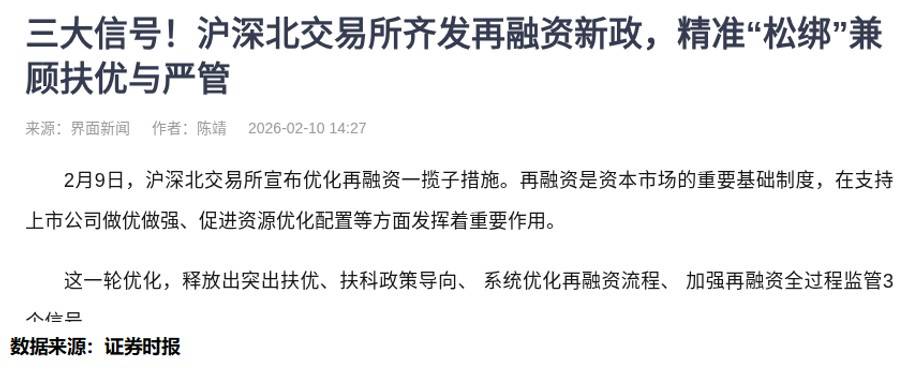
再融资政策“多箭齐发”,最新解读来了!靶向发力支持科技创新
券商中国· 2026-02-09 14:43
Core Viewpoint - The article discusses a comprehensive set of policies introduced by the Shanghai, Shenzhen, and Beijing stock exchanges to optimize the refinancing system, aiming to enhance resource allocation efficiency and support quality listed companies and technological innovation [2]. Group 1: Policy Measures - The reform focuses on improving review efficiency and revising standards for "light asset, high R&D investment" recognition, supporting fundraising for new industries, new business formats, and new technologies that align with main business operations [2][3]. - The principle of "supporting the strong and limiting the weak" is emphasized, aiming to direct resources towards high-quality listed companies and new productive forces [3]. - The new measures allow listed companies to use raised funds for projects that have a synergistic effect with their main business, promoting the development of secondary growth curves [3][4]. Group 2: Support for Innovative Companies - The article outlines three dimensions of support for technology innovation companies, including the introduction of a recognition standard for "light asset, high R&D investment" for main board companies, which previously applied only to the ChiNext board [5][6]. - The criteria for "light asset" and "high R&D investment" are defined, with "light asset" meaning physical assets account for no more than 20% of total assets, and "high R&D investment" requiring an average R&D investment of at least 15% of revenue over the last three years [6]. - The refinancing interval for unprofitable innovative companies is reduced from 18 months to 6 months, provided that previous fundraising has been effectively utilized [6][7]. Group 3: Process Optimization - The exchanges aim to enhance the flexibility and convenience of the refinancing process by optimizing the disclosure mechanism for refinancing plans and simplifying application materials [9]. - Companies are now required to disclose previous fundraising usage and future plans succinctly, with the timing for reporting previous fund usage adjusted to the application submission [9]. - The exchanges also allow companies to use financial data from annual or semi-annual reports directly in their refinancing applications, reducing the burden on listed companies [9]. Group 4: Regulatory Environment - Despite the positive signals from the refinancing policies, the article stresses that regulatory scrutiny remains stringent, with a focus on preventing excessive financing [10]. - The exchanges emphasize the importance of risk prevention and strong regulation, ensuring that companies provide detailed justifications for their financing needs [10][11]. - There are differentiated arrangements for companies that have experienced stock price declines, allowing them to raise funds through various methods while ensuring compliance with regulatory standards [8][10].

视频 芯联集成赵奇:期待两项政策对“盈利要求”松绑
Zhong Guo Jing Ying Bao· 2025-12-20 03:47
Group 1 - The chairman and general manager of ChipLink Integration (688469.SH), Zhao Qi, expressed the hope for an expansion of refinancing channels for high-quality unprofitable companies after their IPOs, anticipating further adjustments to the "profit first, then financing" policy [2] - Zhao Qi highlighted that issuing targeted convertible bonds to acquire assets is a valuable tool in mergers and acquisitions, but current policies require listed companies to have profits sufficient to cover one year's interest on the convertible bonds, which excludes loss-making enterprises from utilizing this tool [2] - Zhao Qi called for the relaxation of profit requirements for convertible bonds for companies in the Sci-Tech Innovation Growth Sector [2]

外资券商2024年平均减员10%!这家外资最新出击,重启“招兵买马”
券商中国· 2025-05-12 05:35
Core Viewpoint - The article discusses the reduction in employee numbers among foreign securities firms in China for 2024, highlighting that this is not indicative of a strategic shift but rather a response to market conditions and policy changes [1][8]. Employee Reduction - Foreign securities firms in China have seen an average employee reduction of 10% in 2024, with notable exceptions like 法巴证券 (French bank) which has not yet commenced operations [2]. - Specific firms such as 高盛 (Goldman Sachs) and 瑞银 (UBS) reported employee reductions of 10.63% and 11.23% respectively, despite significant profit increases [2][4]. - The largest reduction was observed at 瑞信证券 (Credit Suisse), which saw an 18.25% decrease in staff [2]. Business Focus and Adjustments - Different foreign securities firms have varying focuses; for instance, 高盛 and 摩根大通 (J.P. Morgan) prioritize investment banking, while 野村东方国际证券 (Nomura) and 东亚前海证券 (East Asia Qianhai) focus more on brokerage services [4][5]. - The brokerage divisions of 野村 and 东亚前海 experienced significant staff reductions of 41% and 24% respectively [5]. - 瑞银 has a strong emphasis on research, with 22.9% of its staff dedicated to this area, indicating a strategic focus on research capabilities [4]. Market Conditions and Future Outlook - The reduction in staff is attributed to industry cycles and short-term policy impacts, rather than a long-term strategic withdrawal from the Chinese market [8]. - Following the introduction of the 9.24 policy package, there has been a notable increase in market activity, prompting foreign institutions to reassess and increase their investments in China [1][8]. - Firms like 瑞银 and 摩根大通 are actively seeking to expand their operations in China, with 瑞银 aiming for full ownership of its securities arm and 摩根大通 restarting recruitment efforts [8][7].