
创投市场

Search documents
开年汇总创投圈!区域洗牌 + 融资变天,看完直接拿捏风向
Sou Hu Cai Jing· 2026-02-08 01:44
Core Insights - The emergence of "+ rounds" in financing, such as A+, B+, A++, and A+++, indicates a shift in the investment landscape in China, where traditional financing labels no longer align with the rapid development pace of companies [1] - This change reflects a transition from "rapid expansion" to "meticulous cultivation" in the venture capital market, signaling a more mature and pragmatic phase [1] Financing Trends - The financing scale in the Yangtze River Delta region accounts for nearly half of the national total, showcasing a cluster advantage in sectors like hard technology, biomedicine, and new energy [1] - The Beijing-Tianjin-Hebei region follows closely, leveraging academic and research resources to make breakthroughs in artificial intelligence and high-end manufacturing [1] Regional Characteristics - Each region in China is developing its own industrial characteristics and advantageous sectors, shifting the focus from "snatching projects" to "building ecosystems," which clarifies choices for entrepreneurs and investors [1] Impact of Regional Integration Policies - Regional integration is reshaping the geographical landscape of venture capital in China, with Beijing's "magnetic effect" attracting quality projects and capital to major cities [1] - The Yangtze River Delta has adopted a balanced development path, with cities like Shanghai, Suzhou, Hangzhou, and Nanjing complementing each other in industries, facilitating efficient flow of innovation resources within the urban cluster [1] - The dual influence of policy guidance and market selection will be key variables affecting long-term investment strategies and regional collaboration effects [1]
田轩:珍惜向你借钱的“孤僻”同学,他们可能是未来的超级创业者
Xin Lang Cai Jing· 2026-01-15 07:54
Group 1 - The forum titled "2026 Global and China Capital Market Outlook" was held in Beijing on January 15, featuring a keynote speech by Tian Xuan, the Dean of the National Institute of Financial Research at Tsinghua University [1][5] - Tian Xuan emphasized the need for a more inclusive venture capital market that allows for trial and error to support technological innovation [3][7] - He referenced a study on "super entrepreneurs," highlighting three categories of traits: positive qualities, neutral characteristics, and traditionally negative descriptions, which together drive their innovative capabilities [3][7] Group 2 - Tian Xuan argued that disruptive innovation often requires unconventional thinking and actions, contrasting with the stability-seeking nature of most individuals [3][7] - He encouraged students to value peers who may exhibit traits like introversion or self-centeredness, suggesting that investing in such individuals can genuinely support their innovative endeavors [3][7]


田轩:“十五五”资本市场“三支柱”:包容创投、稳健二级、完善法治
Xin Lang Cai Jing· 2026-01-15 07:13
Core Viewpoint - The forum emphasized the need for a capital market that adapts to the current complex landscape of opportunities and risks, highlighting the importance of supporting the real economy and technological self-reliance, particularly in the context of artificial intelligence [3][7]. Group 1: Current Market Challenges - The past five years have seen geopolitical changes, trade tensions, and the ongoing impact of the pandemic on supply chains, leading to increased uncertainty [3][7]. - The policy direction has shifted from passive responses focused on maintaining strategic stability to a more proactive approach aimed at overcoming challenges and risks [3][7]. Group 2: Development Goals - The focus has transitioned from "six stabilities" and "six guarantees" to promoting effective qualitative economic growth and reasonable quantitative improvement, placing greater emphasis on quality and structure [3][7]. Group 3: Proposed Market Adjustments - A more inclusive venture capital market is needed to provide sufficient early-stage financing for high-risk, long-cycle technology projects, especially in AI and other frontier fields [5][8]. - The secondary market should avoid excessive short-term speculation and volatility, shifting towards a more stable state that emphasizes long-term value and serves the real economy [5][8]. - There is a necessity to improve the legal environment, enhance investor protection, and combat illegal activities to establish a fair, transparent, and predictable market order [5][9].
交易量暴增 28%,7627 家公司获融资——中国创投走出寒冬
Sou Hu Cai Jing· 2026-01-05 13:13
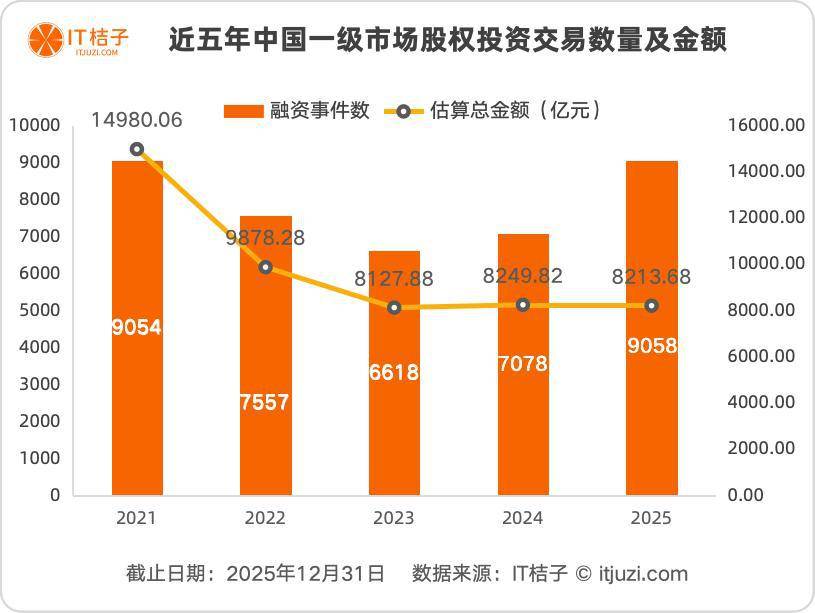
Core Insights - The venture capital market in 2025 is characterized by a strong rebound after a prolonged downturn in 2022 and 2023, with transaction numbers reaching a five-year high, although total investment amounts remained stable [1][2]. Group 1: Market Performance - Investment transaction numbers increased by 28%, with 9,058 transactions in 2025 compared to 7,078 in 2024, marking a significant rise [5][6]. - Total investment amount decreased by 0.44%, totaling 821.368 billion yuan in 2025, down from 824.982 billion yuan in 2024, indicating a stable market size [7][8]. - The number of companies receiving investment rose by 19.4%, with 7,627 companies funded in 2025, up from 6,386 in 2024, reflecting a broader market coverage [10][11]. Group 2: Market Trends - The market trajectory over five years shows a "V" shape, with a decline from 2021 to 2023 followed by a recovery starting in 2024 [12][16]. - The period from 2021 to 2023 saw a significant drop in investment activity, with transaction numbers falling by 26.9% and total investment amounts decreasing by nearly 46% [13][14]. - The recovery phase from 2024 to 2025 indicates a return to levels close to those of 2021, with transaction numbers and company funding nearly back to previous highs, although total investment amounts have not yet reached 2021 levels [16]. Group 3: Investment Behavior - The phenomenon of increased transaction numbers with stable total investment suggests a more rational and diversified investment approach, with funds being allocated to a larger number of companies [17][18]. - Early-stage projects are receiving more attention, as evidenced by the growth in the number of funded companies, indicating a shift in investor focus towards potential startups rather than established projects [18]. - The market is returning to a more rational state, with investment decisions becoming more cautious and valuations more reasonable, suggesting a healthier investment environment [18][19]. Group 4: Future Outlook - The 2025 venture capital market is described as "early spring," indicating a recovery with increased opportunities but not yet at a peak state, suggesting a balanced environment for both entrepreneurs and investors [19][20].
第十四届全国人大代表、清华大学国家金融研究院院长田轩:构建与科技创新更匹配的资本市场
Zheng Quan Ri Bao· 2025-12-26 16:44
Group 1 - The core viewpoint emphasizes the need for a capital market that supports technological innovation, which requires a more inclusive venture capital market and a less aggressive secondary market [1][2] - The "14th Five-Year Plan" outlines seven development goals focused on the real economy and technological innovation, necessitating strong support from the capital market [1] - Technological innovation is characterized by long cycles, high uncertainty, and high failure rates, which necessitates a more accommodating venture capital environment [1] Group 2 - A less aggressive secondary market is essential for providing a stable environment for innovative companies, which includes five key aspects: strong anti-takeover provisions, moderate stock liquidity, long-term institutional investors, reduced analyst pressure, and less frequent information disclosure [2] - Strong anti-takeover provisions, such as dual-class share structures, can protect the stability of company control and encourage innovation [2] - Moderate stock liquidity is linked to innovation, where low liquidity can be beneficial, but excessive liquidity may attract short-term investors, creating pressure on companies [2] - Long-term institutional investors are crucial as they can better identify and support innovative companies, enhancing their focus on core business and innovation efficiency [2] - Reducing analyst pressure can prevent management from overly focusing on short-term earnings, which may lead to cuts in R&D spending and harm long-term innovation [2] - Less frequent information disclosure is preferred by investors in innovative companies, as it can mitigate short-sighted management behavior [2]
田轩:我们需要什么样的资本市场
Zheng Quan Ri Bao· 2025-12-26 05:19
Core Viewpoint - The report emphasizes the need for a capital market that supports technological innovation and the development of the real economy, focusing on two main aspects: a more inclusive venture capital market and a "less aggressive" secondary market [2][13]. Group 1: Inclusive Venture Capital Market - A more inclusive venture capital market is essential to support technological innovation, which is characterized by long cycles, high uncertainty, and high failure rates [4]. - The report highlights the importance of being tolerant towards entrepreneurs and venture capital funds, allowing for failures and encouraging early-stage investments [5]. - The comparison of venture capital fund durations between the U.S. (10-12 years) and China (5-7 years) indicates a need for longer investment horizons to support early-stage and high-risk projects [5]. Group 2: Less Aggressive Secondary Market - The secondary capital market is crucial, with approximately 600-700 million individuals involved, and the central government has emphasized its importance in recent policy discussions [6]. - A "less aggressive" secondary market is proposed to provide a quieter environment for high-growth and innovative companies, reducing short-term pressures from investors and analysts [6][7]. - Mechanisms such as strong anti-takeover provisions and controlled board member turnover are suggested to maintain stability and encourage long-term innovation [8]. - The report argues that excessive stock liquidity can attract short-term investors, which may negatively impact a company's innovation efforts [9]. - Long-term institutional investors are needed to better support innovative companies, as they can provide stability and oversight, especially during periods of failure [10]. - Reducing analyst pressure and the frequency of earnings disclosures can help alleviate short-term performance pressures on companies, allowing them to focus on long-term innovation [11][12]. Conclusion - A well-designed capital market that is both inclusive and less aggressive is essential for fostering an environment conducive to technological innovation and supporting the real economy [13].
清华大学田轩:支持科技创新,创投市场需包容像马斯克一样的“疯子与天才”
Xin Lang Cai Jing· 2025-12-05 04:24
Core Viewpoint - The South Finance Forum 2025 emphasizes the need for a more inclusive venture capital market and a less aggressive secondary market to support technological innovation and achieve high-level self-reliance in technology [1][5]. Group 1: Venture Capital Market - A more inclusive venture capital market is necessary, which should be accommodating to the unique traits of "super unicorn" entrepreneurs, who often possess unconventional characteristics that drive innovation [3][7]. - The current venture capital market in China lacks "patient capital," with fund lifespans averaging 5-7 years compared to the 10-12 years typical in the U.S., limiting investments in early-stage projects [8][9]. - The composition of Limited Partners (LPs) in China has shifted from individual investors to state-owned entities, which, despite being patient capital, exhibit risk-averse behavior due to concerns over state asset preservation [4][9]. Group 2: Secondary Market - The secondary market in China needs to be less aggressive, requiring strong anti-takeover provisions, reduced stock liquidity, and a focus on long-term institutional investors [4][9]. - There should be fewer analysts tracking stocks and less frequent information disclosure to create a more stable investment environment [9]. - A combination of a more inclusive venture capital market and a less aggressive secondary market is essential for leveraging technology and financial power to support innovation [4][9].
清华大学田轩:LP结构导致中国缺乏真正的“耐心资本”
Xin Lang Cai Jing· 2025-12-05 04:19
Core Viewpoint - The South Finance Forum 2025 emphasizes the need for a more inclusive venture capital market and a less aggressive secondary market to support technological innovation and achieve high-level self-reliance in technology [1][5]. Group 1: Venture Capital Market - A more inclusive venture capital market is necessary, which should be open to diverse entrepreneurs, including those with unconventional traits that drive innovation [3][7]. - The characteristics of "super unicorn" entrepreneurs often include traits that are typically seen as negative, such as being eccentric or difficult to work with, which are essential for groundbreaking innovation [3][7]. - The current venture capital market in China lacks "patient capital," with fund lifespans averaging 5-7 years compared to the 10-12 years typical in the U.S., limiting investments in early-stage projects [8][9]. Group 2: Limited Partners (LPs) - The composition of LPs in China has shifted from individual investors to state-owned entities, which, while inherently patient, are often risk-averse due to concerns over state asset preservation [4][9]. - The risk-averse nature of state-backed venture capital institutions leads to insufficient support for early-stage investments, hindering technological innovation [4][9]. Group 3: Secondary Market - A less aggressive secondary market is needed, characterized by strong anti-takeover provisions, limited stock liquidity, a focus on long-term institutional investors, fewer analysts tracking stocks, and less frequent information disclosure [4][9]. - The combination of a more inclusive venture capital market and a less aggressive secondary market is essential for leveraging technology and finance to support innovation and achieve technological self-reliance [4][9].
251个交易日翻倍:揭秘机构"囤货"手法
Sou Hu Cai Jing· 2025-11-28 12:33
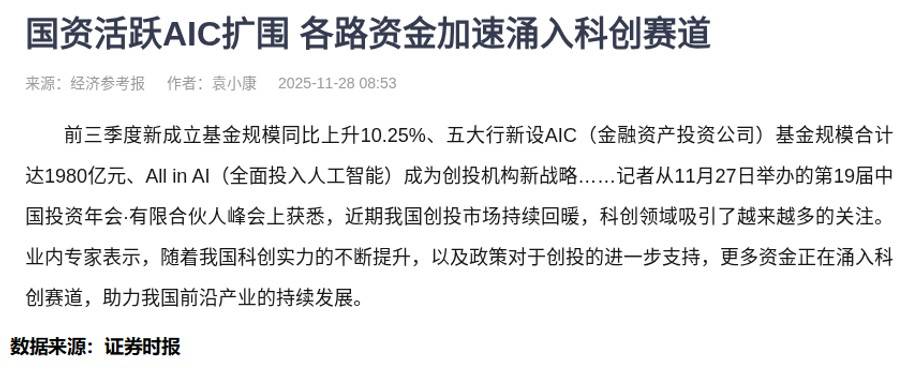
Core Insights - The recent surge in venture capital activity indicates a strong interest in the technology sector, reminiscent of the 2015 bull market in the startup space [1] - Retail investors are experiencing "missed opportunity anxiety," often hesitating to invest even as stock prices rise significantly [3] - The current venture capital market is characterized by a consensus among large institutional investors, which is driving substantial investment growth [4] Group 1: Market Dynamics - The venture capital market is seeing a significant influx of funds, with state-owned capital accounting for 75%-80% of investments and bank-affiliated AIC funds reaching a scale of 198 billion [3] - The total scale of venture capital funds is projected to reach 1.78 trillion by the third quarter of 2025, reflecting a year-on-year growth of 10.25% [4] - Investment scale in the sector has increased to 912 billion, marking a growth of 19.98% [4] Group 2: Institutional Behavior - Institutions tend to accumulate stocks quietly over time, often leading to a prolonged "dead period" before significant price movements occur [5] - Quantitative data indicates that stocks may show minimal price changes while institutional activity remains high, suggesting accumulation rather than selling pressure [8] - The pattern of three phases of price increases, with decreasing intervals, indicates growing urgency among institutions to invest [14] Group 3: Recommendations for Retail Investors - Retail investors should abandon the fantasy of timing the market perfectly and instead focus on monitoring capital flows using quantitative tools [16] - Stocks that remain stagnant during a bull market may warrant closer attention, as they could indicate institutional accumulation [16] - Trusting quantitative data over personal intuition is crucial, especially when there is a conflict between the two [16] - The current technology sector exemplifies a strong consensus among major investors, suggesting that this trend is likely to continue [16]
打通创投市场“募投管退”环节 助力新质生产力发展
Zhong Guo Zheng Quan Bao· 2025-11-09 20:14
Core Insights - The development of a well-functioning capital market is crucial for nurturing new productive forces, emphasizing the importance of venture capital and private equity in supporting the lifecycle of innovative enterprises [1][2] Group 1: Importance of Venture Capital - The lifecycle of enterprises, especially innovative ones, includes various stages such as seed, startup, growth, and maturity, which require different financing and risk management tools [1] - Venture capital plays a critical role in supporting early-stage innovative enterprises when traditional financing methods are inadequate [1][2] Group 2: Recommendations for Enhancing the Venture Capital Market - It is essential to streamline the "fundraising-investment-management-exit" process, particularly improving exit channels to stabilize the venture capital market [2] - Reforming the management philosophy and model of government or state-owned venture capital funds is necessary to increase risk tolerance and extend performance evaluation periods [2] - Supporting the transformation of scientific and technological achievements is vital for accelerating the integration of technological and industrial innovation [2] - Developing a robust merger and acquisition market is crucial, as it serves as an important exit channel for venture capital funds, particularly for high-potential innovative enterprises [2]