
利率债市场

Search documents
3月利率展望-两会窗口与地缘摩擦下-债市会否出现新定价
2026-03-09 05:18
Summary of Conference Call Notes Industry Overview - The notes primarily focus on the bond market and macroeconomic conditions in China, particularly in relation to interest rates and government fiscal policies for 2026. Key Points and Arguments Bond Market Dynamics - In February, the bond market saw a structural shift in institutional behavior, with major banks reducing positions while smaller banks and insurance companies increased their holdings. This led to a stabilization in market sentiment, with the 10-year government bond yield forming a new equilibrium around 1.8% [1][4][5]. - The overall yield curve showed a slight decline in long-term rates while short-term rates increased, resulting in a flattening of the yield curve [3]. - The 10-year government bond yield fell from above 1.8% to around 1.78%, indicating a monthly decline of approximately 3.6 basis points [3]. Fiscal Policy and Government Debt - The fiscal policy for 2026 is set to be moderately positive, with a deficit rate of about 4% (5.89 trillion yuan) and special bonds totaling 4.4 trillion yuan. The issuance of ultra-long special government bonds is projected at 1.3 trillion yuan [1][7]. - The supply structure of government bonds is expected to remain long-term and proactive, with a net supply of approximately 1.77 trillion yuan in March, up from about 1.4 trillion yuan in February [14]. Monetary Policy Outlook - The monetary policy is expected to continue a stance of "moderate easing," with potential room for interest rate cuts of 10-20 basis points within the year, although the timing may be influenced by the Federal Reserve's actions [1][11]. - The government work report emphasizes the need for monetary policy to support economic growth and promote reasonable price recovery, indicating a focus on addressing current economic weaknesses [10][11]. External Influences and Risks - Global bond markets have shifted from a "risk-off" to an "inflation expectation" pricing logic, with U.S. Treasury yields rising by nearly 20 basis points recently. However, domestic bond yields have shown limited transmission due to a significant supply-demand gap and a prevailing deflationary environment [8]. - Key risks for March include geopolitical developments, commodity price fluctuations, and the effectiveness of fiscal measures in managing long-term bond supply pressures [9][16]. Market Strategy Recommendations - The strategy for March suggests controlling duration and leverage, with a focus on gradual trading and profit-taking. The 10-year government bond yield's break below 1.8% presents a higher probability for downward movement, but the potential for significant gains is limited [9][16]. - Observations on institutional behavior indicate a shift towards a more optimistic sentiment in trading, while the configuration of the market remains sensitive to external uncertainties and potential new drivers [15][17]. Additional Important Content - The notes highlight the importance of monitoring inflation indicators, particularly the Consumer Price Index (CPI) and Producer Price Index (PPI), as well as the impact of external factors such as tariffs on exports and real estate market trends [2][13]. - The government’s focus on expanding domestic demand through coordinated fiscal and monetary policies is a critical aspect of the economic strategy for 2026, aiming to alleviate financing constraints for businesses and individuals [11].
利率债周报:楼市新政冲击债市,利率曲线转为熊陡-20260227
BOHAI SECURITIES· 2026-02-27 09:13
1. Report Industry Investment Rating - No industry investment rating is provided in the report 2. Core Viewpoints of the Report - In the short - term, the interest rate curve has shifted to a bearish steepening pattern due to the impact of the new real - estate policy. The 10Y Treasury bond yield has risen to 1.83%. It is expected that interest - rate bonds will maintain a volatile pattern around the Two Sessions. The 10Y Treasury bond yield's fluctuation range may be within 5bp, and the curve is more likely to steepen. Attention should be focused on short - term and 5Y - nearby varieties [2][19][28] 3. Summary by Relevant Catalog 3.1 Important Event Reviews - **Financial Data**: In January 2026, the year - on - year increase in social financing mainly came from government bond financing. The "good start" of credit was mediocre, and the medium - and long - term financing demand of residents and enterprises was relatively weak. The 1 - month structural interest - rate cut is expected to gradually take effect, but due to the Spring Festival date difference, the year - on - year growth rates of the social financing stock, M1, and M2 in February are expected to decline [2][8][9] 3.2 Funding Prices - The central bank over - renewed 3000 billion yuan of MLF. During the statistical period, the central bank's net injection of funds in the open market was 1.1 trillion yuan, and funding prices remained generally stable. DR007 was maintained below 1.6%, R007 was maintained near 1.6%, and the 3M inter - bank certificate of deposit rate was basically flat [2] 3.3 Primary Market - The issuance scale of special bonds decreased marginally. During the statistical period, 40 interest - rate bonds were issued in the primary market, with an actual issuance total of 698.2 billion yuan. Among them, the issuance scale of Treasury bonds increased, and that of special bonds decreased. As of February 26, 2026, the newly added special bonds from January to February totaled about 800 billion yuan, an increase of about 300 billion yuan compared to the same period in 2025, showing an obvious early - issuance characteristic [2][17] 3.4 Secondary Market - The interest - rate curve shifted to a bearish steepening pattern. During the statistical period, interest rates adjusted upwards. On February 25 - 26, the yields of Treasury bonds of all maturities rose, mainly due to the implementation of the new Shanghai real - estate policy. The long - term varieties were more affected, and the 10Y Treasury bond yield rose to 1.83% [2][19] 3.5 Market Outlook - **Fundamentals**: During the Spring Festival holiday in 2026, the daily average sales revenue of the national consumption - related industries increased by 13.7% compared to the same period of the previous year, and the overall performance of the Spring Festival consumption field was stable [27] - **Policy**: The Two Sessions will be the main focus in the next stage. About 60% of the 31 provincial - level regions in China have lowered their GDP growth targets for 2026. Most of the regions that disclosed the growth targets for social retail sales and fixed - asset investment have also lowered their targets, which may be beneficial to the bond market. There is no need to be overly pessimistic about the subsequent impact of real - estate - related policies [27] - **Funding**: As the seasonal factor disturbances subside, funding prices are expected to decline in early March [28]
2月利率展望-赔率阶段性不足-关注再通胀与供给扰动
2026-02-10 03:24
Summary of Key Points from Conference Call Records Industry Overview - **Industry**: Government Bonds and Real Estate - **Key Focus**: Interest rates, inflation, government bond supply, and real estate market conditions Core Insights and Arguments 1. **Export Growth**: December exports increased by 6.6% year-on-year, with non-US regions (such as India, EU, ASEAN) growing over 10%, indicating strong export resilience and diversification [5] 2. **Real Estate Market**: The real estate sector is still in a bottoming phase, with new home sales and construction area showing negative year-on-year growth. Policy adjustments are being closely monitored for their impact on the market [6][7] 3. **Government Bond Supply**: February's government bond supply is expected to reach approximately 1.56 trillion yuan, an increase from January, with significant issuance of special bonds [8][9] 4. **Monetary Policy**: The central bank maintains a moderately loose monetary policy, with room for further rate cuts. The focus is on managing liquidity through government bond transactions [11][12] 5. **Market Performance**: In January, the yield on ten-year government bonds fluctuated between 1.8% and 1.9%, driven by central bank bond purchases and market conditions [2] 6. **Inflation Indicators**: CPI is expected to continue rising, supported by food prices, while PPI shows signs of structural improvement. However, inflation expectations may lead to market volatility [4][18] 7. **Institutional Behavior**: There is a shift in institutional buying from insurance companies to banks, particularly small and medium-sized banks, indicating changing market dynamics [13] Additional Important Content 1. **Supply-Demand Dynamics**: The bond market is expected to face rebalancing pressures due to increased supply, particularly in the long-end bonds, which may affect yields [14][16] 2. **Market Sentiment**: The overall market sentiment is cautious, with limited trading activity expected due to the holiday season and low trading days [17] 3. **Investment Strategy**: Recommendations include cautious operations, such as profit-taking and avoiding aggressive downward trading, while monitoring the performance of long-term bonds [14][17] 4. **Future Monitoring**: Key factors to watch in February include CPI and inflation trends, government bond supply pressures, and the impact of the Spring Festival on liquidity [18]
固定收益|点评报告:信用情绪降温了吗?
Changjiang Securities· 2026-02-04 23:30
1. Report Industry Investment Rating No relevant content provided. 2. Core Viewpoints of the Report - From January 26th to January 30th, the performance of general credit bonds was stronger than that of secondary capital bonds, possibly due to some institutions taking phased profit - taking after the yields of secondary capital bonds declined for two consecutive weeks. Large banks increased their allocation of interest - rate bonds due to abundant liabilities, small and medium - sized banks became more cautious, wealth management products increased their allocation of low - volatility amortized cost - based bond funds under the net - value constraint, and insurance preferred local government bonds. In the next few weeks, the concentrated opening of amortized bond funds will benefit specific - term credit bonds, and the market of secondary capital bonds is driven by the buying power of funds and insurance, with different yield performances for each term. In terms of future allocation, it is recommended to focus on 5 - year AA+ and AAA urban investment bonds with more attractive interest - rate differentials, and for secondary capital bonds, focus on the allocation opportunities of medium - and long - term varieties after phased profit - taking and the warming of market sentiment [3]. - The overall credit bond market recently followed the fluctuations of interest - rate bonds but showed relative resilience. Urban investment bonds generally outperformed secondary and perpetual bonds. The short - end interest rates of interest - rate bonds rose due to the temporary tightening of the capital market, while the long - end and ultra - long - end interest rates fluctuated under the alternating influence of stock market sentiment and policy expectations. The weakening participation of trading - type funds in ultra - long - term interest - rate bonds led to a shift of funds to credit bonds, which is a key reason for the relatively better performance of credit bonds [7]. - The behaviors of major investment institutions have significantly diverged, affecting the supply - demand pattern of credit bonds. Large banks increased their net purchases of interest - rate bonds due to asset shortages and abundant liabilities, which created conditions for the narrowing of credit spreads. At the end of 2025, wealth management products slightly increased their holdings of credit bonds but significantly increased their holdings of public funds, cash, and deposits. This reflects the demand for stable asset net values under the net - value transformation [8]. - In the future, asset supply and specific product cycles will directly affect the credit bond market. Although the supply of government bonds in January was large, the market interest rates remained stable due to the active participation of insurance and other allocation funds, providing a good allocation window for credit bonds. The upcoming opening peak of amortized cost - based bond funds in the next 16 weeks will bring re - allocation demand for corresponding - term credit bonds, and the deepening of the net - value transformation of wealth management products may increase the demand for medium - and long - term amortized bond funds, benefiting medium - and long - term credit bonds [9]. - The recent strong market of secondary capital bonds is driven by the implementation of the new public - fund fee regulations, the structural change of bond - type funds, and the hot sales of dividend - insurance products. Currently, the market has shown signs of differentiation. The yields of 1 - 3 - year varieties have fallen back to near the previous lows, with a narrowing spread protection space, while the 5 - year, 7 - year, and 10 - year varieties still have a certain spread protection margin and relatively high allocation cost - effectiveness. The market rhythm is expected to slow down, and medium - and long - term secondary capital bonds still have certain allocation value. In terms of the allocation strategy, it is recommended to focus on 5 - year AA+ and AAA urban investment bonds and medium - and long - term secondary capital bonds with relatively sufficient spread protection [10]. 3. Summary According to Relevant Catalogs 10Y Treasury Bonds: Large Banks Net Buy, Small and Medium - Sized Banks Net Sell - Since January 7, 2026, as the yield of 10 - year treasury bonds gradually declined, the net purchase volume of 7 - 10 - year treasury bonds by large banks showed a fluctuating upward trend, with a single - day peak of 14.105 billion yuan. The increase in large - bank purchases of 10 - year treasury bonds has created conditions for the narrowing of credit spreads. On the demand side, bank deposits have shown super - seasonal growth, increasing the scale of on - balance - sheet funds and reducing the pressure on the liability side. On the supply side, the slow issuance of government bonds, especially local government bonds, has created an asset gap, forcing large banks to increase their net purchases [19]. - In contrast, small and medium - sized banks have a more obvious left - hand trading characteristic in bond investment. Since January 7, 2026, as the yield of 10 - year treasury bonds declined, their willingness to allocate medium - and long - term treasury bonds decreased. Their conservative trading strategy is a passive choice due to the weakening of the traditional profit model. The narrowing of the interest - rate spread of 3 - year large - denomination certificates of deposit between representative city commercial banks and large banks has limited their bond - allocation funds, and the increasing difficulty and risk of obtaining capital gains through trading in the volatile bond market have made them more cautious, focusing on stable coupon income [24]. Bank Wealth Management: Slightly Increase Holdings of Credit Bonds, Focus on Low - Volatility and High - Liquidity Assets - At the end of 2025, bank wealth management slightly increased its holdings of credit bonds, focused on increasing the allocation of public funds, cash, and bank deposits, and reduced its holdings of equity - type assets and inter - bank certificates of deposit. The proportion of bond investment was at a low level in recent years. The increase in public - fund investment may be related to the increase in the allocation of amortized cost - based bond funds and bond ETFs, and the increase in cash and bank - deposit investment may be due to the temporary increase in the supply of inter - bank deposits at the end of the year and the relatively attractive interest rates. The decrease in the scale of equity - type assets and inter - bank certificates of deposit may be due to the contraction of the net supply of inter - bank certificates of deposit [30]. New Trends in the Long - Term Bond Market: Slower Brokerage Trading, Insurance Allocation Shift - At the beginning of the year, the concentrated short - selling behavior of brokerage self - operation in 30 - year treasury bonds, combined with the weak承接 power of insurance and other allocation funds, suppressed the trading sentiment of interest - rate bonds. Trading - type investors, represented by funds, reduced their participation in 30 - year treasury bonds and shifted some funds to credit bonds, which is an important reason for the relatively better performance of credit bonds. The selling amount and borrowing balance of 20 - 30Y treasury bonds by brokerage self - operation have declined recently, but they are still at a relatively high level. Insurance institutions prefer local government bonds over 30 - year treasury bonds, mainly for the relatively higher coupon and continuous tax advantages [33]. Is the Supply of Government Bonds in January in Line with Expectations? - Although the supply of government bonds in January was large, the active participation of allocation funds, mainly insurance, in local government bonds effectively alleviated the supply pressure, and the market interest rates remained stable, providing a good allocation window for credit bonds. The actual issuance volume of government bonds in January 2026 was higher than the planned volume, and the issuance scale was basically the same as that of the same period in 2025. After adjusting for seasonal factors, the issuance scale was actually similar to that of the previous year [40]. Future 16 Weeks: Peak Opening of Amortized Bond Funds, Benefiting Corresponding - Term Credit Bonds - The next 16 weeks will be the peak opening period of amortized bond funds, with those with a fixed - opening period of less than 1 year and more than 5 years being the main types, which will have a positive impact on corresponding - term credit bonds. The demand of wealth management products for stable net values may benefit medium - and long - term credit bonds. The opening scale in February is small, but there will be a peak in March. The term structure shows that in February, bonds with a term of more than 5 years are the main type, and in March, bonds with a term of less than 1 year are the main type, which may increase the demand for corresponding - term credit bonds [48]. Adjustment of Cash - Bond Trading Data Caliber: Institutional Classification and Callable Bond Terms - The adjustment of the institutional net - purchase data caliber implemented in 2026 includes two dimensions. One is the simplification of the classification of all - market institutions, and the other is the adjustment of the calculation rule of callable bond terms from being based on the maturity date to being based on the exercise date. After the adjustment, the configuration behavior of wealth - management funds needs to be tracked through the "other" category, and the previous method of judging institutional allocation behavior of secondary capital bonds based on the net - purchase data of 5 - 10Y "other" - type bonds is no longer applicable [52]. How Long Will the Secondary Capital Bond Market Last? - The recent strong market of secondary capital bonds is driven by the improvement of policy expectations, the structural adjustment of bond funds, and the allocation demand of dividend - insurance products. Currently, insurance mainly undertakes long - term secondary capital bonds such as 10Y, while funds have become the main buyers of medium - and short - term secondary capital bonds since December 2025. However, due to the influence of the spread level of secondary capital bonds of different terms, the daily net - purchase growth rate of funds has slowed down. The yields of 1 - 3Y secondary capital bonds have fallen back to near the lows after the release of the draft new public - fund fee regulations in September 2025, with a narrowing spread protection space, while medium - and long - term secondary capital bonds still have a certain spread protection margin and relatively high investment cost - effectiveness [59]. Bond Allocation Strategy: Slightly Cooled Market Sentiment, Focus on Credit Bond Catch - Up - In the past four weeks, the market has shifted from the dominance of secondary capital bonds in mid - January to the recent leadership of general credit bonds. Based on the current interest - rate differential quantile, valuation level, and rotation rhythm, the next - week allocation priority is adjusted as follows: urban investment bonds (AA+, 5Y) > urban investment bonds (AAA, 5Y) > secondary capital bonds (AAA -, 5Y). The 5Y AA+ urban investment bonds have coupon advantages and certain credit - sinking space, and have clear valuation - repair potential; the 5Y AAA urban investment bonds have low credit risk and good liquidity; the 5Y AAA - secondary capital bonds have a relatively reasonable valuation in their sector. For previously strong varieties, such as 5Y AA and AA(2) urban investment bonds and 10Y local government bonds, caution is recommended in allocation [65].
利率债周报:债市整体回暖,长债收益率明显下行-20260119
Dong Fang Jin Cheng· 2026-01-19 10:01
Report Summary 1. Report Industry Investment Rating No industry investment rating is provided in the report. 2. Core Viewpoints - Last week, the bond market rebounded, and the yield curve continued to steepen. The 10 - year Treasury bond yield approached 1.90%, attracting more allocation buyers. The stock market cooled due to regulatory measures on margin trading, and the central bank announced a structural interest rate cut, leading to a generally strong bond market with declining long - term bond yields. Short - term bond yields also declined, with a larger decline than long - term yields, steepening the yield curve [2]. - This week (the week of January 19), the bond market is expected to oscillate weakly. Although the Q4 2025 economic growth rate continued to decline, factors such as stable employment, rising prices, policy optimizations, and expected export growth in Q1 2026 suggest a rebound in GDP growth. With no clear incremental drivers, the bond market will continue to oscillate. The stock market's "spring rally" expectation may divert funds from the bond market, and the tax - payment month in January will put pressure on the capital market, but the central bank is expected to maintain liquidity. The 10 - year Treasury bond yield is expected to fluctuate between 1.80% and 1.90% [2]. 3. Summary by Directory 3.1 Last Week's Bond Market Review - **Secondary Market**: The bond market rebounded last week, with significantly declining long - term bond yields. The 10 - year Treasury bond futures' main contract rose 0.27% for the week. The 10 - year Treasury bond yield fell 3.58bp, and the 1 - year yield dropped 4.63bp compared to the previous Friday, widening the term spread [3]. - **Primary Market**: 44 interest - rate bonds were issued last week, a decrease of 14 from the previous week. The issuance volume was 4516 billion yuan, a decrease of 3116 billion yuan, and the net financing was - 1925 billion yuan, a significant decrease of 5417 billion yuan. The issuance volumes of Treasury bonds, policy - bank bonds, and local government bonds all decreased. The net financing of Treasury bonds and local government bonds decreased, while that of policy - bank bonds increased. The subscription demand for interest - rate bonds was generally acceptable, with an average subscription multiple of 3.53 for Treasury bonds, 3.92 for policy - bank bonds, and 19.54 for local government bonds [16][17]. 3.2 Last Week's Important Events - **December Import and Export Data**: In December 2025, exports in US dollars increased 6.6% year - on - year, accelerating by 0.7 percentage points from November. The full - year export growth was 5.5%, 0.3 percentage points lower than the previous year. Imports in December increased 5.7% year - on - year, accelerating by 3.8 percentage points from November, and the full - year import growth was 0.0%, 1.0 percentage point lower than the previous year. The strong export growth was due to external demand, trade transfer, and growth in chip and car exports. The import growth was driven by export growth and increased oil import demand [19]. - **December Financial Data**: In December 2025, new RMB loans were 9100 billion yuan, 800 billion yuan less than the same period last year. The new social financing scale was 22075 billion yuan, 6462 billion yuan less than the same period last year. At the end of December, M2 increased 8.5% year - on - year, accelerating by 0.5 percentage points from the previous month, and M1 increased 3.8% year - on - year, decelerating by 1.1 percentage points from the previous month. The decrease in new loans was "strong in enterprises, weak in residents," and the decrease in social financing was mainly due to government bond financing [19]. 3.3 Real - Economy Observation - **Production**: High - frequency production data showed mixed trends last week. The blast furnace operating rate and daily hot - metal output declined, while the asphalt plant operating rate and semi - steel tire operating rate increased [22]. - **Demand**: The BDI index continued to decline, while the CCFI index continued to rise. The sales area of commercial housing in 30 large and medium - sized cities decreased [22]. - **Prices**: Pork prices continued to rise slightly, and most commodity prices increased, including copper, oil, and rebar [22]. 3.4 Last Week's Liquidity Observation - The central bank's net open - market capital injection was 11128 billion yuan last week [31]. - R007 and DR007 both declined. The issuance rate of joint - stock bank certificates of deposit fluctuated upward. The 3M national - share direct - discount rate continued to rise. The volume of pledged repurchase decreased slightly. The inter - bank market leverage ratio first decreased then increased, with an overall decline [32][35][36].
长假过后,债市四季度如何布局?
Xin Hua Cai Jing· 2025-10-08 07:57
Core Viewpoint - The bond market is experiencing a weak and volatile trend, with various factors influencing its performance, including macroeconomic data and policy changes [2][3][4]. Group 1: Market Trends - Since July, the equity market has been rising, leading to a correction in the bond market, with the yield spread between 30-year and 10-year government bonds reaching above the 75th percentile for 2023, indicating improved cost-effectiveness for pure bond assets [1][3]. - As of September 30, the interbank bond market showed mixed yield movements, with the 10-year yield around 1.86%, reflecting a general upward trend in bond yields since September [2]. - The bond market is under pressure due to factors such as unexpected developments in US-China negotiations and increased redemption pressures from bond funds [2]. Group 2: Positive Factors - Despite the seasonal weakness in September, there are positive indicators, including weak macro data and a shift in the central bank's reverse repurchase auction method, suggesting a supportive monetary policy stance [3]. - The reduction in new bond supply for October is expected to positively impact the bond market, with government bond net financing projected to decrease significantly compared to previous months [4]. Group 3: Investment Strategies - In the current environment of market volatility, maintaining an open mindset is recommended, as fundamental support remains strong [6]. - Analysts suggest focusing on short-term and cross-product arbitrage opportunities, as well as identifying underpriced bonds with buying support [6]. - The bond market is believed to be in a bottoming phase, with potential for improved cost-effectiveness, particularly as the fourth quarter approaches [6].
【笔记20250530— 宏观研究奥义:研究川普们的脑回路】
债券笔记· 2025-05-30 11:14
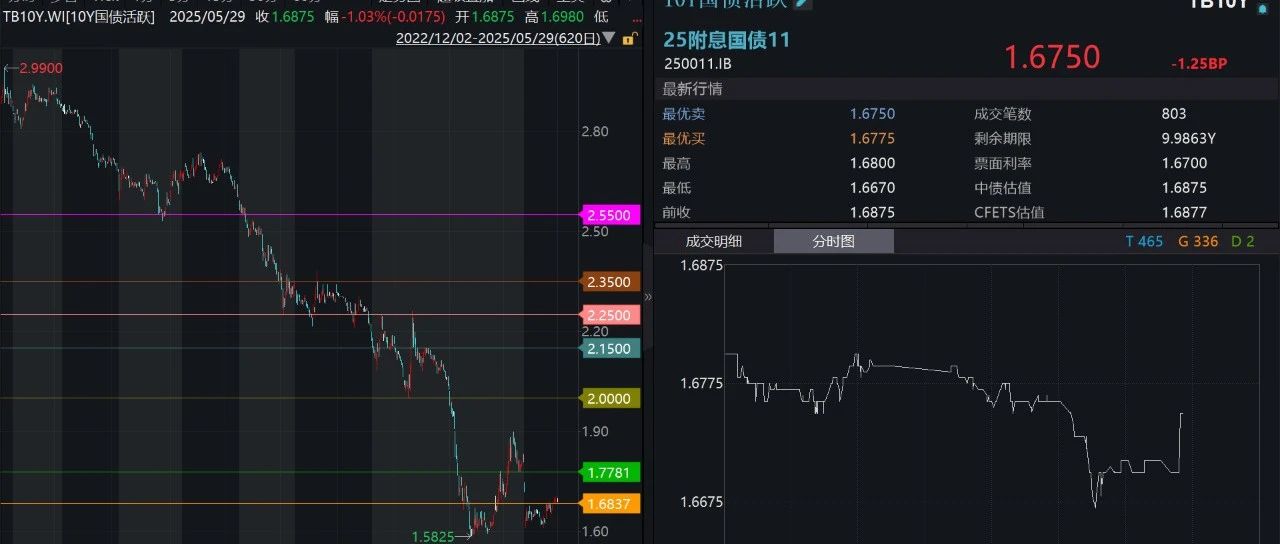
Group 1 - The article discusses the concept of false breakouts in trading, suggesting that recognizing these can lead to more confident counter-trading actions [1] - It highlights the current macroeconomic environment, indicating a balanced and slightly loose funding situation with a small decline in long-term bond yields [1][3] - The People's Bank of China (PBOC) conducted a 7-day reverse repurchase operation of 291.1 billion yuan, with a net injection of 148.6 billion yuan after 142.5 billion yuan of reverse repos matured [1][2] Group 2 - The U.S. appellate court temporarily reinstated Trump tariffs, contributing to a weak stock market and a slight decline in bond market rates [2][3] - The 10-year government bond yield opened slightly lower and fluctuated, with the lowest rate reaching 1.667% before closing at 1.675% [3][4] - Market participants were closely monitoring the central bank's announcements regarding bond purchases, although no such operations were conducted, leading to a slight rebound in rates [3][4]

基本面利多确定,把握回调买债机会
Dong Zheng Qi Huo· 2025-05-11 07:12
Report Investment Rating - The trend rating of treasury bonds is "volatile" [4] Core Viewpoints - The market is expected to gradually strengthen in the volatility, and it is recommended to seize the opportunity to go long. The fundamental factors are relatively certain to be favorable, and the medium - to - long - term upward trend of the bond market is clear. However, the price of treasury bond futures is still high, and there may be short - term disturbances. It is necessary to time the entry and adjust the adding strategy [2][16]. - After the central bank's interest rate cut, the capital interest rate center has declined rapidly, and the yield curve has changed from flat to steep. The direction of the curve steepening is relatively certain, and its space is determined by the downward space of the capital interest rate, which is expected to have some room for decline but with a possibly tortuous rhythm [2][17]. Summary by Directory 1. One - Week Review and Outlook 1.1 This Week's Trend Review - From May 5th to May 11th, treasury bond futures fluctuated at a high level. On Tuesday, the central bank net - withdrew a large amount of funds through reverse repurchase, the short - end varieties were weak, and the long - end varieties were slightly strong due to the expected weakening of April's economic indicators. On Wednesday, after the central bank announced the reserve requirement ratio and interest rate cuts, the interest rate briefly declined, then institutions' profit - taking intention rose rapidly, and short - end varieties outperformed long - end ones. On Thursday, with the marginal loosening of the capital market and the lack of upward momentum in the stock market, treasury bond futures rose and the curve steepened. On Friday, treasury bond futures rose in the morning but weakened in the afternoon due to the better - than - expected April export data. As of May 9th, the settlement prices of the main continuous contracts of 2 - year, 5 - year, 10 - year, and 30 - year treasury bond futures were 102.356, 106.105, 109.035, and 120.320 yuan respectively, changing by - 0.012, + 0.005, - 0.015, and - 0.520 yuan compared to last weekend [1][13]. 1.2 Next Week's Outlook - Although the central bank announced the "double - cut" this week and the curve started to steepen, the long - end treasury bond futures did not break through upwards because the market had over - anticipated the interest rate cut and April's export data exceeded expectations. In the future, the market should gradually strengthen in the volatility, but the timing of going long should be well - grasped. Fundamental factors are favorable, but short - term disturbances may exist. It is more cost - effective to wait for pullbacks to buy [16]. 2. Weekly Observation of Interest - Bearing Bonds 2.1 Primary Market - This week, 50 interest - bearing bonds were issued, with a total issuance volume of 578.579 billion yuan and a net financing of 235.291 billion yuan, an increase of 443.487 billion yuan and 100.594 billion yuan respectively compared to last week. 28 local government bonds were issued, with a total issuance of 105.459 billion yuan and a net financing of 67.191 billion yuan, an increase of 12.367 billion yuan and a decrease of 25.506 billion yuan respectively compared to last week. 453 inter - bank certificates of deposit were issued, with a total issuance of 857.920 billion yuan and a net financing of 334.360 billion yuan, an increase of 608.580 billion yuan and 420.330 billion yuan respectively compared to last week [23][24]. 2.2 Secondary Market - As of May 9th, the yields of 2 - year, 5 - year, 10 - year, and 30 - year treasury bonds were 1.43%, 1.49%, 1.64%, and 1.84% respectively, changing by - 1.54, - 1.92, + 0.76, and + 1.35 basis points compared to last weekend. The spreads of 10Y - 1Y, 10Y - 5Y, and 30Y - 10Y all widened. The yields of 1 - year, 5 - year, and 10 - year policy - financial bonds were 1.47%, 1.55%, and 1.66% respectively, changing by - 9.22, - 2.50, and + 0.31 basis points compared to last weekend [28][29]. 3. Treasury Bond Futures 3.1 Price, Trading Volume, and Open Interest - As of May 9th, the settlement prices of the main continuous contracts of 2 - year, 5 - year, 10 - year, and 30 - year treasury bond futures were 102.356, 106.105, 109.035, and 120.320 yuan respectively, changing by - 0.012, + 0.005, - 0.015, and - 0.520 yuan compared to last weekend. The trading volumes of 2 - year, 5 - year, 10 - year, and 30 - year treasury bond futures this week were 46,612, 70,116, 82,596, and 99,245 lots respectively, an increase of 4,851, 10,812, 16,677, and 16,030 lots compared to last weekend. The open interests were 149,492, 210,970, 245,395, and 132,157 lots respectively, changing by + 2,582, + 5,180, + 8,820, and - 1,496 lots compared to last weekend [36][39]. 3.2 Basis and IRR - The positive - arbitrage strategy is recommended. The IRRs of T and TF have been running at a relatively high level. After the capital market gradually loosened at the end of Q1, the cost - effectiveness of the positive - arbitrage strategy became prominent. There are stable positive - arbitrage opportunities because the negative carry problem still exists in some varieties and the basis center is difficult to rise, and at the same time, some investors are actively going long on the bond market [43]. 3.3 Inter - Delivery and Inter - Variety Spreads - As of May 9th, the inter - delivery spreads of 2 - year, 5 - year, 10 - year, and 30 - year treasury bond futures contracts 2506 - 2509 were - 0.196, - 0.340, - 0.165, and - 0.530 yuan respectively, changing by + 0.068, - 0.040, - 0.020, and - 0.260 yuan compared to last weekend. The inter - delivery spread of TS started to rise, and its future trend is expected to be tortuous [47][48]. 4. Weekly Observation of the Capital Market - This week, the central bank conducted 836.1 billion yuan of reverse repurchase operations in the open market, with 1,617.8 billion yuan of reverse repurchases maturing, resulting in a net withdrawal of 781.7 billion yuan. As of May 9th, R007, DR007, SHIBOR overnight, and SHIBOR 1 - week were 1.58%, 1.54%, 1.50%, and 1.52% respectively, down 25.91, 25.77, 26.30, and 24.30 basis points compared to last weekend. The average daily trading volume of inter - bank pledged repurchase this week was 6.81 trillion yuan, an increase of 1.34 trillion yuan from last week, and the overnight proportion was 85.79%, higher than last week [52][56][58]. 5. Weekly Overseas Observation - As of May 9th, the US dollar index rose 0.38% to 100.4218 compared to last weekend, the 10Y US Treasury yield was 4.37%, up 4 basis points compared to last weekend, and the 10Y China - US Treasury yield spread was inverted by 274 basis points. The progress of the UK - US trade negotiation and the Fed's slightly hawkish stance in the May interest - rate meeting led to the strengthening of the US dollar index and the rise of US Treasury yields [63]. 6. Weekly Observation of High - Frequency Inflation Data - This week, industrial product prices fell across the board. As of May 9th, the Nanhua Industrial Product Index, Metal Index, and Energy and Chemical Index were 3,446.32, 6,047.02, and 1,608.41 points respectively, down 31.89, 59.87, and 12.60 points compared to last weekend. Agricultural product prices rose across the board. The prices of pork, 28 key vegetables, and 7 key fruits were 20.62, 4.40, and 8.01 yuan/kg respectively, up 0.03, 0.01, and 0.42 yuan/kg compared to last weekend [67]. 7. Investment Recommendations - It is recommended to pay attention to the strategy of buying on pullbacks. Specific strategies include: 1) Recommend the strategy of laying out medium - term long positions on dips. 2) Pay attention to the positive - arbitrage opportunities of short - end varieties. 3) The opportunity to steepen the curve has initially emerged, and continue to monitor the change of the capital interest rate. 4) Stop profiting from the strategy of narrowing the TS06 - 09 spread in advance [2][18][68].