
债市布局

Search documents
周观:何时是窄幅波动下债市的合适布局时机?(2025年第44期)
Soochow Securities· 2025-11-16 07:33
Group 1: Report General Information - The report is a fixed - income weekly report dated November 16, 2025, focusing on the bond market and related data [1] Group 2: Report Industry Investment Rating - No industry investment rating information is provided in the report Group 3: Report Core Views - The 10 - year Treasury bond active coupon yield is expected to remain in the range of 1.75% - 1.85% until the end of the year. There may be a better layout opportunity in the first quarter of next year when betting on interest rate cuts. A potential fund redemption fee new rule in early December could lead to a pulse - like rise in interest rates, presenting a good entry opportunity [13] - The US 12 - month interest rate cut probability has decreased, and US Treasury yields have collectively risen. The NFIB small - business optimism index in October was lower than expected, and the number of initial jobless claims in the week of November 8 decreased [15][20][21] Group 4: Summary by Directory 4.1 One - Week Views - **Domestic Bond Market**: From November 10 - 14, 2025, the 10 - year Treasury bond active coupon yield decreased by 0.1bp from 1.8060% to 1.8050%. The bond market was in a narrow - range fluctuation. Two factors restricted the interest rate from breaking through the range: market expectations of the weakening fundamentals and the higher probability of interest rate cuts in the first quarter of next year [9][13] - **US Bond Market**: The NFIB small - business optimism index in October was 98.2%, lower than the expected 98.3%. The number of initial jobless claims in the week of November 8 decreased from 228,000 to about 225,000. The probability of a December interest rate cut decreased, and US Treasury yields rose. The 10 - year US Treasury yield rose 4bp to 4.12%, and the 2 - year yield rose 2bp to 3.59% [15][20][21] 4.2 Domestic and Overseas Data Aggregation 4.2.1 Liquidity Tracking - Open - market operations from November 10 - 14, 2025, had a net injection of 781 billion yuan. Interest rate bonds' total issuance, total repayment, and net financing showed certain changes compared to the previous week [27] 4.2.2 Domestic and Overseas Macroeconomic Data Tracking - Commodity prices such as steel and LME non - ferrous metals had mixed rises and falls. The total floor area of commercial housing transactions showed a downward trend [50][51] 4.3 Local Bond One - Week Review 4.3.1 Primary Market Issuance Overview - From November 10 - 14, 2025, 73 local bonds were issued, with a total issuance amount of 285.066 billion yuan, a net financing of 242.792 billion yuan. The top five provinces in terms of issuance amount were Jiangsu, Zhejiang, Liaoning, Jilin, and Beijing [76][78] 4.3.2 Secondary Market Overview - The local bond stock was 54.01 trillion yuan, with a trading volume of 31.0134 billion yuan and a turnover rate of 0.57%. The top three provinces with active trading were Hubei, Guangdong, and Shandong [90] 4.3.3 This Month's Local Bond Issuance Plan - Some provinces and regions have planned local bond issuances from November 17 - 21, 2025 [98] 4.4 Credit Bond Market One - Week Review 4.4.1 Primary Market Issuance Overview - A total of 311 credit bonds were issued, with a total issuance of 268.14 billion yuan, a total repayment of 236.697 billion yuan, and a net financing of 31.443 billion yuan, a decrease of 59.068 billion yuan compared to the previous week [94] 4.4.2 Issuance Interest Rates - The short - term financing bill's latest issuance interest rate was 1.7115%, up 7.53bp; the medium - term note was 2.1127%, down 1.53bp; the corporate bond was not provided; the corporate bond was 2.2449%, up 2.72bp [106] 4.4.3 Secondary Market Transaction Overview - The total credit bond trading volume was 538.76 billion yuan, with different trading volumes for different ratings and bond types [107] 4.4.4 Maturity Yields - The maturity yields of national development bonds generally decreased, while those of credit bonds such as short - term financing bills, medium - term notes, corporate bonds, and urban investment bonds showed different trends [108][109][111] 4.4.5 Credit Spreads - The credit spreads of short - term financing bills and medium - term notes showed a differentiated trend, while those of corporate bonds and urban investment bonds generally widened [115][118][120] 4.4.6 Rating Spreads - The rating spreads of short - term financing bills, medium - term notes, corporate bonds, and urban investment bonds generally narrowed [124][127][131] 4.4.7 Trading Activity - The top five most actively traded bonds for each bond type were listed, and the industrial industry had the largest weekly bond trading volume [136][137] 4.4.8 Subject Rating Changes - There were no bonds with upgraded ratings or outlooks, and no bonds with downgraded ratings or outlooks this week [138][139]
债市 中长期布局正当时
Qi Huo Ri Bao· 2025-10-17 22:11
Group 1 - The bond market has experienced multiple shifts in logic this year, with tightening liquidity in Q1 leading to adjustments in short-term bonds, followed by pressure release in long-term bonds as liquidity turned loose in Q2 [1] - The 10-year government bond yield has risen to around 1.75%, with support expected near 1.8% after a 10 basis point rate cut this year [1] - The upward movement in bond yields since Q3 has been primarily driven by non-fundamental factors, indicating significant pressure on the bond market despite the central bank's efforts to maintain liquidity [2] Group 2 - The macroeconomic narrative has improved, but the bond market is still facing substantial pressure, with a bear-steep yield curve indicating stability in short-term bonds while long-term bonds have seen larger adjustments [2] - Recent inflation data shows a narrowing decline in PPI to 2.3% year-on-year, while core CPI has increased by 1%, suggesting a potential bottoming out of inflation, although demand remains a critical factor for further increases [4] - The bond market's attractiveness has diminished this year, leading to a higher likelihood of new funds entering the stock market rather than the bond market, resulting in reduced incremental funds and declining stock scale [4] Group 3 - The central bank's potential reinitiation of government bond trading is anticipated, especially if the bond market enters an overshoot state, with expectations for such actions remaining high for the year [5][6] - The central bank's objectives for restarting bond trading include liquidity management, influencing interest rates, and supporting government bond issuance [6] - Observations from September indicate a reversal in the decline of household deposits, suggesting a shift in market dynamics that could impact M1 growth, which needs further monitoring [7]

【财经分析】贸易局势催生避险情绪 债市或迎布局契机
Xin Hua Cai Jing· 2025-10-16 08:05
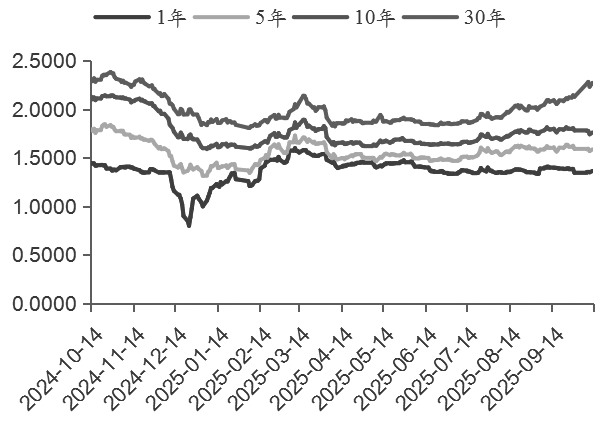
Core Viewpoint - The bond market sentiment has shown signs of recovery following the National Day holiday, influenced by various economic factors and trade tensions, leading to increased risk aversion in the market [1][2]. Group 1: Market Sentiment and Trends - After the National Day holiday, the bond market sentiment improved significantly, with the yield curve flattening and moving downward [2]. - The 10-year government bond yield fell to around 1.82% by October 11, down from 1.89% before the holiday, indicating a recovery in market sentiment [2]. - Market expectations for a potential interest rate cut by the central bank are rising as the year-end approaches, which could further support the bond market [3][5]. Group 2: Economic Factors and Predictions - The ongoing trade tensions, particularly between China and the U.S., are expected to create a cautious environment, but the overall situation is likely to remain manageable [4]. - Analysts suggest that the speed and extent of bond market recovery in the fourth quarter may not replicate the rapid recovery seen in April, as investors are focused on turning previous losses into profits [4]. - The central bank's liquidity support has been consistent, with net injections through reverse repos, which is crucial for the bond market's stability [2][4]. Group 3: Investment Strategies - Institutions with an optimistic outlook believe that the bond market is in a favorable position, despite ongoing trade frictions, and suggest maintaining a bullish stance [6]. - The potential for a decline in the 10-year government bond yield to challenge the 1.7% level is noted, indicating that bonds currently hold investment value [6]. - Caution is advised for short-term bond investments, with recommendations to focus on credit bonds with shorter durations and higher liquidity for more stable returns [7].
长假过后,债市四季度如何布局?
Xin Hua Cai Jing· 2025-10-08 07:57
Core Viewpoint - The bond market is experiencing a weak and volatile trend, with various factors influencing its performance, including macroeconomic data and policy changes [2][3][4]. Group 1: Market Trends - Since July, the equity market has been rising, leading to a correction in the bond market, with the yield spread between 30-year and 10-year government bonds reaching above the 75th percentile for 2023, indicating improved cost-effectiveness for pure bond assets [1][3]. - As of September 30, the interbank bond market showed mixed yield movements, with the 10-year yield around 1.86%, reflecting a general upward trend in bond yields since September [2]. - The bond market is under pressure due to factors such as unexpected developments in US-China negotiations and increased redemption pressures from bond funds [2]. Group 2: Positive Factors - Despite the seasonal weakness in September, there are positive indicators, including weak macro data and a shift in the central bank's reverse repurchase auction method, suggesting a supportive monetary policy stance [3]. - The reduction in new bond supply for October is expected to positively impact the bond market, with government bond net financing projected to decrease significantly compared to previous months [4]. Group 3: Investment Strategies - In the current environment of market volatility, maintaining an open mindset is recommended, as fundamental support remains strong [6]. - Analysts suggest focusing on short-term and cross-product arbitrage opportunities, as well as identifying underpriced bonds with buying support [6]. - The bond market is believed to be in a bottoming phase, with potential for improved cost-effectiveness, particularly as the fourth quarter approaches [6].
中信证券:关注7月风险资产走势,把握债市调整后的布局机会
news flash· 2025-07-10 00:41
Core Viewpoint - The current bond market is influenced by multiple factors, including policy effectiveness in curbing disorderly competition and promoting industry clearing, which could support inflation and impact the bond market [1] Group 1: Market Conditions - There are concerns about the sustainability of improvements in the fundamental and inflation outlook, compounded by weak domestic and external demand, as well as fiscal and real estate pressures [1] - The short-term effects of policies may be moderate, despite a generally accommodative monetary policy and ample liquidity supporting the bond market [1] Group 2: Market Dynamics - Short-term vulnerabilities in the bond market are heightened due to compressed spreads, high leverage, and low funding rates [1] - Strong performance in equity and commodity markets is creating disturbances in the bond market [1] Group 3: Investment Strategy - It is recommended to monitor the performance of risk assets in July to seize opportunities for positioning in the bond market after adjustments [1]

30年国债ETF博时(511130)午盘上涨24个bp,下半年债市“震荡偏强”如何布局?
Sou Hu Cai Jing· 2025-06-19 06:22
Group 1 - The A-share market experienced a decline, with all three major indices falling over 1%, and the ChiNext Index down by 1.39% [1] - The 30-year government bond futures rose by 0.22% to 121.13, while the 10-year bond futures increased by 0.03% [1] - The trading volume of the 30-year government bond ETF (Boshi 511130) exceeded 1.3 billion yuan, indicating active trading [1] Group 2 - The bond market is expected to continue a slightly strong oscillating trend in the second half of the year, with strategies suggesting a focus on wave operations [2] - The 30-year government bond ETF (Boshi 511130) was established in March 2024 and is one of only two on-market ultra-long-term bond ETFs, tracking the "Shanghai 30-Year Government Bond Index" [2] - The index reflects the overall performance of corresponding term government bonds in the Shanghai market and is sensitive to interest rate changes [2]