利率政策调整

Search documents
3月FOMC会议点评:不确定的通胀前景,预期内的按兵不动
GUOTAI HAITONG SECURITIES· 2026-03-20 01:05
1. Report Industry Investment Rating No relevant information provided. 2. Core Viewpoints of the Report - The Fed maintained the federal funds rate target range at 3.50%–3.75% in the March FOMC meeting, and its policy focus has shifted to re - evaluating inflation risks after a previous round of preventive easing [1][4]. - The current policy environment involves a prudent balance among growth, inflation, and geopolitical risks, rather than just the single logic of "growth slowdown" [4][20]. - The Fed still has some room for rate cuts this year, but the threshold has significantly increased, and future rate path decisions will more depend on whether oil price shocks and inflation expectations can stabilize [4][21][22]. 3. Summary by Relevant Catalogs 3.1. The Interest - Rate Meeting's Inaction Meets Expectations, and the Balance between Economy and Inflation Remains to Be Observed - On March 19, the Fed kept the federal funds rate unchanged. In the context of high inflation and rising oil prices due to the Middle - East situation, it chose to wait and observe the new balance among growth, employment, and inflation [6]. - The Fed believes the U.S. economy is expanding at a "relatively robust" pace, employment growth is low, the unemployment rate has changed little, and inflation is still "somewhat high" [6]. - SEP shows that the median forecast of the federal funds rate at the end of 2026 is still 3.4%, indicating about one 25bp rate cut this year, the same as in December 2025 [7]. - Stephen I. Miran opposed keeping the interest rate unchanged and favored a 25bp rate cut, but the mainstream view is to maintain the status quo [8]. 3.2. Market Reaction: Limited Downward Space for Short - Term Rates, and Long - Term Rates More Reflect Oil Price and Inflation Disturbances - The Fed's decision to keep the interest rate unchanged restricts the downward space of short - term yields. After the decision, the S&P 500 index fell slightly, 1 - 10 - year U.S. Treasury yields rose about 5bp, and the U.S. dollar index rose about 0.5% [11]. - Long - term rates are affected by multiple factors. Due to the Middle - East situation pushing up oil prices and the unresolved U.S. fiscal deficit and Treasury supply pressure, long - term rates lack downward momentum and are more constrained by re - inflation expectations and rising risk premiums. The 30 - year Treasury yield rose only 2.5bp on the day of the meeting [12]. 3.3. Reasons for the Suspension of Rate Cuts 3.3.1. Growth Momentum Remains Resilient - The Fed does not think the current economic environment requires immediate additional easing. The U.S. economy is expanding at a "relatively robust" pace, and the current monetary policy helps achieve the dual goals of employment and inflation [15]. 3.3.2. Employment is Cooling Marginally, but It Has Not Triggered an Urgent Need for Policy Hedging - Employment growth is low, but the unemployment rate has changed little, indicating that the labor market is cooling rather than deteriorating rapidly. Employment weakness is an important variable for the Fed to observe, but it is not enough to dominate the policy direction for now [17]. 3.3.3. Inflation Remains Sticky - Inflation is still "somewhat high". The Fed emphasizes the uncertainty of the Middle - East situation's impact on the U.S. economy. Higher energy prices will push up overall inflation in the short term, and the Fed prefers to observe the transmission of oil price shocks to inflation and inflation expectations before deciding whether to resume rate cuts [20]. 3.4. Policy Signals - The Fed's policy focus has returned to the balance of observing the two - way risks of inflation and growth, rather than turning to radical easing [21]. - There is still room for rate cuts this year, but the threshold is high. The SEP's median forecast of the federal funds rate at the end of 2026 is 3.4%, corresponding to about one 25bp rate cut, but it is not a commitment [21]. - The determining variable for the future interest rate path has shifted from "whether to support growth" to "whether oil price shocks and inflation expectations can stabilize" [22].
Thailand's Central Bank Surprises With Rate Cut
WSJ· 2026-02-25 07:21
Core Viewpoint - Thailand's central bank has unexpectedly cut its policy rate, marking the second consecutive easing to support early signs of economic recovery [1] Group 1 - The central bank's decision to lower the policy rate aims to stimulate economic growth amid tentative recovery signals [1] - This move reflects a proactive approach by the central bank to address economic challenges [1]


欧德第二银行发布2025年Q4业绩报告及2026年战略展望
Jing Ji Guan Cha Wang· 2026-02-12 19:30
Core Viewpoint - Old Second Bancorp (OSBC) is focusing on its fourth-quarter performance for 2025 and management outlook, highlighting key events and strategic directions for the upcoming years [1] Group 1: Performance Strategy - Management expects loan growth to reach a low single-digit percentage in 2026, with expenses projected to grow moderately at around 3% [2] - The net interest margin is anticipated to stabilize around 5% by 2027, indicating a positive outlook for profitability [2] - The company hinted at a potential share buyback and is open to opportunistic acquisitions, emphasizing that any actions must enhance the bank's fundamentals [2] Group 2: Company Status - The integration of Evergreen Bank has been completed in the fourth quarter of 2025, leading to improved operational efficiency, though the realization of subsequent synergies needs to be monitored [3] - The performance of the power sports portfolio, with an average credit score of 730, may face upward pressure from seasonal charge-offs [3] - The size of the syndicated loan book has decreased by approximately 80% over the past five years, necessitating observation of its impact on the asset structure [3] Group 3: Industry Policy and Environment - Sensitivity to interest rate policies is noted, as adjustments by the Federal Reserve could affect the net interest margin (currently at 5.09%) and deposit costs (which have decreased to 115 basis points) [4] - The U.S. Office of the Comptroller of the Currency (OCC) is expected to strengthen scrutiny on capital adequacy and anti-money laundering for mid-sized banks in 2026, which may lead to changes in compliance costs [4]

TradeMax:美联储动向不明 美元指数小幅回落
Sou Hu Cai Jing· 2026-01-13 06:46
Group 1 - The US dollar index has significantly declined, ending its upward trend since the beginning of the year, primarily driven by uncertainties surrounding the Federal Reserve and upcoming Supreme Court policy decisions [1] - The US Department of Justice has accused Federal Reserve Chairman Jerome Powell of construction cost issues, escalating the controversy and raising concerns about the Fed's independence [1] - The market is focused on the upcoming US CPI data for December, with expectations of a year-on-year growth rate of 2.7% and core CPI rising from 2.6% to 2.7% [4] Group 2 - Non-US currencies have generally rebounded against the weakening dollar, with the euro ending a four-day decline, while the Japanese yen has fallen to a one-year low amid political developments [2] - Precious metals have shown active performance, with gold reaching $4600 before retreating, and silver rising by 6.6% to surpass $85 [2] - Global stock markets have continued their strong performance, with major US and European indices reaching historical highs, particularly in defensive sectors [2] Group 3 - The euro has faced resistance at 1.1695, and if the US CPI data is lower than expected, it may support a short-term rebound for the euro [5] - The Nikkei 225 index has shown signs of overbought correction after reaching historical highs, with key support levels identified [6]
Fed seen on longer rate-cut pause after jobs data
Reuters· 2026-01-09 14:16
Core Insights - A decrease in the U.S. unemployment rate may alleviate concerns at the Federal Reserve regarding labor market weakness [1] - This development could support the argument for maintaining the current policy rate for a longer period [1] - Traders are anticipating that the Federal Reserve will delay any rate reductions until June [1]

FXGT:亚洲股市受美股回调影响
Sou Hu Cai Jing· 2025-12-09 15:04
Group 1 - Asian stock markets experienced a general decline, influenced by a pullback in US stocks from historical highs, while US stock futures showed slight upward movement [1] - The Tokyo Nikkei 225 index was one of the few markets to rise, increasing by 0.2% to 50,691.39 points [1] - The Hong Kong Hang Seng Index fell by 0.8% to 24,549.54 points, while the Taiwan Weighted Index decreased by 0.5% and the South Korean KOSPI index dropped by 0.3%, indicating cautious investor sentiment towards short-term market volatility [4] Group 2 - The Australian S&P/ASX 200 index also declined by 0.2%, closing at 8,607.80 points, influenced by the Reserve Bank of Australia's decision to maintain the benchmark interest rate at 3.6% [4] - Nvidia's stock price rose by 2.3% in after-hours trading following news that its H20 chip was approved for sale to "approved customers," which boosted investor sentiment in the tech sector [4] - The focus is currently on the upcoming Federal Reserve interest rate decision, with expectations that a potential rate cut may provide liquidity support to global markets and influence risk appetite in Asia [6] Group 3 - The entertainment industry is experiencing notable merger and acquisition dynamics, with Netflix's acquisition of Warner Bros potentially facing regulatory hurdles, while Paramount's cash offer introduces new uncertainties for investors [10] - Mergers and restructuring events within the sector often lead to short-term volatility in individual stocks, prompting traders to adjust their positions based on market developments [10] - Overall, Asian stock markets are exhibiting a fluctuating pattern influenced by US stock trends, policy expectations, and industry events, suggesting a need for investors to monitor core market indicators and adopt flexible strategies [10]


Wall Street Lunch: Powell Plays The Grinch (undefined:US10Y)
Seeking Alpha· 2025-10-29 20:42
Core Viewpoint - The Federal Reserve cut interest rates by 25 basis points for the second time this year, but Chairman Jay Powell indicated that another cut in December is not guaranteed, leading to mixed market reactions [2][3][4]. Federal Reserve Actions - The Fed lowered the fed funds rate target to a range of 3.75% to 4%, marking the first time it has been below 4% since late 2022 [4]. - The Fed announced the end of its balance sheet runoff, concluding reductions in Treasury and agency securities on December 1 [5]. Market Reactions - Following Powell's comments, the odds of the Fed maintaining rates steady in December surged to 40% from below 10%, while the odds of a cut decreased to 55% and a 5% chance of a rate hike emerged [4]. - The S&P 500 finished flat, the Nasdaq rose by 0.6%, and the Dow fell by 0.2% after initial declines [6]. - Treasury yields increased, with the 2-year yield rising by 11 basis points to 3.61% and the 10-year yield increasing by 9 basis points to 4.07% [6]. Economic Outlook - The Fed described economic growth as "expanding at a moderate pace," a shift from previous language emphasizing moderation, while acknowledging slowed job gains and rising inflation [5]. - Powell noted that there are differing views within the Committee regarding future economic conditions, suggesting a cautious approach moving forward [3].


新加坡华侨投资基金管理有限公司:不受关税与信心低迷影响,美消费者支出保持稳定
Sou Hu Cai Jing· 2025-09-17 10:35
Core Insights - The article highlights the continuous growth of U.S. retail sales for the third consecutive month, indicating a robust performance in the consumer market during the summer of this year [1]. Retail Sales Performance - According to the U.S. Department of Commerce, the seasonally adjusted retail sales increased by 0.6% month-over-month, remaining consistent with the growth rate from July. Excluding the automotive sector, retail sales rose by 0.7% [1]. - Among the thirteen retail categories analyzed, nine experienced positive growth, with online retailers, clothing stores, and sporting goods stores showing particularly strong performance, attributed to back-to-school demand. In contrast, while automotive sales continued to grow, the pace of growth has slowed [3]. Consumer Spending Trends - Despite facing multiple pressures such as tariffs increasing prices on certain goods, persistent low consumer confidence, and signs of fatigue in the labor market, U.S. consumers have demonstrated a strong willingness to spend. The report notes that although overall wage growth has slowed, many workers' income increases still outpace inflation [5]. - The rise in U.S. stock markets has also provided additional income for certain groups, particularly high-income households, further supporting their spending capacity [5]. Economic Implications - Consumer spending, which accounts for approximately two-thirds of U.S. economic activity, remains a key indicator monitored by the Federal Reserve. Currently, policymakers are closely observing retail dynamics and employment market conditions to assess the direction of future interest rate adjustments [7]. - There is a general market expectation that the Federal Reserve will announce a rate cut in the upcoming meeting to mitigate potential further weakness in the labor market, although the full impact of the implemented tariff policies on final prices is yet to be comprehensively evaluated [7].

全球央行深陷贸易与政治“迷雾”,降息前景扑朔迷离
智通财经网· 2025-06-20 02:08
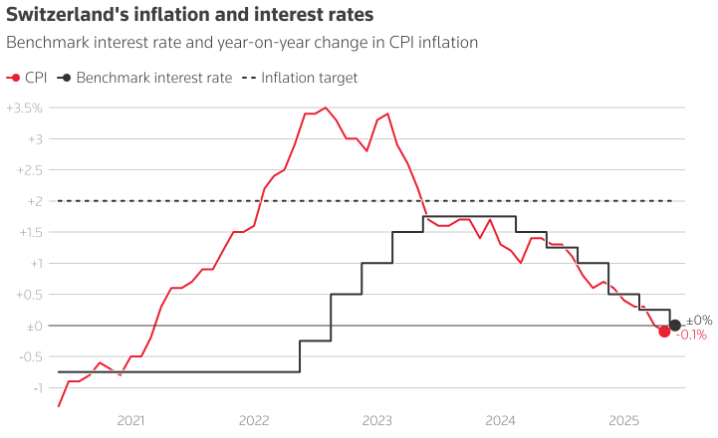
Central Banks Overview - Global central banks are facing increased uncertainty regarding economic growth and inflation, complicating their decision-making processes, especially for those nearing the end of their rate-cutting cycles [1] - The Norwegian central bank unexpectedly announced a rate cut, marking its first reduction since 2020 [1] Switzerland - The Swiss National Bank lowered its benchmark interest rate to zero, citing declining inflation, appreciation of the Swiss franc, and economic instability due to uncertain U.S. trade policies [2] - There is speculation about whether the Swiss National Bank will move rates into negative territory, but further cuts are deemed more challenging now that rates are at zero [2] Canada - The Bank of Canada maintained its interest rate at 2.75%, indicating potential further cuts if economic downturns occur due to tariff impacts [5] - This marks the second consecutive pause in rate hikes after a significant reduction of 225 basis points over nine months [5] Sweden - The Swedish central bank reduced its benchmark rate from 2.25% to 2%, with indications of possible further easing by year-end due to low price pressures [8] - The bank has cut rates by a total of 200 basis points since May 2024 [8] New Zealand - The Reserve Bank of New Zealand is expected to keep rates unchanged on July 9, following a 25 basis point cut to 3.25% in May to protect the economy [12] - There is an expectation of another 25 basis point cut later this year, with a total of 225 basis points cut during the current cycle [12] Eurozone - The European Central Bank recently cut rates, marking its eighth reduction since mid-2024, while keeping all policy options open for the next meeting [15] - ECB President Lagarde stated that the 2% inflation target is achievable, but the key concern for investors is whether inflation will fall below this target, necessitating further easing [15] United States - The Federal Reserve maintained its interest rate, with potential declines expected by 2025, although Chairman Powell cautioned against over-reliance on this forecast [18] - Powell noted that if not for tariff issues, lower rates might have been considered due to recent low inflation data, with expectations of about two 25 basis point cuts by year-end [18] United Kingdom - The Bank of England unexpectedly kept rates at 4.25%, with market expectations for two more cuts by year-end [21] - Three out of nine rate setters voted for a cut, with speculation that weak labor data could accelerate the rate-cutting pace, although high inflation may hinder this [21] Australia - The Reserve Bank of Australia is preparing for rapid rate cuts due to weak economic growth and concerns over U.S.-China trade disputes affecting commodity producers [24] - In May, the RBA cut rates by 25 basis points to 3.85%, with expectations that borrowing costs could approach 3% by year-end [24] Norway - The Norwegian central bank cut its policy rate by 25 basis points to 4.25%, marking its first cut since 2020, which surprised many analysts [27] - The central bank is known for its cautious approach to rate cuts, with expectations of one to two more cuts this year [27] Japan - The Bank of Japan maintained its interest rate, aligning with investor expectations, while facing challenges from escalating Middle East tensions and U.S. tariff policies [31] - The bank decided to slow the pace of balance sheet reduction next year, indicating a cautious approach to unwinding a decade of stimulus measures [31]