劳动法律监督

Search documents
2025年劳动法律监督“一函两书”典型案例发布——共商共治保护劳动者权益
Xin Lang Cai Jing· 2026-01-10 13:17
Core Viewpoint - The "One Letter and Two Books" system, jointly released by the All-China Federation of Trade Unions, the Supreme People's Court, and the Supreme People's Procuratorate, serves as an important institutional tool for labor law supervision, combining flexible supervision with rigid guarantees to address the challenges of protecting workers' rights [1][2]. Multi-Party Collaborative Governance - Since 2025, trade unions at all levels have collaborated with courts and procuratorates to implement the "One Letter and Two Books" system, ensuring timely and efficient handling of cases involving violations of labor rights such as wage arrears and occupational safety [1][2]. - A nationwide network for rights protection is gradually taking shape, with all 31 provincial-level trade unions establishing collaborative mechanisms with local courts and procuratorates [1][2]. Effectiveness of Collaborative Governance - In 2024, over 170,000 "One Letter and Two Books" were issued, successfully resolving 7,846 cases of wage and insurance arrears, recovering economic losses of 38.4125 million yuan for workers [3]. - Trade unions play a unique role as "early warning sentinels," "negotiation bridges," and "collaborative hubs," facilitating collective bargaining and democratic management between enterprises and workers [3]. Addressing Algorithmic Challenges - The rise of the platform economy has led to 84 million new employment form workers, raising concerns about their rights protection, particularly regarding algorithm management and transparency [4]. - The "One Letter and Two Books" system addresses these issues by facilitating communication between trade unions and platform enterprises, promoting the rectification of unreasonable algorithm settings that harm workers' rights [4][5]. Preventive Effects - The increasing number of disputes involving older workers highlights the need for legal protections, as existing labor laws do not adequately cover their rights [7][8]. - The collaborative efforts of trade unions, procuratorates, and courts in protecting the rights of older workers demonstrate the power of institutional innovation, leading to the establishment of a rights protection mechanism that fills legal gaps [7][8].
“一函两书”让劳动者更有底气
Xin Lang Cai Jing· 2025-12-26 19:01
Core Viewpoint - The article discusses the implementation of the "One Letter and Two Documents" system by the All-China Federation of Trade Unions, the Supreme People's Court, and the Supreme People's Procuratorate to enhance labor law supervision and protect the rights of new employment form workers [1] Group 1: Implementation of the "One Letter and Two Documents" System - The "One Letter and Two Documents" system aims to remind employers to comply with labor laws and rectify illegal labor practices [1] - The system includes a "letter" (Labor Law Supervision Reminder Letter) and two documents (Labor Law Supervision Opinion Letter and Labor Law Supervision Suggestion Letter) [1] - This system is particularly relevant as the scale of new employment forms continues to grow, leading to frequent labor relationship conflicts [1] Group 2: Case Examples and Impact - A case involving a local express delivery company highlighted issues with algorithm assessment rules, prompting judicial authorities to issue a supervisory suggestion to the local human resources department [1] - The local trade union sent a reminder letter to the relevant employers, resulting in improved algorithms and labor rule agreements that benefited over 1.65 million workers in the industry [1] - The "One Letter and Two Documents" system combines soft reminders with hard constraints, effectively addressing labor disputes at their source [1] Group 3: Importance for Workers and Companies - The system serves as a compliance reminder for companies and a warning against legal risks [1] - For workers, it reduces the cost of rights protection and enhances the efficiency of claiming their rights [1] - The article emphasizes the need for a fair employment environment to support the healthy development of the platform economy and the continuous growth of new business models [1]
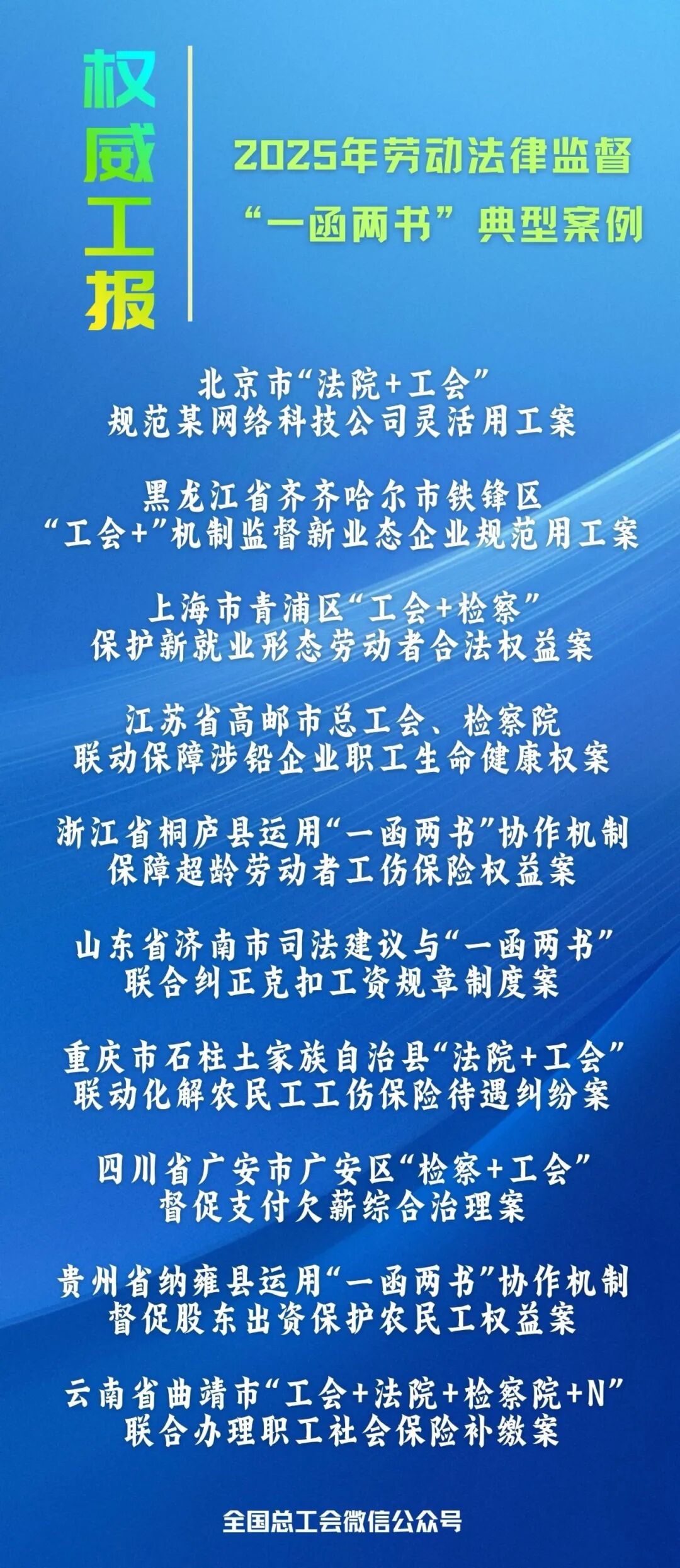
三部门发布劳动法律监督“一函两书”典型案例
Xin Lang Cai Jing· 2025-12-25 18:25
Core Viewpoint - The article discusses the joint release of ten typical cases by the All-China Federation of Trade Unions, the Supreme People's Court, and the Supreme People's Procuratorate to promote the implementation of labor laws and regulations, emphasizing the importance of labor legal supervision and collaboration mechanisms [1] Group 1: Typical Cases - The ten typical cases include various mechanisms such as "court + union" and "union + procuratorate" to ensure compliance with labor laws in different regions, addressing issues like flexible employment and protection of workers' rights [1] - Specific cases highlighted include the regulation of flexible employment in a tech company in Beijing, supervision of new employment forms in Heilongjiang, and protection of workers' rights in various provinces [1] Group 2: Mechanism and Characteristics - The "one letter, two documents" mechanism is introduced, which consists of a reminder letter and two types of supervision documents aimed at ensuring compliance with labor laws by employers [1] - The ten cases demonstrate four main characteristics: protection of new employment forms, the effectiveness of multi-party collaboration, preventive governance effects, and addressing the limitations of individual laborers' rights protection [1]
最高法:聚焦欠薪问题多发的建设工程领域,坚决打击建筑领域“三包一挂”
Xin Lang Cai Jing· 2025-12-25 07:24
Group 1 - The core focus of the news is the implementation of labor law supervision through the "one letter, two documents" approach, aimed at addressing wage arrears and protecting workers' rights [1][3] - The Supreme Court has emphasized the importance of collaboration with various departments to effectively tackle wage arrears, particularly in the construction sector, by prioritizing the execution of wage-related cases [1][3] - A new interpretation of labor dispute laws has been released, clarifying the responsibilities of contractors and subcontractors in cases of wage disputes, thereby supporting workers' claims for unpaid wages and insurance benefits [1][3] Group 2 - The Supreme Court is enhancing the protection of rights for new employment forms, balancing the need for worker protection with the promotion of a healthy platform economy [2][4] - The establishment of a "total-to-total" work mechanism aims to facilitate multi-channel dispute resolution, integrating resources from courts, labor departments, and trade unions to resolve conflicts before they escalate [2][5] - The court has published guiding cases to clarify the recognition of labor relationships in new employment forms, setting standards for determining worker management and liability in cases of harm [2][4]
全国总工会、最高法、最高检联合发布2025年劳动法律监督“一函两书”典型案例
Yang Shi Wang· 2025-12-25 04:34
Core Viewpoint The article discusses the collaboration between the All-China Federation of Trade Unions, the Supreme People's Court, and the Supreme People's Procuratorate in promoting labor law supervision through ten typical cases, emphasizing the protection of workers' rights, especially in new employment forms, and the establishment of a multi-faceted cooperative mechanism for labor rights protection. Group 1: Key Characteristics of the Cases - The cases highlight the protection of the legitimate rights and interests of workers in new employment forms, ensuring timely and efficient handling of cases involving labor remuneration, rest, safety, and insurance [3][4] - The multi-faceted collaborative mechanism is emphasized, showcasing the systematic integration of social and judicial supervision to address labor disputes effectively [3][4] - The cases demonstrate the preventive and protective effects of governance through similar case management, aiming to resolve conflicts at the grassroots level [3][4] Group 2: Case Summaries - Case 1 involves a network technology company where the court ruled that the company was liable for unpaid wages due to improper outsourcing practices, highlighting issues in flexible employment [5][6] - Case 2 focuses on a new employment form in Heilongjiang, where the union and the procuratorate worked together to ensure the rights of delivery workers were protected, addressing issues like lack of insurance and inadequate working conditions [9][10] - Case 3 discusses the algorithmic issues in the express delivery industry in Shanghai, where the court and union collaborated to rectify unfair practices affecting workers' rights [13][14] - Case 4 addresses the health rights of workers in lead-related industries, where the union and procuratorate worked to ensure compliance with social insurance laws [18][19] - Case 5 highlights the protection of older workers' rights to workers' compensation, showcasing the collaborative efforts of the union and procuratorate in addressing legal ambiguities [22][23] - Case 6 illustrates the judicial recommendations and union supervision in correcting wage deduction practices in a car company, emphasizing the importance of fair labor practices [27][28] - Case 7 demonstrates the resolution of a workers' compensation dispute through the collaboration of the court and union, showcasing effective dispute resolution mechanisms [32][33] - Case 8 involves a construction company where the union and procuratorate worked together to ensure payment of owed wages to migrant workers, highlighting the importance of legal compliance [35][36] - Case 9 discusses the enforcement of shareholder contributions to protect migrant workers' rights in a company that failed to pay wages, showcasing the collaborative efforts of various authorities [39][40] - Case 10 illustrates a multi-department collaboration to address social insurance payment issues in companies, emphasizing the need for coordinated efforts to protect workers' rights [43][44]