半导体景气

Search documents
韩国股市2026年展望:半导体景气与政策支持成焦点
Jing Ji Guan Cha Wang· 2026-02-11 14:52
Market Overview - The KOSPI index is projected to reach 7500 points by February 2026, indicating significant upside potential driven by the semiconductor industry's performance and corporate reforms [2] - Despite a single-day drop of over 5% on February 6, 2026, the KOSPI index has maintained a strong overall performance since breaking the 5000-point mark in January 2026 [2] Recent Events - The South Korean National Assembly passed the "Special Act on Strengthening and Supporting the Competitiveness of the Semiconductor Industry" on January 29, 2026, which is expected to take effect by the third quarter of 2026, providing institutional support for the semiconductor supply chain [3] - The South Korean government continues to promote the "Value Enhancement Plan" aimed at improving corporate governance and shareholder returns, with record levels of stock buybacks and dividends expected to continue into 2026 [3] Company Developments - Samsung Electronics plans to implement a stock price-linked employee compensation scheme from October 2025 to 2028, which may influence market sentiment; the company's Q4 2025 earnings guidance indicates a significant year-on-year increase in operating profit [4] - SK Hynix is expected to achieve record high performance in FY 2025 and has announced additional dividends; the company anticipates sustained demand for high bandwidth memory (HBM) and is focusing on capacity expansion plans for 2026 [4] - LG Energy's 2026 strategy focuses on expanding energy storage battery production, aiming to increase North American capacity to over 60 GWh and plans to launch new technology products such as lithium iron phosphate batteries within the year [4] - Hyundai Motor Group's Beijing Hyundai plans to launch four new energy vehicle models between 2026 and 2027, covering various technology routes including pure electric and hybrid [4] Industry Policy Landscape - The Bank of Korea maintained the benchmark interest rate at 2.5% for the fifth consecutive time in January 2026, with future meetings likely to cautiously balance economic recovery and inflation risks [5] - The National Pension Service (NPS) plans to reduce overseas stock investments by approximately $20 billion in 2026, shifting towards increased domestic allocations, which may impact market liquidity [5]
半导体股拉升 华虹半导体涨超5% 半导体景气超预期
Ge Long Hui· 2026-01-14 03:27
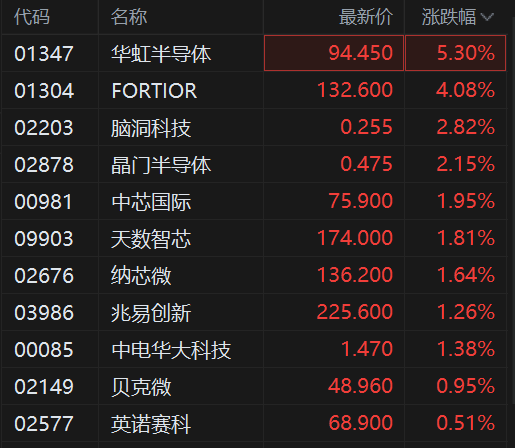
Group 1 - Semiconductor stocks in Hong Kong experienced a collective surge, with Huahong Semiconductor rising over 5%, and other companies like Jingmen Semiconductor and SMIC increasing by 2% [1] - Guosen Securities' latest report indicates that the semiconductor sector is performing better than expected, with price increases across multiple segments and the imminent release of AI glasses [1] - Research institutions predict that the average capacity utilization rate of global 8-inch wafer fabs will rise to the range of 85% to 90% by 2026, a significant improvement from 75% to 80% in 2025, reflecting a recovery in downstream application areas [1] Group 2 - The U.S. has relaxed export regulations on Nvidia's H200 chips to China, which may impact the semiconductor market dynamics [1] - The stock performance of various semiconductor companies includes Huahong Semiconductor at 94.450 with a 5.30% increase, and SMIC at 75.900 with a 1.95% increase [2]

A股投资策略周报:中央经济工作会议与美联储货币政策变化对A股的影响-20251214
CMS· 2025-12-14 09:33
Core Insights - The report highlights the impact of the Central Economic Work Conference and the Federal Reserve's monetary policy changes on the A-share market, emphasizing the focus on addressing the "strong supply and weak demand" contradiction in the domestic economy [1][3][4] - The report suggests that the upcoming implementation of a plan to increase urban and rural residents' income will release consumption potential, while the push to stabilize investment is expected to create positive expectations for major projects [1][3][4] Economic Analysis - The Central Economic Work Conference identified the "strong supply and weak demand" issue as a significant concern, indicating a heightened focus on demand-side policies that are likely to be introduced in the near future [5][6] - The conference projected that the fiscal deficit rate for the coming year would remain at 4%, with an emphasis on maintaining necessary fiscal deficits and managing total debt and expenditure effectively [7][8] Monetary Policy - The report notes that the monetary policy will prioritize promoting stable economic growth and reasonable price recovery, with flexible use of various policy tools such as reserve requirement ratio cuts and interest rate reductions [9][10] - The Federal Reserve's recent decision to lower interest rates by 25 basis points and implement the RMP tool is aimed at maintaining ample reserves in the banking system, which is expected to keep liquidity relatively loose in the short term [24][26] Investment Strategy - The report recommends focusing on large-cap stocks and sectors supported by policy initiatives, particularly in the context of major projects expected to drive investment recovery [1][3][13] - Historical data suggests that sectors such as oil and petrochemicals, telecommunications, and electronics have a higher probability of outperforming in the week following the conference [13][14] Consumer and Investment Outlook - The report emphasizes the importance of consumer spending, with plans to implement a resident income increase plan and optimize consumption policies to stimulate demand [11][12] - It also highlights the need to address the recent decline in investment data, with a commitment to stabilize investment levels and increase central budget investment appropriately [11][12]
晶圆代工,2300亿美元
半导体芯闻· 2025-11-24 10:28
Core Insights - The global wafer foundry market is expected to reach $199.4 billion in revenue by 2025, with a year-on-year growth of over 25% driven by strong AI demand [1] - In 2026, the market size is projected to grow by an additional 17%, surpassing $230 billion, supported by ongoing investments in AI infrastructure [1] - From 2025 to 2030, the compound annual growth rate (CAGR) for the global wafer foundry market is anticipated to be 14.3%, although risks related to AI investment bubbles and geopolitical tensions remain significant [1] Industry Analysis - AI has become the core driving force for the semiconductor industry amid global economic instability and weak consumer electronics demand [1] - Cloud service providers (CSPs) are expanding AI computing power, which is increasing the demand for AI accelerators and self-developed AI ASICs, thereby driving mid-term growth in the wafer foundry industry [1] - By 2030, industry revenue is expected to double compared to 2025 [1] Advanced Process Competition - In the advanced process competition, TSMC remains the main player in global capacity expansion, with plans to add over 300,000 12-inch wafers per month in the next five years [1] - Samsung Electronics and Intel are expected to have relatively limited capacity increases, allowing TSMC to maintain its competitive advantage until 2030 [1] Mature Process Developments - In the mature process segment, China's semiconductor self-sufficiency policies are expected to lead to an increase of approximately 350,000 12-inch wafers per month from Chinese foundries over the next five years, significantly reshaping the global supply landscape [2] - Despite benefiting from AI opportunities, the wafer foundry industry faces uncertainties due to the long payback period for AI infrastructure investments and geopolitical risks stemming from the US-China tech war [2]