半导体AI产业

Search documents
大厂春节抢算力,液冷龙头超预期
傅里叶的猫· 2026-02-11 13:48
Core Insights - Major companies are competing to release new models and marketing activities, leading to a tight supply of computing power, which is expected to persist for a considerable time [2] Group 1: Liquid Cooling Market - The global liquid cooling market is projected to grow 5-10 times compared to last year, with many companies expected to receive substantial orders [4] - Vertiv reported strong order growth, with organic growth of approximately 252% year-over-year and 117% quarter-over-quarter, estimating order size between $8.2 billion and $8.4 billion [6] - The backlog of orders reached $15 billion, showing a year-over-year increase of about 109% and a quarter-over-quarter increase of 57% [6] Group 2: UBS Upgrade on Invec - UBS raised the target price for Invec by 60% to 160 yuan, driven by a significant upward revision of the global liquid cooling market size and an expected CAGR of 51% from 2025 to 2030 [10] - Invec's market share is anticipated to increase faster than previously expected, with a projected market share of 10% by 2027 [10] - UBS believes Invec's core competitive advantage lies in its full value chain liquid cooling capabilities, which enhance heat dissipation efficiency [11] Group 3: Valuation Insights - UBS argues that Invec's current valuation is unreasonable and significantly underestimates its growth potential, with a projected revenue and EPS CAGR of 69% and 167% from 2025 to 2027 [12] - The valuation adjustment reflects confidence in the company's short-term market share increase and the potential for margin improvement from overseas business [12] Group 4: ByteDance's Liquid Cooling - ByteDance has increased its global capital expenditure to 300 billion, indicating a significant commitment to liquid cooling technology [13]



CPU、燃机和液冷
傅里叶的猫· 2026-01-21 15:42
CPU - The demand for CPUs is driven by the need for incremental CPUs, particularly from Agentic AI, which requires external CPUs that are not influenced by GPU ratios [1] - Supply-side constraints include TSMC's tight capacity, prioritizing AI chip production, and limited availability of general semiconductor equipment and materials, which indirectly affects CPU manufacturers' capacity [1] 燃机 - A certain HRSG company has indicated that industry trends are established, and prices have been consistently increasing, aligning with previous discussions on price increase logic [3] - SemiAnalysis has repeatedly highlighted the potential of gas turbines, indicating a positive outlook for the gas turbine and HRSG combination [3] Supercomputing - xAI announced the operation of the Colossus 2 supercomputing cluster, the world's first GW training cluster, with plans to upgrade to 1.5GW in April [4] - The rapid construction of xAI's supercomputing clusters is attributed to their reliance on onsite gas power generation, bypassing traditional grid dependencies, a method now being emulated by OpenAI and Oracle [6] Liquid Cooling - Recent discussions highlighted that liquid cooling has significant orders from domestic manufacturers, with specific procurement guidance from major domestic companies [7] Industry Updates - A Shenzhen cold plate company, previously a subcontractor for Cooler Master, has received new intention orders from Cooler Master after the New Year [8]
谷歌审厂即将结束—液冷厂商出海其它海外大厂展望
傅里叶的猫· 2025-12-17 13:37
Core Viewpoint - The liquid cooling industry is approaching a significant turning point, with expectations for explosive growth in 2024, marking it as the "year of liquid cooling" [1]. Group 1: Industry Dynamics - The demand for liquid cooling components from NVIDIA is expected to double next year, indicating a substantial market opportunity for domestic manufacturers [2]. - Domestic manufacturers are likely to gain unexpected market share, with projections for certain companies' market share increasing from 5-8% to potentially 10-15% [2]. - The collaboration between domestic companies and Taiwanese/American firms for OEM production is anticipated to ensure supply stability, with expected overflow in cold plate manufacturing reaching several billion [2]. Group 2: Key Projects and Collaborations - Meta's Prometheus project is showing signs of acceleration, with domestic liquid cooling leaders poised to capture significant market share due to the project's large scale and favorable procurement model [2]. - Google is projected to procure liquid cooling cabinets worth approximately $3-3.5 billion, with a target of 40,000 units, highlighting the collaboration potential with domestic liquid cooling leaders [2]. Group 3: Growth Potential of Leading Companies - Delta's revenue from liquid cooling is projected to reach around 1 billion RMB in 2024, with expectations to grow tenfold to 10 billion RMB by 2025, and further doubling by 2026, indicating a strong growth trajectory for domestic liquid cooling manufacturers [3].

英伟达GTC大会后,再看光模块、PCB和SST
傅里叶的猫· 2025-10-29 12:35
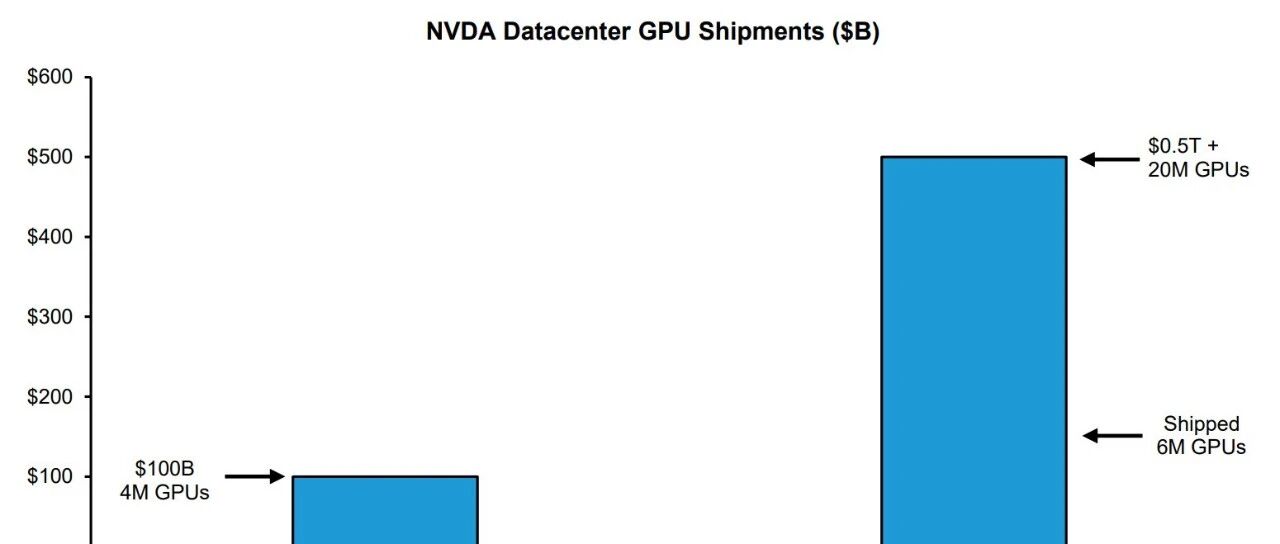
Core Insights - The article highlights the significant growth and future projections of NVIDIA's GPU series, particularly the Hopper, Blackwell, and Rubin series, indicating a strong revenue potential in the upcoming quarters [1][3]. GPU Shipment and Revenue - NVIDIA's Hopper series GPUs have shipped 4 million units, generating $100 billion in revenue [1] - The Blackwell series GPUs are expected to ship 20 million units over the next five quarters, with projected revenue of approximately $500 billion, marking a fivefold increase compared to the H series [3]. Optical Module Demand - Excluding the already shipped 6 million units, an additional 14 million optical modules are expected to be shipped in the next five quarters, averaging about 2.8 million units per quarter [4] - The demand for 1.6T optical modules is projected to exceed 34 million units, significantly surpassing previous market expectations of 20 million units by 2026 [6]. Pricing and Supply Dynamics - The anticipated supply shortage of 1.6T silicon optical chips is estimated at 10-20%, which may lead to order delays or shifts towards 800G optical modules [6] - The expected price for 1.6T optical modules has been adjusted to $1,000-$1,100 per unit, up from the previous forecast of $800-$900, potentially increasing revenue contributions by 15-20% [6]. Industry Valuation Concerns - The low valuation of the optical module industry is attributed to several factors, including reliance on North American markets, technological risks from new innovations, low manufacturing barriers, and uncertainty in long-term demand [8]. PCB Developments - The Rubin architecture will utilize M9 materials for its PCB designs, enhancing the value of the boards compared to previous generations [9][10]. - The total value of the PCB in the VR200 NVL144 CPX computing tray is projected to exceed $3,000, significantly higher than earlier models [11]. SST Implementation - The demand for SST (Smart Supply Technology) solutions is expected to accelerate, with major companies like Amazon seeking to test SST samples for potential integration in future products [16][17]. - The optimistic outlook for Rubin's shipment pace may enhance the valuation of the SST industry and the performance of related companies in the coming years [17].