
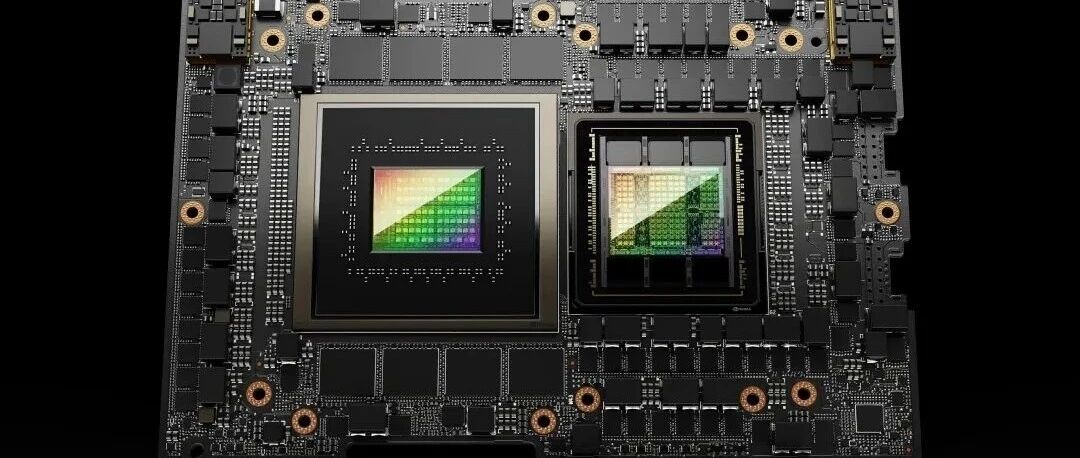
Blackwell系列GPU

Search documents
英伟达:仅需3%溢价即可拥有人工智能领域最重要的公司
美股研究社· 2025-12-22 13:45
Core Viewpoint - The market has not yet peaked, particularly led by Nvidia, which stands at the forefront of the AI revolution and technological breakthroughs. Its current dynamic P/E ratio is only 24 times, suggesting that declaring a peak is premature [1]. Group 1: Market Dynamics - The concentration of funds in leading tech stocks indicates that the bull market has not yet spread to other sectors, which could be a positive sign for index investors [2]. - If the global economy avoids recession and the investment heat for risk assets remains, passive investments through index funds and ETFs may support Nvidia's stock price [2]. - Analysts express concerns about the unprecedented market phenomenon where the combined market value of the "seven tech giants" accounts for 36% of the S&P 500 index, a historical high [1]. Group 2: Nvidia's Performance - Nvidia achieved a remarkable feat by exceeding revenue and earnings expectations for 12 consecutive quarters, with revenue and net profit growing at double-digit rates [5]. - The company's data center business revenue reached $43 billion, with a year-on-year growth of nearly 65%, indicating strong market demand for Nvidia's computing power [6]. - Nvidia's gross margin for the third quarter of fiscal year 2026 was 73.6%, reflecting its market dominance and exceptional profitability [8]. Group 3: Growth Potential - Nvidia's gaming business generated $4.3 billion in revenue, growing 30% year-on-year, but there is still room for improvement compared to competitors like AMD, which saw a 73% growth in gaming revenue [10]. - The global PC gaming market is projected to grow from approximately $62 billion in 2024 to $130 billion by 2030, with a compound annual growth rate of 13.5% [10]. Group 4: Valuation Insights - Analysts expect Nvidia's diluted earnings per share to reach $7.49 in fiscal year 2027, a 60% increase, with revenue projected at $317 billion, a 49% increase [12]. - Nvidia's PEG ratio is currently 1.03, which is 40% lower than the industry median of 1.71, indicating that the stock is undervalued despite its leadership position [14]. - The current valuation of Nvidia, with a premium of only 3% over peers, does not reflect its strong performance and growth potential [6][8].


三日连涨7.7%!大摩:3nm提前落地、DRAM需求爆发,阿斯麦盈利大反转来了?
美股IPO· 2025-11-27 10:28
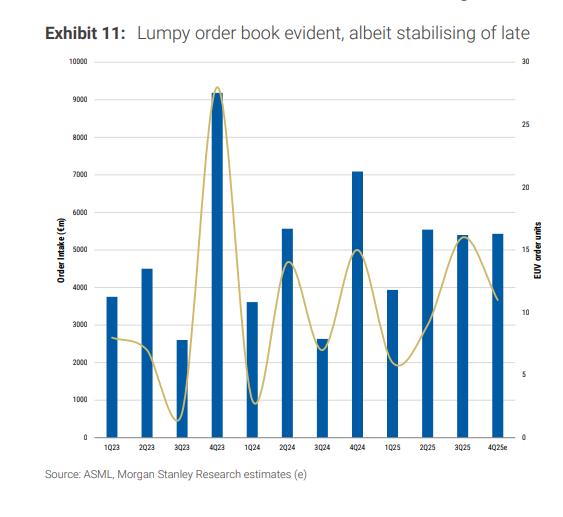
Core Viewpoint - Morgan Stanley believes that the strong DRAM technology upgrade cycle, the potential early rollout of TSMC's 3nm process, and the indirect demand from NVIDIA's AI chips are key catalysts driving ASML's profit growth in 2026-2027. The firm has raised ASML's target price from €975 to €1000 [1][2][11]. Group 1: DRAM Market Dynamics - The demand in the DRAM market is robust, with ASML maintaining solid demand during the transition from 1a and 1b nodes to 1γ/1c nodes. Each technology node evolution increases the number of EUV lithography layers required, with the 1c node needing 5-6 layers [3][4]. - Samsung and SK Hynix's demand for DRAM in FY2026 is expected to be clear, supported by strong price increases in the commodity DRAM market [3]. Group 2: TSMC's 3nm Process - TSMC is reportedly testing the original graphic performance of its 3nm process, with potential adoption at its Arizona facility occurring earlier than the initially planned 2028 [4]. - ASML benefits from TSMC's 3nm technology, as it relies on ASML's EUV lithography machines to produce more powerful, energy-efficient, and smaller chips [4]. Group 3: AI Demand and Market Recovery - The growth of AI is indirectly creating demand for ASML, with NVIDIA's record quarterly revenue indicating strong market interest in its Blackwell series GPUs. This demand is expected to support ASML's wafer fabrication equipment supply in FY2026/27 [6][9]. - ASML is emerging from a prolonged 14-month downturn, with signs of new growth momentum as evidenced by rising commodity DRAM prices and advancements in Samsung's HBM3e/HBM4 [9]. Group 4: Profitability and Challenges - Despite an optimistic outlook, ASML faces challenges, particularly in its DUV business, which is expected to see a 15% year-over-year sales decline due to weakened demand in a key Asian market [10]. - ASML's profit margins are expected to remain resilient, supported by higher EUV sales and contributions from its installed base management business. The projected gross margin for FY2026 is 52.3%, only slightly down from 52.7% in FY2025 [11].

3nm提前落地、DRAM需求爆发,阿斯麦盈利大反转来了?
Hua Er Jie Jian Wen· 2025-11-27 06:48
Core Insights - ASML is emerging from a prolonged 14-month downturn, with new growth drivers identified in the demand for DRAM and advanced logic chips, leading to a positive growth outlook for the fiscal years 2026-2027 [1] Group 1: DRAM Market Dynamics - The strong demand in the DRAM market is evident, with ASML maintaining solid demand during the transition from 1a and 1b nodes to 1γ/1c nodes, which is crucial for enhancing lithography intensity [2] - Each technological node evolution increases the number of EUV lithography layers required, with the 1c node needing 5-6 layers, indicating sustained demand for EUV lithography systems [2] - Samsung and SK Hynix are expected to have clear demand in fiscal year 2026, supported by strong price increases in commodity DRAM [2] Group 2: Advancements in 3nm Technology - TSMC is testing the original graphic performance of 3nm technology, with potential adoption at its Arizona facility possibly occurring earlier than the initially planned 2028 [3] - ASML benefits from TSMC's 3nm process technology, which relies on ASML's EUV lithography machines to produce more powerful, energy-efficient, and smaller chips [3] - The growth of AI is indirectly creating demand for ASML, with NVIDIA's record quarterly revenue indicating strong interest in its Blackwell series GPUs, which is expected to drive TSMC's expansion of 3nm capacity and increase orders for EUV lithography machines [3] Group 3: Market Recovery and Valuation Reassessment - ASML is moving out of a lengthy downturn, with previous cycles typically compressing its two-year forward P/E ratio from 30-35x to 18-22x within 8-10 months; however, this cycle has lasted over 14 months due to geopolitical uncertainties [5] - The downturn was primarily due to weak spending from foundries other than TSMC, such as Intel and Samsung, along with concerns about lithography intensity and pricing pressure, which have now largely dissipated [5] - The report indicates that the average selling price (ASP) of EUV is expected to rise due to TSMC's adoption of computational lithography, with evidence of a "memory super cycle" emerging from rising commodity DRAM prices and advancements in Samsung's HBM3e/HBM4 [5] Group 4: Profitability and Business Challenges - Despite a positive outlook, ASML faces challenges, particularly in its DUV business, which is expected to see a year-on-year sales decline of approximately 15% due to weakened demand in a key Asian market [6] - ASML's profit margins are expected to remain resilient, supported by higher EUV sales and contributions from its installed base management business [6] - The forecast for ASML's gross margin in fiscal year 2026 is 52.3%, only slightly down from 52.7% in 2025, demonstrating the company's ability to control margins during a challenging DUV year [6] Group 5: Investment Outlook - Based on the positive outlook, Morgan Stanley has raised its target price for ASML from €975 to €1000 and maintains an "overweight" rating, viewing the recent stock price decline as an attractive entry point [6]

重磅!美国拟放行H200满血版入华!
是说芯语· 2025-11-22 03:21
Core Viewpoint - The U.S. government is considering approving the sale of Nvidia's H200 AI chips to China, indicating a potential easing of export restrictions amid improving U.S.-China relations [1] Group 1: U.S. Government Actions - The U.S. Commerce Department is reviewing policy adjustments that previously prohibited the sale of advanced AI chips to China [1] - A White House official emphasized the government's commitment to maintaining U.S. technological leadership and national security [1] Group 2: Nvidia's Position - Nvidia has stated that current regulations prevent it from providing competitive AI data center chips to China, leaving the market open to foreign competitors [1] - Nvidia's CEO, Jensen Huang, noted that the company's market share in China has dropped to zero, urging the U.S. government to lift restrictions on its more advanced Blackwell series GPUs [4] Group 3: Chip Comparisons - The H200 chip, released two years after the H100, offers higher memory bandwidth for faster data processing [2] - The H200 chip's performance is estimated to be twice that of the H20 chip, which is currently the most advanced AI semiconductor legally exportable to China [4] - The H20 chip is designed to comply with U.S. export controls, while the H200 aims to enhance large model inference and training performance [6] Group 4: Recent Developments - The U.S. Commerce Department has approved the shipment of up to 70,000 next-generation Blackwell AI chips to Saudi Arabia and the UAE [4]
Cipher Mining、Iren飙升,币圈“血流成河”之际,比特币矿商却“因AI暴涨”
美股IPO· 2025-11-04 02:16
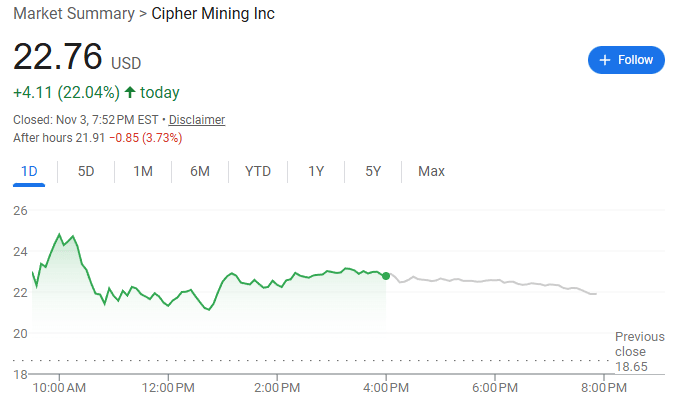
Core Viewpoint - The valuation logic of Bitcoin mining companies is being fundamentally reshaped as they transition from cryptocurrency producers to critical infrastructure providers for AI, driven by their existing power resources and partnerships with tech giants [3][6][9]. Group 1: Partnerships and Market Reaction - Bitcoin miner Iren signed a $9.7 billion five-year cloud services agreement with Microsoft, while Cipher Mining entered a $5.5 billion deal with AWS to provide 300 megawatts of power, igniting market interest [1][3]. - Following these announcements, Iren's stock surged by 11.5% and Cipher Mining's stock skyrocketed by 22%, both reaching new highs during trading [4]. Group 2: Economic Pressures and Transition - The urgency for Bitcoin mining companies to transition stems from the deteriorating mining economics, exacerbated by last year's halving event, which reduced miner rewards and increased network difficulty [7]. - Bitcoin miners are facing historical low profitability, prompting many, including Riot Platforms and Bitfarms, to refrain from expanding their mining capacity [8]. Group 3: Valuation Changes - The stock prices of Bitcoin mining companies increasingly reflect their prospects in high-performance computing (HPC) and AI rather than their mining operations, with investor focus shifting to HPC/AI opportunities [9]. - Funds tracking publicly listed Bitcoin miners have surged over 150% this year, significantly outpacing Bitcoin's 14% increase, with Iren's stock up 519% and Cipher Mining's stock more than quadrupling [9]. Group 4: Competitive Advantage - Bitcoin mining facilities possess a critical advantage in their ability to provide immediate power, bypassing the lengthy approval processes required for new data centers [10]. - U.S. Bitcoin miners have approximately 6.3 gigawatts of operational capacity and 2.5 gigawatts under construction, with an additional 8.6 gigawatts having secured grid access, allowing for rapid conversion to AI data centers [11].
Cipher Mining、Iren飙升,币圈“血流成河”之际,比特币矿商却“因AI暴涨”
Sou Hu Cai Jing· 2025-11-04 01:15
Core Insights - The valuation logic of Bitcoin mining companies is being fundamentally reshaped as they transition into power suppliers for AI, detaching their stock performance from the volatile cryptocurrency market [1][5][6] - Major partnerships with tech giants, such as Iren's $9.7 billion deal with Microsoft and Cipher Mining's $5.5 billion agreement with AWS, have significantly boosted their stock prices [1][3] Market Dynamics - Bitcoin mining companies are no longer viewed merely as Bitcoin producers but as critical infrastructure providers in the AI wave, especially as Bitcoin prices drop below $107,000 [3][4] - The mining economy is deteriorating, with the Bitcoin halving last year reducing miner rewards and increasing network difficulty, which has pressured profit margins [3][4] Financial Performance - Bitcoin miners' revenue metrics are nearing historical lows, and even recent Bitcoin price highs have not significantly improved unit revenues for mining companies [4] - The stock prices of Bitcoin mining companies are increasingly reflecting their prospects in high-performance computing (HPC) and AI rather than their mining operations [5][6] Investment Trends - Investors are primarily valuing these companies based on HPC/AI opportunities, with discussions about Bitcoin mining accounting for less than 10% of their conversations [6] - Funds tracking publicly listed Bitcoin mining companies have surged over 150% this year, significantly outpacing Bitcoin's 14% increase [6] Competitive Advantage - Bitcoin mining companies possess a critical competitive advantage with their ability to provide "immediate power," as they have existing grid connections and large-scale power supply capabilities [7] - The U.S. faces a significant power shortage for data centers, with predictions indicating a shortfall of 5 to 15 gigawatts by 2028, making the existing power resources of Bitcoin miners invaluable [7]
再创历史!英伟达市值一夜突破5万亿美元!
具身智能之心· 2025-10-31 00:04
Core Viewpoint - Nvidia has become the first company in history to surpass a market valuation of $5 trillion, marking a significant milestone in the tech industry [2][4][11]. Group 1: Market Performance - On October 29, Nvidia's stock price rose by 5.44%, reaching an intraday high of $212.19 per share, and closing at $207.04 per share, resulting in a market capitalization of $5.03 trillion [3][11]. - Since the beginning of 2025, Nvidia's stock has surged by 56%, showcasing its rapid growth compared to other major tech companies [6][40]. - Nvidia's market value now exceeds the combined market capitalizations of major competitors such as AMD, Intel, and Qualcomm, as well as entire sectors within the S&P 500 [6][7]. Group 2: Growth Trajectory - Nvidia's market value has skyrocketed from $1 trillion to $5 trillion in just two and a half years, a feat unmatched by other tech giants [10][24]. - The company achieved its first $1 trillion valuation in May 2023, followed by reaching $3 trillion in June 2024, and then $4 trillion in just over a year [23][24]. - In contrast, Microsoft took nearly six years to grow from $1 trillion to $4 trillion, while Apple took over seven years for the same growth [17][20]. Group 3: Strategic Developments - The recent surge in Nvidia's market value is attributed to announcements made during the GTC developer conference, where CEO Jensen Huang unveiled several technological advancements and partnerships [26][40]. - Key highlights from the conference included plans to collaborate with the U.S. Department of Energy to build new supercomputers and the introduction of the Blackwell chip series, which is expected to significantly increase production [27][28]. - Nvidia's new open system architecture, Nvidia NVQLink, aims to accelerate the development of quantum supercomputers, further positioning the company at the forefront of technological innovation [29][32]. Group 4: Future Outlook - Nvidia anticipates that the cumulative revenue from its upcoming products, including the Blackwell and Rubin chip platforms, could reach $500 billion by the end of next year [32][34]. - The company is also set to invest up to $100 billion in building AI data centers in collaboration with OpenAI, indicating a strong commitment to expanding its AI infrastructure [40][41]. - Nvidia's growth is closely tied to the increasing demand for computational power driven by AI advancements, with its GPUs being integral to the infrastructure of leading AI companies [40].
再创历史!英伟达市值一夜突破5万亿美元,今年涨幅56%,黄仁勋晋升全球第八富豪
量子位· 2025-10-30 01:06
Core Viewpoint - Nvidia has become the first company in history to surpass a market capitalization of $5 trillion, marking a significant milestone in the tech industry [1][10]. Group 1: Market Performance - On October 29, Nvidia's stock price rose by 5.44%, reaching an intraday high of $212.19 per share, and closing at $207.04 per share, resulting in a market cap of $5.03 trillion [2][10]. - Since the beginning of 2025, Nvidia's stock has surged by 56%, showcasing its rapid growth compared to other major companies [5][39]. - Nvidia's market cap now exceeds the combined total of several major tech companies, including AMD, Intel, and TSMC, as well as entire sectors within the S&P 500 [5][6]. Group 2: Growth Trajectory - Nvidia's market value has skyrocketed from $1 trillion to $5 trillion in just two and a half years, a feat unmatched by other tech giants [9][23]. - The company achieved its first $1 trillion valuation in May 2023, followed by $3 trillion in June 2024, and then $4 trillion in just over a year [22][23]. - The growth from $4 trillion to $5 trillion took only three months, highlighting Nvidia's exceptional market performance [23][24]. Group 3: Key Drivers of Growth - The recent surge in Nvidia's market cap is attributed to announcements made during the GTC developer conference, where CEO Jensen Huang unveiled several technological innovations and partnerships [25][39]. - Key highlights from the conference included plans to collaborate with the U.S. Department of Energy to build new supercomputers and the introduction of the Blackwell chip series, which is expected to significantly increase production [26][27][31]. - Nvidia's anticipated revenue from the new products is projected to reach $500 billion by the end of next year, reflecting a major shift in global computing infrastructure towards Nvidia's accelerated computing model [31][33]. Group 4: Competitive Landscape - Nvidia's rapid ascent has created a substantial gap between it and its closest competitor, Microsoft, which has a market cap of $4.03 trillion, and Apple at $4.00 trillion [13][14]. - The company has positioned itself as a key player in the AI boom, with its GPUs being integral to the infrastructure of leading AI companies like OpenAI and Google DeepMind [39][40]. - Nvidia's strategic investments and partnerships, including a potential $100 billion investment in AI data centers, further solidify its leadership in the AI sector [40][41].

英伟达GTC大会后,再看光模块、PCB和SST
傅里叶的猫· 2025-10-29 12:35
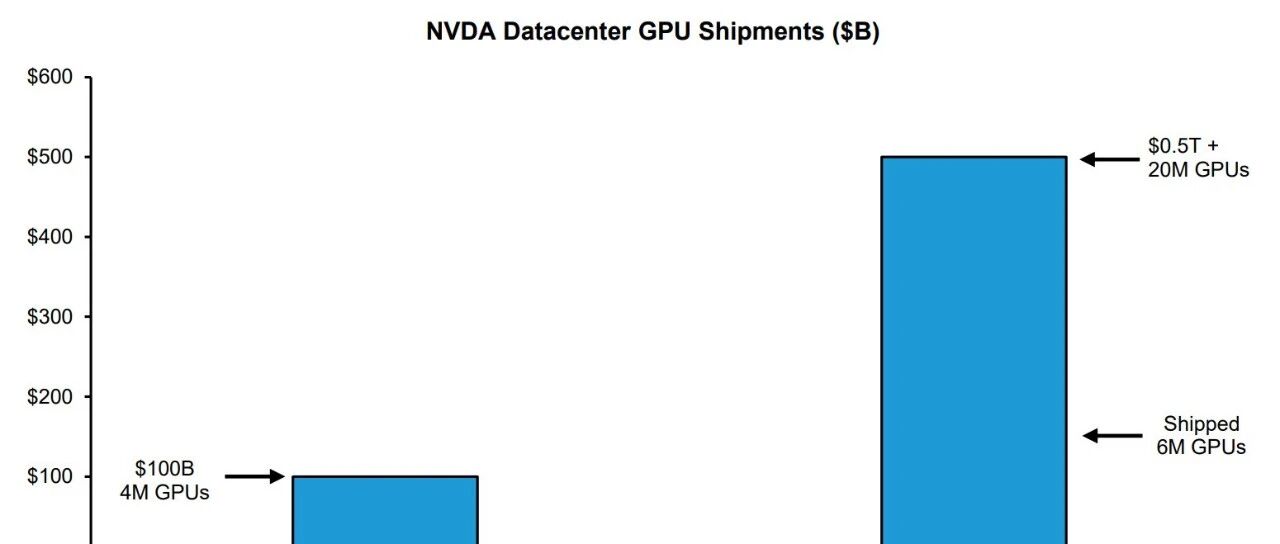
Core Insights - The article highlights the significant growth and future projections of NVIDIA's GPU series, particularly the Hopper, Blackwell, and Rubin series, indicating a strong revenue potential in the upcoming quarters [1][3]. GPU Shipment and Revenue - NVIDIA's Hopper series GPUs have shipped 4 million units, generating $100 billion in revenue [1] - The Blackwell series GPUs are expected to ship 20 million units over the next five quarters, with projected revenue of approximately $500 billion, marking a fivefold increase compared to the H series [3]. Optical Module Demand - Excluding the already shipped 6 million units, an additional 14 million optical modules are expected to be shipped in the next five quarters, averaging about 2.8 million units per quarter [4] - The demand for 1.6T optical modules is projected to exceed 34 million units, significantly surpassing previous market expectations of 20 million units by 2026 [6]. Pricing and Supply Dynamics - The anticipated supply shortage of 1.6T silicon optical chips is estimated at 10-20%, which may lead to order delays or shifts towards 800G optical modules [6] - The expected price for 1.6T optical modules has been adjusted to $1,000-$1,100 per unit, up from the previous forecast of $800-$900, potentially increasing revenue contributions by 15-20% [6]. Industry Valuation Concerns - The low valuation of the optical module industry is attributed to several factors, including reliance on North American markets, technological risks from new innovations, low manufacturing barriers, and uncertainty in long-term demand [8]. PCB Developments - The Rubin architecture will utilize M9 materials for its PCB designs, enhancing the value of the boards compared to previous generations [9][10]. - The total value of the PCB in the VR200 NVL144 CPX computing tray is projected to exceed $3,000, significantly higher than earlier models [11]. SST Implementation - The demand for SST (Smart Supply Technology) solutions is expected to accelerate, with major companies like Amazon seeking to test SST samples for potential integration in future products [16][17]. - The optimistic outlook for Rubin's shipment pace may enhance the valuation of the SST industry and the performance of related companies in the coming years [17].
英伟达(NVDA.US)驳斥供应受限说法 称相关报道“严重失实”
智通财经网· 2025-09-03 02:46
Core Viewpoint - Nvidia clarifies that there are no supply constraints for its H100, H200, and Blackwell series GPUs, countering recent media reports of shortages and sold-out status [1] Group 1: Supply Chain and Inventory - Nvidia states that cloud service partners can rent all available H100 and H200 GPUs on their platforms, indicating that new orders can still be accepted [1] - The company emphasizes that it has sufficient inventory of H100 and H200 GPUs to meet all order demands without delays [1] - Nvidia refutes claims that the sales of the H200 series GPUs are affecting the supply of H100, H200, or Blackwell series products, asserting that these rumors are completely false [1]