
原油供需结构

Search documents
能源日报-20260119
Guo Tou Qi Huo· 2026-01-19 12:02
1. Report Industry Investment Ratings - Crude Oil: ★★★, indicating a clearer upward trend and a relatively appropriate investment opportunity currently [2] - Fuel Oil: ★★★, suggesting a clearer upward trend and a relatively appropriate investment opportunity currently [2] - Low - Sulfur Fuel Oil: ★★★, showing a clearer upward trend and a relatively appropriate investment opportunity currently [2] - Asphalt: ★★★, meaning a clearer upward trend and a relatively appropriate investment opportunity currently [2] 2. Core Views - The geopolitical risk premium of crude oil has declined with the easing of the Iran situation, and the inventory pressure is significant in Q1 2026. Supply surplus is the main factor suppressing oil prices [3] - Geopolitical risks continue to support the high - sulfur cracking spread of fuel oil, but the supply of high - sulfur heavy raw materials will tend to be loose in the medium term. The supply of low - sulfur fuel oil is increasing, and its weak pattern is expected to continue [4] - The asphalt price fluctuates with crude oil, and the current upward driving force is limited. The market is in a range - bound pattern, and attention should be paid to the arrival of Venezuelan crude oil [5] 3. Summary by Related Catalogs Crude Oil - With the easing of the Iran situation, the geopolitical risk premium has declined. The market is gradually desensitized to geopolitical news, and the geopolitical premium space is limited without actual conflicts [3] - In Q1 2026, the global crude oil supply - demand structure shows significant inventory pressure, and supply surplus is the main factor suppressing oil prices [3] Fuel Oil & Low - Sulfur Fuel Oil - Geopolitical situations continue to disrupt the fuel oil market. The threat from Iran and the slowdown of Russia's shipping rhythm support the high - sulfur cracking spread [4] - However, in the medium term, the supply of high - sulfur heavy raw materials will tend to be loose. The supply of low - sulfur fuel oil is increasing, and its weak pattern is expected to continue [4] Asphalt - The asphalt price fluctuates with crude oil, but the amplitude is relatively limited. The arrival in January is still expected to be sufficient according to kpler data [5] - The current upward driving force is limited after the market has priced in the expected increase in costs due to the tightened supply of Venezuelan crude oil to China. The market is in a range - bound pattern, and attention should be paid to the arrival of Venezuelan crude oil [5]
能源日报-20260112
Guo Tou Qi Huo· 2026-01-12 11:12
Report Industry Investment Ratings - Crude oil: ★★★, indicating a clearer upward trend and a relatively appropriate investment opportunity currently [2] - Fuel oil: ★★★, indicating a clearer upward trend and a relatively appropriate investment opportunity currently [2] - Low - sulfur fuel oil: ★★★, indicating a clearer upward trend and a relatively appropriate investment opportunity currently [2] - Asphalt: ★★★, indicating a clearer upward trend and a relatively appropriate investment opportunity currently [2] Core Viewpoints - Geopolitical risks in the short - term drive up oil prices, but the sustainability of the price increase is limited due to significant inventory pressure and supply surplus in the global crude oil market in Q1 2026 [3] - The unilateral trend of fuel oil mainly follows the cost side of crude oil, and geopolitical situations affect both high - sulfur and low - sulfur fuel oil markets [4] - The recent rebound in crude oil has little impact on asphalt futures prices, and the reduction of Venezuelan crude oil shipments to China may impact domestic asphalt raw material supply [5] Summary by Related Categories Crude Oil - The geopolitical situation in Iran is tense but controllable, and the US continues to seize Venezuelan oil tankers, which drives up oil prices in the short - term [3] - In Q1 2026, the global crude oil supply - demand structure shows significant inventory pressure, and supply surplus restricts the upward space of oil prices [3] Fuel Oil & Low - sulfur Fuel Oil - The unilateral trend of fuel oil follows the cost side of crude oil, and geopolitical tensions are the key driving factors [4] - For high - sulfur fuel oil, US military actions against Venezuela may affect heavy - crude oil supply, and domestic refineries may increase fuel oil use as an alternative raw material for asphalt production. Inventory consumption may appear in late March, and raw material procurement demand may support the high - sulfur market after the Spring Festival in mid - February [4] - For low - sulfur fuel oil, the Azur refinery's CDU device has fully resumed operation, and the supply scale is expected to gradually increase. The overseas supply rebound brings loose pressure, keeping the fundamentals weak [4] Asphalt - The recent crude oil rebound has not affected asphalt futures prices significantly [5] - Since December 2025, the US seizure of Venezuelan oil tankers may impact domestic asphalt raw material supply in February and later, and the current market has priced in the expected tightening of Venezuelan crude oil shipments to China [5] - Attention should be paid to the arrival situation of Venezuelan crude oil [5]
原油周报:地缘风险升级,原油偏强运行-20260105
Bao Cheng Qi Huo· 2026-01-05 02:55
1. Report Industry Investment Rating No relevant content provided. 2. Core Viewpoints of the Report - The crude oil market is currently being pulled by intermittent geopolitical risks and a weak supply - demand structure. In the short term, geopolitical risks may dominate, and it is expected that the prices of domestic and international crude oil futures may maintain a volatile and strong trend after the holiday. However, the weak supply - demand situation in the crude oil market is the long - term logic that suppresses oil prices, and the concern of global supply surplus still exists [5][76]. 3. Summary According to the Table of Contents 3.1 Market Review - **Spot price and basis**: As of the week ending December 31, 2025, the spot price of crude oil produced in the Shengli Oilfield area in China was 57.72 US dollars per barrel (equivalent to 405.7 RMB per barrel), with a week - on - week decrease of 3.2 US dollars per barrel. The main contract of domestic crude oil futures, 2602, closed at 432.2 RMB per barrel, with a week - on - week decrease of 12.5 RMB per barrel. The basis was 26.5 RMB per barrel, and the degree of contango decreased slightly [8]. - **Geopolitical risks and price trends**: In the last week before the holiday, as geopolitical risks were gradually digested by the market, the crude oil premium began to be reversed. The weak supply - demand expectation in the oil market dominated, causing the prices of domestic and international crude oil futures to show a volatile downward trend. The domestic crude oil futures 2602 contract was weak, with a cumulative decline of 2.17% to 432.2 RMB per barrel during the week [11]. 3.2 Crude Oil Supply and Demand Remain in an Excess Expectation, and the Production Increase Rhythm Slows Down - **OPEC+ production increase**: Since the second quarter of 2025, eight major OPEC+ oil - producing countries led by Saudi Arabia and Russia have launched a phased production increase policy. From April to September, the cumulative production increase exceeded 2.1 million barrels per day. In the fourth quarter, the production increase continued. In November, it was decided to continue the production increase plan in December. However, to cope with the possible seasonal off - peak demand in the first quarter of 2026, production increase will be suspended from January 2026 for three months. In November 2025, OPEC member countries' crude oil production was 28.48 million barrels per day, with a year - on - year increase of 1.711 million barrels per day [22][23][24]. - **Non - OPEC oil - producing countries**: Non - OPEC+ countries' capacity expansion has further aggravated the supply surplus. As of the week ending December 26, 2025, the number of active oil drilling platforms in the United States was 409, with a week - on - week increase of 3 and a year - on - year decrease of 74. The daily average crude oil production in the United States was 13.827 million barrels, with a week - on - week increase of 0.2 million barrels per day and a year - on - year increase of 0.254 million barrels per day [42]. - **Northern Hemisphere demand**: The United States, the world's largest crude oil consumer, has obvious seasonal changes in crude oil demand. From December to February is the peak season for heating oil consumption. Entering December, the demand for crude oil in the Northern Hemisphere will enter the peak season, and the inventory will change from accumulation to depletion. However, the EIA and IEA have both lowered their oil price forecasts and increased their forecasts for oil supply growth, while lowering their forecasts for demand growth [44][45][46]. - **US inventory and refinery operation rate**: As of the week ending December 26, 2025, US commercial crude oil inventory decreased by 1.934 million barrels week - on - week to 422.9 million barrels, and the refinery operation rate was 94.7%, with a week - on - week increase of 0.1 percentage points [48]. - **China's crude oil imports**: In November 2025, China's crude oil imports were 50.891 million tons, a year - on - year increase of 4.88%. The daily average import volume reached 12.38 million barrels, the highest level since August 2023. In 2026, China's crude oil production is expected to increase by 1.2% - 1.5%, demand is expected to reach 758 million tons, and imports are expected to reach 530 million tons [57][58]. 3.3 South American Geopolitical Turmoil Continues to Escalate, and Crude Oil Premium Increases - **Short - term impact**: In December 2025, the South American geopolitical situation heated up. The US military's actions against Venezuela triggered market concerns, leading to a short - term increase in the risk premium of international crude oil futures prices. However, this increase was mainly due to market sentiment rather than a substantial supply interruption [65]. - **Long - term impact**: In the long - term, the actual supply capacity of Venezuela is limited, and the global crude oil market is facing a structural supply - demand imbalance. The South American geopolitical risk is difficult to reverse the overall weak pattern of oil prices. After the initial sharp fluctuations, oil prices are expected to return to being dominated by fundamentals [66][67][69]. 3.4 Net Long Positions in the International Crude Oil Market Increased Significantly Week - on - Week - As of December 16, 2025, the average non - commercial net long position of WTI crude oil was 54,896 contracts, a week - on - week decrease of 3,537 contracts and a significant decrease of 9,975 contracts from the November average. As of December 23, 2025, the average net long position of Brent crude oil futures funds was 99,095 contracts, a week - on - week increase of 58,107 contracts and a significant decrease of 56,093 contracts from the November average [71]. 3.5 Conclusion - During the New Year's Day holiday, the US military's actions in Venezuela and the threat from President Trump may lead to an increase in oil prices after the holiday. However, the weak supply - demand situation in the crude oil market is the long - term factor suppressing oil prices. In the short term, domestic and international crude oil futures prices may maintain a volatile and strong trend [76].
宝城期货原油早报-2025-12-03-20251203
Bao Cheng Qi Huo· 2025-12-03 03:21
Report Summary 1. Report Industry Investment Rating - Not provided 2. Report's Core View - The domestic crude oil futures are expected to run in a moderately bullish pattern on Wednesday. The market is influenced by a combination of factors, with the weakening of geopolitical premiums due to the potential cooling - off of the Russia - Ukraine conflict and the improvement of demand expectations as the northern hemisphere enters the winter consumption peak season [1][5]. 3. Summary by Related Catalogs 3.1. Time - cycle Views on Crude Oil 2601 - Short - term: The short - term view (within one week) is that the crude oil 2601 will be in a sideways pattern [1]. - Medium - term: The medium - term view (two weeks to one month) is that the crude oil 2601 will be in a sideways pattern [1]. - Intraday: The intraday view is that the crude oil 2601 will be moderately bullish [1]. 3.2. Price Movement Calculation Rules - For varieties with night trading sessions, the starting price is the night - trading closing price; for those without, it's the previous day's closing price. The ending price is the day - trading closing price, and the price change is calculated based on these [2]. 3.3. Strength Classification Rules - A decline of more than 1% is considered weak, a decline between 0 - 1% is considered moderately weak, a rise between 0 - 1% is considered moderately strong, and a rise of more than 1% is considered strong. The moderately strong/moderately weak classification only applies to intraday views [3][4]. 3.4. Driving Logic of Crude Oil (SC) Price Movement - The potential cooling - off of the Russia - Ukraine conflict with US mediation is weakening the geopolitical premium for international oil prices, thus reducing the impetus for further price rebounds. However, the approaching winter consumption peak season in the northern hemisphere is improving the demand outlook, and the future supply - demand structure of the oil market is expected to improve. On Tuesday night, domestic crude oil futures showed a slightly bearish sideways movement with a slight decline, but are expected to continue the moderately bullish trend on Wednesday [5].
宝城期货原油早报-20251124
Bao Cheng Qi Huo· 2025-11-24 03:12
Report Summary 1. Report Industry Investment Rating - Not provided 2. Report's Core View - The crude oil 2601 contract is expected to run weakly, with short - term and medium - term trends being oscillatory and the intraday trend being weak [1][5]. 3. Summaries by Related Content Price and Trend - The domestic crude oil futures maintained an oscillatory and weak trend on the night of last Friday, with futures prices slightly lower. It is expected to maintain a weak trend on Monday [5]. Core Logic - The macro sentiment weakened as the US September non - farm payroll data announced last weekend was significantly worse than expected [5]. - The latest quarterly report of OPEC changed the global oil market in the third quarter from "supply shortage" to "a daily surplus of 500,000 barrels", amplifying the expectation of loose supply [5]. - The current weak supply - demand structure of the oil market is gradually competing with geopolitical sentiment [5].
宝城期货原油早报-20251119
Bao Cheng Qi Huo· 2025-11-19 09:33
Report Summary 1) Report Industry Investment Rating - Not provided in the given content 2) Core View of the Report - The domestic crude oil futures contract 2601 is expected to run strongly, with a short - term weak - bias, medium - term oscillation, and intraday strong - bias [1][5] 3) Summary by Related Content Price and Market Outlook - The short - term view of crude oil 2601 is weak - bias, the medium - term view is oscillation, and the intraday view is strong - bias, with a reference view of strong operation [1] - The domestic crude oil futures 2601 contract maintained an oscillating and stable trend on Tuesday night, with a slight rebound in the futures price, and is expected to maintain a strong trend on Wednesday [5] Driving Logic - The latest quarterly report of OPEC turned the global oil market in the third quarter from "supply shortage" to "daily surplus of 500,000 barrels", amplifying the expectation of loose supply [5] - After the geopolitical factors became prominent, the crude oil futures price showed an oscillating and stable trend under the boost of optimistic funds [5] - The weak supply - demand structure of the oil market is gradually competing with geopolitical sentiment. Benefiting from the sharp rise in European diesel prices, the demand factor is prominent, which drives the intraday strength of crude oil [5] Definition of Fluctuation - For varieties with night trading, the starting price is the night - trading closing price; for those without night trading, it is the previous day's closing price, and the end price is the day - trading closing price to calculate the increase or decrease [2] - A decline greater than 1% is considered weak, a decline of 0 - 1% is weak - bias, an increase of 0 - 1% is strong - bias, and an increase greater than 1% is strong [3] - The strong - bias/weak - bias only applies to the intraday view, and there is no distinction for the short - term and medium - term views [4]
美联储官员发声!COMEX金价再创历史新高!OPEC+会议前夕油价波动加大
Qi Huo Ri Bao· 2025-09-04 00:13
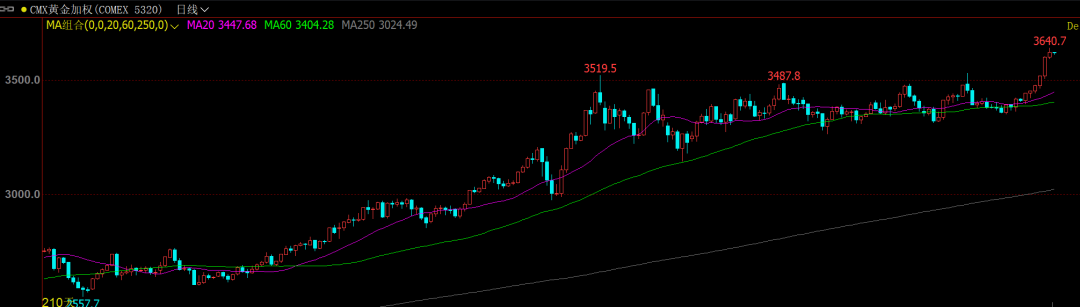
Market Performance - On September 3, U.S. stock indices closed mixed, with the Dow Jones down 0.05%, the S&P 500 up 0.51%, and the Nasdaq up 1.02% [1] - Google shares rose over 9%, marking the best single-day performance since April 9, reaching a record high [1] - Apple shares increased by 3.8%, the largest gain in nearly a month [1] Labor Market and Economic Indicators - The U.S. Labor Department reported that July JOLTS job openings were 7.181 million, below expectations, indicating a gradual weakening in hiring demand [1] - Following the report, the U.S. dollar index dropped sharply, continuing its depreciation trend, which benefits dollar-denominated assets like gold [1] Precious Metals Market - Spot gold rose by 0.78% to $3,560.67 per ounce, while COMEX gold futures increased by 0.82% to $3,621.80 per ounce, reaching an intraday high of $3,640.10, a new historical peak [1] - The Philadelphia Gold and Silver Index closed up 0.79% at 257.07 points, marking a record high for three consecutive trading days [1] - Spot silver increased by 0.78% to $41.20 per ounce, nearing the 2011 peak of $49.8044 per ounce [3] Federal Reserve Policy - Federal Reserve Governor Christopher Waller advocated for starting interest rate cuts this month, suggesting multiple reductions in the coming months [4][5] - Market expectations indicate a greater than 95% probability of a 25 basis point cut in September, with potential cuts totaling 50 to 75 basis points by year-end [5] Oil Market Dynamics - On September 3, WTI crude oil fell over 2% to $64.19 per barrel, while Brent crude dropped nearly 2% to $67.81 per barrel [7] - Geopolitical tensions have driven recent oil price fluctuations, with ongoing conflicts affecting market stability [7] - Analysts predict that despite geopolitical factors pushing prices up, the overall supply surplus will continue to pressure oil prices, especially as the peak demand season ends [8] OPEC+ Production Outlook - OPEC+ is expected to maintain current production levels in its upcoming meeting, with a projected increase of 2.467 million barrels per day, although actual increases have been around 1 million barrels per day [8] - Analysts suggest that if OPEC+ keeps production unchanged, it could support oil prices, but the market is closely watching for any signals regarding future production plans [8] Market Sentiment and Risks - The macroeconomic environment appears stable, with U.S. stock indices recovering despite previous declines [9] - Short-term oil prices may find support due to stable macro conditions and inventory drawdowns, but medium-term risks are rising due to seasonal demand declines and OPEC+ production plans [10] - The U.S. shale oil production's breakeven points are critical, with $60 per barrel for new drilling and $40 for existing wells, indicating sensitivity to price changes [11]

中信证券:OPEC+增产对油价的拖累难言结束 维持大宗商品黄金>铜>油判断
智通财经网· 2025-05-07 01:41
Core Viewpoint - The recent OPEC+ meeting revealed an unexpected increase in production plans, indicating a shift in OPEC+'s stance on oil price support since 2022, raising concerns about future diplomatic negotiations [1][3]. Production Changes - The production increase plan exceeded expectations, with an additional adjustment of 411,000 barrels per day announced for June, accelerating the previous production schedule by three months [1][2]. Market Sentiment - OPEC's statement characterized the current market fundamentals as "relatively healthy," despite the significant increase in production, which may lead to downward pressure on oil prices [2][3]. Supply-Demand Dynamics - The global oil supply-demand structure is transitioning to a "loose balance" state, with potential oversupply if OPEC continues to increase production, which could exacerbate downward pressure on the oil market [4]. Future Outlook - The company maintains a preference for gold over copper and oil in the commodity market, anticipating that ongoing supply and risk events will keep international oil prices weak and volatile [5].
