
周期性复苏

Search documents
玻璃纤维行业专题报告:周期复苏与结构性增长共振行业迎来发展新机遇
Dongguan Securities· 2026-03-30 11:29
Investment Rating - The report maintains a standard investment rating for the fiberglass industry, indicating a positive outlook for the sector due to cyclical recovery and structural growth opportunities. Core Insights - The fiberglass industry is experiencing a combination of cyclical recovery and structural growth, driven by increasing demand in traditional markets and emerging applications such as wind energy, automotive, and electronics. This dual momentum is expected to enhance pricing and profitability for leading companies in the sector [5][14][61]. Summary by Sections 1. Fiberglass Industry Overview - Fiberglass is a lightweight, high-strength, corrosion-resistant inorganic non-metallic fiber material, widely used in construction, automotive, aerospace, energy, and electronics. The industry is currently undergoing a reconstruction opportunity due to cyclical recovery and structural growth [13][14]. 2. Industry Scale and Competitive Landscape - The global fiberglass market is projected to grow from USD 24.15 billion in 2025 to USD 36.03 billion by 2032, with a CAGR of 5.88%. In China, fiberglass production capacity has exceeded 7.5 million tons, accounting for over 70% of global production [26][27][30]. The industry exhibits a concentrated competitive landscape, with a few major players dominating the market [31][34]. 3. Emerging Applications Driving Demand Growth - Traditional applications provide a stable demand base, while emerging sectors such as wind energy, automotive lightweighting, and electronics are expected to drive rapid structural growth. These sectors require advanced material performance, leading to technological upgrades and value enhancement in the fiberglass industry [38][39][49]. 4. Fiberglass Industry Recovery from Cyclical Bottom - After experiencing a price decline in 2023, the fiberglass industry is expected to recover in 2024 as supply-demand dynamics improve. Price increases have already been observed, with electronic fiberglass prices rising significantly [53][54]. The profitability of leading companies is anticipated to recover as they avoid price wars and focus on value-added products [55][60]. 5. Overall Perspective and Investment Recommendations - The fiberglass industry is positioned for growth due to its expanding application areas and changing demand structure. Key growth drivers include the large-scale wind energy projects, automotive lightweighting, and AI infrastructure. The report recommends focusing on leading companies such as China Jushi (600176), China National Materials (002080), International Composites (301526), and Honghe Technology (603256) [61][64].


周期复苏与结构性增长共振,行业迎来发展新机遇
Dongguan Securities· 2026-03-30 09:18
Investment Rating - The report maintains a standard investment rating for the fiberglass industry, indicating a positive outlook for the sector's recovery and growth opportunities. Core Insights - The fiberglass industry is experiencing a combination of cyclical recovery and structural growth, presenting new opportunities for development. The demand from traditional markets is rebounding, while emerging applications in wind energy, automotive, and electronics are driving rapid structural growth [5][14]. - The global fiberglass market is expected to maintain a medium to high growth rate of 4%-7% over the next 5-8 years, with significant contributions from new applications [6][26]. - The industry is characterized by a concentrated competitive landscape, with a few major players dominating the market. In China, three major fiberglass producers account for approximately 70% of domestic production capacity [6][31]. Summary by Sections 1. Fiberglass Industry Overview - Fiberglass is a lightweight, high-strength, corrosion-resistant material widely used in various sectors, including construction, automotive, aerospace, energy, and electronics. The industry is currently undergoing a reconstruction opportunity due to cyclical recovery and structural growth [13][14]. - The demand for fiberglass is expected to rebound, driven by traditional markets and new applications that require higher performance materials [14]. 2. Industry Scale and Competitive Landscape - The global fiberglass market is projected to grow from $24.15 billion in 2025 to $36.03 billion by 2032, with a CAGR of 5.88% [26]. - China has become the world's largest producer, consumer, and exporter of fiberglass, with domestic production capacity exceeding 70% of the global total [27][30]. - The industry exhibits a highly concentrated competitive structure, with major players like China Jushi, Taishan Fiberglass, and Chongqing International Composite Materials holding significant market shares [31][34]. 3. Emerging Applications Driving Demand Growth - The fiberglass market is expanding into new applications, particularly in wind energy, automotive lightweighting, and electronics, which are expected to drive significant demand growth [35][38]. - In the wind energy sector, the demand for high-modulus fiberglass is increasing due to the trend of larger wind turbine blades [39][40]. - The automotive industry is focusing on lightweight materials to improve fuel efficiency and performance, with fiberglass composites becoming increasingly prevalent [43][44]. - In electronics, fiberglass is essential for manufacturing printed circuit boards (PCBs), with high-end electronic fabrics being critical for advanced applications [49][50]. 4. Recovery from the Industry Bottom - The fiberglass industry faced a downturn in 2023, with prices hitting historical lows. However, a recovery is anticipated starting in 2024 as supply-demand dynamics improve [53][54]. - Profitability for major fiberglass companies is expected to recover significantly in 2025, driven by price increases and cost control measures [55][59]. 5. Overall View and Investment Recommendations - The fiberglass industry is positioned for growth due to its expanding application areas and structural changes in demand. Key drivers include the large-scale wind energy projects, automotive lightweighting, and advancements in AI infrastructure [61]. - The report recommends focusing on leading national companies and specialized firms, such as China Jushi, Zhongcai Technology, International Composite Materials, and Honghe Technology, as potential investment opportunities [61][64].
美股科技巨头利润“霸权”告终?盈利增长正向全行业扩散
Hua Er Jie Jian Wen· 2026-02-11 06:49
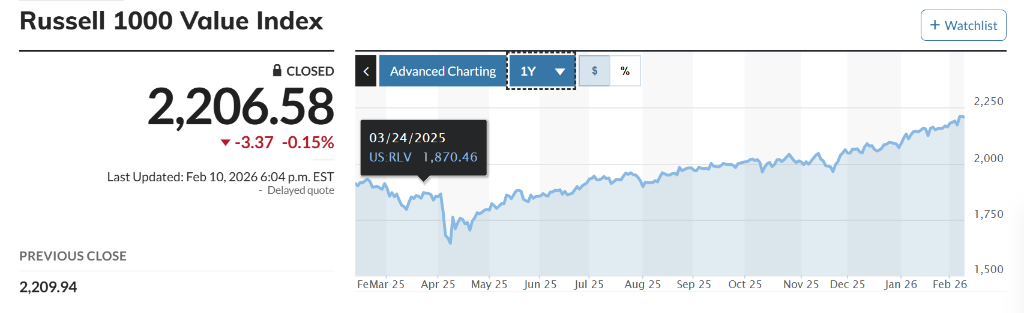
Core Insights - The dominance of a few tech giants in profits is fundamentally changing as the earnings season progresses, with the Russell 1000 Value Index outperforming growth indices since mid-December 2022 [1] - The number of sectors in the S&P 500 showing positive growth has increased from 6 to 8, with nearly half of the companies reporting double-digit growth rates, and a median growth rate close to 10%, marking a four-year high [1] Group 1: Earnings Growth and Market Dynamics - The overall earnings growth rate for the S&P 500 has risen to 14.5%, a four-year high, indicating a broadening of growth beyond just large tech stocks [3] - Market analysts suggest a style rotation is occurring, driven by cyclical factors rather than a decline in tech giants, signaling an end to the previously rare concentration of profits [3] - The current economic phase is characterized as a "robust broad expansion," which typically benefits widespread corporate profits, as confirmed by the earnings reports of S&P 500 constituents [4] Group 2: Sector Rotation and Valuation Shifts - There has been a significant rotation towards "AI-immune" sectors such as utilities, food, mining, construction, and telecommunications, reflecting a reevaluation of capital-intensive and traditional industry valuations [4] - The weakening dollar has notably impacted corporate earnings, with export-oriented S&P 500 companies experiencing higher earnings and revenue growth compared to those focused on domestic business [5] - Nvidia Corp. plays a crucial role in the earnings growth of S&P 500 companies with significant international exposure; excluding Nvidia, the blended earnings growth rate would drop from 17.7% to 12.0% [5]


高盛-2026年美国股市主题展望
Goldman Sachs· 2026-01-13 01:10
Investment Rating - The report maintains a positive outlook for the S&P 500, projecting a target of 7,600 points for 2026, with a core logic based on expected earnings growth of 12% and a corresponding return rate of 12% for the index [2]. Core Insights - The S&P 500 is expected to see a price increase of 16% in 2025, with 14 percentage points attributed to earnings contributions. For 2026, earnings growth is anticipated at 12%, aligning with a 12% return rate for the index, while the price-to-earnings (P/E) ratio is projected to remain at 22 times [1][2]. - Despite rising interest rates, they remain below long-term averages, and the S&P 500's profitability has reached multi-decade highs. However, structural factors may hinder the reallocation of one-third of household portfolios into equities [1][5]. - AI-related spending by large enterprises is nearing $550 billion, reflecting a nearly 40% year-over-year growth, although the growth rate is beginning to slow. The focus of AI investments is shifting from infrastructure stocks to other sectors, with some companies demonstrating actual profitability impacts from AI applications [1][6]. - Productivity growth is forecasted at 0.5% for this year and 1.5% for the next, indicating a gradual increase despite modest figures [7]. - The IPO market is expected to improve in 2026, with macro indicators suggesting an increase in IPO numbers, which currently remain below long-term averages [8]. - Stock buybacks continue to be a significant demand source in the U.S. equity market, with daily demand estimated at $4 to $5 billion, although this demand is slowing down [9]. - The report highlights cyclical recovery opportunities, particularly in non-residential construction, transportation, building materials, and semiconductor sectors, with a focus on the middle-income consumer group [10]. Summary by Sections - **Earnings and Valuation**: The report indicates that the current P/E ratio of 22 is reasonable given the stability of macroeconomic factors such as interest rates and growth rates. The valuation is expected to remain below historical highs, with a potential upward bias in a healthy economic environment [3][4]. - **AI Investment Trends**: AI investments are projected to continue driving market growth, with significant spending expected to shift towards applications beyond infrastructure, indicating a maturation of the AI sector [6]. - **Productivity and IPO Outlook**: The anticipated gradual increase in productivity and a more favorable IPO environment in 2026 are seen as positive indicators for market health and investment opportunities [7][8].
亚德诺:Q4营收30.8亿美元,26财年Q1预期超30亿
Sou Hu Cai Jing· 2025-11-25 14:12
Core Viewpoint - Analog Devices reported strong fourth-quarter results, exceeding both revenue and profit expectations, indicating resilience amid macroeconomic uncertainties [1] Financial Performance - Revenue for the fourth quarter reached $3.08 billion, representing a 26% year-over-year increase, surpassing analyst expectations of $3 billion [1] - Adjusted earnings per share were $2.26, slightly above the anticipated $2.24 [1] Future Outlook - The company anticipates first-quarter revenue for fiscal year 2026 to be between $3 billion and $3.2 billion, exceeding analyst expectations of $2.97 billion [1] - Richard Puccio, a company representative, mentioned the ability to leverage cyclical recovery and long-term growth opportunities despite macroeconomic uncertainties potentially impacting fiscal year 2026 [1]
盘后一度涨近3%!恩智浦Q4指引重回增长强于预期,需求复苏显现
美股IPO· 2025-10-28 00:25
Core Viewpoint - NXP's third-quarter revenue exceeded analyst expectations, with a year-on-year decline of only 2%, indicating a significant slowdown in the revenue drop compared to previous quarters [1][11][12] Financial Performance - Revenue: In Q3, NXP reported revenue of $3.17 billion, a 2% year-on-year decline, slightly above the analyst expectation of $3.16 billion. The guidance for Q4 is between $3.05 billion and $3.25 billion [7][11] - EPS: The adjusted diluted EPS for Q3 was $3.11, down 10% year-on-year, slightly below the analyst expectation of $3.12. The guidance for Q4 EPS is between $2.89 and $3.30 [7][11] - Operating Profit: Adjusted operating profit for Q3 was $1.071 billion, a 7% year-on-year decline, also above the company's guidance range [8][12] - Gross Profit: Adjusted gross profit for Q3 was $1.81 billion, down 4% year-on-year, with a gross margin of 57.0% [8][12] Market Segments - Automotive Chips: This segment contributed nearly 60% of NXP's Q3 revenue, showing zero year-on-year growth but a 6% quarter-on-quarter increase, which is double the growth rate of the previous quarter [12][13] - Industrial and IoT: Revenue in this segment grew 6% quarter-on-quarter, reversing the previous quarter's decline, with year-on-year growth of 3% [13] - Mobile Business: This segment saw a significant quarter-on-quarter growth of 30%, with a year-on-year increase of 6% [13] Future Guidance - Q4 Guidance: NXP expects Q4 revenue to be between $3.2 billion and $3.4 billion, indicating a potential year-on-year growth for the first time in over a year. The midpoint of the guidance suggests a 6.1% increase compared to the previous year [10][14] - CEO's Remarks: The guidance reflects strong specific growth drivers and signs of cyclical recovery, with a focus on disciplined investment and portfolio enhancement to drive profit growth [14][15]

需求复苏提振下恩智浦(NXPI.US)Q3业绩显回升势头 Q4营收展望剑指正增长
智通财经网· 2025-10-27 23:09
Core Insights - NXP Semiconductors (NXPI.US) reported a slowing revenue decline in Q3, with a better-than-expected outlook indicating potential revenue growth in Q4 [1][2] - Q3 revenue decreased by 2% year-over-year to $3.17 billion, slightly above analyst expectations of $3.16 billion, with a smaller decline compared to Q2's 6% [1] - Adjusted operating profit was $1.07 billion, down 7% year-over-year, also showing improvement from Q2's 13% decline [1] Revenue Breakdown - Automotive chips accounted for nearly 60% of NXP's Q3 revenue, with this segment showing zero year-over-year growth but a 6% quarter-over-quarter increase, double the growth rate of Q2 [1] - Industrial and IoT revenue grew by 3% year-over-year in Q3, while mobile business revenue increased by 6%, reversing the decline seen in Q2 [1] Future Outlook - The company expects Q4 revenue to be between $3.2 billion and $3.4 billion, surpassing analyst predictions and indicating the first year-over-year growth since Q1 of the previous year [2] - Adjusted earnings per share for Q4 are projected to be between $3.07 and $3.49, reflecting strong growth drivers and signs of cyclical recovery [2] - NXP's performance is seen as better than expected amid ongoing trade tensions and industry recovery from inventory surplus [2]

美联储的危险实验:一场为投资者设下的高风险黄金机遇?
智通财经网· 2025-10-27 07:32
Core Viewpoint - The current market is witnessing one of the highest economic experiments in decades, potentially opening new investment opportunities for investors [1] Economic Growth and Structure - The actual GDP growth is projected at 3.9%, indicating the fastest expansion since the global financial crisis, with any growth above 3% seen as a positive signal [3] - The AI industry has become a core driver of this growth, contributing approximately one-third to GDP growth in the first half of the year, while other sectors show weak growth, indicating that the benefits of the technological revolution are concentrated in a few areas [5] Business Sentiment and Manufacturing - Surveys of business executives and purchasing managers show that while current business sentiment is not pessimistic, it is significantly lower than the peaks seen in 2017 and 2021 [8] - The ISM manufacturing index has been in contraction territory since late 2022, reflecting ongoing pressures from high interest rates, persistent inflation, weak consumer demand, and tariff uncertainties [8] Federal Reserve Challenges - The Federal Reserve faces the challenge of promoting cyclical recovery amid a high-pressure economy, with potential strategies including stimulating nominal growth through the real estate market and improving credit conditions [8] - Regulatory easing may boost key sectors such as housing, data center construction, and manufacturing [8] Capital Expenditure Trends - Morgan Stanley research indicates that capital expenditures for large-scale data centers will reach $480 billion from 2022 to 2024, with projections of $1.15 trillion from 2025 to 2027, and potentially exceeding $1.6 trillion by 2028 [9] Investment Recommendations - Investment in the energy sector, particularly in the natural gas industry driven by AI electricity demand and LNG exports, is recommended [12] - Physical assets like gold and high-quality dividend stocks should be part of the foundational investment strategy, as they may offer better value compared to tech giants facing uncertain returns [12]
德州仪器(TXN.US)营收指引不及预期引担忧 大行纷纷下调目标价
智通财经网· 2025-10-22 12:56
Core Viewpoint - Texas Instruments (TXN.US) reported mixed Q3 results, leading to an approximately 8% drop in stock price due to pessimistic analyst reactions [1] Group 1: Analyst Ratings and Price Targets - Jefferies maintains a "Hold" rating, lowering the target price from $185 to $180, citing seasonal declines in the industry and pressure on gross margins due to reduced production utilization [2] - Morgan Stanley keeps a "Underweight" rating, reducing the target price from $192 to $175, expressing surprise at the poor revenue guidance despite previous expectations of seasonal growth [3] - CFRA assigns a "Hold" rating, noting Q3 earnings per share of $1.48, slightly below the market expectation of $1.49, while sales grew by 14% [3] Group 2: Financial Performance and Guidance - Q3 revenue guidance for Texas Instruments is disappointing, with expected revenue between $4.22 billion and $4.58 billion, and earnings per share between $1.13 and $1.39, both below market expectations [4] - Analysts expect free cash flow per share to approach $8 to $12 in 2026, assuming stable revenue growth, which may increase cash returns as free cash flow pressure eases [4] Group 3: Market Conditions and Future Outlook - Analysts anticipate that the seasonal phenomenon affecting Texas Instruments will persist until March next year, indicating further declines in relevant data [2] - There is a general expectation of a cyclical recovery in the semiconductor sector, but analysts remain cautious about Texas Instruments' performance until signs of recovery are evident [2][3]

凯投宏观:欧元区由关税引发的增长无法持续
news flash· 2025-06-06 11:57
Core Viewpoint - The strong growth in the Eurozone at the beginning of the year masks underlying economic weaknesses, primarily driven by a surge in pharmaceutical exports due to anticipated U.S. trade tariffs [1] Group 1: Economic Growth - Eurozone's first-quarter growth was reported at 0.6%, significantly revised from the previous expectation of 0.3% [1] - The growth was largely attributed to a spike in pharmaceutical exports from key producers like Germany and Ireland, influenced by trade tariff expectations [1] Group 2: Future Outlook - The rapid growth is expected to reverse in early second quarter, indicating a potential weak cyclical recovery [1] - The current situation reflects volatility rather than sustained economic strength, raising concerns about the sustainability of growth [1]