品牌信誉

Search documents
从拒退到愿退,周生生态度转变背后的消费者维权困境
Ge Long Hui· 2026-02-04 13:54
Core Viewpoint - The incident involving the jewelry brand Chow Sang Sang highlights significant issues regarding product quality and brand reputation in the gold jewelry industry, raising questions about transparency and consumer rights [1][2]. Group 1: Company Response and Brand Reputation - Chow Sang Sang's initial response to the quality complaint relied heavily on its brand reputation, which reflects a common mindset among established companies that equate brand history with product quality [1]. - The shift from refusing to accept returns to agreeing to a refund indicates a recognition of consumer demands, but this process has already damaged the brand's reputation [1]. Group 2: Industry Concerns and Standards - The core controversy revolves around the true meaning of "pure gold," as the gold content in the pendant varied significantly, with some points showing as low as 64.37%, which raises compliance issues with national standards [2]. - The presence of other metals such as iron, silver, and palladium in the pendant has led to consumer skepticism about the actual composition of gold jewelry, pointing to potential quality control issues in the production process [2][3]. Group 3: Consumer Rights and Detection Mechanisms - The lack of a robust third-party testing mechanism creates an imbalance between consumers and businesses, making it difficult for consumers to obtain timely and affordable authoritative assessments [3]. - The suggestion from market regulatory authorities to seek third-party verification underscores a common challenge in consumer rights protection, where self-conducted tests are often not recognized by companies [2][3]. Group 4: Industry Reflection and Consumer Awareness - The Chow Sang Sang incident serves as a wake-up call for the entire gold jewelry industry, emphasizing the need for stricter product traceability and quality disclosure mechanisms [4]. - Consumers are encouraged to critically assess brand reputation and actively verify product quality certificates and other relevant information before making high-value purchases [4][6]. Group 5: Future Implications and Market Dynamics - The incident has the potential to catalyze a transformation in the industry, shifting from reliance on brand prestige to establishing a genuine quality assurance system [5]. - The ongoing situation highlights the importance of addressing consumer concerns seriously and ensuring that every piece labeled as "pure gold" can withstand scrutiny [5].

经济日报:职业规范怎能“玩梗”?丨头条热评
Xin Lang Cai Jing· 2026-01-06 12:15
Core Viewpoint - The incident involving a tea shop employee creating "handmade milk tea" videos has sparked significant discussion, highlighting the need for industry professionals to maintain a sense of respect for their roles and adhere to professional standards rather than prioritizing entertainment value [1] Industry Concerns - The actions of the involved employees blurred the lines between personal entertainment and professional identity, as they were seen in uniforms performing staged actions, which could mislead consumers about the brand's image [1] - The incident has raised concerns about the lax safety awareness among some industry practitioners, emphasizing that food safety is a non-negotiable standard that should not be compromised for the sake of viral content [1] Legal and Regulatory Implications - Legal experts have pointed out that even using discarded materials for entertainment purposes violates food safety laws and operational regulations, indicating potential legal repercussions for such actions [1] Brand Reputation - Although the involved brand acted quickly to address the situation, the ongoing public discourse serves as a reminder that a brand's core competitiveness stems from long-term quality assurance and the trust established with consumers, rather than from gimmicks aimed at attracting attention [1]
乐歌股份:“浙江省雄鹰企业”等荣誉是政府部门对公司综合实力与行业地位的认可
Zheng Quan Ri Bao· 2026-01-06 12:11
Core Viewpoint - Lege Co., Ltd. emphasizes its recognition as a leading cross-border logistics service provider through government honors, aiming to enhance brand reputation and attract quality clients and partners [2] Group 1 - The company received honors such as "Eagle Enterprise of Zhejiang Province," reflecting its comprehensive strength and industry position [2] - Lege Co., Ltd. plans to strengthen its brand reputation through customer expansion, government collaboration, and industry communication [2] - The company aims to consolidate its image as a top cross-border logistics service provider [2]

半岛观察|假磷虾油风波下,同仁堂金字招牌如何守护?
Da Zhong Ri Bao· 2025-12-25 12:02
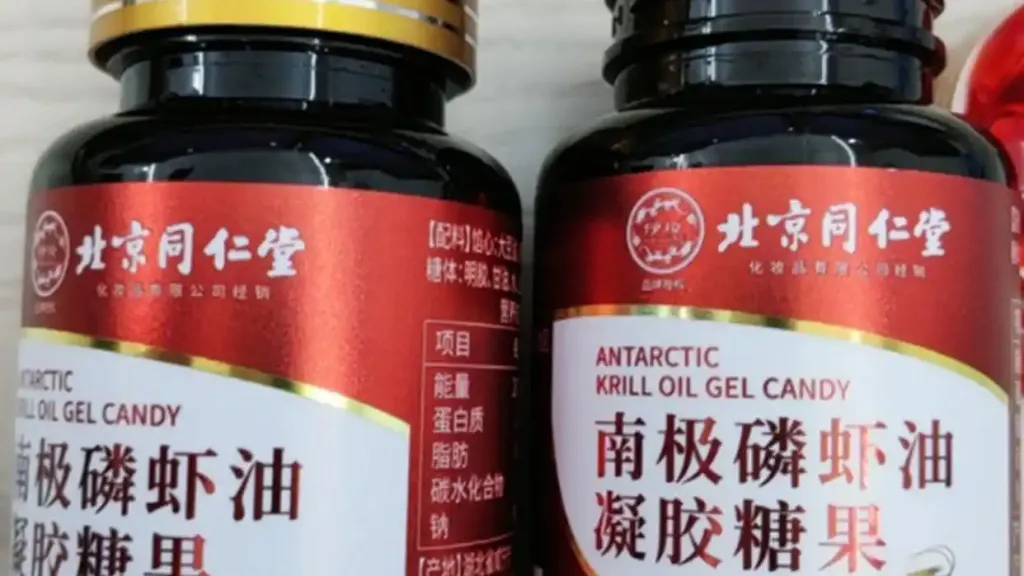
Core Viewpoint - The incident involving Antarctic krill oil products linked to Tongrentang has exposed significant issues in production practices and brand management, raising concerns about consumer trust and the integrity of traditional brands [1][3][12]. Group 1: Regulatory Response - The State Administration for Market Regulation has identified problems with companies prioritizing profit over product quality and has announced measures to regulate commissioned production, including the upcoming release of the "Food Commissioned Production Supervision Management Measures" [3][9]. - The regulatory body plans to enhance oversight of private label processing and conduct special inspections on products like krill oil and fish oil to combat illegal activities [3][9]. Group 2: Incident Details - The controversy began when a product marketed as "Beijing Tongrentang 99% High Purity Antarctic Krill Oil" was found to have a phospholipid content of 0%, contrasting sharply with the claimed 43% [3][6]. - The involved distributor, Beijing Tongrentang (Sichuan) Health Pharmaceutical, purchased the product at a price of 3 to 3.7 yuan, while it was sold at over 60 yuan, indicating a nearly 20-fold markup and raising suspicions of fraud [6][8]. Group 3: Consumer Trust and Brand Impact - The scandal has shaken consumer confidence, with many expressing disbelief that a reputable brand could engage in such practices, leading to a significant decline in purchases of related products [8][12]. - The incident highlights the vulnerability of traditional brands, as the trust built over three centuries can be jeopardized by a single violation [8][12]. Group 4: Legal and Industry Challenges - The actions of the involved companies have been deemed illegal, infringing on consumer rights and potentially constituting the crime of selling counterfeit goods if sales exceed 50,000 yuan [9][12]. - The lack of national standards for Antarctic krill oil has created regulatory blind spots, allowing for fraudulent activities to proliferate [9][12]. Group 5: Company Response and Future Outlook - In response to the crisis, Tongrentang has initiated corrective measures, including the resignation of the involved company's general manager and the recall of affected products [12]. - The company faces the challenge of addressing its complex brand authorization system to prevent future risks and restore consumer trust [12].

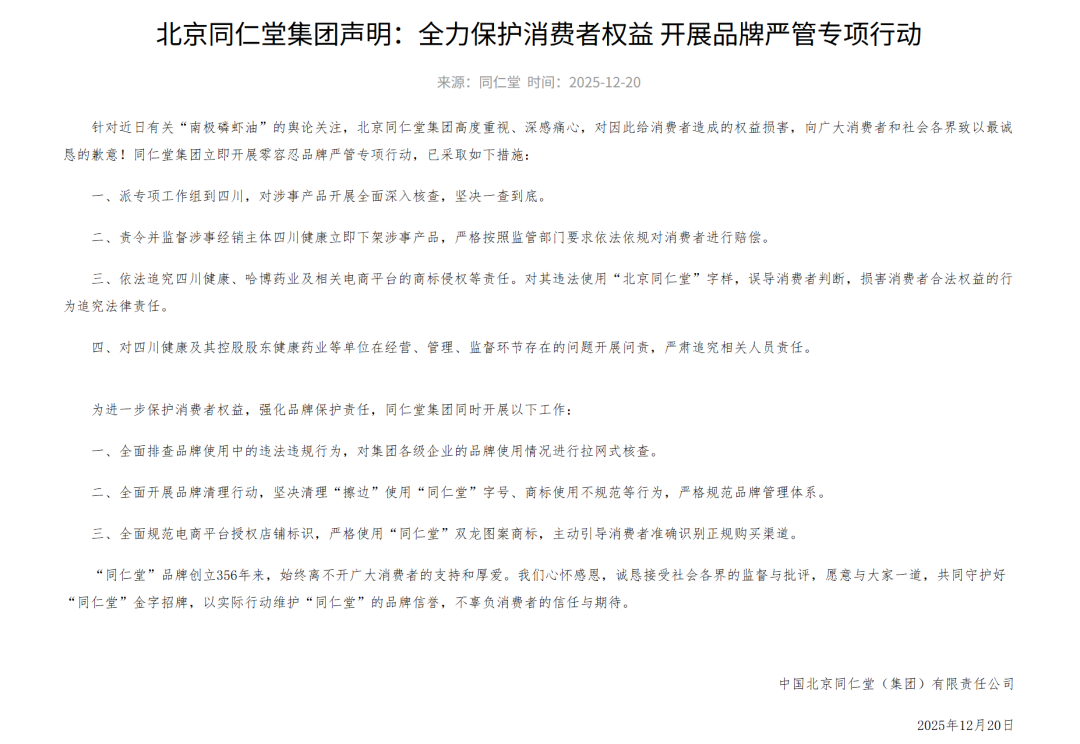
同仁堂集团:深感痛心、诚恳致歉
Zhong Guo Ji Jin Bao· 2025-12-20 01:49
Core Viewpoint - Tong Ren Tang Group publicly apologized for the recent controversy surrounding its Antarctic krill oil product, acknowledging the damage caused to consumer rights and committing to a thorough brand management initiative [1][3]. Group 1: Company Response - The company has initiated a zero-tolerance brand management action, deploying a special task force to Sichuan for a comprehensive investigation of the involved products [3]. - The company has ordered the immediate removal of the implicated products from the market and is ensuring compliance with regulatory requirements for consumer compensation [4]. - Legal actions will be pursued against the involved parties, including Sichuan Health and Habao Pharmaceutical, for trademark infringement and misleading consumers [4]. Group 2: Brand Protection Measures - To further protect consumer rights, the company will conduct a thorough review of brand usage for any illegal or non-compliant activities and implement a comprehensive brand cleanup initiative [5]. - The company aims to standardize the use of its trademarks and ensure that consumers can accurately identify legitimate purchasing channels [5]. Group 3: Background Information - Tong Ren Tang brand was established in 1669, and the group was formed in 1992, transitioning to a state-owned enterprise in 2001 [8]. - The company has multiple subsidiaries, with Tong Ren Tang Health, established in April 2023, being one of its strategic branches in the health sector [8]. - As of December 19, the A-share price of Tong Ren Tang was 32.42 yuan per share, with a total market capitalization of 44.5 billion yuan [8].
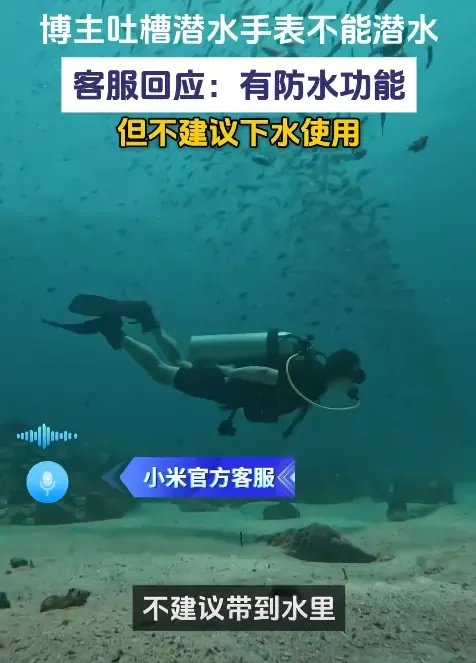
小米又道歉了!“潜水表”可能只是名称,跟功能无关
Xin Lang Cai Jing· 2025-11-24 09:37
Core Viewpoint - The incident involving a Xiaomi "diving watch" that leaked water during use has escalated into a significant brand trust crisis, highlighting issues of misleading marketing and inadequate customer service [1][3]. Group 1: Incident Overview - A user experienced water leakage in a Xiaomi "diving watch" after using it for diving, leading to a problematic customer service interaction where the company initially blamed the user for "human damage" [3]. - Xiaomi later clarified that the user had purchased a standard version, not the professional diving version, which is certified for 40 meters of diving [4]. - The user's insistence on having purchased the professional version, supported by an order, raises questions about the clarity of product distinctions [5]. Group 2: Industry Standards and Misleading Marketing - The 5ATM water resistance rating typically applies to swimming and showering, far from actual diving standards, which usually require 20ATM or higher and certification through EN13319 [7]. - The marketing of the watch, which prominently features "diving" while downplaying limitations in fine print, is seen as misleading to consumers [5][11]. - The disparity between marketing promises and actual product performance reflects a broader industry issue where brands prioritize marketing over product reliability [9][13]. Group 3: Consumer Trust and Brand Reputation - The incident has sparked a broader discussion about consumer expectations and the responsibility of brands to provide clear and honest information [11]. - Legal actions are being considered, emphasizing the need for brands to uphold consumer trust and avoid misleading marketing practices [11][13]. - The situation serves as a reminder for all manufacturers that in an age of information overload, transparency and honesty are crucial for maintaining brand reputation [13][14].