
国际贸易秩序

Search documents
特朗普突然发文昭告全球,包括中俄在内,这次一个都跑不掉?
Sou Hu Cai Jing· 2026-02-26 07:04
Core Viewpoint - The U.S. Supreme Court's ruling against Trump's previous tariffs has led to a new wave of tariffs, with Trump announcing a 10% tariff on all imports, which was quickly raised to 15%, indicating a significant shift in U.S. trade policy and its potential impact on global supply chains [1][3][5]. Group 1: Tariff Implementation - The Supreme Court's decision deemed Trump's previous tariffs illegal, prompting him to invoke Section 122 of the Trade Act to impose a 10% tariff on all imports for 150 days [1][3]. - Trump escalated the tariff to 15% shortly after, utilizing the maximum allowable rate under the law, which reflects a more aggressive trade stance [3][5]. Group 2: Global Supply Chain Impact - The new tariffs are expected to create widespread disruption across global supply chains, affecting countries from China to Canada, and raising concerns among U.S. retailers about cost increases [5][7]. - The imposition of these tariffs is likely to lead to increased costs for American consumers, potentially reigniting inflationary pressures that had previously been subdued [9]. Group 3: International Response - China's Ministry of Commerce has expressed a calm but firm stance, indicating that it will assess the U.S. actions and may implement countermeasures, including adjustments to tariffs on U.S. goods [11][13]. - The current trade dynamics suggest that the vulnerability of supply chains has shifted, with many foreign companies in China having increased local procurement, which may mitigate the impact of U.S. tariffs [13]. Group 4: Broader Economic Implications - The tariffs are seen as a means for the U.S. to fill a fiscal gap created by the Supreme Court's ruling, but this approach risks undermining the existing international trade order [7][15]. - The potential for capital flight from the U.S. market is heightened, as the tariffs could lead to rising domestic prices and the formation of self-sustaining economic circles that exclude the U.S. [17][18].

美国关税政策“横跳”无常 退税或成糊涂账
Sou Hu Cai Jing· 2026-02-23 11:44
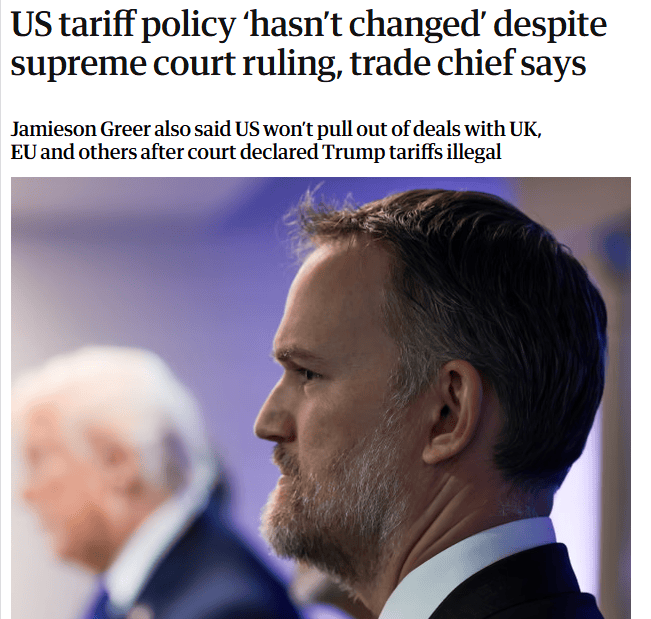
Core Viewpoint - The U.S. Customs and Border Protection (CBP) announced the cessation of tariffs imposed under the International Emergency Economic Powers Act (IEEPA) starting February 24, following a Supreme Court ruling that deemed such tariffs unconstitutional. President Trump subsequently announced a new 10% tariff on all imported goods, which was quickly raised to 15% within 24 hours, creating significant confusion in international trade and U.S. foreign relations [1][4][5]. Group 1: Impact on International Trade - The frequent adjustments to U.S. tariff policies have led to chaos in international trade, undermining established trade order and disrupting global supply chains [5]. - The U.S. government's erratic tariff changes have resulted in a diplomatic stalemate, eroding trust among allies such as the EU and India, who are now reconsidering trade agreements with the U.S. [5]. - The Supreme Court's ruling has left unresolved questions regarding the refund of previously collected tariffs, creating uncertainty for U.S. businesses and markets [5][9]. Group 2: Corporate Investment Decisions - The increase to a 15% tariff is expected to pressure corporate investment decisions, as companies face rising costs and uncertainty regarding future trade policies [6][7]. - Businesses are now left to navigate a complex landscape of potential tariffs, leading to indecision on whether to invest domestically or internationally [7]. Group 3: Refunds and Financial Implications - The Supreme Court's decision has created ambiguity around the process for refunding illegally collected tariffs, with significant hurdles for businesses seeking reimbursement [8][9]. - The majority of the costs associated with Trump's tariffs have been borne by U.S. consumers, complicating the calculation of how much businesses have actually paid [9]. - The likelihood of refunds remains low due to the complexities involved, and the government appears reluctant to return collected tariffs, prioritizing its reputation over financial restitution [9].
关键矿产合作,韩国没全听美国
Xin Lang Cai Jing· 2026-02-06 06:35
Group 1 - The U.S. Trade Representative's Office announced new initiatives to form a critical minerals trade alliance with allies, finalize a critical minerals action plan with Mexico, and establish strategic partnerships with the EU and Japan [1] - The U.S.-Mexico critical minerals action plan is the first of its kind, aiming to create coordinated trade policies and mechanisms, including a border-adjusted price floor, to address global market distortions affecting North American critical mineral supply chains [1] - The U.S., EU, and Japan plan to develop a resilience action plan for critical mineral supply chains, which will include a border-adjusted price floor mechanism to reduce supply chain vulnerabilities [1] Group 2 - Turkey's Anadolu Agency commented that the U.S. government has made critical minerals a core part of its industrial and trade policy, aiming to reduce dependence on China [2] - In contrast to the U.S.-led "decoupling" efforts, South Korea is seeking to deepen cooperation with China in the critical minerals supply chain, establishing communication hotlines and a joint committee to facilitate stable imports of Chinese mineral resources [2] - A spokesperson from the Chinese Foreign Ministry emphasized the importance of maintaining an open and inclusive international trade environment, opposing any attempts by countries to disrupt global supply chains through exclusive rules [2]
商务部——中欧妥善解决电动汽车案具有重要积极意义
Ren Min Ri Bao· 2026-01-15 22:08
Group 1 - The core viewpoint of the article emphasizes the positive significance of resolving the electric vehicle case between China and the EU under the framework of WTO rules, highlighting mutual respect and cooperation [1] - The announcement made on January 12, 2026, regarding the positive outcomes from multiple rounds of negotiations has garnered significant attention and is welcomed by both Chinese and European industries, indicating a "soft landing" that will boost market confidence and invigorate trade and investment cooperation [1] - European politicians have described the resolution as a positive step towards establishing a sustainable trade relationship between China and the EU, demonstrating the feasibility of resolving trade disputes through partnership [1] Group 2 - The Chinese side appreciates the dialogue spirit shown by the European side and expresses willingness to further implement the consensus reached during the China-EU leaders' meeting, maintaining communication and supporting deepened cooperation based on market principles [2] - The resolution is seen as beneficial for the healthy development of China-EU economic and trade relations, contributing to the stability of the global automotive industry supply chain and sending a clear signal of commitment to maintaining a rules-based international trade order [1]
商务部:中欧电动汽车案“软着陆”为双方汽车贸易投资合作注入新动力
Huan Qiu Wang· 2026-01-15 08:13
Group 1 - The core viewpoint of the article highlights the successful resolution of the electric vehicle case between China and the EU, which is seen as a positive development for market confidence and trade relations [1][2] - The agreement reached on January 12, 2026, is viewed as a significant step towards establishing sustainable trade relations between China and the EU, demonstrating the feasibility of resolving trade disputes through partnership [1] - The resolution is expected to contribute to the healthy development of China-EU economic and trade relations, stabilize the global automotive supply chain, and send a clear signal of commitment to a rules-based international trade order [1] Group 2 - The Chinese side appreciates the EU's spirit of dialogue and expresses willingness to further implement the consensus reached during the leaders' meeting, maintaining communication and supporting deepened cooperation based on market principles [2]

商务部:中欧妥善解决电动汽车案具有重要积极意义
Xin Hua She· 2026-01-15 07:17
Core Viewpoint - The recent agreement between China and the EU regarding electric vehicles is seen as a significant step towards enhancing trade relations and market confidence, with both sides expressing strong support for the outcome of the negotiations [1]. Group 1: Agreement Details - On January 12, 2026, China and the EU announced a positive outcome from multiple rounds of negotiations concerning the electric vehicle case, which has garnered high attention from various sectors [1]. - The resolution of the electric vehicle case is viewed as a "soft landing" that will significantly boost market confidence and inject new momentum into China-EU automotive trade and investment cooperation [1]. Group 2: Political and Economic Implications - EU politicians have described the agreement as a positive step towards establishing a sustainable trade relationship between China and the EU, indicating that resolving trade disputes through partnership remains feasible [1]. - The current international situation necessitates a mutual respect approach, and the resolution of the electric vehicle case under the World Trade Organization framework is considered to have important positive implications for the healthy development of China-EU economic and trade relations [1]. Group 3: Global Trade Impact - The agreement is expected to contribute to the stability of the global automotive industry supply chain and send a clear signal to the world that China and the EU are committed to maintaining a rules-based international trade order [1]. - This collaboration sets a good example for other countries on resolving disputes through dialogue and consultation, thereby injecting more certainty and positive energy into global economic development [1].
德国中国商会:对中欧电动汽车案磋商取得积极成果表示欢迎
Zhong Guo Xin Wen Wang· 2026-01-15 01:51
Core Viewpoint - The German-Chinese Chamber of Commerce welcomed the positive outcomes of the China-Europe electric vehicle negotiations, highlighting the replacement of tariff measures with price commitments as a response to the automotive industry's expectations [1] Group 1: Trade Relations - The negotiations signal a constructive approach to resolving trade differences between China and Europe, promoting a rules-based international trade order [1] - The automotive industry exemplifies mutual cooperation between China and Germany, with complementary supply chain advantages and significant potential for collaboration in electrification, intelligence, and green transformation [1] Group 2: Market Impact - Successfully addressing the China-Europe electric vehicle case is expected to significantly boost market confidence and create a favorable environment for deepening cooperation between Chinese and German automotive and related industry chain enterprises [1] Group 3: Future Initiatives - The German-Chinese Chamber of Commerce aims to strengthen communication with both governments and industry sectors, reflecting the concerns and demands of Chinese enterprises to promote mutually beneficial cooperation in the automotive industry [1]
中欧电动汽车案磋商进展公布 欧洲媒体:“应能为市场提供更大的稳定性”
Huan Qiu Wang· 2026-01-13 02:53
Core Viewpoint - The China-EU electric vehicle negotiations have progressed, with the EU set to issue guidelines for price commitment applications from Chinese exporters, aiming to resolve trade concerns in a mutually respectful manner [1][2]. Group 1: Negotiation Progress - The negotiations between China and the EU have been characterized by mutual respect and multiple rounds of discussions, leading to the decision to provide general guidance for Chinese exporters of pure electric vehicles regarding price commitments [2]. - The EU will confirm in the forthcoming guidelines that it will adhere to non-discrimination principles and apply the same legal standards to all price commitment applications, ensuring an objective and fair evaluation process [2]. Group 2: Implications for Trade Relations - The agreement reflects the spirit of dialogue and the outcomes of negotiations, indicating that both parties are capable and willing to resolve differences within the framework of World Trade Organization rules, thereby maintaining stability in the automotive supply chain [2]. - The Italian news report suggests that replacing tariffs with a minimum price mechanism could provide greater market stability and avoid potential escalation of commercial retaliation [3]. Group 3: Future Outlook - A clear operational framework has been established, with guidelines sent to Chinese exporters to facilitate quick adaptation, marking a temporary resolution to one of the most contentious chapters in EU-China trade relations during the green transition era [5]. - The success of this agreement in balancing European industrial protection with the acceleration of zero-emission vehicle adoption remains to be seen in the medium term [5].
中欧电动汽车案实现“软着陆”,欧方将发布价格承诺指导文件
Xin Hua Cai Jing· 2026-01-13 00:07
Core Points - The Ministry of Commerce announced progress in negotiations regarding the EU-China electric vehicle case, indicating a "soft landing" after multiple rounds of discussions [1][2] - The EU will issue guidelines for Chinese exporters of pure electric vehicles to submit price commitment applications, aiming to address concerns in a practical and WTO-compliant manner [1] - The EU has committed to a non-discriminatory principle, ensuring that all price commitment applications will be evaluated based on the same legal standards in an objective and fair manner [1] Group 1 - The negotiations reflect the spirit of dialogue and the results achieved between China and the EU, demonstrating their capability and willingness to resolve differences within the framework of WTO rules [2] - Successfully addressing the EU's anti-subsidy case against Chinese electric vehicles is a common expectation among the upstream and downstream industries in both regions, promoting the stability of the relevant supply chains [2] - The dialogue and mutual respect between China and the EU have led to a successful push for a "soft landing" of the case after several rounds of negotiations [2]
中欧电动汽车案“软着陆” 中国机电商会:鼓励企业争取对欧出口权益
Yang Shi Xin Wen· 2026-01-12 11:28
Core Viewpoint - The China Machinery Industry Federation announced positive outcomes from the dialogue between China and the EU regarding the electric vehicle anti-subsidy case, highlighting the importance of resolving this issue for both parties [1] Group 1: Negotiation Outcomes - The EU Commission released guidelines for submitting price commitment applications, allowing Chinese electric vehicle companies to apply based on these guidelines [1] - The EU Commission committed to an objective and fair review of applications from Chinese companies, adhering to non-discrimination principles [1] - Eligible companies can replace anti-subsidy duties with price commitments, which is seen as a significant development for the industry [1] Group 2: Industry Implications - The resolution of the EU's anti-subsidy case against Chinese electric vehicles is a common expectation among the upstream and downstream sectors of the industry, promoting stability in the supply chain [1] - The successful negotiations are viewed as a "soft landing" for the case, reflecting mutual respect and dialogue between China and the EU [1] - The China Machinery Industry Federation expressed gratitude to the Ministry of Commerce for its efforts in protecting industry interests and will encourage affected companies to leverage the negotiation outcomes [1]