
地缘政治与贸易摩擦

Search documents
全球黄金ETF无惧波动疯狂“吸金”,金价暴跌日也有资金“抄底”!
Xin Lang Cai Jing· 2026-02-05 15:13
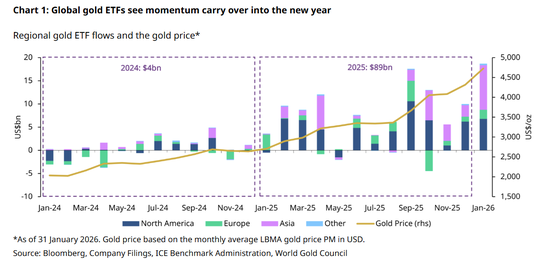
Core Insights - The World Gold Council reported that global gold ETFs attracted significant inflows in January, reaching record highs in both assets under management (AUM) and total holdings [1][14] - North American and Asian investors were the largest buyers, while European funds also saw notable growth [1][14] - The trading volume in the gold market surged to an average of $623 billion per day, marking a historic high [1][15] Inflows and Performance - In January, gold ETFs saw net inflows of $19 billion, the highest monthly record ever [1][15] - The AUM of global gold ETFs rose to $669 billion, a 20% increase month-over-month, while total holdings increased by 120 tons to 4,145 tons [4][16] - All regions recorded inflows, with North America achieving the second-highest monthly net inflow and Asia reaching the highest ever [4][16] Regional Market Overview - **North America**: Experienced a net inflow of $7 billion in January, marking the eighth consecutive month of inflows. Geopolitical tensions and rising gold prices drove investor interest [5][17] - **Europe**: Recorded a net inflow of $2 billion, supported by geopolitical and trade tensions, particularly related to tariffs [6][19] - **Asia**: Saw net inflows of $10 billion, with China contributing $6 billion and India $2.5 billion, driven by strong gold prices and geopolitical uncertainties [7][22] Trading Volume and Market Activity - The average daily trading volume in the gold market increased by 52% month-over-month, significantly higher than the average for the previous year [8][23] - The trading volume spike was particularly pronounced in the last week of January, with average daily transactions reaching $963 billion [11][26] - OTC trading and derivatives also saw substantial increases, with OTC daily volumes rising to $280 billion and derivatives to $320 billion [12][27] Positioning and Market Sentiment - Despite a 6% decrease in net long positions in COMEX gold, the overall market sentiment remained bullish, with investors showing a tendency to buy on dips [13][28]

地缘扰动叠加美元走弱,铂钯显著上行
Zhong Xin Qi Huo· 2026-01-27 00:59
Report Summary 1. Report Industry Investment Rating No information provided. 2. Core Viewpoints - Recently affected by geopolitical disturbances and a weak US dollar, platinum and palladium prices have significantly increased with the precious metals sector [1]. - The short - term trends of platinum and palladium are expected to be oscillatingly strong, and investors can consider low - buying opportunities, but should be wary of increased short - term price volatility [2][3]. 3. Summary by Related Content Platinum - As of January 26, 2026, the closing price of the GFEX platinum main contract was 744.7 yuan/gram, with a 9.68% increase [1]. - Main logic: Geopolitical and trade frictions have damaged market confidence in US government policy stability and US dollar credit. The strengthening of the Japanese yen has also pressured the US dollar. The nomination of the new Fed chairman and US tariff expectations for platinum and palladium are key market factors. In the future, South Africa, the main supplier of platinum - group metals, faces risks in power supply and extreme weather. The platinum market is in a structural expansion phase, with stable demand in the automotive catalyst field, the hydrogen energy industry as a future growth point, and expanding demand in jewelry and investment. The "interest rate cut + soft landing" combination will amplify long - term price elasticity [2]. - Outlook: Oscillatingly strong, as the supply - demand fundamentals are healthy and the macro - expectations are positive [2]. Palladium - As of January 26, 2026, the closing price of the GFEX palladium main contract was 534.8 yuan/gram, with a 7.17% increase [1]. - Main logic: Besides the weak US dollar and geopolitical disturbances, the supply side has significant uncertainties. The US Department of Commerce's report on unforged palladium imported from Russia has not been released, and the spot shortage continues to support prices. In the short term, palladium shows significant structural pressure. Although the long - term supply - demand is loosening, the short - term spot shortage and the Fed's re - entry into the interest rate cut cycle support the bottom of the palladium price [3]. - Outlook: Oscillatingly strong, due to the spot shortage and relatively favorable macro - environment [3]. Index Information - On January 26, 2026, the comprehensive index of CITICS Futures commodities was presented, including the commodity index (2503.03, +1.13%), the commodity 20 index (2879.55, +1.44%), and the industrial products index (2369.84, +0.40%) [49]. - The non - ferrous metals index on January 26, 2026, had a daily increase of +0.07%, a 5 - day increase of +1.31%, a 1 - month increase of +7.62%, and a year - to - date increase of +5.37% [51].
金银价格再创新高 还能涨多久?
Guo Ji Jin Rong Bao· 2026-01-19 17:39
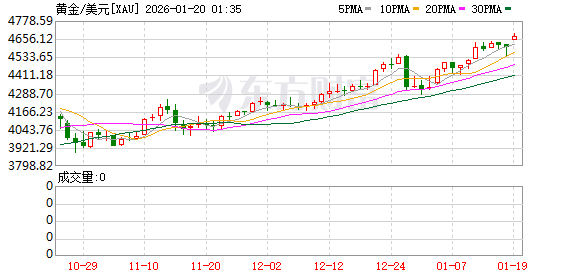
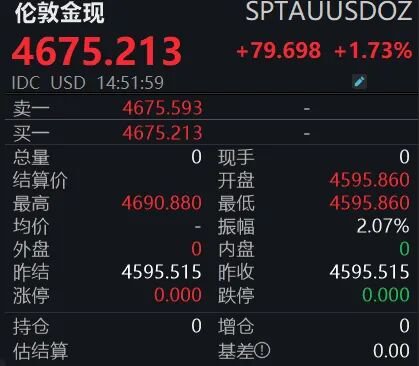
Core Viewpoint - Gold and silver prices have reached historical highs, driven by geopolitical tensions and market uncertainties, particularly following the announcement of punitive tariffs by the U.S. on several European countries [3][4][5]. Group 1: Market Performance - As of January 19, gold prices surged by 1.73% to $4,675.213 per ounce, with an intraday high of $4,690 per ounce [3]. - Silver prices increased by 3.75%, reaching $93.514 per ounce, with a peak of $94.12 per ounce during the day [3]. - COMEX gold futures rose by 1.81% to $4,678.4 per ounce, while COMEX silver futures jumped by 5.44% to $93.35 per ounce [3]. Group 2: Factors Behind the Surge - The price increase was triggered by U.S. President Trump's announcement of a 10% tariff on goods from eight European countries, which could rise to 25% if disputes continue [4][5]. - This geopolitical move has heightened market fears and increased demand for safe-haven assets like gold and silver [5][6]. Group 3: Market Sentiment and Future Outlook - Analysts suggest that the recent price surge reflects both immediate reactions to geopolitical risks and underlying structural trends in the precious metals market [6]. - The long-term outlook for gold remains bullish due to ongoing geopolitical tensions and central bank gold purchases, despite potential short-term volatility [7]. - Silver's price dynamics are more complex, influenced by industrial demand and potential supply constraints, which may support higher prices in the long run [7][8].
金银价格再创新高,还能涨多久?
Xin Lang Cai Jing· 2026-01-19 14:02
Core Viewpoint - Gold and silver prices reached historical highs on January 19, with London gold rising 1.73% to $4,675.213 per ounce and London silver soaring 3.75% to $93.514 per ounce, marking significant market movements [1][10]. Market Performance - London gold spot price increased by 1.73%, closing at $4,675.213 per ounce, with an intraday high of $4,690 per ounce [2][10]. - London silver spot price surged by 3.75%, reaching $93.514 per ounce, with a peak of $94.12 per ounce during the day [2][10]. - COMEX gold futures rose by 1.81% to $4,678.4 per ounce, hitting a high of $4,698 per ounce [3][12]. - COMEX silver futures experienced a significant increase of 5.44%, closing at $93.35 per ounce, with a maximum of $94.365 per ounce [4][13]. Factors Driving Price Increase - The surge in gold and silver prices was primarily triggered by geopolitical tensions, particularly the announcement by U.S. President Trump regarding punitive tariffs on eight European countries opposing the U.S. acquisition of Greenland [5][14]. - The tariffs, set to begin at 10% on February 1, 2026, and potentially rising to 25% by June 1, were seen as a direct challenge to international norms and increased market uncertainty, leading to heightened demand for safe-haven assets like gold and silver [5][14]. - The combination of geopolitical risks and concerns over the independence of the Federal Reserve, amid ongoing investigations into its chairman, further weakened the dollar's credibility, prompting a shift towards precious metals [6][16]. Market Sentiment and Future Outlook - Analysts suggest that the recent price increases reflect a robust underlying demand for gold and silver, driven by both defensive buying due to geopolitical risks and structural factors such as low silver inventories and strong industrial demand [7][16]. - The long-term outlook for gold remains bullish, supported by ongoing geopolitical tensions and central bank purchases, while silver's trajectory may be more volatile due to its dual role as an industrial metal and a safe-haven asset [8][17]. - Investors are advised to remain cautious of short-term volatility, as any easing of geopolitical tensions or unexpected strength in the dollar could lead to rapid profit-taking and price corrections [8][18].
德国5月机械设备订单强劲增长 欧元区需求成核心引擎
Xin Hua Cai Jing· 2025-07-02 12:38
Group 1 - The core viewpoint of the article highlights a significant increase in Germany's machinery and equipment manufacturing orders, driven by a surge in demand from the Eurozone, with a year-on-year growth of 9% in May [1] - Domestic orders in Germany grew by 2% year-on-year in May, while foreign orders saw a more substantial increase of 12%, indicating a strong recovery in the Eurozone [1] - The VDMA reported that cumulative orders for the first five months of 2025 increased by 3% year-on-year, with foreign business growing by 4% and domestic orders remaining stable [1] Group 2 - There is a notable divergence between domestic and foreign demand, with total machinery orders in Germany increasing by 2% year-on-year from March to May, but domestic orders declining by 1% while foreign orders grew by 4% [1] - VDMA's chief economist Johannes Gernandt emphasized that the low base from May of the previous year significantly contributed to the pronounced year-on-year growth, while global uncertainties continue to pose challenges for investment decisions [2] - Despite strong demand from the Eurozone, orders from non-Eurozone countries have been weak, with a reported decline of 4.4% in exports to the U.S. and a 12.2% drop in exports to China in the first quarter of 2025 [1][2]