
地缘政治因素影响油价

Search documents
大连商品交易所农产品日报-20260313
Guang Da Qi Huo· 2026-03-13 05:13
Group 1: Investment Ratings - No investment ratings are provided in the report. Group 2: Core Views - Corn: The maize futures contract 2605 increased in volume and price, oscillating around the 2400 yuan mark. The spot price of maize in the Northeast was stable with an upward trend, while that in North China remained stable. The market supply of maize was tight. After the profit - taking of long positions in the maize market, attention should be paid to the impact of policies on the grain market [1]. - Soybean and Soybean Meal: CBOT soybeans reached a two - year high. Domestic soybean meal futures followed the upward trend of the external market. The 5 - 9 spread of soybean meal decreased significantly, and the short - term long strategy was recommended [1]. - Palm Oil and Other Oils: BMD palm oil rose, and domestic oils were strong. The price of oils fluctuated with crude oil. The inventory of oils in the spot market declined, and the long - position holding strategy was recommended [1]. - Eggs: Egg futures continued to rebound. The spot price of eggs was flat. Due to sufficient supply and the off - season of demand, eggs were expected to oscillate within a range. For the long positions of the main contract, dynamic stop - profit was recommended [1]. - Pigs: Pig futures rebounded and then declined. The spot price of pigs was flat. The supply was sufficient and the demand was in the off - season. However, there was a demand for a rebound in the market, and attention should be paid to the impact of macro and spot prices on the market [1][2]. - Crude Oil: The short - term fundamentals of crude oil were strong, but there was a dispute over the duration of the Strait blockade. Oil prices might have three evolution paths depending on the development of the conflict. The current surge in oil prices was due to the re - pricing of supply security in the Middle East, and geopolitical factors dominated the market [3][4]. Group 3: Market Information - Geopolitical Negotiations: The US and Iran had differences in four core issues including negotiation scope, uranium enrichment, sanctions, and dialogue pre - conditions [3]. - Supply Blockade: Blocking the Strait of Hormuz affected 1500 - 2000 million barrels of crude oil transportation per day and cut off about 15% of global crude oil demand. Qatar's LNG export channels were mostly blocked [3]. - Passive Production Cuts: Iraq had cut nearly 1.5 million barrels per day of production, and the cut might double in the coming days [4]. - Price Projections: If the conflict eases, oil prices may fall to $95 - 100; if the situation remains the same, it will oscillate between $105 - 120; if the conflict escalates, it may reach $130 - 150 [4]. - Market Outlook: The current rise in oil prices is due to the re - pricing of supply security in the Middle East. Short - term volatility will remain high, and geopolitical factors dominate the market [4]. Group 4: Variety Spreads - Contract Spreads: The report presented the 5 - 9 spreads of corn, corn starch, soybeans, soybean meal, soybean oil, palm oil, eggs, and pigs, but no specific analysis was provided [5][6][8][9][11]. - Contract Basis: The report presented the basis of corn, corn starch, soybeans, soybean meal, soybean oil, palm oil, eggs, and pigs, but no specific analysis was provided [13][14][17][19][25]. Group 5: Research Team Introduction - Wang Na, the director of the agricultural product research at Everbright Futures Research Institute, has won the "Best Agricultural Product Analyst" title for many years and led the team to win various awards [27]. - Hou Xueling, a soybean analyst at Everbright Futures, has rich experience and has won multiple awards and published many articles [27]. - Kong Hailan, a researcher of eggs and pigs at Everbright Futures, has participated in various competitions and been interviewed by the media [27].
油价成交清淡,市场进入观望阶段
Xin Lang Cai Jing· 2026-01-19 23:31
Core Viewpoint - The oil market is currently in a phase of balance between bulls and bears, with recent trading days showing reduced volatility due to geopolitical uncertainties, particularly regarding the U.S. military actions in the Middle East and the situation in Iran [4][19]. Market Dynamics - On January 13, speculative investors increased net long positions in Brent crude oil by 85,496 contracts, bringing the total to 208,461 contracts, indicating a shift from a previously dominant bearish sentiment to a more balanced market [4][19]. - The recent geopolitical tensions have led to a partial retreat of the geopolitical premium in oil prices, with market participants closely monitoring developments in Iran [4][19]. Price Movements - As of the latest trading session, WTI crude oil futures closed at $59.43 per barrel, up by $0.09 (0.15%), while Brent crude oil futures fell by $0.19 (0.3%) to $63.94 per barrel [6][21]. - The INE crude oil futures decreased by 0.52%, closing at 440.30 yuan [6][21]. Recent Developments - Russia's oil and gas budget revenues are projected to decline by 46% in January 2025 compared to the previous year, primarily due to falling oil prices and the appreciation of the ruble, with expected revenues dropping to approximately 420 billion rubles (about $54.1 billion) [7][22]. - Azerbaijan's oil exports through the BTC pipeline are expected to decrease by 7.8% in 2025, primarily due to issues with contaminated crude oil [8][23]. Production and Processing - China's crude oil processing volume in December reached 62.46 million tons, a year-on-year increase of 5.0%, with an average daily processing volume of 2.015 million tons [10][25]. - In December, China's crude oil imports were 55.97 million tons, up 17.4% year-on-year, while total imports for the year reached 577.73 million tons, a 4.4% increase [10][25][26].


特朗普暗示暂缓对伊朗采取回应措施,原油结束六日连涨,布伦特油价跌穿65美元
智通财经网· 2026-01-15 02:05
Group 1 - Oil prices experienced a decline for the first time in six days, primarily due to President Trump's indication of a potential delay in military action against Iran [1] - Brent crude futures fell by 3%, dropping below $65 per barrel, after previously rising approximately 11% in the prior week [1] - WTI crude futures traded around $60 per barrel, reflecting the overall market sentiment influenced by geopolitical factors [1] Group 2 - The situation in Iran remains volatile, with authorities temporarily closing airspace around Tehran, while the U.S. has redeployed some personnel from military bases in Qatar and the region [1] - The international oil market regained premium support at the beginning of the year, reversing a five-month streak of monthly declines due to oversupply expectations [1] - The U.S. government reported a significant increase in national crude oil inventories, rising by 3.4 million barrels, marking the largest weekly increase since early November [2]
原油价格再度震荡翻红!
2 1 Shi Ji Jing Ji Bao Dao· 2026-01-05 11:05
Group 1 - The oil market experienced significant volatility, with WTI crude oil reaching a high of $57.73 and Brent crude oil hitting $61.24 before both prices fell below their opening levels, with WTI dropping to $56.31 and Brent to $59.75, reflecting a decline of over 1.6% [1] - By the end of the trading day, WTI crude oil was up 0.07% at $57.37, while Brent crude oil increased by 0.13% to $60.83 [1] Group 2 - Venezuela holds the world's largest proven oil reserves, estimated at over 300 billion barrels, accounting for nearly one-fifth of global oil resources, surpassing Saudi Arabia and being approximately 6.7 times that of the U.S. [3] - The United Nations Secretary-General expressed shock over the escalating situation in Venezuela, with an emergency meeting scheduled to discuss U.S. military actions [3] - The potential regime change in Venezuela is viewed as a significant geopolitical factor that could influence oil prices, although concerns about global supply excess remain a long-term pressure on prices [3] - The U.S. has long sought access to Venezuela's heavy crude oil, with plans for major U.S. oil companies to invest billions to repair the country's oil infrastructure [3][4] Group 3 - Venezuela's proven oil reserves are primarily located in the Orinoco Belt, the largest heavy oil reserve globally, which complements the U.S. market that mainly produces light crude oil [4] - Previous sanctions on Venezuela and Russia forced U.S. refineries to use more expensive alternatives, impacting profit margins [4] - If U.S. policies affect Venezuela's oil industry, refiners along the U.S. Gulf Coast could benefit, as Venezuelan heavy crude aligns with the processing capabilities of many local refineries [4]
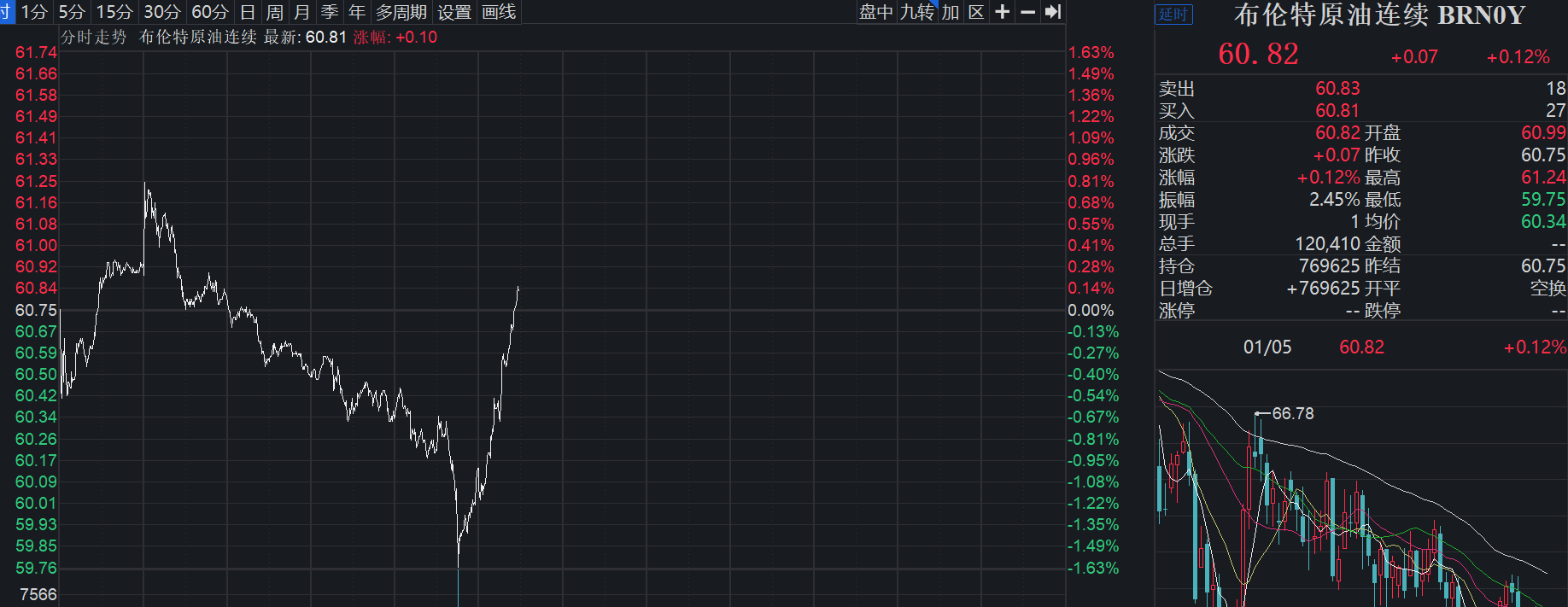
油价跳水翻绿,委内瑞拉超1700万桶原油滞留海上,危机或影响化工市场
21世纪经济报道· 2026-01-05 06:26
Core Viewpoint - The recent capture of Venezuelan President Maduro has led to fluctuations in the oil market, with initial price increases followed by declines due to ongoing geopolitical tensions and supply issues [1][4]. Group 1: Oil Market Reactions - Following Maduro's capture, U.S. crude oil prices rose by 0.5% to a peak of $57.73 per gallon, while Brent crude reached $61.24 per gallon before both experienced declines [1]. - As of 13:40 Beijing time, U.S. crude oil fell by 0.44% to $57.07, and Brent crude decreased by 0.36% to $60.53 [1]. Group 2: Venezuelan Oil Production and Exports - Venezuela's oil exports have plummeted to nearly zero due to U.S. sanctions, with the country’s oil production being significantly affected, leading to a near saturation of domestic storage facilities [2][3]. - The total amount of Venezuelan oil stranded at sea has exceeded 17 million barrels, with daily production dropping from approximately 1.1 million barrels in November to about 500,000 barrels in December [3]. Group 3: Global Oil Supply and Demand Dynamics - Venezuela holds the world's largest proven oil reserves, estimated at over 300 billion barrels, which is nearly one-fifth of the global total [3]. - Despite the short-term potential for price spikes due to geopolitical factors, the long-term outlook remains bearish due to global economic weakness and an oversupply of oil [4]. Group 4: Implications for the Chemical Industry - The disruption in Venezuelan oil supply, particularly of the Merey crude, is expected to lead to shortages in asphalt production, impacting downstream industries such as road construction [5]. - The ongoing geopolitical tensions may also affect methanol supplies to China, as Venezuela's exports are crucial for the region's methanol production [5]. - Rising oil prices are likely to increase costs across the chemical supply chain, affecting the pricing of various downstream products [5].

多家机构预测:2026年原油均价低于60美元
Zhong Guo Hua Gong Bao· 2025-12-16 03:23
Group 1 - The core viewpoint is that most investment banks and the EIA predict that the average oil price in 2026 will be below $60 per barrel due to persistent oversupply, weak global demand growth, and increased supply from OPEC+ and non-OPEC+ oil-producing countries [1][2] - The EIA's latest short-term energy outlook estimates that global oil inventories will continue to rise, with Brent crude averaging $54 in Q1 and $55 for the entire year, an increase of $3 from the previous month, driven by China's strategic reserve purchases and intensified sanctions on Russian oil [1] - Macquarie Group anticipates lower oil prices next year but notes that sanctions on Russia, the situation in Venezuela, and cold winter weather in the U.S. may slow the decline in oil prices, suggesting that OPEC+ may need to cut production in the second half of 2026 to stabilize the market [1] Group 2 - ABN AMRO Bank highlights that weak oil demand and increased supply lead to oversupply, predicting Brent prices of $58 in Q1, $52 mid-year, and $50 by year-end, with an annual average of $55 [1] - SEB Bank indicates a clear downward trend in oil prices, stating that geopolitical premiums from the tense situation in Venezuela cannot offset the bearish backdrop of increased supply and oversupply [1] - A late November Reuters survey shows that oversupply is a key factor for the 2026 oil market, with U.S. benchmark prices expected to be below $60, with WTI averaging $59 and Brent at $62.23, down from $63.15 in October [2]
中东停火协议达成,国际油价跌10%抹去两周涨幅
Sou Hu Cai Jing· 2025-06-27 05:41
Group 1 - The recent volatility in the international crude oil futures market is driven by geopolitical factors in the Middle East, leading to a significant price increase followed by a sharp decline as tensions eased [1][2] - Following the U.S. airstrikes on Iranian nuclear facilities, WTI and ICE Brent crude futures reached around $80, marking a new high since January, with concerns over potential blockage of the Strait of Hormuz, a critical oil transport route [2] - The likelihood of Iran completely blocking the Strait of Hormuz is considered low due to military, economic, and public pressure factors, despite the Strait handling approximately 20 million barrels of oil transport daily [2] Group 2 - The announcement of a ceasefire agreement between Iran and Israel, accepted by Iran, led to a dramatic reversal in oil prices, with ICE Brent crude dropping by 8% and WTI crude falling by 9%, erasing nearly all gains from the previous two weeks [3] - Following the ceasefire, oil prices continued to fluctuate at lower levels, with WTI and ICE Brent futures dropping over 2% to around $67 [3] - OPEC+ has announced production increases for three consecutive months, extending a voluntary production cut of 2.2 million barrels per day until March 2025, despite actual production increases in April and May exceeding planned levels [3]