
原油市场供需

Search documents
大越期货原油早报-20260323
Da Yue Qi Huo· 2026-03-23 03:10
Report Industry Investment Rating - Not provided in the content Core Viewpoints - In the short term, the war between the US, Israel, and Iran continues to intensify, providing strong support for oil prices. In the medium to long term, the increasing passive production cuts in the Middle East and the poor navigation situation provide upward support for prices. It is recommended to operate in the range of 790 - 810 for SC2605 and take a long - term wait - and - see approach [3]. Summary by Directory 1. Daily Prompt - **Fundamentals**: Tensions between the US, Israel, and Iran continue to escalate. Iraq's southern port has stopped oil exports, and the daily output of Basra Oil Company has dropped from 3.3 million barrels to 900,000 barrels [3]. - **Basis**: On March 20, the spot price of Oman crude oil was $158.9 per barrel, and the spot price of Qatar Marine crude oil was $104.27 per barrel. The basis was 24.37 yuan per barrel, with the spot at a premium to the futures [3]. - **Inventory**: The API crude oil inventory in the US for the week ending March 13 increased by 6.556 million barrels, and the EIA inventory increased by 6.156 million barrels. The Cushing area inventory increased by 944,000 barrels. The Shanghai crude oil futures inventory as of March 20 was 3.511 million barrels, unchanged [3]. - **Disk**: The 20 - day moving average is upward, and the price is above the average [3]. - **Main Position**: As of March 17, the main position of WTI crude oil is long, with a decrease in long positions; the main position of Brent crude oil is long, with an increase in long positions [3]. - **Expectation**: The Trump administration has started preliminary consultations on the next - stage arrangements and possible peace negotiations with Iran. However, the war intensity remains high, providing short - term support for prices. The increasing passive production cuts in the Middle East and the poor navigation situation provide medium - to - long - term upward support. It is recommended to operate in the range of 790 - 810 for SC2605 and take a long - term wait - and - see approach [3]. 2. Recent News - **Diplomatic Negotiations**: Jared Kushner and Steve Witkoff are involved in potential diplomatic negotiations. Any agreement to end the war must include reopening the Strait of Hormuz, resolving Iran's high - enriched uranium reserve issue, and reaching long - term agreements on Iran's nuclear program, ballistic missiles, and support for regional proxy forces. Egypt, Qatar, and the UK are transmitting information between the two countries. Iran has set six strategic conditions to stop the war, and a cease - fire is not expected soon [5]. - **Oil Release**: The Trump administration has lent 45.2 million barrels of crude oil from the strategic petroleum reserve to oil companies and issued a 30 - day sanctions waiver for purchasing Iranian oil at sea to ease the energy supply pressure [5]. - **Fed's Stance**: Fed Governor Waller believes that the risk of persistent inflation has increased, supporting keeping interest rates unchanged. Fed Vice - Chair for Supervision Bowman believes it is too early to judge the long - term impact on the US economy. Short - term interest rate contract traders are starting to price in a December interest rate hike [5]. 3. Long - Short Concerns - **Bullish Factors**: Difficulties in strait passage and the deterioration of the Middle East situation [6]. - **Bearish Factors**: Sanctioned oil returning to the market, Trump's intention to end the war quickly, and the release of strategic reserves by IEA member countries [6]. - **Market Driver**: In the short term, continue to focus on geopolitical situation changes; in the medium to long term, wait for the situation to ease before entering the market for a reversal [6]. 4. Fundamental Data - **Futures Market**: The settlement price of Brent crude oil increased from $103.78 to $106.41, an increase of 2.53%; WTI crude oil increased from $95.55 to $98.23, an increase of 2.80%; SC crude oil decreased from 803.4 to 776.4, a decrease of 3.36%; Oman crude oil decreased from $166.96 to $157.94, a decrease of 5.40% [7]. - **Spot Market**: The price of UK Brent Dtd decreased by 0.35%, WTI increased by 2.17%, Oman crude oil decreased by 4.82%, Shengli crude oil decreased by 2.52%, and Dubai crude oil decreased by 4.82% [9]. - **API Inventory**: As of March 13, the API inventory increased by 6.556 million barrels to 472.774 million barrels [11]. - **EIA Inventory**: As of March 13, the EIA inventory increased by 6.156 million barrels to 449.259 million barrels [13]. 5. Position Data - **WTI Crude Oil**: As of March 17, the net long position was 218,688, a decrease of 9,327 [17]. - **Brent Crude Oil**: As of March 17, the net long position was 428,704, an increase of 77,672 [19].
油价上涨又“回吐”,博弈点仍在霍尔木兹海峡将被“锁”多久
经济观察报· 2026-03-02 11:18
Core Viewpoint - The current geopolitical tensions between the U.S. and Iran have led to a short-term oil price premium of approximately $5 to $6 per barrel, primarily due to disruptions in the transportation capacity of the Strait of Hormuz, a critical oil transport route [2][3]. Group 1: Oil Price Dynamics - Brent crude oil opened significantly higher, with an initial increase of nearly 13% to around $81 per barrel, before retracting to approximately $78 per barrel, reflecting a 7% increase [2]. - The future trajectory of oil prices will largely depend on the extent and duration of the impact on transportation through the Strait of Hormuz [2][3]. Group 2: Impact of Strait of Hormuz Closure - If the transportation capacity of the Strait of Hormuz is severely affected for an extended period, global oil transportation may face significant disruptions [3]. - The Strait of Hormuz is vital, with up to 20 million tons of liquid products, including 14 million barrels of crude oil, passing through daily, accounting for one-third of global maritime oil trade [3]. Group 3: OPEC and Global Supply - OPEC announced an increase of 206,000 barrels per day starting in April, but this may not be sufficient to counteract rising oil prices if the conflict persists [3]. - In the event of a prolonged conflict, finding alternative routes for oil transport may prove challenging, especially for OPEC members reliant on the Strait for exports [4]. Group 4: Long-term Market Outlook - Global oil supply remains manageable if the conflict does not extend significantly, with OPEC's planned production increase expected to maintain a supply surplus in the long term [5]. - Oil prices are projected to remain low in 2025, fluctuating between $60 and $80 per barrel, influenced by OPEC's production strategies and geopolitical tensions [5]. - The overall demand for oil is showing moderate recovery but lacks strong positive drivers, leading to a phase of weak demand growth [5].


大越期货原油早报-20260210
Da Yue Qi Huo· 2026-02-10 02:08
1. Report Industry Investment Rating - No relevant information provided 2. Core View of the Report - Geopolitical factors continue to support oil prices. Russian crude oil production declined for the second consecutive month in January due to difficulties in sales caused by US sanctions. Some crude oil flows from India have shifted to China. The US warning about ships passing through the Strait of Hormuz indicates unstable situation, which boosts oil prices. Although there are signs of progress in the nuclear negotiations between Washington and Tehran, the warning still exists. In the short - term, supply - side tightness factors also push up oil prices. The SC2604 is expected to operate in the range of 470 - 480, and there are long - term opportunities to short at high levels [3]. 3. Summary by Directory 3.1 Daily Prompt - **Fundamentals**: Russian oil tankers are increasingly listing Singapore as the official destination, indicating a shift in export flows from India to China and growing concerns about Western sanctions. The US issued the latest guidelines for merchant ships passing through the Strait of Hormuz, suggesting that US - flagged ships stay away from Iranian territorial waters and reject boarding requests verbally [3]. - **Basis**: On February 9, the spot price of Oman crude oil was $67.21 per barrel, and that of Qatar Marine crude oil was $66.56 per barrel. The basis was 31.55 yuan/barrel, with the spot price at a premium to the futures price [3]. - **Inventory**: US API crude oil inventory decreased by 11.079 million barrels in the week ending January 30, far exceeding the expected decrease of 256,000 barrels. EIA inventory decreased by 3.455 million barrels in the same week, while the expected increase was 489,000 barrels. Cushing area inventory decreased by 743,000 barrels in the week ending January 30. As of February 9, the Shanghai crude oil futures inventory remained unchanged at 3.464 million barrels [3]. - **Market**: The 20 - day moving average is upward, and the price is above the average [3]. - **Main Position**: As of February 3, the main positions of WTI and Brent crude oil were long, and the long positions increased [3]. - **Expectation**: SC2604 is expected to operate in the range of 470 - 480, and there are long - term opportunities to short at high levels [3]. 3.2 Recent News - **Price Increase**: Crude oil prices have risen for two days due to the risk premium caused by the Middle East tension. WTI crude oil has risen 1.7% in the past two trading days and is trading above $64 per barrel, while Brent crude oil is above $69. The US warned ships passing through the Strait of Hormuz, although there are signs of progress in the nuclear negotiations between the US and Iran [5]. - **Russian Output**: Russia's crude oil production decreased for the second consecutive month in January, averaging 9.28 million barrels per day (excluding condensate). This is 46,000 barrels per day less than in December and nearly 300,000 barrels per day lower than the production allowed under the OPEC+ agreement. The amount of Russian oil stored on tankers has been increasing, and as of early February, the backlog of Russian crude oil at sea has reached 143 million barrels, almost double that of a year ago and more than a quarter higher than in late November [5]. - **US Warning**: The US government warned that US - flagged ships should stay away from Iranian waters when passing through the Strait of Hormuz due to a recent ship harassment incident, indicating continued tension between the US and Iran [5]. 3.3 Bullish and Bearish Concerns - **Bullish Factors**: Sanctions against Russia and the tense situation in Iran [6]. - **Bearish Factors**: IEA's concern about crude oil surplus and the alleviation of supply problems in some oil - producing countries [6]. - **Market Driver**: Short - term focus on geopolitics; long - term risk of oversupply [6]. 3.4 Fundamental Data - **Futures Market**: The settlement prices of Brent crude oil, WTI crude oil, SC crude oil, and Oman crude oil have changed. Brent crude oil rose from $68.05 to $69.04, an increase of 1.45%. WTI crude oil rose from $63.55 to $64.36, an increase of 1.27%. SC crude oil rose from 461.8 to 466.0, an increase of 0.91%. Oman crude oil rose from $67.46 to $67.78, an increase of 0.47% [7]. - **Spot Market**: The prices of UK Brent Dtd, WTI, Oman crude oil, Shengli crude oil, and Dubai crude oil have changed. UK Brent Dtd rose from $71.42 to $72.29, an increase of 1.22%. WTI rose from $63.55 to $64.36, an increase of 1.27%. Oman crude oil decreased from $67.93 to $67.21, a decrease of 1.06%. Shengli crude oil decreased from $64.28 to $63.57, a decrease of 1.10%. Dubai crude oil decreased from $68.19 to $67.13, a decrease of 1.55% [9]. - **Inventory Data**: API inventory decreased by 11.079 million barrels in the week ending January 30. EIA inventory decreased by 3.455 million barrels in the same week [3]. 3.5 Position Data - **WTI Crude Oil**: As of February 3, the net long position of WTI crude oil funds was 124,565, an increase of 27,583 [18]. - **Brent Crude Oil**: As of February 3, the net long position of Brent crude oil funds was 278,249, an increase of 31,332 [20].
原油周报:伊朗地缘风险升级,油价显著走强-20260201
Xinda Securities· 2026-02-01 13:02
Investment Rating - The report maintains a "Positive" investment rating for the oil processing industry [1]. Core Insights - International oil prices have significantly strengthened due to escalating geopolitical risks in Iran and adverse weather conditions affecting U.S. oil production. As of January 30, 2026, Brent and WTI prices were reported at $69.32 and $65.21 per barrel, respectively, marking increases of 6.53% and 6.78% from the previous week [2][9]. - The oil and petrochemical sector has shown strong performance, with the sector index rising by 7.95% as of January 30, 2026, compared to a slight increase of 0.08% in the broader market index [10]. - The report highlights a notable increase in the number of active offshore drilling platforms, with a total of 376 self-elevating platforms and 134 floating platforms as of January 26, 2026 [26]. Summary by Sections Oil Price Review - Brent crude futures settled at $69.32 per barrel, up $4.25 (+6.53%) from the previous week, while WTI crude futures rose to $65.21 per barrel, an increase of $4.14 (+6.78%) [23]. - The Urals crude price remained stable at $65.49 per barrel, while ESPO crude increased by $4.42 (+8.66%) to $55.46 per barrel [23]. Offshore Drilling Services - The global count of self-elevating drilling platforms remained at 376, while floating platforms increased by one to a total of 134 [26]. U.S. Oil Supply - U.S. crude oil production was reported at 13.696 million barrels per day, a decrease of 36,000 barrels from the previous week. The number of active drilling rigs remained stable at 411 [32]. - The U.S. fracking fleet decreased by 15 units to a total of 148 [32]. U.S. Oil Demand - U.S. refinery crude processing averaged 16.209 million barrels per day, down by 395,000 barrels from the previous week, with a refinery utilization rate of 90.90%, a decline of 2.4 percentage points [40]. U.S. Oil Inventory - Total U.S. crude oil inventories stood at 839 million barrels, a decrease of 1.78 million barrels (-0.21%) from the previous week. Strategic reserves increased by 515,000 barrels (+0.12%), while commercial inventories fell by 2.295 million barrels (-0.54%) [49]. Related Companies - Key companies in the sector include China National Offshore Oil Corporation (CNOOC), China Petroleum & Chemical Corporation (Sinopec), and China National Petroleum Corporation (CNPC) [3].






原油周报:地缘反复,短线走强-20260126
Hua Lian Qi Huo· 2026-01-26 03:25
Report Industry Investment Rating - Not provided in the report Core Viewpoints - The overall supply and demand of crude oil still tend to be in surplus, but recent trends are still affected by geopolitical factors between the US and Iran and weather conditions in Europe and the US. The medium - to long - term outlook is still bearish, but short - term attention should be paid to the pulsed bullish impact of geopolitics. It is recommended to hold long call option positions for protection, with the resistance level of the SC2603 contract at 450 - 460 yuan/barrel [8] Summary by Directory Supply - **Drilling Quantity**: As of December last year, the global active oil and gas rig count was 1,782, a decrease of 30 from the previous month and 82 from the same period last year. Among them, the number of US rigs was 546, a decrease of 3 from the previous month and 43 from the same period last year [27] - **OPEC and Saudi Arabia's Crude Oil Production**: In December, the total OPEC+ crude oil production was 42.831 million barrels per day, a decrease of 238,000 barrels per day from the previous month. OPEC's crude oil production was 28.564 million barrels per day, an increase of 105,000 barrels per day from the previous month. Saudi Arabia's crude oil production was 10.078 million barrels per day, an increase of 27,000 barrels per day from the previous month [8][31] - **US Crude Oil Production**: As of the week of January 16, US crude oil production was 13.732 million barrels per day, a decrease of 21,000 barrels per day from the previous week and an increase of 248,000 barrels per day from the same period last year. US shale oil production in December was 9.22 million barrels per day, accounting for about 66% of total crude oil production [47] - **China's Crude Oil Production and Imports**: In 2025, China's cumulative crude oil production was 216 million tons, a 2.1% decrease from the previous month and a 1.54% increase from the same period last year. Cumulative crude oil imports were 522 million tons, a 4.4% increase from the previous year [51] Demand - **Crude Oil Demand**: In 2025, the global crude oil demand was 104 million barrels per day, a 0.43% increase from the previous month and a 1.10% increase from the same period last year. China's apparent crude oil consumption in 2025 was 791 million tons, a 3.44% increase from the previous year [58] - **Refinery Utilization Rates**: As of the week of January 16, the US refinery utilization rate was 93.3%, a decrease of 2 percentage points from the previous week and an increase of 7.4 percentage points from the same period last year. The US refineries will enter the spring maintenance period, and the utilization rate may gradually decline. China's refinery utilization rate was 71.42%, an increase of 0.8 percentage points from the previous week and an increase of 1.75 percentage points from the same period last year [62] - **Refined Oil Production and Exports**: In 2025, China's cumulative gasoline production from January to December was 162.8 million tons, a 5.07% decrease from the previous year; cumulative gasoline exports were 8.0128 million tons, a 17.7% decrease from the previous year. Cumulative diesel production was 209.6 million tons, a 4.55% decrease from the previous year; cumulative diesel exports were 6.68 million tons, a 16.6% decrease from the previous year. Cumulative kerosene production was 61.6166 million tons, a 5.76% increase from the previous year; cumulative kerosene exports were 21.8231 million tons, a 14.61% increase from the previous year [70][76][80] - **Automobile and Truck Production**: In 2025, China's cumulative automobile production was 34.531 million, a 10.4% increase from the previous year. Among them, cumulative new energy vehicle production was 16.626 million, a 29% increase from the previous year. The new energy vehicle industry in China has developed rapidly since 2020, having a certain substitution effect on traditional oil product demand [85] Inventory - **OECD and Global In - Transit Crude Oil Inventory**: According to the OPEC monthly report in January, OECD's commercial oil inventory in November increased by 4 million barrels month - on - month (with crude oil increasing by 8.1 million barrels and refined oil decreasing by 4.1 million barrels), 77.6 million barrels higher than the same period last year and slightly 0.3 million barrels higher than the five - year average. The global in - transit crude oil inventory remained at a high level [91] - **US Crude Oil and Refined Oil Inventory**: As of the week of January 16, US commercial crude oil inventory increased by 3.602 million barrels, and Cushing crude oil inventory increased by 1.478 million barrels. The EIA gasoline inventory increased by 5.977 million barrels, and distillate fuel oil inventory increased by 3.348 million barrels. Due to the weakening of refinery utilization rates and weak terminal consumption, refined oil inventories continued to accumulate [93][96] - **China's Crude Oil Inventory**: China's crude oil port inventory continued to decline, and the inventory was higher than the same period last year. The exchange warehouse receipt inventory remained stable at a low level [101] Market - **International and Domestic Crude Oil Prices**: Last week, international crude oil prices first rose and then fell, and the main contracts were at the lowest level in recent years during the same period. The domestic SC crude oil mainly followed the trend of international crude oil. The B - W spread weakened slightly last week and was higher than the same period last year. The SC - Oman spread rebounded and was lower than the same period last year [16][21][23]
周末前 受伊朗局势影响 油价小幅回升
Xin Lang Cai Jing· 2026-01-16 14:24
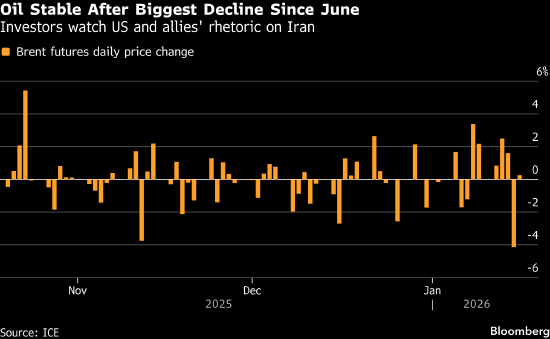
Group 1 - Oil prices experienced volatility but ended slightly higher as traders weighed the tensions in Iran against overall market sentiment [1][4] - Brent crude oil prices fell by 4.2% on Thursday, marking the largest single-day drop since June, before recovering to above $64 per barrel [1][4] - Concerns about potential U.S. military action against Iran, which could disrupt oil production or transportation, have eased following Israeli Prime Minister Benjamin Netanyahu's request to delay such actions [1][4][5] Group 2 - The U.S. is increasing its military presence in the Middle East, with at least one aircraft carrier moving to the region and more military equipment expected to follow [5] - Despite a decrease in the immediate risk of U.S. military intervention in Iran, geopolitical risks remain, keeping the market on alert [5] - If the U.S. does not take action soon, the risk premium may continue to shrink, allowing more bearish fundamental factors to dominate the market [5] Group 3 - Since January 8, oil prices have been driven higher by concerns over potential U.S. actions against OPEC's fourth-largest oil producer, which could threaten over 3 million barrels per day of oil production [7] - Additional factors contributing to the oil market's recovery include disruptions in Kazakhstan's oil exports and tightening supply in the North Sea [7] - The low oil prices have begun to have tangible impacts, with independent oil exploration billionaire Harold Hamm indicating that his company will shut down drilling operations in North Dakota's Bakken region due to low prices [7]
建信期货原油日报-20260116
Jian Xin Qi Huo· 2026-01-16 01:17
1. Report Industry Investment Rating - No relevant information provided 2. Core Viewpoints of the Report - Trump's statement about Iran and the easing of the Middle - East situation led to a rapid decline in the geopolitical premium of crude oil, with the WTI main contract falling below $60 again [6]. - The US is gradually lifting sanctions on Venezuela and selling Venezuelan crude oil, resulting in a marginal negative impact on the supply side. There is also a stockpiling pressure of nearly 3 million barrels per day in the crude oil market in Q1 2026, making the supply - demand situation of oil prices bearish [7]. 3. Summary by Directory 3.1 Market Review and Operation Suggestions - **Market Quotes**: WTI main contract opened at $60.88, closed at $61.02, with a high of $62.20, a low of $59.08, a daily increase of 0.15%, and a trading volume of 41.45 million lots; Brent main contract opened at $65.44, closed at $65.39, with a high of $66.82, a low of $63.45, a daily decrease of 0.12%, and a trading volume of 69.33 million lots; SC main contract opened at 456.4 yuan/barrel, closed at 444.9 yuan/barrel, with a high of 458.7 yuan/barrel, a low of 441.3 yuan/barrel, a daily decrease of 0.89%, and a trading volume of 5.66 million lots [6]. - **Market Analysis**: Trump's remarks on Iran and the easing of the Middle - East situation caused a rapid decline in the geopolitical premium. The US lifting sanctions on Venezuela and selling Venezuelan crude oil brought marginal negative factors to the supply side, and there was a stockpiling pressure in Q1 2026 [6][7]. 3.2 Industry News - Venezuela's crude oil production in December decreased by 60,000 barrels per day to 896,000 barrels per day [8]. - OPEC maintained its forecast for global oil demand growth in 2026 at 1.38 million barrels per day and expected it to be 1.34 million barrels per day in 2027 [8]. - Goldman Sachs maintained its forecast for Iran's crude oil production in 2026, expecting it to remain stable at around 3.5 million barrels per day [8]. - Iran's oil minister said that Iran's oil exports had achieved record - breaking growth in the past 14 months [8]. 3.3 Data Overview - The report presents multiple data charts, including global high - frequency crude oil inventory, EIA crude oil inventory, US crude oil production growth rate, Dtd Brent price, WTI spot price, Oman spot price, US gasoline consumption, and US diesel consumption, with data sources from Bloomberg, EIA, and Wind [10][14][21][23]
建信期货原油日报-20260113
Jian Xin Qi Huo· 2026-01-13 02:05
Group 1: Report Information - Report title: Crude Oil Daily [1] - Date: January 13, 2026 [2] Group 2: Investment Rating - No investment rating information provided Group 3: Core View - Geopolitical risks have eased, the US is gradually lifting sanctions on Venezuela and starting to sell Venezuelan crude oil, resulting in marginal bearishness on the supply side. Coupled with the inventory build - up pressure of nearly 3 million barrels per day in the crude oil market in Q1 2026, crude oil is expected to be weak. Attention should be paid to the situation in Iran [7] Group 4: Market Review and Operation Suggestions Market Review | Variety | Opening Price ($/barrel) | Closing Price ($/barrel) | Highest Price ($/barrel) | Lowest Price ($/barrel) | Change (%) | Trading Volume (10,000 lots) | | --- | --- | --- | --- | --- | --- | --- | | WTI (main contract) | 58.19 | 58.62 | 59.57 | 57.46 | 1.7 | 27.71 | | Brent (main contract) | 62.6 | 63.02 | 63.92 | 61.83 | 1.66 | 45.85 | | SC (main contract, Yuan/barrel) | 431.7 | 437.5 | 440.1 | 429.8 | 2.75 | 8.66 | [6] Event - Trump met with the heads of 17 major oil companies at the White House. After the meeting, Trump said that oil companies would invest $100 billion in Venezuela to revitalize its oil industry. Oil companies have different attitudes. ExxonMobil is cautious about increasing investment, while Chevron expects to increase production by 120,000 barrels per day in 18 - 24 months, and Repsol expects to increase production by 100,000 barrels per day in two to three years [6] Group 5: Industry News - Iranian Foreign Ministry spokesman: In addition to Switzerland as an intermediate channel, the communication channel between Iran and the US special envoy remains open [8] - US President Trump: He is in contact with Iranian opposition leaders and is studying very tough options against Iran. The military is also studying this matter [8] - US President Trump: Cuba has relied on a large amount of oil and funds from Venezuela for years, but this will no longer happen. He strongly advises Cuba to reach an agreement quickly [8] Group 6: Data Overview - The report provides multiple data charts, including global high - frequency crude oil inventory, EIA crude oil inventory, US crude oil production growth rate, Dtd Brent price, WTI spot price, Oman spot price, US gasoline consumption, and US diesel consumption. The data sources are Bloomberg, EIA, and Wind [10][14][21][23]
建信期货原油日报-20260109
Jian Xin Qi Huo· 2026-01-09 01:54
1. Report Industry Investment Rating - No relevant information provided 2. Core Viewpoints of the Report - In the short term, geopolitical tensions have eased, and there is insufficient support for oil prices. Venezuelan resources will flow to the US first, which will support the domestic asphalt market. In the long - term, as the US takes over Venezuela's oil sector, sanctions will be gradually lifted, and production capacity will gradually recover, putting pressure on the supply side [7] - The EIA data from the week ending on the 2nd shows that US crude oil inventories decreased by 3.83 million barrels, but gasoline and diesel inventories increased significantly, and the data is neutral [6] 3. Summary by Directory 3.1 Market Review and Operation Suggestions - WTI's opening price was $57, closing price was $56.4, highest price was $57.17, lowest price was $55.76, with a decline of 1.28% and a trading volume of 352,400 lots. Brent's opening price was $60.1, closing price was $60.39, highest price was $60.93, lowest price was $59.81, with a decline of 0.51% and a trading volume of 467,400 lots. SC's opening price was 421.4 yuan/barrel, closing price was 416.2 yuan/barrel, highest price was 422.5 yuan/barrel, lowest price was 414.1 yuan/barrel, with a decline of 2.02% and a trading volume of 70,300 lots [6] - The US has lifted some sanctions on Venezuelan crude oil and started selling Venezuelan crude. Trump said that Venezuela's interim administration will transfer 30 - 50 million barrels of high - quality, sanctioned oil to the US, and Venezuela must cooperate only with the US in oil production and prioritize the US when selling heavy crude [6] 3.2 Industry News - Trump said he has started making money for the US by obtaining sanctioned oil. Trump and his advisors are planning a large - scale plan to dominate Venezuela's oil industry in the coming years. Trump hopes to push oil prices down to $50 per barrel. If successful, the US will control most of the Western Hemisphere's oil reserves. One proposed plan is for the US to control the Venezuelan state - owned oil company PdVSA to some extent, including obtaining and selling most of its crude oil production [8] 3.3 Data Overview - The report presents multiple data charts, including global high - frequency crude oil inventories, EIA crude oil inventories, US crude oil production growth rate, WTI and Brent spot prices, and US gasoline and diesel consumption, with data sources from Bloomberg, EIA, and Wind [11][12][17]
宝城期货原油早报-20260108
Bao Cheng Qi Huo· 2026-01-08 02:20
Report Summary 1. Industry Investment Rating - No industry investment rating is provided in the reports [1][5] 2. Core Viewpoints - The crude oil 2602 contract is expected to be volatile in the short - and medium - term, and weak in the intraday. Overall, it is likely to run weakly, with oversupply in the supply - demand situation being the dominant factor [1] - Although geopolitical risks have increased during the New Year's holiday, the weak supply - demand situation in the crude oil market is the long - term logic for the decline in oil prices. It is expected that domestic crude oil futures prices on Thursday may maintain a volatile and weak trend [5] 3. Summary by Related Catalogs 3.1 Time - period and Viewpoint Summary - **Short - term**: The short - term view of crude oil 2602 is "volatility" [1] - **Medium - term**: The medium - term view of crude oil 2602 is "volatility" [1] - **Intraday**: The intraday view of crude oil 2602 is "weak", and the reference view is "weakly running" [1][5] 3.2 Price Movement and Driving Logic - The core logic for the weak trend of crude oil is the oversupply in the supply - demand situation [1] - During the New Year's holiday, geopolitical risks increased due to the US military operation in Venezuela and threats to other South American countries, which may be a factor for the post - holiday oil price increase. However, the long - term pressure on oil prices comes from the weak supply - demand situation in the crude oil market. The domestic crude oil futures maintained a volatile and weak trend on Wednesday night and are expected to continue this way on Thursday [5]