外汇套利交易

Search documents
美元走弱助推外汇套利交易开门红 华尔街押注新兴货币涨势延续
Zhi Tong Cai Jing· 2026-01-26 15:45
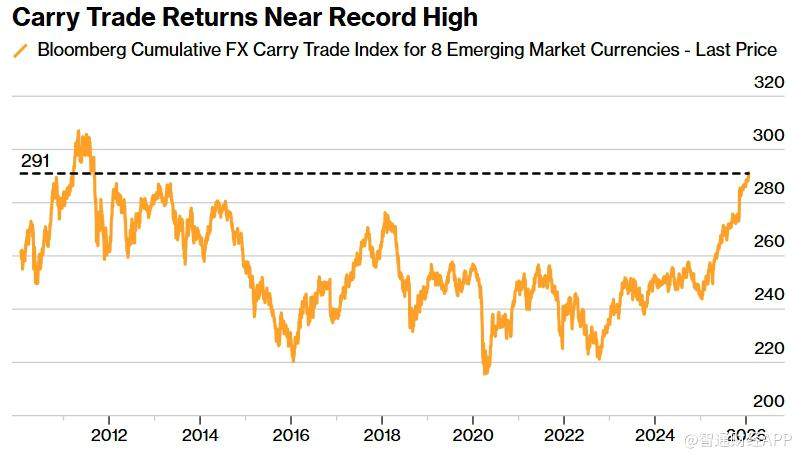
Core Viewpoint - Investors have achieved significant returns through "arbitrage trading" by selling dollars and buying high-yield emerging market currencies, with expectations for continued gains amid ongoing pressure on the dollar from Trump-era policies [1] Group 1: Market Performance - The index tracking returns from eight emerging market currencies has risen by 1.3% year-to-date [1] - As of Monday, the index reached 291 points, just about 5% shy of its historical high set in 2011 [4] - The Brazilian real has accumulated a return of 4.3% since the beginning of 2026, building on a 23.5% increase from the previous year [4] Group 2: Economic Factors - The attractiveness of arbitrage trading stems from both currency appreciation and the high real interest rates in developing countries [4] - Many emerging market central banks are cautiously advancing easing policies, maintaining a high interest rate environment despite signs of slowing inflation [4] Group 3: Investment Strategies - Morgan Stanley's emerging markets strategy head, James Lord, is optimistic about currencies from countries with tight monetary policies and high central bank credibility, including the Brazilian real, Turkish lira, and Czech koruna [4] - Citigroup strategists also recommend going long on the Brazilian real against the dollar and see potential in the Turkish lira [4] Group 4: Risks and Considerations - Not all emerging market currencies are benefiting; the Indian rupee, which was the worst performer last year, has continued to decline, down approximately 2% in arbitrage returns this year [4] - The Indonesian rupiah has also put investors at a loss [4] - Historical data shows that the strongest year for arbitrage trading was in 2003, with a return of 25%, but a repeat of such a "harvest year" requires a sustained weakening of the dollar and stable emerging market currency fluctuations [5]

香港10亿日元劫案背后的“找换店”生意
Sou Hu Cai Jing· 2025-12-19 04:04
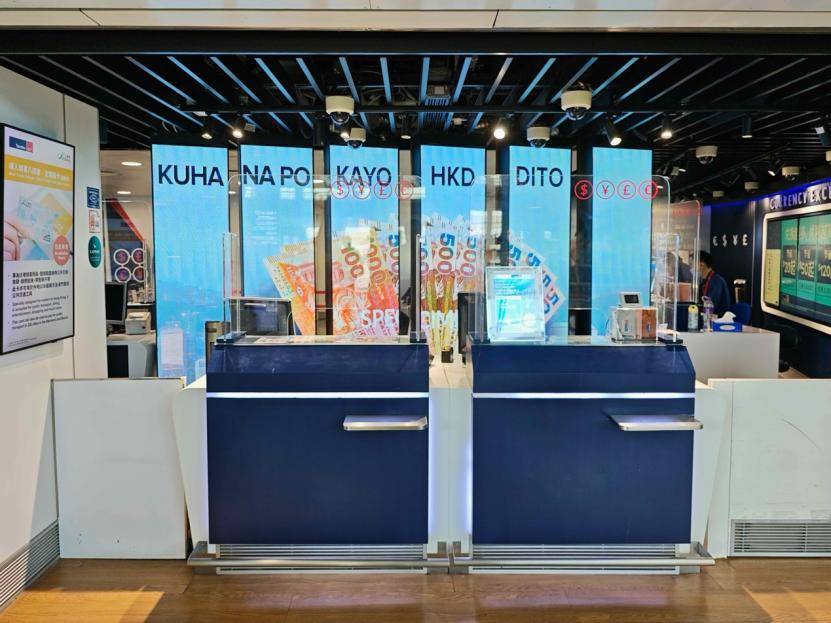
Core Viewpoint - The recent cash robbery in Hong Kong, involving approximately 1 billion yen, highlights the ongoing significance of cash exchange businesses in the region, despite the rise of electronic payments [2][3]. Group 1: Incident Details - The robbery occurred on December 18, with a staff member from a currency exchange shop reporting the incident after being approached by three suspicious men, two of whom were armed [2][3]. - The stolen cash, amounting to 1 billion yen, weighs at least 100 kilograms, as the largest denomination of yen is 10,000 yen, weighing about 1 gram each [3]. - Following the incident, police arrested a suspect and discovered a vehicle linked to the crime, along with a suitcase containing a significant amount of yen [3][4]. Group 2: Currency Exchange Business Context - The cash involved in the robbery belonged to a client engaged in foreign trade, who has been operating in the currency exchange business for years without prior incidents [4]. - Hong Kong remains the fourth largest foreign exchange center globally and the largest offshore renminbi business hub, according to a survey by the Bank for International Settlements [4]. - The yen exchange market has seen increased activity due to fluctuations in the foreign exchange market, particularly since October, with expectations of a slowdown in interest rate hikes by the Bank of Japan [4]. Group 3: Currency Exchange Shops in Hong Kong - Currency exchange shops, prevalent in Hong Kong, cater to a wide range of customers, from residents to financial traders, benefiting from competitive exchange rates [5]. - The rental prices for these shops have been described as exorbitant, with some locations charging up to 26 million HKD per month for a small space [6]. - The business model of currency exchange shops has faced challenges in recent years due to the rise of electronic payments and the impact of the pandemic, leading to a decline in their profitability [6][7]. Group 4: Regulatory Environment and Future Trends - The emergence of cryptocurrency exchange shops has introduced new dynamics to the currency exchange landscape, with around 200 such establishments operating in Hong Kong [7]. - The Hong Kong government is working on regulatory measures to oversee virtual asset transactions, aiming to prevent money laundering and fraud in this sector [7].
新兴市场外汇套利交易明年继续被看好,波动性成唯一隐忧
Di Yi Cai Jing· 2025-12-15 07:51
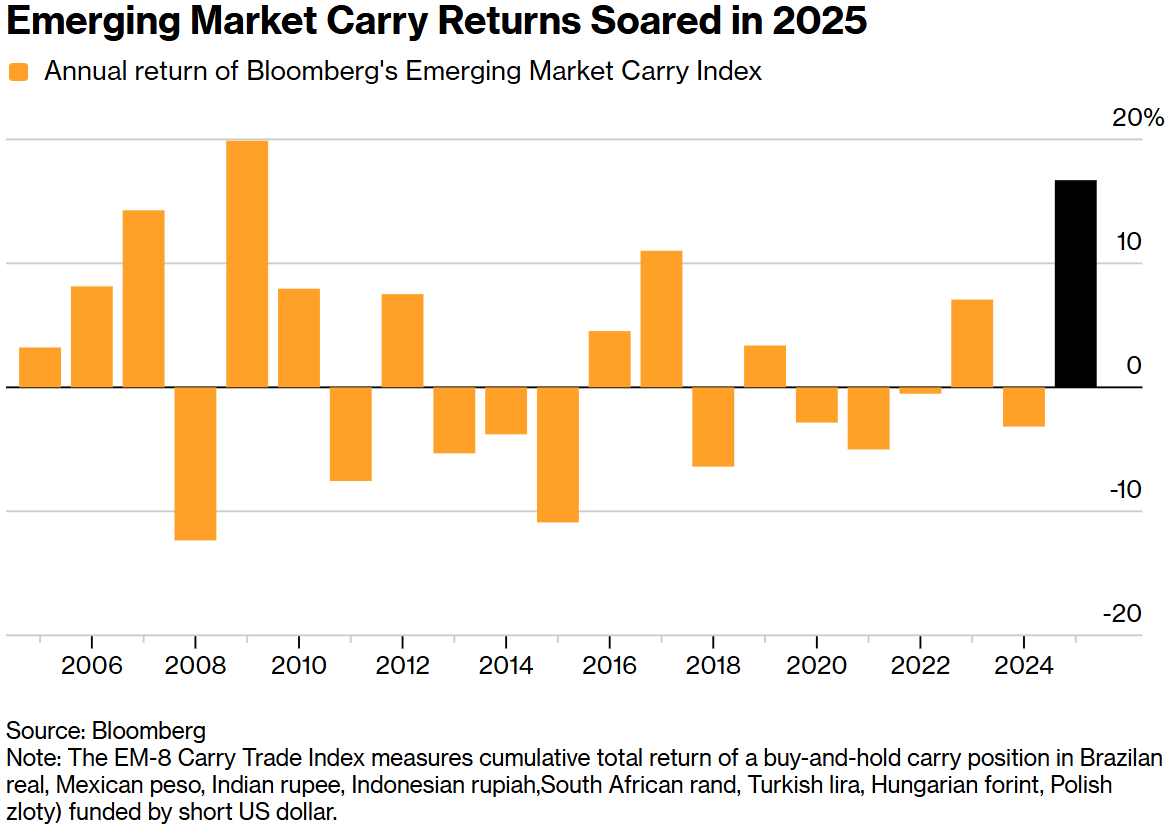
Core Insights - Emerging market carry trades are expected to remain effective through 2026, driven by low borrowing costs from central banks in developed economies and sustained interest rate differentials between developed and emerging markets [1][3]. Group 1: Performance of Emerging Market Carry Trades - The Bloomberg Emerging Market Carry Index has achieved a year-to-date return of 16.71%, the highest since 2009, when it reached 19.89% [3]. - In the previous five years, four years recorded negative returns, with rates of -2.84%, -5.02%, -0.52%, and -3.17% for 2020, 2021, 2022, and 2024 respectively [3]. - High benchmark interest rates in countries like Brazil, Mexico, and South Africa have resulted in three-month implied yields of 13.4%, 7.5%, and 6.6%, significantly outperforming developed economies [3]. Group 2: Market Sentiment and Strategies - The trajectory of the U.S. economy is seen as a key factor for the continued strong performance of emerging market currencies, with expectations of a slowdown encouraging the Federal Reserve to ease monetary policy [4]. - Investment firms like Invesco and Goldman Sachs recommend increasing short positions on the U.S. dollar against currencies such as the Brazilian real and South African rand [4]. - Neuberger Berman highlights that reduced volatility in the foreign exchange market and a weak dollar create favorable conditions for emerging market carry trades [5][6]. Group 3: Volatility Concerns - There is ongoing debate about whether low foreign exchange volatility can be maintained, as adverse currency movements could quickly erase gains [7]. - Current indicators from JPMorgan show emerging market currency volatility is near a five-year low, but concerns remain about potential increases due to factors like U.S. midterm elections and Federal Reserve policy divergences [7]. - Vanguard Group believes that market disruptions from events like Trump's tariff policies are diminishing, suggesting a stable environment for emerging market currencies in 2026 [7].


新兴市场套利狂潮未止!华尔街看好2026年高收益货币前景
智通财经网· 2025-12-14 23:25
Group 1 - Emerging market carry trades are expected to continue thriving in 2026, supported by reduced forex market volatility and a weak US dollar [1] - A key indicator for this strategy has shown a return of approximately 17% this year, marking the highest increase since 2009 [1] - Major asset management firms and banks anticipate that the interest rate gap between developed and emerging markets will persist, with the Federal Reserve and other wealthy nations' central banks likely to maintain low borrowing costs [1] Group 2 - Emerging market stocks, bonds, and currencies have seen significant increases this year, with countries like Brazil and Colombia experiencing currency appreciation of over 13% against the US dollar [3] - The performance of these markets is closely tied to the US economic outlook, with investors hoping for weak growth to encourage further easing of monetary policy by the Federal Reserve [3] - Goldman Sachs has highlighted the attractiveness of shorting the US dollar against currencies like the Brazilian real and South African rand, with a basket of these trades yielding approximately 20% returns this year [3] Group 3 - Investors are assessing whether forex volatility will remain low, as adverse currency movements can quickly erase months of gains [6] - Current market expectations for volatility are low, with a JPMorgan indicator nearing a five-year low, raising concerns among market participants [6] - Despite potential factors that could increase currency volatility, such as US midterm elections and central bank policy divergences, Vanguard Group expects that market disruptions will remain controlled into 2026 [6]
高市早苗胜选推升宽松预期 日元套利交易或卷土重来
智通财经网· 2025-10-07 04:00
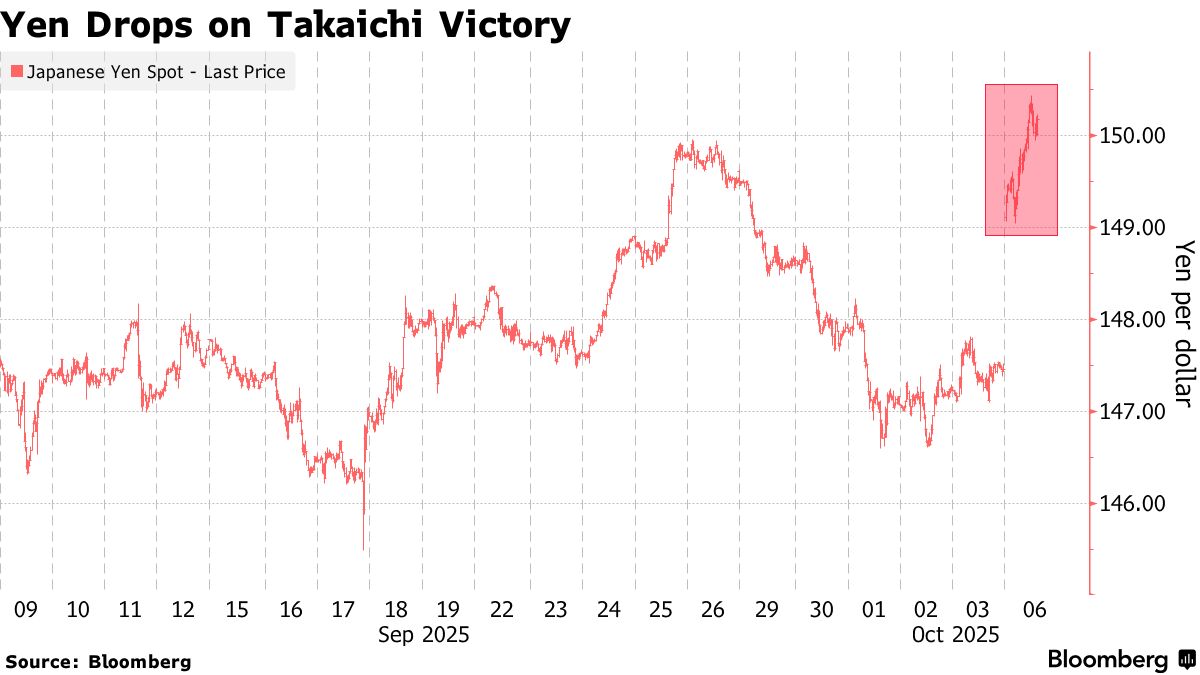
Core Viewpoint - The election of Fumio Kishida as the new president of Japan's ruling Liberal Democratic Party is expected to lead to a slowdown in interest rate hikes by the Bank of Japan, reviving interest in yen carry trades [1][3]. Group 1: Market Reactions - The yen depreciated significantly against major currencies, with a drop of up to 2% against the US dollar following Kishida's victory [3]. - Market participants are reducing bets on the Bank of Japan tightening its monetary policy, with the likelihood of a rate hike on October 30 now estimated at only 19%, down from approximately 57% before the election [3]. Group 2: Economic Implications - Kishida's stance on economic policy, which includes potential increased government spending and a reluctance to raise interest rates, is causing concerns about inflation and the value of the yen [3][4]. - Analysts suggest that if Kishida continues to advocate for a weak yen, it could lead to a resurgence of carry trades, further weakening the yen [4]. Group 3: Carry Trade Opportunities - Recent weeks have seen profitable carry trades, particularly those involving borrowing in yen to invest in higher-yielding currencies, with returns exceeding 5% for certain trades [4]. - The current market environment is reminiscent of the mid-2000s, a period characterized by favorable conditions for currency carry trades [4]. Group 4: Future Outlook - Traders will closely monitor statements from Bank of Japan officials for any signs of a shift in policy direction, although some analysts believe the central bank is unlikely to change its stance quickly [5]. - The yen's weakness is expected to maintain the attractiveness of carry trades, with projections suggesting the USD/JPY exchange rate could reach 155 by year-end [8].