
哥伦比亚比索

Search documents
哥伦比亚比索从周四的大幅下跌中反弹,上涨1.8%,领跑新兴市场。
Xin Lang Cai Jing· 2026-02-27 14:47
Core Insights - The Colombian peso rebounded from a significant decline on Thursday, increasing by 1.8%, leading among emerging markets [1] Group 1 - The Colombian peso's recovery indicates a positive shift in its performance compared to other emerging market currencies [1] - The 1.8% increase reflects a notable recovery after a period of substantial depreciation [1] - This rebound positions the Colombian peso as a leader in the emerging market currency space [1]
高盛:2026美元仍被高估约15%,科技“例外主义”重估是重大下行风险
Hua Er Jie Jian Wen· 2026-01-15 10:35
Group 1 - The core message from Goldman Sachs is that while the dominance of the US dollar is weakening, it is not collapsing yet, with a projected slow decline influenced by global growth and balanced asset returns [1][2] - Goldman Sachs predicts that the dollar will experience a "slow downward process," driven by strong global growth, despite the dollar being overvalued by approximately 15% according to their GSDEER model [1][2] - The report highlights that the most significant risks to the dollar's value may arise from structural changes in capital markets rather than traditional macroeconomic data [1][2] Group 2 - The outlook for the euro is that it is nearing "fair value" against the dollar, with further appreciation likely driven by the dollar's weakness rather than explosive growth in the Eurozone [3] - The British pound is identified as a "laggard" among G10 currencies, facing structural overvaluation and lacking fundamental support due to pressures from fiscal tightening and a weak domestic economic outlook [3] - Goldman Sachs forecasts that the Bank of England will implement more aggressive rate cuts than the market expects, which will negatively impact the pound's performance compared to its European counterparts [3] Group 3 - In Asia, Goldman Sachs sees opportunities in low-yield currencies closely tied to the technology supply chain, such as the South Korean won, New Taiwan dollar, and Malaysian ringgit, which are expected to outperform higher-yield currencies like the Indonesian rupiah and Philippine peso [5] - The South Korean won is particularly favored due to expected inflows from the inclusion in the FTSE World Government Bond Index and the resumption of foreign exchange hedging by the National Pension Service [5] - For emerging markets, Goldman Sachs recommends focusing on currencies with improving fundamentals and attractive valuations, such as the Brazilian real and Colombian peso, which offer significant carry trade potential despite political uncertainties [6]

全球瞭望丨荷兰国际集团:美国冒险主义对美元和石油意味着什么
Xin Hua She· 2026-01-05 14:47
Core Viewpoint - The analysis report from ING highlights the market's focus on the recent U.S. attack on Venezuela and its potential short-term, medium-term, and long-term impacts on regional and international relations [1] Group 1: Immediate Market Reactions - The initial market reaction to the January 3rd event in Venezuela was a mild "risk-off" sentiment, with gold and Swiss franc gaining traction, while the dollar received some support [1] - Stock index futures did not show excessive reaction to the current situation, while the oil market remained volatile as it assessed the short-term and medium-term impacts on Venezuela's oil production [1] Group 2: Currency and Commodity Implications - Investors may prefer the liquidity of the dollar in the face of uncertainty in the coming days, which could put pressure on Latin American currencies, particularly the Colombian peso and potentially the Mexican peso [1] - The oil market is expected to face increased uncertainty regarding supply, with short-term impacts largely dependent on the nature of the power transition in Venezuela [1] Group 3: Long-term Projections - The long-term market impact will depend on how much Venezuela can increase its oil production, which may take 5 to 10 years to reach levels of 2.5 to 3 million barrels per day [2] - The euro to dollar exchange rate has faced pressure after briefly exceeding 1.18 in late December 2025, with future developments in Venezuela potentially influencing further declines in the euro [2] Group 4: Geopolitical Considerations - Geopolitical factors are significant, as U.S. President Trump has not ruled out the possibility of deploying ground troops to Venezuela, which could lead to a complex military situation in multiple Latin American countries [2] - If the U.S. becomes embroiled in such conflicts, investors may adopt a more pessimistic outlook on U.S. fiscal health and the dollar's future [2]

全球瞭望|荷兰国际集团:美国冒险主义对美元和石油意味着什么
Sou Hu Cai Jing· 2026-01-05 13:47
Group 1 - The core focus of the financial market is on the recent U.S. attack on Venezuela, with investors assessing its short-term, medium-term, and long-term impacts on regional and international relations [1] - Initial market reactions included a mild "risk-off" sentiment, with gold and Swiss franc gaining traction, while the dollar received some support [1] - Oil market remains uncertain as investors evaluate the short-term and medium-term impacts on Venezuela's oil production, with current supply at approximately 500,000 barrels per day due to sanctions [1] Group 2 - The long-term market impact will depend on Venezuela's ability to increase oil production, which could take 5 to 10 years to reach levels of 2.5 to 3 million barrels per day [2] - The euro to dollar exchange rate has faced pressure, with geopolitical factors influencing its future trajectory [2] - U.S. President Trump's potential military involvement in Venezuela could lead to a more pessimistic outlook on U.S. fiscal health and the dollar, prompting investors to reconsider U.S. asset holdings [2]
机构:市场将高度关注油价走势 但短期内供应料变化不大
Ge Long Hui A P P· 2026-01-04 23:29
Core Viewpoint - The market is primarily focused on oil price movements following the capture of Venezuelan President Maduro by U.S. forces, indicating President Trump's significant interest in restoring Venezuela's oil production [1] Group 1: Oil Market Impact - The short-term oil supply is not expected to change significantly despite the geopolitical developments [1] - The situation may lead to increased volatility in currencies such as the Mexican peso and Colombian peso [1] Group 2: Geopolitical Considerations - There is uncertainty regarding whether the Trump administration will take further actions in other regions as a result of this event [1] - Denmark is attempting to quell speculation regarding U.S. actions related to Greenland [1]
新兴市场外汇套利交易明年继续被看好,波动性成唯一隐忧
Di Yi Cai Jing· 2025-12-15 07:51
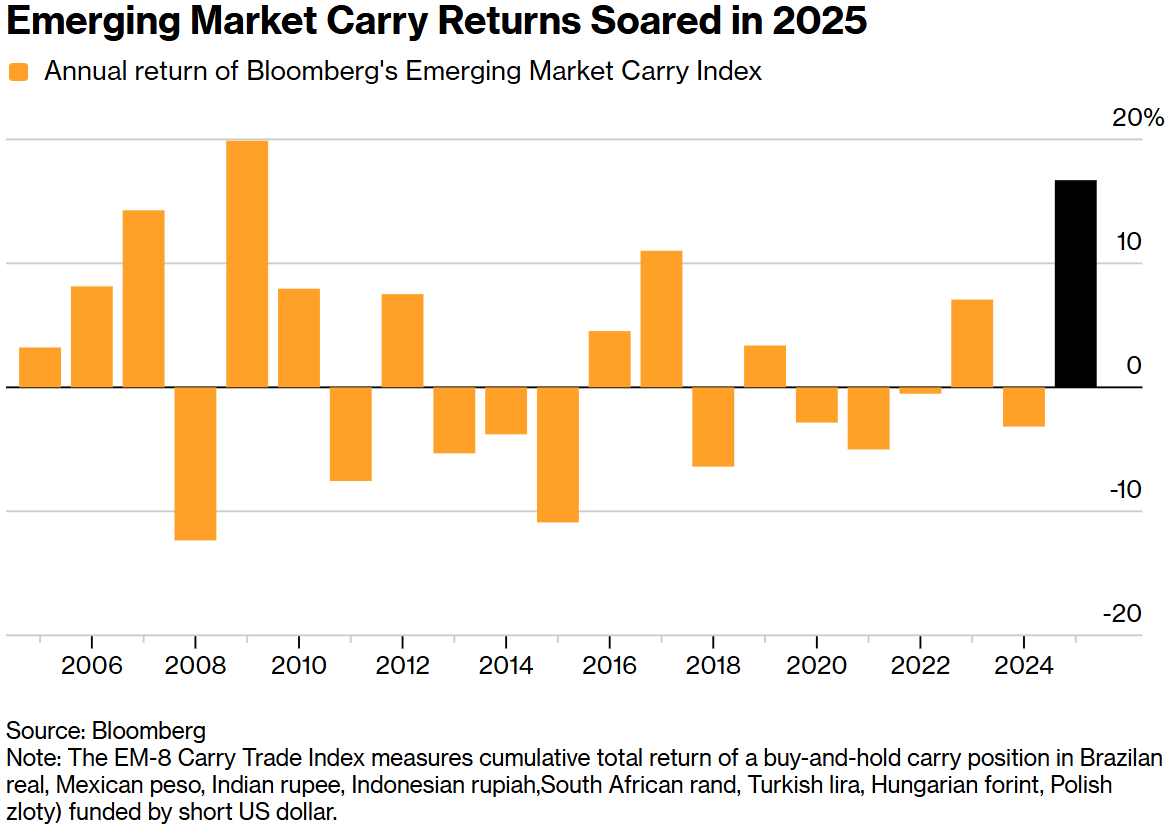
Core Insights - Emerging market carry trades are expected to remain effective through 2026, driven by low borrowing costs from central banks in developed economies and sustained interest rate differentials between developed and emerging markets [1][3]. Group 1: Performance of Emerging Market Carry Trades - The Bloomberg Emerging Market Carry Index has achieved a year-to-date return of 16.71%, the highest since 2009, when it reached 19.89% [3]. - In the previous five years, four years recorded negative returns, with rates of -2.84%, -5.02%, -0.52%, and -3.17% for 2020, 2021, 2022, and 2024 respectively [3]. - High benchmark interest rates in countries like Brazil, Mexico, and South Africa have resulted in three-month implied yields of 13.4%, 7.5%, and 6.6%, significantly outperforming developed economies [3]. Group 2: Market Sentiment and Strategies - The trajectory of the U.S. economy is seen as a key factor for the continued strong performance of emerging market currencies, with expectations of a slowdown encouraging the Federal Reserve to ease monetary policy [4]. - Investment firms like Invesco and Goldman Sachs recommend increasing short positions on the U.S. dollar against currencies such as the Brazilian real and South African rand [4]. - Neuberger Berman highlights that reduced volatility in the foreign exchange market and a weak dollar create favorable conditions for emerging market carry trades [5][6]. Group 3: Volatility Concerns - There is ongoing debate about whether low foreign exchange volatility can be maintained, as adverse currency movements could quickly erase gains [7]. - Current indicators from JPMorgan show emerging market currency volatility is near a five-year low, but concerns remain about potential increases due to factors like U.S. midterm elections and Federal Reserve policy divergences [7]. - Vanguard Group believes that market disruptions from events like Trump's tariff policies are diminishing, suggesting a stable environment for emerging market currencies in 2026 [7].


新兴市场套利狂潮未止!华尔街看好2026年高收益货币前景
智通财经网· 2025-12-14 23:25
Group 1 - Emerging market carry trades are expected to continue thriving in 2026, supported by reduced forex market volatility and a weak US dollar [1] - A key indicator for this strategy has shown a return of approximately 17% this year, marking the highest increase since 2009 [1] - Major asset management firms and banks anticipate that the interest rate gap between developed and emerging markets will persist, with the Federal Reserve and other wealthy nations' central banks likely to maintain low borrowing costs [1] Group 2 - Emerging market stocks, bonds, and currencies have seen significant increases this year, with countries like Brazil and Colombia experiencing currency appreciation of over 13% against the US dollar [3] - The performance of these markets is closely tied to the US economic outlook, with investors hoping for weak growth to encourage further easing of monetary policy by the Federal Reserve [3] - Goldman Sachs has highlighted the attractiveness of shorting the US dollar against currencies like the Brazilian real and South African rand, with a basket of these trades yielding approximately 20% returns this year [3] Group 3 - Investors are assessing whether forex volatility will remain low, as adverse currency movements can quickly erase months of gains [6] - Current market expectations for volatility are low, with a JPMorgan indicator nearing a five-year low, raising concerns among market participants [6] - Despite potential factors that could increase currency volatility, such as US midterm elections and central bank policy divergences, Vanguard Group expects that market disruptions will remain controlled into 2026 [6]
政策变革预期支撑智利比索走强
Shang Wu Bu Wang Zhan· 2025-12-10 18:23
Core Viewpoint - The Deutsche Bank report indicates that Latin American currencies are expected to perform strongly in 2025 due to high real interest rates and favorable external conditions, with Brazil, Mexico, Chile, Colombia, and Peru achieving double-digit returns. However, a reversal of this trend is anticipated in 2026 as focus shifts to national fiscal, external balance, and political fundamentals [1] Group 1: Currency Performance - In 2025, currencies of Brazil, Mexico, Chile, Colombia, and Peru are projected to achieve double-digit returns due to favorable conditions [1] - The report forecasts specific exchange rate targets for the end of 2026: Brazilian Real at 5.2, Colombian Peso at 4000, Chilean Peso at 870, Peruvian Sol at 3.30, and Mexican Peso at 18 [1] Group 2: Risks and Challenges - Brazil and Colombia face the highest risks due to significant macroeconomic imbalances, with potential erosion of currency protection from fiscal deterioration or electoral uncertainties [1] - Brazil's high uncertainty from the October elections may lead to increased fiscal spending and volatility [1] - Colombia may enter a rate hike cycle due to unanchored inflation expectations and fiscal deterioration [1] Group 3: Individual Currency Outlook - Chilean Peso is expected to gradually appreciate due to potential policy adjustments such as lowering corporate taxes, deregulation, and fiscal consolidation [1] - Peruvian currency appreciation is limited due to high valuation [1] - Mexican Peso is likely to remain strong due to solid access to the U.S. market [1]
高市早苗胜选推升宽松预期 日元套利交易或卷土重来
智通财经网· 2025-10-07 04:00
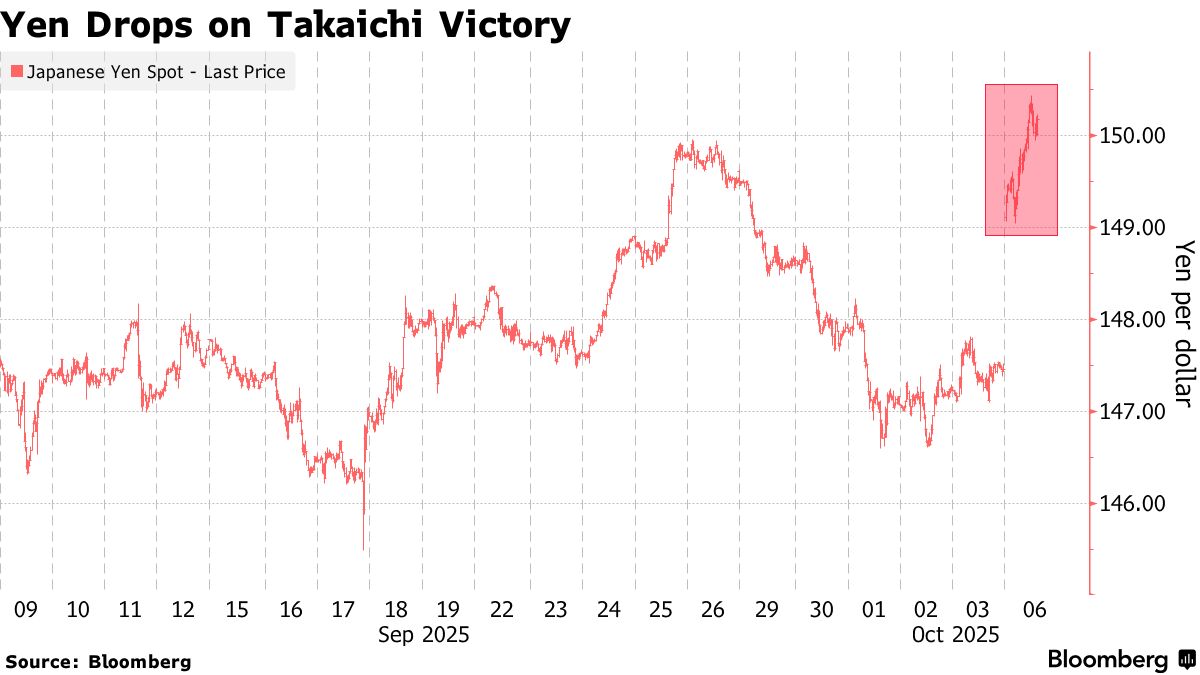
Core Viewpoint - The election of Fumio Kishida as the new president of Japan's ruling Liberal Democratic Party is expected to lead to a slowdown in interest rate hikes by the Bank of Japan, reviving interest in yen carry trades [1][3]. Group 1: Market Reactions - The yen depreciated significantly against major currencies, with a drop of up to 2% against the US dollar following Kishida's victory [3]. - Market participants are reducing bets on the Bank of Japan tightening its monetary policy, with the likelihood of a rate hike on October 30 now estimated at only 19%, down from approximately 57% before the election [3]. Group 2: Economic Implications - Kishida's stance on economic policy, which includes potential increased government spending and a reluctance to raise interest rates, is causing concerns about inflation and the value of the yen [3][4]. - Analysts suggest that if Kishida continues to advocate for a weak yen, it could lead to a resurgence of carry trades, further weakening the yen [4]. Group 3: Carry Trade Opportunities - Recent weeks have seen profitable carry trades, particularly those involving borrowing in yen to invest in higher-yielding currencies, with returns exceeding 5% for certain trades [4]. - The current market environment is reminiscent of the mid-2000s, a period characterized by favorable conditions for currency carry trades [4]. Group 4: Future Outlook - Traders will closely monitor statements from Bank of Japan officials for any signs of a shift in policy direction, although some analysts believe the central bank is unlikely to change its stance quickly [5]. - The yen's weakness is expected to maintain the attractiveness of carry trades, with projections suggesting the USD/JPY exchange rate could reach 155 by year-end [8].
在新兴市场货币中,哥伦比亚比索兑美元领跌。媒体报道称,该国将暂停执行财政制度。
news flash· 2025-06-10 19:17
Group 1 - The Colombian peso is experiencing the largest decline among emerging market currencies against the US dollar [1] - Reports indicate that Colombia will suspend the implementation of its fiscal framework [1]