
外资企业国民待遇

Search documents
事关3万亿政府采购,两部门强调依法落实外资企业国民待遇
Xin Lang Cai Jing· 2025-12-19 10:13
Core Viewpoint - The Chinese government aims to promote fair and open government procurement markets through the implementation of domestic product standards, as outlined in the recent opinions issued by the Ministry of Finance and the Ministry of Industry and Information Technology [1][2]. Group 1: Government Procurement Market - The scale of the national government procurement market for 2024 is projected to be 33,750.43 billion yuan [1]. - The new policy regarding domestic product standards will take effect on January 1, 2026 [1]. Group 2: Implementation of Domestic Product Standards - The Ministry of Finance will collaborate with relevant industry authorities to develop specific cost accounting rules for components produced domestically, taking into account the characteristics of different industries and the actual development of Chinese industries [2]. - A transition period will be established to ensure that the standards are practical and operable, considering the complexity of setting component cost ratios for various products [2]. Group 3: Impact on Foreign Enterprises - The transition period is seen as beneficial for foreign enterprises, allowing them time to adjust their production and investment strategies in China to meet the new domestic product standards [3]. - The opinions emphasize that foreign enterprises should receive national treatment in government procurement, ensuring equal participation in procurement activities as long as their products meet domestic standards [3]. - The new policy aims to eliminate biases against foreign enterprises in procurement processes, thereby fostering a fair competitive environment and breaking down market barriers [3].
重磅消息!刚刚,国务院办公厅印发!
证券时报· 2025-09-30 11:22
Core Viewpoint - The article discusses the implementation of a new policy in government procurement that provides a 20% price evaluation advantage for domestically produced products compared to foreign products, effective from January 1, 2026 [2][4]. Summary by Sections Government Procurement Policy - The State Council has issued a notification to establish standards for domestically produced products in government procurement, aiming to create a unified and competitive procurement market [2]. - The definition of domestically produced products includes those manufactured within China, with a specified percentage of production costs originating from within the country [2][4]. Implementation and Transition - The Ministry of Finance, along with relevant industry authorities, will categorize products and determine the required domestic component cost ratios over a five-year period, allowing for a transition phase of 3 to 5 years [3]. - Until the new component cost ratio requirements are implemented, products meeting the domestic production criteria will be treated as domestically produced in procurement activities [3]. Equal Treatment of Enterprises - The policy emphasizes equal treatment for state-owned, private, and foreign enterprises, prohibiting any discriminatory practices based on ownership or investment nationality [3][4]. - Local governments and departments are required to coordinate and avoid policies that contradict the new notification [3]. Clarity and Transparency - The introduction of clear definitions for domestically produced products enhances the fairness and transparency of government procurement policies, addressing previous ambiguities [4][5]. - The policy is seen as a significant step towards improving the business environment in China and boosting foreign investment confidence [4][5].


国务院:合理分类设定本国产品标准
Mei Ri Jing Ji Xin Wen· 2025-09-21 13:47
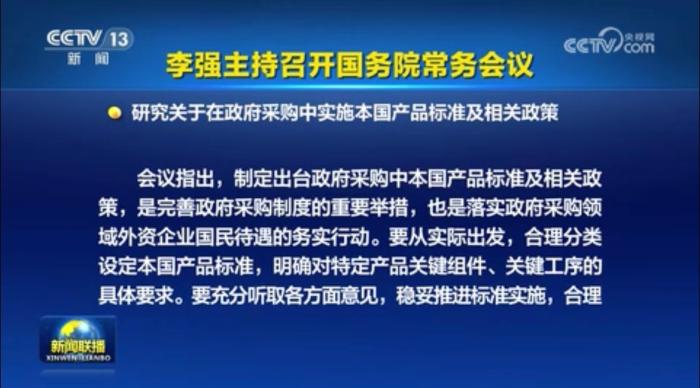
Core Points - The State Council meeting emphasized the importance of establishing domestic product standards and related policies in government procurement to enhance the procurement system and ensure fair competition for all business entities [2][5]. Group 1: Government Procurement Standards - The introduction of domestic product standards aims to clarify the definition of "domestic products," which previously lacked uniformity, leading to ambiguity in practice [3]. - The standards will require products to be produced within China, with specific cost ratios for components and localization of key components and processes [3][4]. - A 20% price evaluation preference will be granted to domestic products compared to non-domestic products in government procurement activities [4]. Group 2: Impact on Foreign Enterprises - The new policies will ensure that foreign enterprises producing in China are treated equally, thus enhancing their confidence and encouraging more multinational companies to invest in China [5][6]. - This approach aligns with international trade rules and aims to stabilize foreign investment by reducing concerns about "invisible discrimination" [5]. Group 3: Supply Chain and Technological Innovation - The policies are designed to enhance supply chain security and resilience by promoting localization of critical components and processes [6]. - By leveraging government procurement as a demand-side tool, the policies aim to guide resources towards high-end manufacturing and strategic emerging industries, fostering technological innovation and industrial upgrading [6].
政府采购新规强化公平竞争 对内外资一视同仁
Zhong Guo Xin Wen Wang· 2025-09-20 22:20
Core Viewpoint - The recent government procurement policy changes in China aim to implement domestic product standards, marking a significant step towards institutionalization and standardization of the procurement system [1][3]. Group 1: Policy Implementation - The State Council meeting on September 19 emphasized the importance of establishing domestic product standards and related policies in government procurement as a crucial measure to enhance the procurement system [1]. - The Ministry of Finance plans to solicit public opinions on the draft notice regarding domestic product standards and implementation policies in government procurement by December 2024 [3]. Group 2: Market Impact - The new policies are expected to have a profound impact on the government procurement market, which exceeds 30 trillion yuan, growing from 100.9 billion yuan in 2002 to 3.6399 trillion yuan in 2021, with its share of fiscal expenditure increasing from 4.6% to 10.1% [4]. - In 2023, the national government procurement scale was reported at 3.39296 trillion yuan, indicating a slight decline in recent years [5]. Group 3: Classification and Transition - The meeting proposed a reasonable classification approach to set domestic product standards, suggesting that specific requirements for key components and processes will be established based on industry characteristics, rather than a one-size-fits-all domestic production ratio [5]. - The policy will include a transition period to support enterprises in preparing for industrial layout and investment plans, with varying durations based on industry complexity [6]. Group 4: Fair Competition - The emphasis on equal treatment for all business entities, including state-owned, private, and foreign enterprises, aligns with the goal of ensuring fair competition in the procurement process [6]. - The establishment of clear domestic product standards is seen as a prerequisite for fair treatment of foreign enterprises, reflecting China's commitment to optimizing the business environment [6]. Group 5: International Context - The new procurement policy is part of China's broader reform and opening-up strategy, reflecting both the need to safeguard national economic security and a commitment to expanding openness [6]. - Similar standards for domestic products in government procurement are already established in major developed countries, such as the U.S. with the "Buy American Act" [6]. Group 6: Future Outlook - The implementation of these policies is expected to lead to a more standardized, transparent, and open government procurement market in China [7].
恒指收跌304点,内需股部分走强
Guodu Securities Hongkong· 2025-08-27 01:48
Core Insights - The Hang Seng Index closed down 304 points or 1.18% at 25,524, with significant selling pressure in the A-shares market contributing to the decline [3] - Among 85 blue-chip stocks, 66 declined while 18 rose, indicating a mixed performance in the market [4] - Domestic demand stocks showed strength, with notable gains in companies like Master Kong (00322) up 3.4% and Mengniu Dairy (02319) up 1.9% [4] Economic and Industry Dynamics - Hong Kong's exports in July increased by 14.3% year-on-year, surpassing expectations, with total export value reaching HKD 446.3 billion [7] - The import value for July also rose by 16.5% year-on-year, totaling HKD 480.4 billion, leading to a tangible trade deficit of HKD 34.1 billion [7] - The Investment Promotion Agency is actively working to attract high-quality technology companies to Hong Kong, emphasizing its role as an international financial center [8] Company News - Qingdao Beer (00168) reported a 7.2% increase in mid-year profit to RMB 3.904 billion, with revenue rising by 2.11% to RMB 20.491 billion [11] - Lingbao Gold (03330) announced a significant profit increase of 335% to RMB 664 million, with revenue up 82.02% to RMB 7.793 billion [12] - Zijin Mining (02899) reported a 54% increase in mid-year profit to RMB 23.292 billion, with revenue rising by 11.5% to RMB 167.711 billion [14]
商务部:切实落实外资企业国民待遇
Zheng Quan Ri Bao· 2025-08-26 16:28
Group 1 - The 25th China International Investment Trade Fair (CIFIT) will be held from September 8 to 11 in Xiamen, focusing on "Investing in China," "Chinese Investment," and "International Investment" [1] - The event will see participation from nearly a hundred executives from multinational companies and heads of international investment institutions, indicating China's significant investment potential despite global economic challenges [1] - The theme "Investing in China is Investing in the Future" reflects China's comprehensive advantages, including its vast market, efficient supply chain, and opportunities from the new technological revolution and industrial transformation [1] Group 2 - The Chinese government is committed to expanding its openness, with pilot programs in sectors like telecommunications and biotechnology already showing positive progress [2] - Efforts are being made to enhance open platforms, including the implementation of free trade zone strategies and reforms in national economic development zones to boost foreign investment [2] - The Ministry of Commerce is actively addressing foreign enterprises' concerns through regular roundtable meetings, having resolved over 1,500 issues since last year, ensuring a fair competitive environment for both domestic and foreign companies [2]