多元解纷机制

Search documents
最高人民法院:“总对总”合作单位增至18家 累计调解纠纷637.8万件、调解成功443.6万件
Zheng Quan Ri Bao· 2026-01-30 07:42
Core Viewpoint - The Supreme People's Court has introduced a new opinion to deepen the "total-to-total" diversified dispute resolution mechanism, aiming to enhance the effectiveness of dispute resolution and improve the quality of mediation services by 2025 [1][2]. Group 1: Implementation and Achievements - Since 2019, the Supreme People's Court has established a "total-to-total" mediation mechanism, with 18 cooperating units and 38,000 mediation organizations by the end of 2025 [1]. - By the end of 2025, the total number of disputes mediated is expected to reach 6.378 million, with a successful mediation rate of 75%, an increase of 9 percentage points from 2020 [1]. - Specific success rates include 88.2% for the China Securities Regulatory Commission and 81.6% for the Ministry of Veterans Affairs, with other organizations achieving over 70% [1]. Group 2: Systematic Deployment and Coordination - The new opinion provides a systematic framework for the "total-to-total" mechanism, ensuring comprehensive coverage and effective coordination among various departments and social forces [2]. - It emphasizes the importance of integrating legal resources and enhancing the efficiency of dispute resolution through collaborative efforts [2]. Group 3: Meeting Public Needs - The opinion addresses the growing demand for diversified dispute resolution in the context of increasing social conflicts and new types of disputes, aiming to provide efficient and low-cost services [3]. - It highlights the need for better communication between courts and relevant units to facilitate professional mediation and improve service quality for the public [3]. Group 4: Case Library and Examples - The multi-faceted dispute resolution case library has collected 1,266 typical cases since its launch, showcasing successful resolutions through non-litigation methods [4]. - The Supreme People's Court has selected nine exemplary cases to demonstrate the effectiveness of the diversified dispute resolution mechanism [4]. Group 5: Future Directions - The Supreme People's Court plans to enhance the case library and provide more quality legal services to the public, focusing on proactive dispute prevention and resolution [5]. - It aims to strengthen grassroots governance and ensure that minor disputes are resolved locally, thereby improving community relations [5].
最高法:2025年全国法院民事调解撤诉率47.4%
Jing Ji Guan Cha Wang· 2026-01-30 02:37
Core Insights - The Supreme People's Court has reported significant advancements in the multi-faceted dispute resolution mechanism since 2025, with a focus on enhancing mediation and reducing litigation burdens for citizens [1][2][3] Group 1: Mediation Success and Growth - In 2025, the national courts achieved a 28% quarterly increase in mediation, resulting in 4.323 million successful mediation cases, effectively safeguarding the rights of litigants [1] - The civil mediation withdrawal rate reached 47.4%, an increase of 7.3 percentage points compared to 2024 [1] Group 2: Integration with Community Services - All grassroots court litigation service teams have integrated into county-level comprehensive governance centers, connecting with over 8,800 town and street governance centers to streamline dispute resolution [1] - The establishment of litigation service windows and expedited trial courts at governance centers has led to the deployment of 17,510 judges and mediators to provide on-site guidance and support [1] Group 3: Development of "Total-to-Total" Mechanism - The "Total-to-Total" mechanism has expanded, with partnerships established with 18 organizations, including the All-China Women's Federation and the China Federation of Literary and Art Circles, covering all provinces and regions [2] - By the end of 2025, the number of mediation organizations is expected to reach 38,000, with the number of mediators increasing to 96,000, reflecting a year-on-year growth of 3.3% and 8.9% respectively [2] Group 4: Improvement in Public Satisfaction and Feedback - In 2025, the national courts recorded 1.297 million registered litigation-related petitions, a decrease of 3.5% year-on-year, indicating improved public trust in the judicial system [3] - The satisfaction rate for litigation services reached 90.4%, an increase of 7.2 percentage points from 2024, demonstrating enhanced public perception of the judicial process [3]
湖北武汉两起知产调解案例入选最高法多元解纷案例库
Xin Lang Cai Jing· 2026-01-20 03:29
Core Insights - Wuhan's innovative approach to intellectual property dispute resolution has been recognized, with two cases selected for the 2025 Supreme Court's multi-faceted dispute resolution case library, highlighting the city's achievements in building a diversified resolution mechanism [1][3] Group 1: Case Studies - The first case involved a Zhejiang-based management company suing a cultural company in Hunan for unauthorized use of its artwork on beverage packaging. The case was resolved through mediation by the Wuhan Intellectual Property Protection Center, which utilized a collaborative model with the Changsha center, resulting in a settlement of 200,000 yuan from an initial claim of 1 million yuan [1][2] - The second case was a trademark infringement issue on an e-commerce platform, where a well-known group company discovered a clothing company selling products that infringed its registered trademark. The case was resolved in just 20 days through the Wuhan Intellectual Property Rapid Rights Protection Center, significantly reducing dispute resolution time and costs [2][3] Group 2: Systemic Developments - The multi-faceted dispute resolution case library, led by the Supreme Court, aims to collect typical cases resolved through non-litigation methods such as mediation and arbitration. The inclusion of Wuhan's cases reflects the effective collaboration in addressing complex cross-regional disputes and new e-commerce challenges [3]
枫桥图景:以解纷合力垒营商暖巢
Xin Lang Cai Jing· 2026-01-08 22:05
Core Viewpoint - In 2025, Shenyang courts are actively implementing the "Fengqiao Experience" to enhance grassroots governance, integrating resources and optimizing services to create a "one-stop" conflict resolution platform, thereby improving the modern governance level and providing a solid legal guarantee for a law-based business environment [1] Group 1: Grassroots Governance Initiatives - In April 2025, the Faku County People's Court established "non-litigation dispute resolution workstations" in 19 townships and two professional mediation organizations, forming a team of judges, assistants, and mediators to enhance multi-party collaboration in dispute resolution [2] - The city court is actively participating in the operationalization of comprehensive governance centers, improving the capacity for substantive conflict resolution by deploying judges and mediators to 13 regional centers [2] Group 2: Training and Capacity Building - On August 15, 2025, the Liaozhong District People's Court held a specialized training session for mediators at the comprehensive governance center, focusing on common disputes and enhancing mediation skills [3] - The city court has initiated training programs for 13 grassroots courts to improve the mediation capabilities of personnel at comprehensive governance centers, aiming for efficient conflict resolution [3] Group 3: Case Application and Guidance - The city court is implementing case application as a key initiative, using case studies to help parties resolve legal issues and improve dispute resolution practices [4] - In 2025, the Shenyang court has successfully integrated case studies into mediation processes, addressing common disputes such as property and labor issues, and guiding over 900 agricultural land dispute cases to resolution before litigation [4][5] Group 4: Feedback from Representatives - City representatives have praised the Shenyang court for its innovative mechanisms like "judge stationed guidance" and "joint mediation," which effectively resolve civil disputes at the grassroots level [6] - The court's training initiatives have been recognized for enhancing the legal and professional standards of grassroots mediation, contributing to a collaborative governance framework [6]
昆明市致和商事调解院入驻西山法院
Xin Lang Cai Jing· 2026-01-07 22:25
Group 1 - The core viewpoint of the article highlights the establishment of the Kunming Commercial Mediation Institute at the Xishan District People's Court, which signifies a collaborative effort to enhance commercial dispute resolution services [1] - The signing of the agreement and the unveiling of the mediation workspace is part of the court's initiative to innovate and develop the "Fengqiao Experience" in the new era [1] - The Kunming Commercial Mediation Institute, established by the Kunming Lawyers Association, aims to address the challenges of long resolution cycles and high costs associated with commercial disputes [1] Group 2 - The initiative aligns with the requirements of the "Commercial Mediation Regulations" to promote specialized commercial mediation services and improve the multi-faceted dispute resolution mechanism [1] - This effort represents a beneficial exploration towards creating a new pattern of multi-faceted dispute resolution involving both the court and the legal profession [1]
从“宁打官司”到“不要违约金”,调解两公司欠款纠纷
Qi Lu Wan Bao· 2025-12-23 13:37
Core Viewpoint - The article discusses a debt dispute between a company in Shouguang and a company in Henan, highlighting the innovative mediation approach taken to resolve the issue through a flexible payment plan and judicial confirmation, which serves as a model for efficiently resolving similar business disputes [1][2]. Group 1: Background of the Dispute - The dispute involves Shouguang A Company and Henan H New Materials Company over an unpaid debt of 70 million yuan, stemming from a contract for the purchase of flame-retardant masterbatch [2]. - A Company completed five batches of supply but faced non-payment from H Company, which only paid 10 million yuan of the 80 million yuan owed [2]. Group 2: Mediation Process - The Shouguang mediation committee designed a flexible payment plan and sought judicial confirmation to transform the voluntary agreement into a legally enforceable document, addressing the concerns of the creditor [1][3]. - The mediation involved verifying evidence and identifying the core issues: H Company’s reluctance to make a lump-sum payment due to cash flow concerns and A Company’s insistence on full payment to avoid risks associated with installment payments [2][3]. Group 3: Resolution Strategy - The mediators employed a dual communication strategy, combining back-to-back discussions and face-to-face negotiations, focusing on legal responsibilities and the implications of litigation for both parties [4][5]. - H Company expressed its financial difficulties, indicating that a lump-sum payment could halt production, while A Company was initially unwilling to compromise on the penalty for late payment [4][5]. Group 4: Final Agreement - After multiple discussions, a resolution was reached where H Company agreed to a payment plan of 5 million yuan per month over 14 months, with penalties for late payments [7]. - The agreement was judicially confirmed, granting it enforceability, and by October 2025, H Company had made three timely payments totaling 15 million yuan, demonstrating the effectiveness of the mediation process [7].
从“宁打官司”到“不要违约金”,调解打破欠款僵局
Qi Lu Wan Bao· 2025-12-12 05:37
Core Viewpoint - The article discusses a debt dispute between a company in Shouguang and a company in Henan, highlighting the innovative mediation approach taken to resolve the issue through a flexible payment plan and judicial confirmation, which serves as a model for resolving similar disputes in the future [2][3][4]. Group 1: Background of the Dispute - A company in Shouguang (Company A) entered into four sales contracts with a Henan company (Company H) for a total of 800,000 yuan worth of flame-retardant masterbatch, with payment due within 30 days of delivery [3]. - Company H failed to make the full payment, only paying 100,000 yuan, leaving a balance of 700,000 yuan, which led Company A to seek property preservation and mediation due to financial pressure [3][4]. Group 2: Mediation Process - The mediation committee designed a flexible payment plan and sought judicial confirmation to transform the voluntary agreement into a legally enforceable document, addressing both parties' concerns [4]. - The mediator employed a "back-to-back communication and face-to-face negotiation" strategy, focusing on legal responsibilities and the implications of litigation for both companies [5][7]. Group 3: Resolution Outcome - After negotiations, both companies agreed on a payment plan where Company H would pay 50,000 yuan monthly from July 2025 to August 2026, with penalties for late payments [9]. - The agreement was judicially confirmed, granting it enforceability, and by October 2025, Company H had made three payments totaling 150,000 yuan without any delays [9].


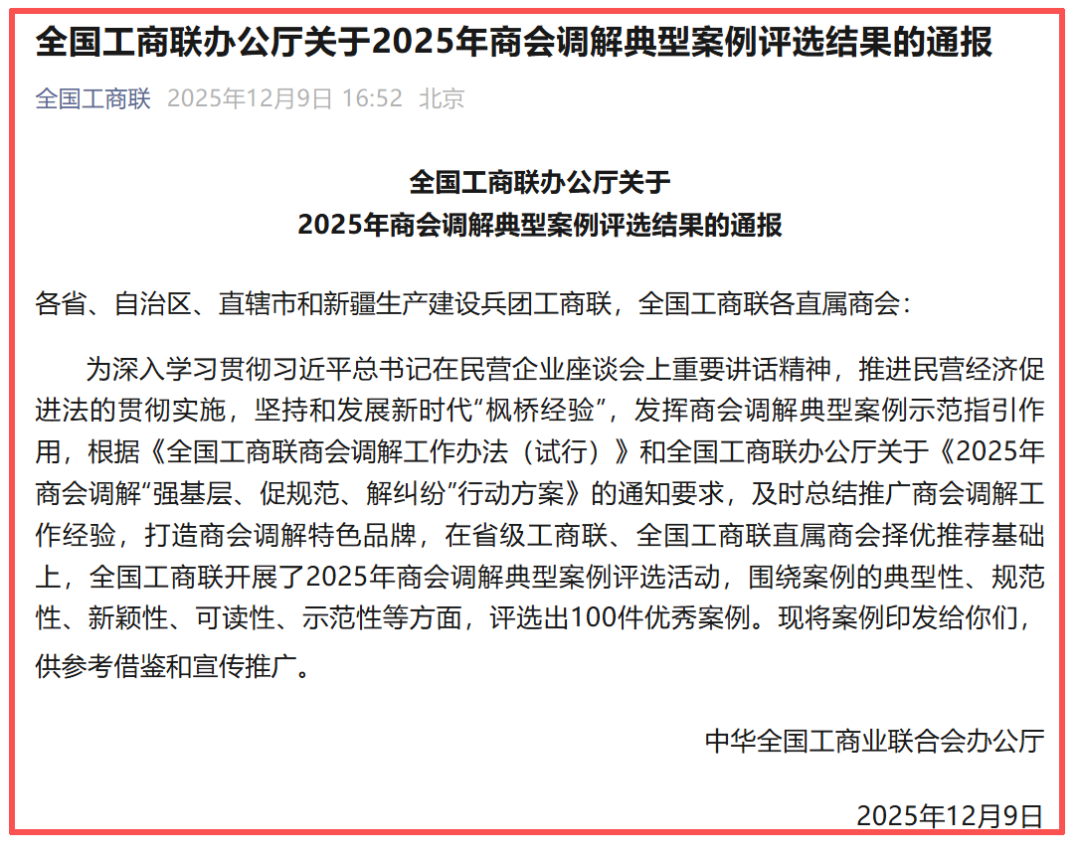
喜报:贵阳西南国际商贸城企业商会调解案例入选全国典型案例
Xin Lang Cai Jing· 2025-12-09 13:36
Core Insights - The article highlights the successful mediation of a rental dispute involving over a hundred tenants at the Guiyang Southwest International Trade City, showcasing the effectiveness of the local business association's mediation efforts [2][8]. Group 1: Background of the Dispute - In August 2024, over a hundred tenants in the Guiyang Southwest International Trade City faced significant challenges, including reduced foot traffic, increased vacancy rates, and declining sales, exacerbated by unfulfilled promises of rent reductions from the management [3][9]. - The high rental costs were pushing these businesses to the brink of survival, raising concerns about a potential mass exodus of tenants, which could disrupt the overall business ecosystem of the trade city [3][9]. Group 2: Mediation Process - The business association quickly responded by forming a special task force, adhering to the principle of "mediation first, rapid response," and conducted thorough research to understand tenant grievances and management's commitments [4][10]. - A four-party negotiation mechanism was established, involving tenants, the business association, government departments, and the management, facilitating effective dialogue and resolution [4][10]. Group 3: Outcomes of Mediation - Following extensive negotiations, the management agreed to implement a rent reduction plan, providing an average annual rent reduction of approximately 130,000 yuan per tenant, benefiting over a hundred tenants [4][10]. - The successful mediation not only alleviated the financial pressure on tenants but also stabilized the management's operations, demonstrating a win-win outcome for both parties [13]. Group 4: Broader Implications - Guiyang's business association has a long-standing history of mediation, having established 46 mediation committees since 2015, which have effectively resolved numerous commercial disputes [5][11]. - The province of Guizhou has developed a "five-party linkage" mechanism involving various legal and business entities, enhancing the support for mediation efforts and achieving a mediation success rate of 83% with a satisfaction rate of 92% [6][12][13].
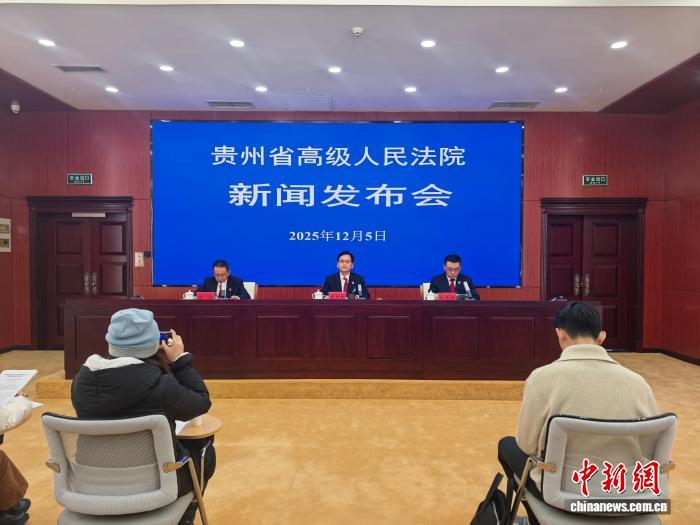
近五年贵州法院受理医疗损害责任纠纷案件4937件 结案4576件
Zhong Guo Xin Wen Wang· 2025-12-05 12:12
Core Insights - The Guizhou courts have handled 4,937 medical liability cases since the implementation of the Civil Code, with 4,576 cases concluded, indicating a significant volume of medical disputes in the region [2][3] Case Statistics - From January 1, 2021, to October 31, 2025, Guizhou courts received 4,937 medical liability cases, with 4,576 concluded [2] - Breakdown of cases: 3,774 first-instance cases (including 255 old cases) with 3,436 concluded; 920 second-instance cases (including 9 old cases) with 903 concluded; 214 cases for retrial review with 209 concluded [2] Legal Framework - The Civil Code's Chapter on "Medical Liability" clarifies the principles of liability and burden of proof, enhancing patient rights protection and setting higher standards for medical institutions [2][3] Trends in Medical Disputes - There is an increasing trend in the number and diversity of medical liability cases, characterized by sharp conflicts and high social attention, making them a focus for judicial work [2][3] Judicial Measures - Guizhou courts have improved their political stance and judicial measures, emphasizing conflict resolution and case closure, leading to initial successes in case quality and efficiency [3] - The establishment of specialized panels for medical liability cases aims to enhance the quality of judgments and reduce inconsistencies in rulings [5] Dispute Resolution Mechanisms - The courts are exploring multi-faceted dispute resolution mechanisms, integrating mediation throughout various stages of the legal process to fundamentally resolve conflicts [3][5] - A dual-track support model combining expert consultation and judicial appraisal has been established to address common professional issues in cases [6] Future Initiatives - Guizhou courts plan to strengthen judicial guarantees by promoting information sharing, risk warning mechanisms, and a three-tier mediation system involving hospitals, health departments, and professional mediation institutions [6]
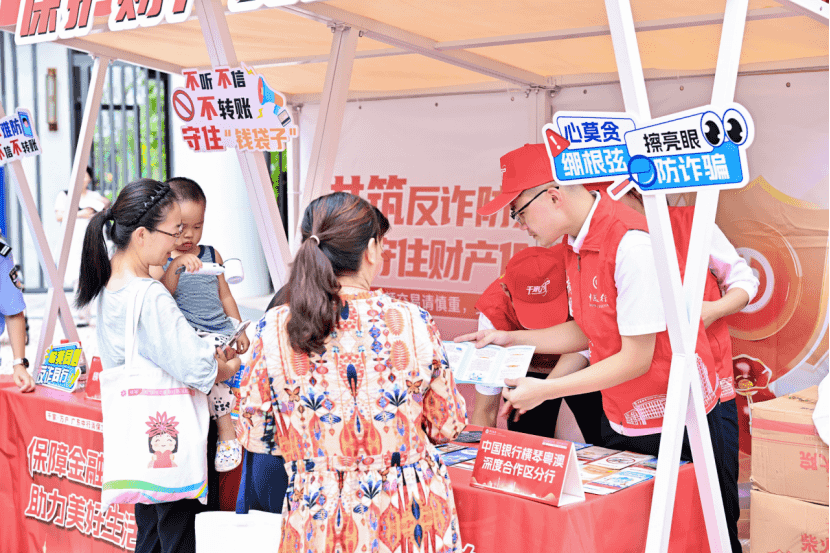
万场活动暖民心 多元解纷护消费 广东中行打造消保实践新样板
Zhong Guo Jin Rong Xin Xi Wang· 2025-12-04 09:54
Core Viewpoint - Guangdong Bank emphasizes consumer rights protection as a fundamental aspect of its operations, integrating it into all business processes and customer service through innovative mechanisms, technology, and multi-party collaboration [1][2]. Group 1: Consumer Rights Protection Initiatives - Since 2025, Guangdong Bank has conducted over 10,000 financial education activities, reaching nearly 100 million consumers, focusing on themes like "investing wisely" and "safe payments" [1]. - The bank has established mediation workstations in cities and counties to explore diversified dispute resolution paths, including the creation of a financial dispute mediation committee in Zhuhai [1][4]. Group 2: Mechanism and Management - Guangdong Bank employs a matrix management system led by senior executives to ensure consumer rights protection is implemented effectively, transitioning from "soft constraints" to "hard implementation" [2]. - The bank integrates consumer rights protection into key meetings and emphasizes customer needs in product design and service processes, addressing common pain points like long wait times [2]. Group 3: Dispute Resolution and Service Improvement - The bank has developed a "five two" complaint management system to clarify responsibilities and improve response times for consumer complaints [4]. - By collaborating with social forces, Guangdong Bank has created platforms for diversified dispute resolution, bringing mediation services closer to the public [4]. Group 4: Financial Education and Awareness - Guangdong Bank integrates financial education into various life scenarios, making it more engaging and accessible, such as through interactive activities at popular tourist spots [6]. - Initiatives like "Little Bankers" allow children to learn about banking through role-playing, fostering an understanding of financial concepts in a fun environment [6][9]. Group 5: Technology and Risk Management - The bank is leveraging digital tools to enhance consumer rights protection, transitioning from manual to data-driven governance in dispute resolution [9]. - Guangdong Bank utilizes technology to raise awareness about financial risks, employing social media and mobile platforms to educate customers about potential scams [9]. Group 6: Collaborative Ecosystem for Consumer Protection - Guangdong Bank collaborates with various stakeholders, including law enforcement and educational institutions, to create a comprehensive consumer protection ecosystem [10]. - The bank's initiatives include community events that combine cultural elements with financial education, enhancing public engagement and awareness [10].