
期货业

Search documents
存单收益率继续下行支撑中短债,曲线陡峭趋势仍在持续:国内经济起步有力,全球滞涨交易影响货币预期
Zhong Tai Qi Huo· 2026-03-22 13:09
1. Report Industry Investment Rating No relevant content provided. 2. Core Viewpoints of the Report - The core of current bond market trading lies in the contrast between loose liquidity and a significant rise in inflation expectations. The bond market shows little volatility, but the curve steepening trend continues. Due to the decline in inter - bank certificate of deposit rates, the yields of medium - and short - term bonds within 10 years may still decline, while the yields of ultra - long - term bonds are more significantly affected by fundamentals and show a weak trend [8]. - Overseas stagflation trading is the current macro - mainline but will not affect domestic monetary policy, as the core lies in the different supply - demand contradictions between domestic and overseas markets. High - frequency real - estate data is not sufficient to change the medium - term data conclusion, and it is too early to change the cyclical conclusion. Looking forward, the probability of a steeper bond market yield curve is still high, and there is insufficient evidence of a bond market bear market [8]. 3. Summary According to the Table of Contents 3.1 Logic and Strategy - The decline in certificate of deposit yields continues to support medium - and short - term bonds, and the curve steepening trend persists [6]. - Regarding the money and policy front, after the tax period, the money price is stable with a slight decline, and the LPR quote remains unchanged, meeting market expectations. The certificate of deposit rate continues to decline. The MLF due next Wednesday is 450 billion yuan, and if the central bank maintains a 50 - billion - yuan bond - buying scale and a 1 - trillion - yuan monthly medium - and long - term liquidity injection, the MLF needs to be renewed by 1.7 trillion yuan. There is a large gap, and the central bank may use other tools such as future reserve requirement ratio cuts. The central bank's research on canceling the 5% lower limit of the deposit reserve ratio lacks market - recognized authenticity, but the market logic has some merit. Currently, the certificate of deposit rate is likely to continue approaching 1.5%. The central bank may cut the reserve requirement ratio in the second quarter, and the pace of interest rate cuts may be postponed [8][32]. - On the fundamental front, domestic economic indicators in January - February showed a significant recovery, except for the real - estate sector. The industrial sector played a key role in production, and new - quality productivity accelerated. The three - horse - carriage of demand worked together, and both domestic and external demand improved. The CPI rose by 0.8% year - on - year, and the core CPI rose by 1.3%, indicating a mild recovery in demand and a further alleviation of deflationary pressure. However, the macro - data from January - February was significantly affected by the Spring Festival, and the data in March may be negatively affected. Overseas, during the "super week" of global central banks from March 16 - 22, 2026, major central banks' policy stances turned hawkish or cautious, and the previously expected easing cycle was postponed or reversed. The market's expectation of interest rate cuts in major developed economies has basically disappeared, replaced by concerns about possible interest rate hikes [8][18]. 3.2 Macro Main Asset Fund Flow Changes - Affected by inflation, the yields of Chinese and US bonds have both increased, the US dollar has rebounded with fluctuations, and the US and Chinese stock markets have significantly declined. The stagflation expectation continues to prevail. The China Securities Commodity Index has weakened with severe differentiation, precious metals and non - ferrous metals have weakened significantly, and crude - oil - related commodities have continued to rise sharply [12]. 3.3 Recent Macro Data Analysis and Review - Domestic data from January - February showed a comprehensive recovery in most economic indicators except for real - estate. However, the data was affected by the Spring Festival, and the data in March may be under pressure. Overseas, major central banks' policy stances turned hawkish or cautious during the "super week" due to the energy price shock caused by the escalation of the Middle - East geopolitical conflict [8][18]. - In February, domestic inflation showed that the CPI increase expanded, and the PPI decline narrowed, both exceeding expectations. Foreign trade exports increased significantly, mainly driven by the global AI investment boom in the semiconductor industry chain. Financial data showed that the growth rate of social financing was flat, and government bonds were the key support for social financing growth. Overseas, in February, the US CPI and core CPI met expectations and were the same as the previous values, with structural differences in the sub - categories of the CPI [24]. - In February, the domestic manufacturing PMI declined unexpectedly, mainly due to the impact of the extended Spring Festival holiday. Overseas, the unexpectedly weak February non - farm payrolls report in the US and the tense Middle - East situation have created a stagflation combination, putting the Fed in a difficult policy dilemma. The market's expectation of the Fed's interest rate cut rhythm has changed [25]. 3.4 Fundamentals Analysis and Bond Futures and Spot Indicator Monitoring - The money price is stable with a slight decline after the tax period, the LPR quote remains unchanged, and the certificate of deposit rate continues to decline. The MLF due next Wednesday is 450 billion yuan, and there is a large gap in the renewal amount. The central bank may use other tools such as reserve requirement ratio cuts. The central bank's meeting in March emphasized maintaining liquidity and the stability of financial markets, and the necessity of interest rate cuts has decreased. The central bank may cut the reserve requirement ratio in the second quarter, and the interest rate cut rhythm may be postponed [8][32]. - The yields of Chinese and US bonds, the US dollar index, and the RMB exchange rate have shown certain trends. The bond market curve shows a steepening trend, and the yields of medium - and short - term bonds within 10 years may decline [12][36]. 3.5 Equity Broad - Based Index Fundamentals, Liquidity, and Futures - Spot Indicator Monitoring - The ROE of listed companies and macro - economic data show certain relationships. The EPS and PE of major broad - based indexes have different trends, reflecting the performance and valuation of the equity market [90][91]. - The trading volume, turnover rate, and margin trading balance of the equity market show the market's liquidity and activity. The style of the equity index and the basis rate of stock index futures also reflect the market's characteristics [110][129]. 3.6 Medium - Term Fundamental Tracking and Monitoring of the Macroeconomy - The net financing amounts of government bonds, local bonds, and policy - bank bonds, as well as the fiscal revenue and expenditure, show the government's financing and fiscal situation. The relationship between social financing, M2, and M1 reflects the money supply and demand in the market [137][156]. - The real - estate market data, including land transactions, housing sales, and prices, show the current situation and trends of the real - estate market. The inflation data, including the CPI, PPI, and price indexes of various commodities, reflect the inflation situation [164][186]. - The industrial production and inventory data, including production capacity utilization, output, and inventory levels, show the operation of the industrial sector. The import and export data, BCI index, and power generation data reflect the economic situation and business confidence [207][240]. 3.7 Long - Wave Fundamental Tracking and Monitoring of the Macroeconomy No relevant content provided. 3.8 Appendix - The comparison of central meetings shows the economic goals, policy tones, and key points of different periods, reflecting the government's economic decision - making and policy orientation [326][327][328]. - The comparison of public - offering fund sales regulations shows the changes in fees such as subscription fees, redemption fees, and sales service fees for different types of funds, which will affect the investment cost and return of investors [332]. - The event of the US tariff policy change shows the development process, impact, and future prospects of the US - China trade war, which will have an impact on the global economic and trade situation [333][334][335]. - The comparison of government work report indicators shows the economic goals, fiscal and monetary policies, and development priorities of different years, reflecting the government's economic development strategy [340].
黄金白银强势反弹,国际市场动荡,地缘政治风险与美联储降息预期共同推动贵金属市场深V反弹
Sou Hu Cai Jing· 2026-02-21 01:25
Core Insights - The international gold market has seen a significant surge, with spot gold prices surpassing $5000 per ounce, reaching a peak of $5021.25, while silver prices also increased by over 2% to above $78, indicating a strong market rebound after a recent downturn [1][3] Group 1: Market Dynamics - As of February 19, 2026, London spot gold was quoted at $5014.62, up $39.79, reflecting a 0.80% increase, while New York futures reached $5035.7 [3] - Domestic gold prices in China remained stable due to the Spring Festival holiday, with prices for major gold contracts at 1108.5 yuan per gram and 1110.1 yuan per gram [3] - Retail prices for gold jewelry have increased, with brands like Chow Tai Fook and Lao Feng Xiang raising their prices to 1560 yuan and 1556 yuan per gram, respectively [3] Group 2: Key Drivers of Price Increase - Geopolitical risks have intensified, particularly concerning U.S.-Iran relations, leading to increased demand for gold and silver as safe-haven assets [3][5] - Market expectations regarding the Federal Reserve's monetary policy have shifted, with potential interest rate cuts anticipated, which supports gold and silver prices by lowering the opportunity cost of holding these non-yielding assets [5] - Central banks globally have continued to purchase gold, with net purchases reaching 863 tons in 2025, indicating sustained demand and potential for future increases in gold reserves, particularly in emerging markets [5] Group 3: Silver Market Insights - Silver has outperformed gold in this rally, driven by its dual role as both a precious and industrial metal, with over 58% of its demand coming from industrial applications [6] - The photovoltaic industry is a significant growth driver for silver demand, with new solar technologies requiring 30% to 100% more silver per gigawatt compared to traditional solar cells [6][8] - Other industrial applications, such as AI and electric vehicles, are also increasing silver demand, with usage in AI servers being 3 to 5 times higher than traditional servers and electric vehicles using 2 to 3 times more silver than conventional cars [8] Group 4: Market Volatility and Future Predictions - The silver market has experienced extreme volatility, with prices previously reaching $120 before a sharp decline of over 27% due to external market factors [8] - Financial institutions have varying predictions for gold and silver prices, with UBS forecasting gold could reach $6200 per ounce by mid-2026, while other banks like ANZ and Morgan Stanley provide more conservative estimates [9] - Some analysts express caution regarding silver's rapid price increase, suggesting potential technical corrections, especially if the gold-silver ratio falls below historical averages [11]


贵金属集体回暖,金价明跌暗涨?避险情绪成核心推手
Sou Hu Cai Jing· 2026-02-20 12:36
Core Viewpoint - The precious metals market experienced a "mixed performance" on February 19, 2026, with gold prices showing a slight decline compared to the previous day's close, but actually rising over 1.5% compared to the same time yesterday. Silver prices surged nearly 5%, indicating strong rebound momentum, while platinum and palladium also showed signs of recovery. This volatility is driven by geopolitical tensions in the Middle East and Eastern Europe, alongside internal divisions within the Federal Reserve regarding interest rate policies [1][3][9]. Market Performance - As of February 19, 2026, international spot gold prices briefly surpassed $5020 per ounce, reaching a high of $5010.90, and closed above $4976 per ounce, reflecting a significant increase of over 2% for the day. In the domestic market, Shanghai Gold Exchange's gold T+D contract was quoted at 1108.5 yuan per gram, showing a decline that is attributed to the holiday effect rather than a reflection of international market strength [3][6]. - Silver emerged as the standout performer, with spot silver prices increasing by 5.04% to close at $77.2335 per ounce, demonstrating greater volatility and upward momentum compared to gold. Platinum prices returned above $2000, closing at $2081.95 per ounce, while palladium also recorded notable gains, indicating a broad strengthening across the precious metals sector [4][6]. Consumer Behavior - Despite high gold prices, consumer demand remained robust during the Spring Festival, with major domestic brands maintaining retail prices for gold jewelry between 1499 yuan and 1518 yuan per gram. Some stores even reported prices as high as 1565 yuan per gram, reflecting gold's unique position as both a decorative and a value-preserving asset in the current economic environment [6][12]. Key Drivers - The surge in precious metals prices is primarily driven by escalating geopolitical tensions in the Middle East, particularly between the U.S. and Iran, and ongoing conflicts in Eastern Europe, notably between Ukraine and Russia. The U.S. military is reportedly prepared for potential strikes against Iran, while peace talks in Ukraine have stalled, contributing to persistent geopolitical risk premiums in the market [6][8][9]. - Additionally, internal divisions within the Federal Reserve regarding future interest rate policies have added another layer of uncertainty. Recent meeting minutes revealed significant disagreement among officials about whether to raise or lower rates, impacting market expectations and contributing to the volatility in precious metals [9][11]. Institutional Perspectives - Analysts from various financial institutions have mixed views on the market outlook. UBS predicts gold prices could reach as high as $6200 per ounce by mid-2026, driven by central bank demand and geopolitical risks. ANZ has also raised its second-quarter gold price target to $5800 per ounce, while Jefferies increased its 2026 forecast from $4200 to $5000 per ounce [12][14]. - Conversely, HSBC cautions that while gold is traditionally seen as a safe haven, it may still experience significant price fluctuations due to the Fed's hawkish stance and a strong dollar. Recent economic data, including a 2.4% year-on-year increase in the consumer price index, suggests that the Fed may maintain restrictive rates for an extended period, which could increase the opportunity cost of holding gold [14][16].

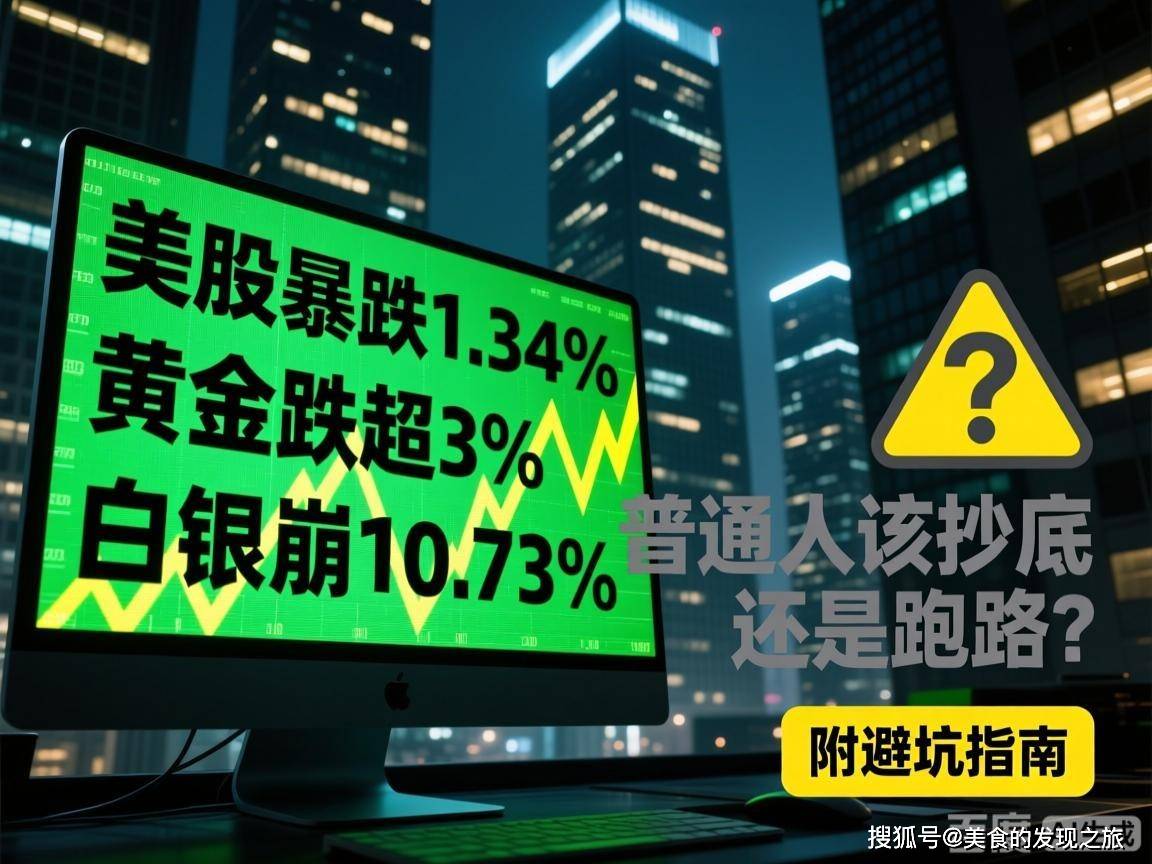
猝不及防!美股暴跌1.34%、黄金跌超3%、白银崩10.73%,深夜闪崩真相曝光,普通人该抄底还是跑路?附避坑指南
Sou Hu Cai Jing· 2026-02-13 13:45
Core Viewpoint - The recent market crash on February 12, where both U.S. stocks and precious metals experienced significant declines, is attributed to multiple underlying factors, including unexpected U.S. employment data and a subsequent drop in interest rate expectations from the Federal Reserve [6][30]. Summary by Sections U.S. Stock Market Performance - On February 12, the three major U.S. stock indices opened in a downward trend, with the Dow Jones Industrial Average closing down 669.42 points, a drop of 1.34%, and the Nasdaq Composite Index falling 2.03%, down 469.32 points [3][30]. - The trading volume for the S&P 500 index reached a recent high, indicating a growing sense of panic among investors [3]. Precious Metals Market Performance - On the same day, international spot gold fell by over 3%, closing at $4921.7 per ounce, with a peak decline of more than 4% during the session [4][30]. - Silver experienced an even more dramatic drop, closing down 10.73% at $75.224 per ounce, marking one of the largest single-day declines since 2026 [4][30]. Key Factors Behind the Market Crash - The primary trigger for the market downturn was the U.S. non-farm payroll data, which exceeded expectations, leading to a significant reduction in the likelihood of interest rate cuts by the Federal Reserve [6][7]. - Concerns over the impact of artificial intelligence on job markets contributed to the sell-off in tech stocks, which in turn led to a liquidity crisis, prompting traders to liquidate precious metals to cover losses [9][10]. - Algorithmic trading exacerbated the situation by triggering stop-loss orders, resulting in a chain reaction of selling in both stocks and precious metals [11][12]. Implications for Investors - The market crash has direct implications for investors holding U.S. stocks, gold, or silver, as many experienced significant losses [14][30]. - Even those not directly involved in the markets should be aware of the broader economic implications, as U.S. monetary policy and economic performance can influence global markets, including domestic equities [14][30]. Investment Guidance - Investors are advised to control their positions and avoid leverage, ensuring that no single asset constitutes more than 10% of their total liquid assets [20]. - It is recommended to optimize investment tools and avoid blindly following market trends, as well as to establish clear stop-loss and take-profit strategies [21][27]. - Monitoring key economic indicators, such as the upcoming U.S. Consumer Price Index (CPI) data, is crucial for understanding potential market movements [28].


资讯早班车-2026-02-12-20260212
Bao Cheng Qi Huo· 2026-02-12 02:10
I. Industry Investment Rating No information provided in the report. II. Core Views - The global economic outlook shows some resilience but also increased uncertainties. The domestic economic situation is generally positive, with inflation showing positive changes. The monetary policy will continue to be moderately loose, and the RMB internationalization process may speed up. In the commodity market, there are various trends in different sectors, such as potential price increases in nickel and silver, and changes in energy and agricultural product markets. In the financial market, the bond market shows a "warm but restrained" trend, and the stock market has different performances in A - shares and Hong Kong stocks [35][36]. III. Summary by Directory 1. Macro Data - GDP in Q4 2025 grew 4.5% year - on - year, lower than the previous quarter and the same period last year. The manufacturing PMI in January 2026 was 49.3%, and the non - manufacturing PMI: business activity was 49.4%. Social financing scale in December 2025 was 22075 billion yuan, lower than the previous month and the same period last year. CPI in January 2026 was 0.2% year - on - year, and PPI was - 1.4% year - on - year [1]. 2. Commodity Investment Reference Comprehensive - In January, CPI rose 0.2% month - on - month and 0.2% year - on - year, and core CPI rose 0.8% year - on - year. PPI rose 0.4% month - on - month, with the decline narrowing year - on - year. The CME is exploring the launch of the first rare earth futures contract. There are differences in the basis of domestic commodities, with some having positive and some negative basis [2][3]. Metals - On February 11, London base metals rose across the board, with LME nickel up over 3%. Indonesia plans to cut nickel ore production quotas. Silver prices soared, and the silver market is expected to have a supply gap for the sixth consecutive year. Global silver demand is expected to be stable in 2026, with retail investment growth offsetting some losses in other sectors [4][5][6]. Coal, Coke, Steel and Minerals - Trump said coal is a reliable energy source, and coal power generation will increase by about 25 - 30% this year. Ukrainian steel production in January fell 16.3% [9][10]. Energy and Chemicals - The State Council issued an opinion on improving the national unified power market system, aiming to build a unified, efficient and safe power market by 2030 and fully complete it by 2035. OPEC maintained its forecast for global oil demand growth in 2026 and 2027. US EIA crude inventory increased last week, and the US expects Venezuela's oil, gas and power production to increase significantly [11][12][13]. Agricultural Products - The National Development and Reform Commission took measures to ensure the supply and price stability of important livelihood commodities. Jordan plans to buy up to 120,000 tons of wheat. The Indonesian palm oil association expects the production of CPO to increase by 2% - 3% in 2026, but land rectification may affect production [14][15]. 3. Financial News Compilation Open Market - On February 11, the central bank conducted 785 billion yuan of 7 - day reverse repurchase operations and 4000 billion yuan of 14 - day reverse repurchase operations, with a net investment of 4035 billion yuan [16]. Important News - In January, China's CPI and PPI showed certain trends. The US non - farm payrolls in January were strong, and the Fed's interest - rate cut expectations were postponed. The State Council promoted AI development, and the government took measures in various fields such as rare earth, agricultural product supply, and capital project opening. There were also news about trade disputes, antitrust, and the automotive industry [17][18][19]. Bond Market Summary - The inter - bank bond market showed a warm trend, with yields of some long - term interest - rate bonds falling. The exchange bond market had mixed performances, and the convertible bond market also had ups and downs. Different interest - rate indicators showed various trends, and there were changes in bond issuance and yields in domestic and foreign markets [28][29][30]. Foreign Exchange Market - The on - shore RMB against the US dollar rose 14 points, and the RMB central parity rate against the US dollar was adjusted up 20 points. The US dollar index rose slightly, and non - US currencies had different performances [33]. Research Report Highlights - Fixed - income + funds had a turning point in 2025, and future strategies need to focus on asset allocation. The RMB internationalization process may speed up. Different institutions gave comments on the economic situation, monetary policy, and exchange - rate trends. The spread of urban investment bonds is expected to remain low in 2026 [34][35][36]. Today's Reminder - On February 12, a large number of bonds will be listed, issued, paid, and have principal and interest repaid [38]. 4. Stock Market News - On Wednesday, the A - share market was narrowly sorted, with some cyclical stocks rising and hot - topic sectors adjusting. The Hong Kong stock market rose, with gold and auto stocks performing actively. The pre - Spring Festival dividend of listed companies in 2025 - 2026 reached a new high [39].
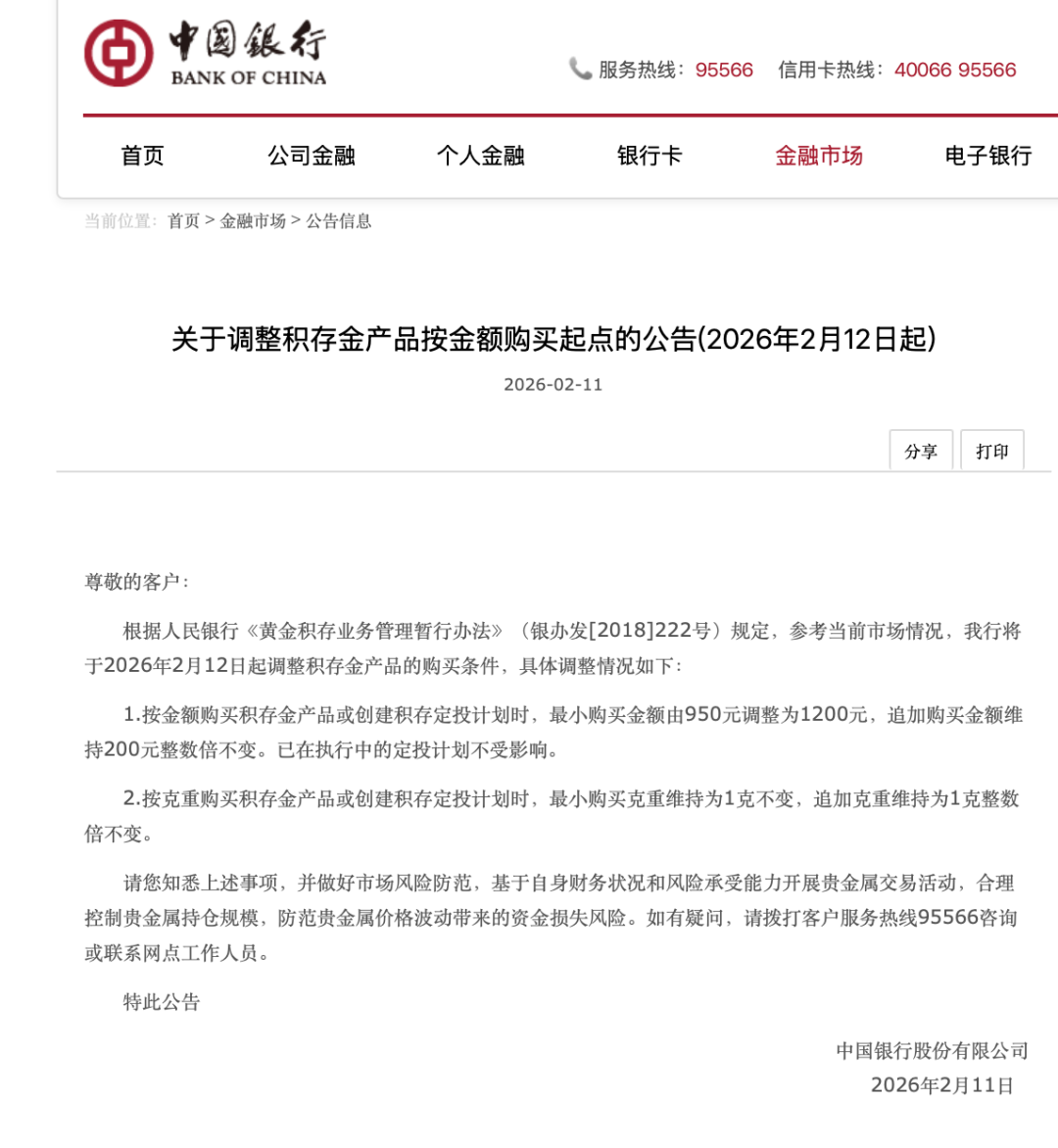
黄金大消息!又一国有大行宣布,上调起购金额
Zhong Guo Ji Jin Bao· 2026-02-11 22:38
Group 1 - The core point of the article is that China Bank has adjusted the minimum purchase amount for its accumulation gold products from 950 yuan to 1200 yuan, effective February 12, 2026 [1][2] - The adjustment in purchase conditions includes maintaining the additional purchase amount at 200 yuan and keeping the minimum weight for purchasing gold at 1 gram unchanged [2] - This change follows a trend among several banks, including Industrial and Commercial Bank of China and Agricultural Bank of China, which have also raised their minimum purchase amounts for accumulation gold products in early 2026 [5] Group 2 - In 2025, China Bank raised the minimum purchase amount for accumulation gold products four times, starting from 650 yuan in February and reaching 950 yuan by October [4] - The overall trend in the banking industry shows a tightening of access to accumulation gold business, with banks responding to regulatory requirements and market conditions to protect investors from irrational short-term trading [5] - The gold prices have shown significant volatility, with recent trends indicating a rebound above 5000 USD per ounce, which may influence banks' strategies regarding gold accumulation products [6][9]
大家千万不要太冲动!金价狂飙急跌,下周金价大盘估计这样走?
Sou Hu Cai Jing· 2026-02-07 17:20
Core Viewpoint - The recent fluctuations in the gold market have been dramatic, with significant price drops and increased volatility, prompting banks to issue risk warnings and adjust their precious metal business rules [1][3][5]. Group 1: Market Dynamics - On January 30, 2026, international gold prices fell sharply, with spot gold dropping below $4,700 per ounce, marking a nearly 10% decline, the largest single-day drop in 40 years [1]. - The volatility in gold prices is attributed to multiple factors, including political pressures on Trump, fiscal expansion, a weakening dollar, and a resurgence of liquidity in the market [3]. - The recent surge in gold prices had exceeded normal macro pricing rhythms, leading to concentrated positions and leverage among investors, which triggered a chain of sell-offs when market sentiment shifted [3][5]. Group 2: Geopolitical and Economic Influences - Geopolitical factors have also played a role, with a significant drop in gold prices on October 21, 2025, attributed to easing geopolitical tensions, particularly regarding the Ukraine conflict [5]. - A strengthening dollar has further suppressed gold prices, as the appreciation of the dollar increases the cost of purchasing gold for investors holding other currencies [5]. - The rapid rise in gold prices has led to a desire among investors to take profits, contributing to increased short-term volatility [3][7]. Group 3: Banking Sector Response - Major banks in China, including ICBC, CCB, and ABC, have issued multiple risk warnings and adjusted their gold accumulation business rules in response to market volatility [5][7]. - Banks have raised the minimum investment amounts for gold accumulation and emphasized the need for investors to operate cautiously based on their risk tolerance [7][10]. - Despite the banks' warnings, the demand for physical gold remains high, with many investment gold bars reported as "out of stock" or "sold out" [7][8]. Group 4: Investor Behavior and Market Sentiment - Investor behavior has shown a divide, with some viewing the price drop as a buying opportunity while others remain cautious due to potential further volatility [10][16]. - The market sentiment has shifted rapidly, with some investors feeling the urge to "catch the bottom," which poses operational risks during high volatility periods [16]. - The gold market's performance in 2025 saw prices rise from under $2,700 per ounce at the beginning of the year to over $4,500 per ounce by year-end, driven primarily by investment demand [12].

资讯早班车-2026-02-05-20260205
Bao Cheng Qi Huo· 2026-02-05 02:20
1. Report Industry Investment Rating No relevant content provided. 2. Core Views - The report presents a comprehensive overview of macro - economic data, commodity investment trends, and financial news, offering insights into various sectors such as metals, energy, agriculture, and the stock market. It also includes bond market and foreign exchange market analyses, along with research reports from different institutions [1][2][29] 3. Summary by Directory Macro Data - GDP growth in Q4 2025 slowed to 4.5% year - on - year, compared with 4.8% in the previous quarter and 5.4% in the same period last year. The manufacturing PMI in January 2026 was 49.3%, and the non - manufacturing PMI was 49.4%. Social financing and new RMB loans decreased in December 2025. CPI and PPI showed positive and negative growth trends respectively [1] Commodity Investment - **Comprehensive**: The EU's investigation into Chinese wind power companies has drawn strong responses from China. The CME will continue contract business under certain conditions. There are differences in the basis of domestic commodities on February 4 [2] - **Metals**: Gold and silver prices fluctuated. Gold futures in New York exceeded $5030/ounce on February 5, and silver reached $90/ounce. The industry is focusing on key technology research and development. Exchanges have adjusted margin levels and price limits to control speculation [3][4] - **Coal, Coke, Iron Ore**: Indonesian coal miners have suspended spot coal exports due to production cuts [6] - **Energy and Chemicals**: Musk's team visited Chinese photovoltaic companies, boosting the A - share photovoltaic sector. Russia's oil revenue in January dropped significantly. Morgan Stanley adjusted its oil price forecast [8][9] - **Agricultural Products**: Most agricultural product prices rose as of late January. South Korea confirmed a new African swine fever case. The government announced key tasks for the "Three Rural Issues" this year [12] Financial News - **Open Market**: The central bank conducted 750 billion yuan of 7 - day reverse repurchase operations on February 4, resulting in a net withdrawal of 3025 billion yuan [13] - **Important News**: High - level diplomatic communications took place between China and the US, and China and Russia. The central bank emphasized financial services for key areas. The government announced measures for agricultural development and responded to EU investigations [14][15][16] - **Bond Market**: Bond yields in the inter - bank and exchange markets showed mixed trends. The money market interest rates had different movements. Some bonds had significant price changes, and new bond issuance and trading information was provided [23][24][25] - **Foreign Exchange Market**: The on - shore RMB exchange rate against the US dollar decreased slightly, and the dollar index rose [28] - **Research Reports**: Institutions such as CITIC Securities and CICC issued research reports, predicting a high probability of a reserve requirement ratio cut in Q2 2026 and the expansion of global liquidity [29] Stock Market - A - shares rose on Wednesday, with the Shanghai Composite Index up 0.85%. The Hong Kong stock market showed mixed performance, with the Hang Seng Index up 0.05%. The number of new margin trading accounts increased significantly in January [32][33]
国债期货:权益市场反弹 长债情绪略回落
Jin Tou Wang· 2026-02-04 02:10
Market Performance - The majority of government bond futures closed higher, with the 30-year main contract down 0.10% at 111.960 yuan, the 10-year main contract up 0.02% at 108.260 yuan, the 5-year main contract up 0.06% at 105.905 yuan, and the 2-year main contract up 0.03% at 102.414 yuan [1] - The yields on major interbank bonds showed mixed movements, with the 10-year China Development Bank bond "25国开15" yield rising by 0.30 basis points to 1.9610%, while the 10-year government bond "25附息国债16" yield fell by 0.30 basis points to 1.8120%, and the 30-year government bond "25超长特别国债06" yield decreased by 0.15 basis points to 2.2500% [1] Funding Conditions - The central bank announced a 1,055 billion yuan 7-day reverse repurchase operation on February 3, with a fixed rate of 1.40%, and the full bid amount was accepted [2] - On the same day, 4,020 billion yuan of reverse repos matured, resulting in a net withdrawal of 2,965 billion yuan [2] - The overall funding conditions in the interbank market remained stable, with the weighted average rate of DR001 dropping about 5 basis points to around 1.31% [2] News Updates - The central bank reported liquidity injection for January 2026, with a net withdrawal of 79 billion yuan from the Standing Lending Facility (SLF), a net injection of 700 billion yuan from the Medium-term Lending Facility (MLF), and a net injection of 1,744 billion yuan from the Pledged Supplementary Lending (PSL) [3] - The central bank will conduct an 8,000 billion yuan buyout reverse repurchase operation on February 4, with a term of 3 months (91 days), aiming for a net injection of 1,000 billion yuan after accounting for 7,000 billion yuan of 91-day reverse repos maturing on the same day [3] Operational Suggestions - The recent rebound in the equity market has slightly suppressed long bond sentiment, but the central bank's announcements of 1,000 billion yuan bond purchases and a 1,000 billion yuan net injection through buyout reverse repos support expectations for a loose funding environment [4] - In the absence of further catalysts, the 10-year bond yield may continue to fluctuate within the 1.8%-1.85% range, while the T2603 contract may oscillate between 108-108.3 [4] - It is suggested to maintain range trading strategies and consider narrowing the spread between ultra-long bonds and other varieties, especially with the seasonal rise in funding rates before the Spring Festival [4]
资讯早班车-2026-02-04-20260204
Bao Cheng Qi Huo· 2026-02-04 01:34
1. Report Industry Investment Rating No information provided in the report. 2. Core Viewpoints of the Report The report comprehensively presents macro - economic data, commodity investment information, financial news, and stock market trends. It shows that the macro - economy has certain fluctuations, the commodity market has policy - induced changes and price movements, and the financial and stock markets are also affected by multiple factors such as policies, market supply and demand, and international situations. 3. Summary by Relevant Catalogs 3.1 Macro Data - GDP in Q4 2025 grew 4.5% year - on - year, lower than 4.8% in the previous quarter and 5.4% in the same period last year [1] - In January 2026, the manufacturing PMI was 49.3%, up from 49.0% in the previous month, and the non - manufacturing PMI was 49.4%, down from 50.1% in the previous month [1] - In December 2025, social financing scale was 22,075 billion yuan, lower than 35,299 billion yuan in the previous month and 28,537 billion yuan in the same period last year [1] 3.2 Commodity Investment Reference 3.2.1 Comprehensive - The "14th" central No. 1 document on "Three Rural Issues" was released, aiming at rural revitalization [2] - Multiple exchanges adjusted margin ratios and price limit ranges of various commodity futures contracts [2][3] - On February 3, 2026, 38 domestic commodity varieties had positive basis and 30 had negative basis [3] - CME's average daily contract trading volume in January increased 15% year - on - year to a record 29.6 million contracts [3] 3.2.2 Metals - International precious metal futures generally rose, with COMEX gold up 6.83% and COMEX silver up 10.27% [5] - Global alumina production in 2025 reached 144.98 million tons, up 5.1% from 2024 [6] - Chile's copper production is expected to grow 3.7% in 2026 and 6.4% in 2027, with the average price in 2026 expected to be $4.95 per pound [7] 3.2.3 Coal, Coking, Steel and Minerals - Indonesian miners suspended thermal coal spot exports after the government proposed to cut coal production [9] 3.2.4 Energy and Chemicals - On February 3, 2026, domestic gasoline and diesel retail prices were raised by 205 yuan/ton and 195 yuan/ton respectively [10] - Four public fund companies warned of significant premiums in the secondary market trading prices of their crude oil and petroleum - themed funds [10] - The U.S. plans to issue licenses for companies to exploit Venezuelan oil [10] 3.2.5 Agricultural Products - Ukraine's white sugar production in 2025 dropped to 1.72 million tons, a 4% decrease [11] 3.3 Financial News Compilation 3.3.1 Open Market - On February 3, the central bank conducted 105.5 billion yuan of 7 - day reverse repurchase operations, with a net withdrawal of 296.5 billion yuan [13] - On February 4, the central bank will conduct 800 billion yuan of 3 - month (91 - day) outright reverse repurchase operations, with a net injection of 100 billion yuan [13] - In January 2026, the central bank's MLF had a net injection of 700 billion yuan, and PSL had a net injection of 174.4 billion yuan [14] 3.3.2 Important News - The 2026 central No. 1 document focused on rural revitalization, including financial support policies [15] - Rumors about VAT rate adjustments in the game and financial industries were untrue [15][16] - The State - owned Assets Supervision and Administration Commission emphasized the development of strategic emerging industries [16] - The Shanghai headquarters of the central bank called for promoting the reasonable growth and balanced distribution of credit [16] 3.3.3 Bond Market Summary - The Chinese bond market was mainly volatile, with treasury bond futures mostly rising [22] - The exchange bond market had mixed performances, with some bonds rising and some falling [22][23] - The中证 Convertible Bond Index rose 2.63% [23] 3.3.4 Foreign Exchange Market - The on - shore RMB against the US dollar rose 151 points, and the RMB central parity rate was raised 87 points [27] - The US dollar index fell 0.22%, and most non - US currencies rose [27] 3.3.5 Research Report Highlights - Huatai Fixed - income said to focus on the expansion of free - trade offshore bonds and the possibility of using dim - sum bonds to take over free - trade bonds [28] - CITIC Securities expected that dividend insurance products and incremental funds from bank deposits would support 2026 premium income [28] 3.3.6 Today's Reminders - On February 4, 158 bonds will be listed, 163 bonds will be issued, 127 bonds will make payments, and 55 bonds will pay principal and interest [30] 3.4 Stock Market News - On Tuesday, the A - share market rose, with the Shanghai Composite Index up 1.29% [31] - The Hong Kong stock market's main indexes recovered, with the Hang Seng Index up 0.22% [31] - The CSRC chairman met with the head of the UK's FCA to discuss regulatory cooperation [31] - In January, the number of new A - share accounts reached 4.9158 million, a 15 - month high [31]