
套利资金

Search documents
多品牌金饰克价逼近1500元
Huan Qiu Wang Zi Xun· 2026-01-21 03:20
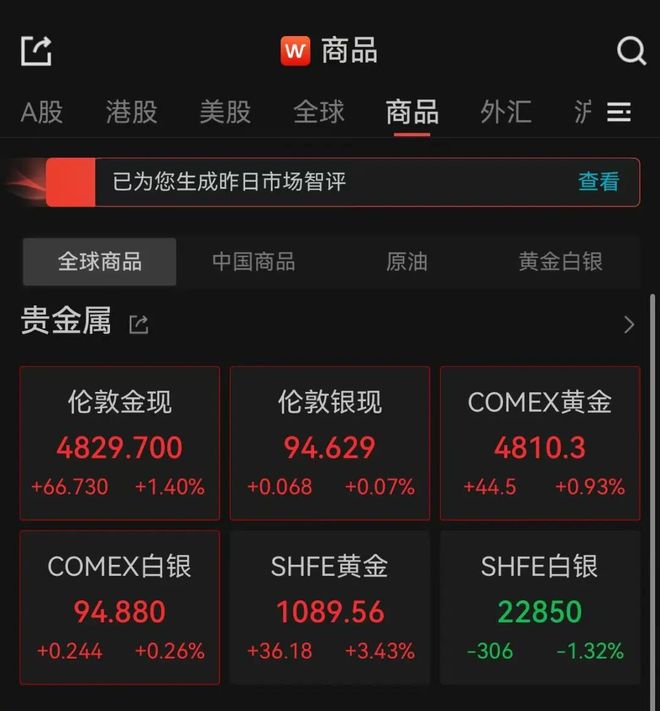
Group 1 - The core point of the news is that spot gold prices have surged, reaching a new historical high of $4829.700 per ounce, with a 1.40% increase [1][2] - COMEX gold futures also saw an increase of nearly 1%, trading at $4810.3 per ounce [1][2] - Year-to-date, spot gold has risen over 11% [2] Group 2 - Domestic gold jewelry prices are on the rise, with multiple brands reporting prices above 1490 yuan per gram, marking a recent high [3] - Specific prices include Chow Sang Sang at 1495 yuan per gram, up 41 yuan; Lao Feng Xiang at 1498 yuan per gram, up 42 yuan; and Lao Miao Gold at 1493 yuan per gram, up 38 yuan [3] Group 3 - The recent surge in gold prices is attributed to heightened geopolitical risks related to Greenland, which has driven safe-haven demand for gold [9] - The significant rise in silver prices since December has also contributed to the upward movement in gold, with the gold-silver ratio dropping to around 50, a low not seen in 14 years [9] - Market analysts suggest that if geopolitical tensions ease, gold prices may face downward pressure, advising profit protection through strategic selling [8][9]

机构看金市:1月21日
Xin Hua Cai Jing· 2026-01-21 03:18
Core Viewpoint - The geopolitical tensions surrounding Greenland have led to increased demand for safe-haven assets, driving up the prices of gold and silver to new highs [1][2][3][4]. Group 1: Geopolitical Events and Market Reactions - The situation in Greenland has escalated, with U.S. President Trump asserting his intention to control the territory, which has raised concerns among European investors [1]. - European institutions, including Denmark's Akademiker Pension, are beginning to sell off U.S. Treasury bonds, reflecting a reassessment of their safe-haven status [1]. - The Polish central bank's decision to purchase 150 tons of gold is seen as a significant factor supporting gold prices amid rising geopolitical tensions [2]. Group 2: Price Movements and Predictions - Gold prices are expected to surpass $5,000 per ounce due to new geopolitical uncertainties and concerns regarding U.S. monetary policy [4]. - Silver prices are projected to reach $100 per ounce, although a potential correction may occur as physical shortages improve [4]. - The gold-silver ratio has decreased significantly, indicating a strong upward trend in silver prices, which is also contributing to gold's rise [3]. Group 3: Institutional Insights - Analysts from various institutions highlight that the ongoing geopolitical tensions and U.S. trade policies are primary drivers of the current gold price surge [4]. - The influx of central bank purchases and ETF investments has further propelled gold prices to unprecedented levels [4].
沪指盘中跌破4100点,贵金属逆势拉涨,四川黄金涨停
2 1 Shi Ji Jing Ji Bao Dao· 2026-01-15 04:49
Core Viewpoint - The market experienced a decline with all three major indices falling, while precious metals, particularly gold and silver, saw significant price increases driven by geopolitical risks and monetary easing expectations [1] Market Performance - As of the midday close on January 15, the three major indices collectively dropped, with the ChiNext Index falling over 1% and the Shanghai Composite Index dipping below 4100 points [1] - Precious metals, including gold and silver, performed well, with Sichuan Gold hitting the daily limit and Hunan Silver and Xiaocheng Technology rising over 5% [1] Precious Metals Analysis - The recent rise in gold prices is attributed to a combination of short-term geopolitical risks, concerns over the independence of the Federal Reserve, and long-term structural factors [1] - Silver prices have surged approximately 15% this week, while gold prices have only increased about 2%, leading to a significant decline in the gold-silver ratio, which is currently around 50, the lowest in 14 years [1] - This low gold-silver ratio is expected to attract arbitrage funds into gold [1] - The sentiment in the precious metals market, especially for silver, is currently high, and the 4600 USD level is noted as a key point for market dynamics [1]
博时基金王祥:黄金年末获利了结,避险情绪或再度升温
Xin Lang Cai Jing· 2026-01-06 04:02
Market Overview - The gold market experienced profit-taking in the last week of 2025, influenced by selling pressure from other precious metals, leading to increased price volatility during the holiday season [1][12] - The gold-silver ratio fell below 50, indicating a relatively restrained performance of gold amidst the precious metals rally since December [1][12] - Despite short-term emotional impacts from other metals' adjustments, the likelihood of a significant decline in gold prices remains low, with potential for arbitrage funds to enter the gold market [1][13] Geopolitical Events - A significant geopolitical event occurred on January 3, 2026, when the U.S. military launched strikes against Venezuela, creating uncertainty about the country's governance and potentially heightening risk aversion in the market [1][13] Economic Indicators - The U.S. third-quarter GDP growth exceeded expectations, with an annualized quarter-on-quarter increase of 4.3%, significantly above the anticipated 3.3%, marking the fastest growth in two years [2][13] - Strong consumer spending contributed to this growth, with a notable acceleration to 3.5% in the same quarter [2][13] - The core PCE price index rose by 2.9% in the third quarter, and there was a rebound in core capital goods orders and shipments in October [2][13] Commodity Index Adjustments - Starting January 8, 2026, Goldman Sachs Commodity Index will undergo annual weight adjustments, resulting in a slight reduction in the weights of gold and silver due to their significant price increases in 2025 [2][13] - This adjustment may indicate that the short-term correction in the precious metals market is not yet over, although the marginal pressure on gold is not expected to be significant [2][13] Federal Reserve Leadership - President Trump is set to announce the next Federal Reserve Chair in the first week of January 2026, as Jerome Powell's term will end in May [2][14] - Trump expressed a preference for the new chair to lower interest rates when the economy and markets are performing well, rather than preemptively curtailing growth due to inflation concerns [2][14]