存储芯片涨价潮

Search documents
身价立涨10倍,抽屉里的碎屏安卓机成香饽饽了
虎嗅APP· 2026-03-28 03:56
Core Viewpoint - The article discusses the recent surge in the value of old smartphones, driven by the booming AI industry and the resulting demand for storage chips, leading to a significant increase in the mobile phone recycling market [5][12][18]. Group 1: Market Dynamics - The recycling market for old smartphones has seen a price surge, with sellers reporting that previously unwanted devices are now in high demand, leading to quick sales and higher offers from recyclers [6][8]. - A specific example includes the OPPO Find X8 Ultra, which can be sold for 3,465 yuan, significantly higher than the 2,900-3,000 yuan offered by online recycling platforms [11]. - The price of recycled phones has reportedly increased five to six times, with some models that were valued at 20-30 yuan last year now fetching 150-180 yuan [11]. Group 2: Chip Demand and Supply - The explosive growth of the AI industry has led to a dramatic increase in demand for high-bandwidth memory (HBM) and large-capacity storage chips, causing a supply-demand imbalance and skyrocketing prices [12][13]. - According to data from TrendForce, the prices of storage chips have increased by over 300% in the last three months, with DRAM prices expected to rise by 80% to 95% in the first quarter of 2026 [12]. - The share of memory chips in the material costs of smartphones has risen from 10%-15% to 30%-40%, prompting manufacturers to raise retail prices [13]. Group 3: Recycling Process and Profitability - Recyclers are focusing on domestic Android phones, as they are more profitable due to the reusability of their memory chips, unlike Apple devices which have a unified memory architecture that limits reuse [11][16]. - The profit margins for recycled devices vary, with normal machines yielding profits of 100 to 300 yuan, while higher-end devices can yield lower percentages due to increased costs [11]. - The internal components of old smartphones, including metals like copper and silver, contribute to their value, making them a source of electronic raw materials rather than mere waste [17]. Group 4: Future Outlook - The current enthusiasm for recycling old smartphones may wane as the market becomes saturated with new entrants, leading to increased competition and potentially lower profit margins [17][18]. - The article suggests that as the storage chip market stabilizes and the recycling industry becomes more regulated, the initial high profits may normalize, returning the focus to sustainable resource utilization [18].


身价立涨10倍,抽屉里的碎屏安卓机成香饽饽了
创业邦· 2026-03-28 03:45
Core Viewpoint - The article discusses the surge in the value of old smartphones due to the booming demand for storage chips driven by the AI industry, leading to a significant increase in the mobile phone recycling market [6][14][22]. Group 1: Recycling Market Dynamics - The old mobile phone recycling market has seen a price surge, with sellers reporting that previously unwanted devices are now in high demand, turning waste into profit [7][10]. - A mobile phone recycler noted that even severely damaged phones can fetch prices between 10 to 20 yuan, with resale values reaching over 100 yuan [11]. - The recycling prices for certain models have increased dramatically, with some phones that were valued at 20-30 yuan last year now fetching 150-180 yuan [12]. Group 2: Impact of AI on Chip Prices - The explosive growth of the AI industry has led to a significant increase in demand for high-bandwidth memory (HBM) and large-capacity storage chips, causing a price surge in the storage chip market [14][15]. - Data from TrendForce indicates that the prices of DRAM and NAND flash memory have reached record highs, with DRAM prices increasing by 369% from their 2025 lows [15]. - The rising costs of storage components have forced smartphone manufacturers to raise their prices, with some models seeing price increases of 300-600 yuan [15]. Group 3: Differences in Smartphone Architecture - The article highlights a stark contrast in the recycling value between Android and Apple smartphones, primarily due to their different hardware architectures [19][21]. - Android phones typically use a modular design that allows for easier extraction and reuse of memory chips, while Apple's unified memory architecture makes its chips less reusable [19][21]. - This architectural difference results in Android phones being more valuable in the recycling market, as they provide reusable memory components that are in high demand [21][22]. Group 4: Future of the Recycling Market - The current enthusiasm for recycling old smartphones may not be sustainable, as increased competition and rising acquisition costs are beginning to normalize the market [22]. - The article suggests that the recycling industry is transitioning towards a more regulated and rational market, moving away from initial high-profit margins [22]. - The evolving landscape of the storage chip market and the recycling industry reflects broader trends in resource utilization and the value of electronic waste [22].

全年净利腰斩背后 “非洲之王”传音的怨与愁
Bei Jing Shang Bao· 2026-02-01 14:13
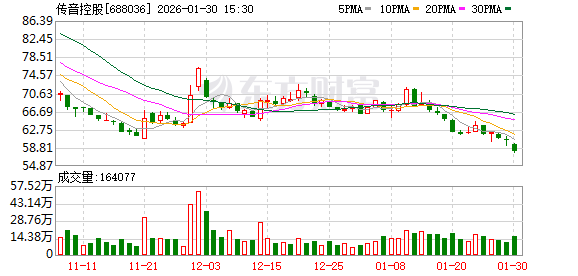
Core Viewpoint - Transsion Holdings, known as the "King of Africa" in the mobile phone industry, reported a disappointing annual performance for 2025, with significant declines in revenue and net profit due to rising supply chain costs and intensified competition in emerging markets [2][3]. Group 1: Financial Performance - The company expects to achieve approximately 65.568 billion yuan in revenue for 2025, a decrease of 4.58% year-on-year, equating to a drop of 3.147 billion yuan [2]. - Net profit attributable to shareholders is projected to be around 2.546 billion yuan, reflecting a substantial decline of 54.11%, or a reduction of about 3.003 billion yuan compared to the previous year [2]. - The non-recurring net profit saw an even steeper decline of 58.06% [2]. Group 2: Market Challenges - The decline in performance is attributed to a combination of rising storage chip prices impacting supply chain costs and increased competition in both local and global emerging markets [2][4]. - The first quarter of 2025 saw a revenue drop of 25.45% and a net profit plunge of 69.87%, indicating a significant early warning of ongoing pressure throughout the year [4]. - By the end of the third quarter, despite a seasonal revenue increase of 22.60%, cumulative revenue still showed a decline of 3.33% year-on-year [4][6]. Group 3: Competitive Landscape - In the global smartphone market, Transsion's performance was mixed, with a notable increase in third-quarter shipments of 29.2 million units, marking a 13.6% year-on-year growth, positioning it among the top five manufacturers [6]. - However, the company struggled in other quarters, failing to maintain a consistent presence in the global top rankings, reflecting instability in its competitive position [6][7]. - In the African market, while still leading with a 51% share, Transsion faced challenges from competitors like Xiaomi and Honor, who exhibited significantly higher growth rates [7][8]. Group 4: Cost Pressures - The rising cost of storage components has become a common challenge in the smartphone industry, particularly affecting Transsion's low to mid-range offerings, where price sensitivity is high [9][10]. - The increase in DRAM prices has raised production costs across all price segments, with low-end models experiencing the most significant increases [9]. - The inability to fully pass on these costs to consumers may lead to further profit compression or reduced shipments of lower-end models, exacerbating the company's operational pressures in emerging markets [10].

全年净利腰斩背后,“非洲之王”传音的怨与愁
Bei Jing Shang Bao· 2026-02-01 13:53
Core Insights - The company, Transsion Holdings, reported a significant decline in revenue and net profit for the year 2025, with expected revenue of approximately 65.568 billion yuan, a decrease of 4.58% year-on-year, and a net profit of about 2.546 billion yuan, down 54.11% from the previous year [1][4] Group 1: Financial Performance - In Q1 2025, the company experienced a revenue drop of 25.45% and a net profit decline of 69.87%, indicating a challenging start to the year [3] - The first half of 2025 showed a continued downward trend, with revenue down 15.86% and net profit down 57.48% [3] - By Q3, despite a 22.60% increase in quarterly revenue, the cumulative revenue for the first three quarters still showed a decline of 3.33% [5] Group 2: Market Position and Competition - Transsion's market position as the "King of Africa" is under threat, with competitors like Xiaomi and Honor rapidly increasing their market share in Africa [6][7] - In Q3 2025, Transsion achieved a 13.6% year-on-year increase in shipments, reaching 29.2 million units, but this was an exception in an otherwise challenging year [5] - The company is facing significant competition in emerging markets, with its growth in Southeast Asia and Latin America also showing signs of decline [6] Group 3: Cost Pressures - The rising cost of storage chips has become a common challenge in the smartphone industry, significantly impacting Transsion's profitability, especially in the low-price segment [8][9] - The increase in production costs due to DRAM price hikes is expected to continue, with low-price segment costs rising by approximately 25% [9] - The company has limited ability to pass on these costs to price-sensitive consumers in emerging markets, leading to further pressure on profit margins [9]
GDIRI观察 | 兆易创新H股上市,存储芯片涨价热浪里的红利与考验
Sou Hu Cai Jing· 2026-01-13 10:33
Core Viewpoint - The demand for AI computing power is entering a rapid growth cycle, leading to a significant price increase for storage chips, with international companies planning to raise server DRAM prices by 60%-70% in Q1 2026 compared to Q4 2025 [2][3]. Industry Overview - The global storage chip market is experiencing a sustained upward cycle due to increased demand driven by AI technology, with DRAM and NAND flash consumption in the server sector expected to grow by 40%-50% year-on-year in 2025 [3]. - The price of DDR4 memory modules has tripled within a year, indicating a severe shortage in the storage chip market [3]. - Major companies like Samsung and SK Hynix are prioritizing advanced process capacities, leading to a reduction in the production of mature processes like DDR4, creating supply gaps for specific mid-range storage chips [3]. Company Performance - Zhaoyi Innovation, a leading domestic storage chip company, has seen its stock price increase by 101.25% in 2025, reaching a historical high of 273.77 yuan per share by early 2026, with a market capitalization exceeding 180 billion yuan [2]. - The company reported a revenue of 26.81 billion yuan in Q3 2025, a year-on-year increase of 31.40%, with net profit rising by 61.13% [11]. Product and Market Position - Zhaoyi Innovation has a diverse product matrix, including niche DRAM, NOR Flash, and MCU, with significant market shares in various segments [5][6]. - The company plans to enhance its NOR Flash product line and aims to achieve mass production of 45nm NOR Flash products by 2026 [5]. Supply Chain and Production Strategy - Zhaoyi Innovation operates on a Fabless model, relying on major foundries for production, which allows for rapid market response but also poses supply chain risks [7]. - The company has invested in binding partnerships with key foundries to secure production capacity and mitigate supply chain risks, including a 1.88% stake in Changxin Storage [8][9]. Capital Expansion and Future Outlook - The company went public in Hong Kong on January 13, 2026, raising approximately 4.18 billion HKD to enhance R&D capabilities and expand its global marketing network [14]. - While capital expansion presents opportunities, it also brings challenges related to funding, technology, and market competition, particularly in a capital-intensive industry like semiconductors [15].


存储芯片巨头突然宣布退出,29年经典品牌即将谢幕
2 1 Shi Ji Jing Ji Bao Dao· 2025-12-11 05:08
Core Viewpoint - Micron Technology has announced its exit from the consumer storage brand Crucial, effective March 2026, to reallocate resources towards enterprise and AI-driven clients due to the explosive growth in data center demand driven by AI [2][3]. Group 1: Company Strategy - Micron's decision to withdraw from the Crucial business is described as a difficult one, aimed at focusing on higher-margin enterprise and AI strategic customers [2]. - The company is one of the top three memory manufacturers globally, holding a 25.7% market share in DRAM and 14.2% in NAND as of Q3 2025 [3]. Group 2: Market Dynamics - The exit of Micron from the consumer storage market adds uncertainty to the already imbalanced supply-demand dynamics in the storage industry [3]. - The ongoing price surge in storage chips is expected to increase costs for smartphones and computers, driven by a shift in demand towards high-bandwidth, low-power products due to AI [4]. Group 3: Financial Performance - In Q3 2025, Samsung's storage business reported sales of 26.7 trillion KRW (approximately $18.7 billion), a 20% year-on-year increase, while SK Hynix's revenue reached 24.45 trillion KRW (approximately $17.1 billion), a 39% year-on-year increase [3]. - Micron's revenue for Q4 FY2025 was $11.32 billion, a 46% year-on-year increase, with a gross margin of 45.7%, up 9.2 percentage points year-on-year [3]. Group 4: Future Market Trends - The current price increase in storage chips is expected to last longer and cover a broader range than previously anticipated, with AI server investments driving future growth [4][5]. - The supply of DDR4 chips is predicted to remain tight until at least mid-2026 due to the shift in production capacity towards advanced processes [5]. Group 5: Opportunities for Domestic Manufacturers - The exit of major players from the consumer storage market creates opportunities for domestic manufacturers to fill the supply gap, particularly in the DDR4 segment [7]. - Companies like GigaDevice have already begun to benefit from the strategic shift of larger firms, with their DRAM business showing significant recovery in profitability [7][8].

刷屏大涨!这一板块爆发
Zhong Guo Zheng Quan Bao· 2025-10-24 11:48
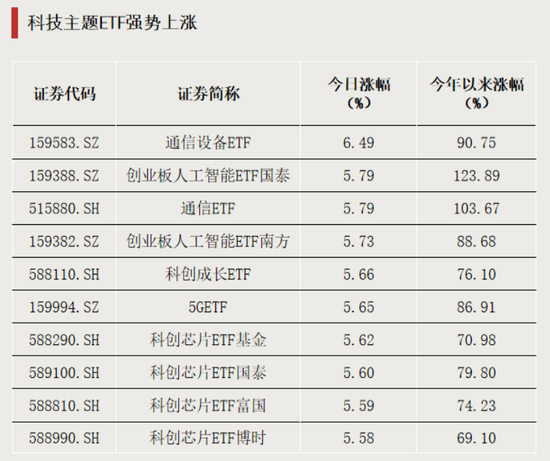
Market Overview - On October 24, A-shares saw all three major indices rise, with total trading volume approaching 2 trillion yuan, an increase of over 330 billion yuan compared to the previous trading day [1] - The Shanghai Composite Index closed at its intraday high of 3950.31 points, with over 1000 of the 1300+ ETFs in the market rising, and more than 130 products gaining over 4% [1] ETF Performance - Technology-themed ETFs performed exceptionally well, with all top ten ETFs by daily gain being technology-focused, each rising over 5% [2] - Some technology-themed ETFs have achieved over 100% returns year-to-date [2] - The Communication Equipment ETF (159583) led the market with a 6.49% increase and a trading volume of 190 million yuan, doubling from the previous day [2][3] - The top-performing stocks within the Communication Equipment ETF included Aerospace Science and Technology, which hit the daily limit, and several others that rose over 10% [2] Sector Analysis - The communication and electronics sectors were the top performers among over 30 industry sectors, with a combined trading volume exceeding 540 billion yuan [2] - Four ETFs linked to the Shanghai Stock Exchange Science and Technology Innovation Board Chip Index also made it to the top ten gainers, with significant increases in stocks related to storage chips [3][4] Fund Flows - On October 23, the ETF market saw a net inflow of approximately 6 billion yuan, with defensive ETFs continuing to attract funds, while some aggressive ETFs also gained interest [7][8] - Defensive ETFs focused on currencies, bonds, banks, and gold saw significant net inflows, with the Hua Bao Tian Yi ETF (511990) leading with a net inflow of 717 million yuan [7][8] - Conversely, some large-cap broad-based products experienced net outflows, with the Coal ETF (515220) seeing a net outflow of 601 million yuan on the same day [9][10] Earnings Outlook - Analysts suggest that the technology growth sector remains a favored investment theme, particularly with the acceleration of AI industry trends [11] - The upcoming third-quarter earnings reports are expected to show strong performance in the electronics and AI sectors, with many companies likely to exceed expectations [11][12] - The overall return on equity (ROE) for A-share listed companies (excluding financials and oil) is expected to rise, indicating improving profitability and market fundamentals [12]
内存条涨成“理财产品”!存储芯片涨价潮背后,有何投资机遇?
Sou Hu Cai Jing· 2025-10-21 10:17
Core Insights - The memory prices are expected to surge in 2025, with DDR4 prices more than doubling, indicating a significant investment opportunity in the memory sector [1] - The demand for memory and storage is skyrocketing due to applications in consumer electronics and AI models, leading to a price increase across the industry [1] - This price surge is creating a favorable environment for domestic memory chip manufacturers in China, providing them with unprecedented market opportunities [1] Part 1: What are Storage Chips? - Storage chips are a major segment of the semiconductor industry, acting as the "memory center" for electronic devices, responsible for storing data and instructions [1] - They offer advantages such as small size and fast storage, enabling cost-effective computing solutions [1] Part 2: Storage Market Enters a "Volume and Price Rise" Cycle - According to CFM's report, enterprise SSD prices are expected to rise over 10%, while DDR5 RDIMM prices may increase by 10% to 15% [5] - The current price increase is driven by a surge in AI computing demand, supply chain adjustments, and production cuts by manufacturers [5][7] - The storage industry is entering a new upward cycle, with server demand recovery and AI server deployment being the core drivers of this price increase [7] Part 3: Domestic Replacement Faces a "Golden Window" - Global supply shortages in storage chips are creating significant market entry opportunities for domestic manufacturers [8] - Domestic brands like Yangtze Memory Technologies and Changxin Memory Technologies are gaining traction as local clients accelerate product validation and procurement [8] - The acceptance of domestic storage solutions is increasing, with expectations that 2025-2026 will be a critical period for enhancing domestic market share [8] Part 4: Investment Logic: From Individual Manufacturers to Full Industry Chain Layout - Investment perspectives are shifting from focusing on individual manufacturers to a broader view of the entire industry chain [12] - Midstream companies, such as memory controller chip and module manufacturers, are particularly sensitive to price fluctuations, which can significantly enhance their profit margins [12] - The most certain opportunities may arise from upstream semiconductor equipment and materials, as domestic manufacturers will need to invest heavily in equipment to expand production [13] Part 5: Semiconductor Equipment and Materials - The construction of a wafer fab involves over 70% of investment in equipment, with domestic equipment rates currently low [13] - As domestic storage manufacturers expand, there will be a direct increase in demand for domestic equipment [13] - The semiconductor materials sector also faces significant opportunities for growth, particularly in high-end materials, as domestic production capabilities improve [14]