
官方外汇储备

Search documents
货币政策预计将保持连续性、稳定性兼顾灵活性丨第一财经首席经济学家调研
Di Yi Cai Jing· 2026-01-09 03:57
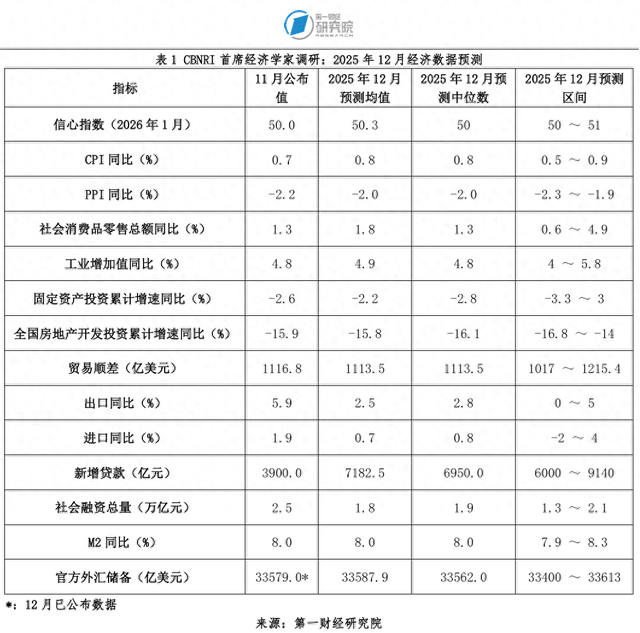
Core Viewpoint - The economic outlook for China in 2025 is expected to show steady progress, with a focus on high-quality development and structural optimization, as indicated by the Chief Economist Confidence Index of 50.32 for January 2026, reflecting a recovery from the previous month [1][4]. Economic Indicators - The average forecast for December 2025 CPI year-on-year growth is 0.8%, slightly higher than the previous month's 0.7% [8][10]. - The average forecast for December 2025 PPI year-on-year growth is -2.0%, an improvement from -2.2% in the previous month [8][10]. - The average forecast for December 2025 industrial added value year-on-year growth is 4.9%, up from 4.8% in November [13]. - The average forecast for December 2025 fixed asset investment cumulative year-on-year growth is -2.2%, an improvement from -2.6% in November [14]. - The average forecast for December 2025 social retail sales year-on-year growth is 1.8%, with a range from 0.6% to 4.9% [10][11]. - The average forecast for December 2025 trade surplus is $1113.5 billion, slightly lower than the previous month's $1116.8 billion [17]. - The average forecast for December 2025 new loans is 7182.5 billion yuan, a significant increase from the previous month's 3900 billion yuan [19]. - The average forecast for December 2025 total social financing is 1.8 trillion yuan, down from 2.5 trillion yuan in November [21]. - The average forecast for December 2025 M2 year-on-year growth is 8%, consistent with the previous month's figure [21][23]. - As of December 2025, China's foreign exchange reserves are expected to be $33579 billion, reflecting a slight increase from the previous month [23]. Policy Outlook - The macroeconomic policy for 2026 is expected to be more proactive, with an increase in fiscal deficit and government debt issuance to support economic growth [25][27]. - Monetary policy is anticipated to remain accommodative, with potential interest rate cuts and reserve requirement ratio reductions to ensure liquidity and lower financing costs [26][27].

2026年经济政策有望维持宽松基调,更加强调质效并重丨第一财经首席经济学家调研
Di Yi Cai Jing· 2025-12-08 09:08
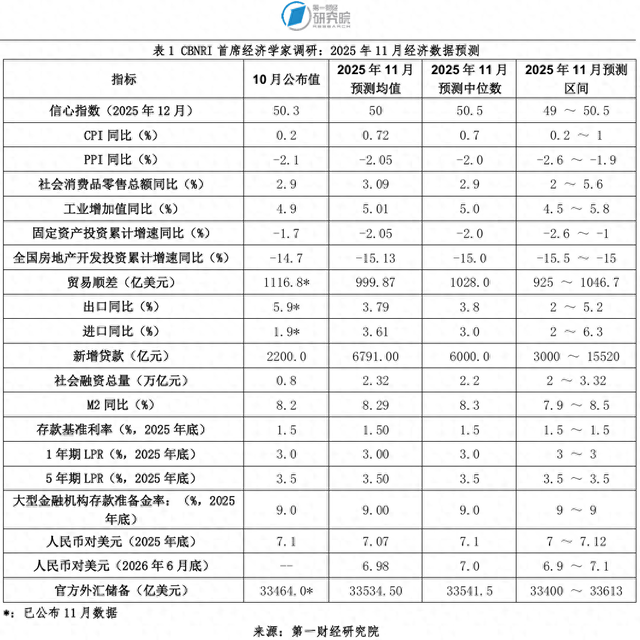
Economic Confidence Index - The "Economic Confidence Index" for December 2025 is reported at 50, slightly lower than the previous month, indicating a weak recovery in the economy [6][8]. Inflation Predictions - Economists predict the Consumer Price Index (CPI) for November 2025 to be 0.72%, up from 0.2% in the previous month, while the Producer Price Index (PPI) is expected to be -2.05% [9][10]. Retail Sales Growth - The forecast for the year-on-year growth of social retail sales in November is 3.09%, slightly higher than the previous month's 2.9%, driven by the "Double 11" shopping festival and a recovery in the dining sector [10][11]. Industrial Value Added - The predicted year-on-year growth rate for industrial value added in November is 5.0%, an increase from the previous month's 4.9% [11]. Fixed Asset Investment - The forecast for the year-on-year growth rate of fixed asset investment in November is -2.1%, lower than the previous month's -1.7%, indicating continued pressure from the real estate market [12][14]. Real Estate Investment - The predicted year-on-year growth rate for real estate development investment in November is -15.1%, reflecting ongoing challenges in the sector [14]. Trade Surplus - China's trade surplus for November is reported at $111.68 billion, with exports growing by 5.9% and imports by 1.9%, aligning with economists' expectations [15]. New Loans - Economists forecast new loans for November to rebound to 679.1 billion yuan, significantly higher than the previous month's 220 billion yuan [16]. Total Social Financing - The predicted total social financing for November is 2.32 trillion yuan, an increase from the previous month's 0.81 trillion yuan [17]. M2 Growth Rate - The forecast for the year-on-year growth rate of M2 in November is 8.29%, slightly above the previous month's 8.2% [18]. Monetary Policy Outlook - Economists expect the possibility of adjustments to the Loan Prime Rate (LPR) and reserve requirement ratios to be low in the near term, with a continued focus on maintaining liquidity in the market [20]. Exchange Rate Predictions - The predicted exchange rate for the Chinese yuan against the US dollar at the end of 2025 is 7.07, with expectations of a potential adjustment to 6.98 by mid-2026 [21]. Foreign Exchange Reserves - As of the end of November, China's foreign exchange reserves are reported at $33,464 billion, reflecting a slight increase from the previous month [22][23].
一财首席经济学家调研:信心指数持平50.3,全年5%增速有望实现
Di Yi Cai Jing· 2025-11-05 12:56
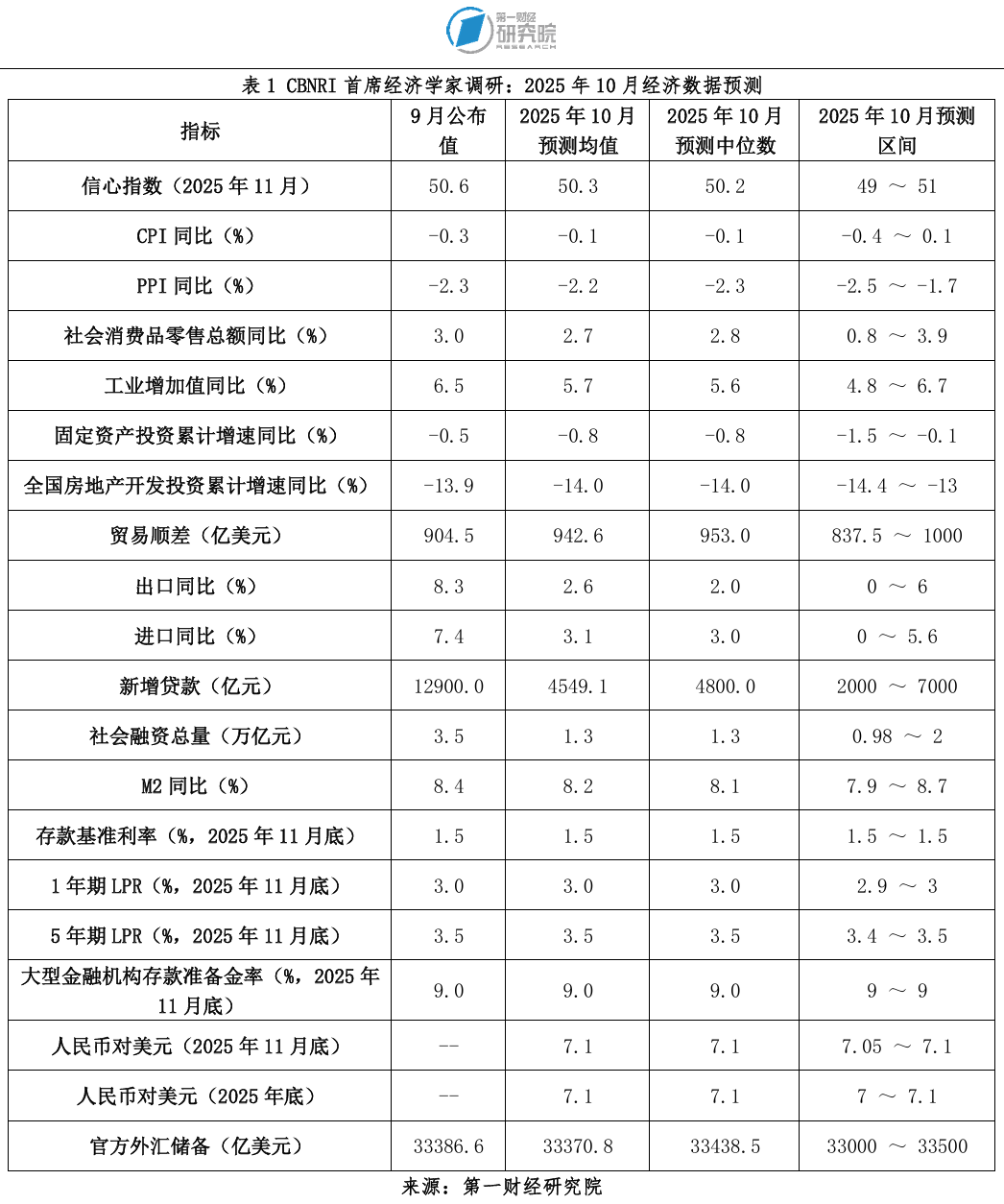
Economic Outlook - The economic confidence index for November 2025 is reported at 50.3, remaining stable compared to the previous month, indicating a steady economic outlook with a target growth rate of 5% for the year [1][4][8] - Economists predict that the external environment will remain complex and variable, emphasizing the need for domestic economic focus on restoring internal demand [1][7] Price Trends - The Consumer Price Index (CPI) for October is forecasted to be -0.1%, showing a slight recovery from the previous month's -0.3% [2][9] - The Producer Price Index (PPI) is expected to be -2.2%, slightly better than the previous month's -2.3% [2][9] Retail and Consumption - The year-on-year growth rate for social retail sales in October is predicted to be 2.7%, down from 3% in the previous month [2][10] - Factors affecting retail growth include a decline in automotive sales and a slowdown in the real estate market, despite positive trends in tourism and online consumption [11][10] Industrial Production - The industrial added value for October is expected to grow by 5.7%, a decrease from the previous month's 6.5% [2][12] - High-frequency data indicates strong production activity, particularly in steel and chemical sectors, suggesting continued robust industrial performance [12] Investment Trends - Fixed asset investment growth is projected to be -0.8%, slightly lower than the previous month's -0.5% [2][13] - Infrastructure investment is anticipated to receive a boost from new fiscal policies, while real estate investment continues to face challenges [14][15] Trade Balance - The trade surplus for October is forecasted to be $94.26 billion, an increase from the previous month's $90.45 billion [2][16][18] - Export growth is expected to be 2.6%, while import growth is projected at 3.1%, both lower than previous figures [18] Financial Indicators - New loans for October are expected to drop to 454.91 billion yuan from 1.29 trillion yuan in September [2][19] - The total social financing amount is predicted to be 1.3 trillion yuan, down from 3.53 trillion yuan in September [20] Monetary Policy - The M2 money supply growth rate is forecasted to be 8.2%, slightly lower than the previous month's 8.4% [21] - Economists expect little change in the LPR and reserve requirement ratios in the near term, with potential for slight adjustments to stimulate domestic demand [22] Currency and Foreign Reserves - The RMB to USD exchange rate is expected to stabilize at 7.1 by the end of November [3][23] - Foreign exchange reserves are projected to remain steady at approximately $333.71 billion [24] Policy Directions - Macroeconomic policies are expected to focus on enhancing infrastructure and social welfare, with an emphasis on "investment in people" to drive sustainable economic growth [26][27][29] - The government aims to improve residents' income and consumption capacity, which is crucial for stimulating domestic demand [31][32]
中国_外汇局数据显示 9 月外汇流入-China_ SAFE data suggest FX inflows in September
2025-10-23 02:06
Summary of Key Points from the Conference Call Industry Overview - The conference call discusses the foreign exchange (FX) inflows and outflows in China for September 2025, highlighting the dynamics of the FX market and its implications for the economy. Core Insights and Arguments 1. **Net FX Inflows**: In September 2025, there were net FX inflows of **US$27 billion**, a significant recovery from **US$34 billion** in outflows in August, primarily driven by increased inflows related to goods trade [1][2][3]. 2. **Current Account Performance**: The current account channel recorded **US$64 billion** in FX inflows in September, up from **US$22 billion** in August. Notably, goods trade contributed a net inflow of **US$72 billion** in September compared to **US$36 billion** in August [3][4]. 3. **FX Conversion Ratio**: The FX conversion ratio for goods trade surged to **80%** in September, compared to **35%** in August and **58%** in Q3, indicating a stronger conversion of trade surpluses into foreign currency [3][15]. 4. **Services Trade Deficit**: FX outflows related to the services trade deficit decreased to **US$11 billion** in September from **US$14 billion** in August, suggesting a slight improvement in the services sector [3]. 5. **Portfolio Investment Channel**: The portfolio investment channel experienced **US$8 billion** in FX outflows in September, contrasting with **US$5 billion** in inflows in August. Bond Connect flows showed **US$6 billion** in outflows, down from **US$14 billion** in August [4]. 6. **Official FX Reserves**: Official FX reserves rose to **US$3,339 billion** in September from **US$3,322 billion** in August. After adjusting for FX valuation effects, reserves increased by **US$16 billion** [5]. 7. **Commercial Banks' External Assets**: Commercial banks' net external assets increased by **US$10 billion** in September, recovering from a **US$50 billion** decline in August, with the total outstanding amount now at **US$1,227 billion** [5]. Additional Important Insights - The data indicates a trend of foreign investors slowing their sales of RMB bonds from August to September, which may reflect a more stable outlook for the Chinese bond market [1][12]. - The overall improvement in FX inflows and reserves could signal a strengthening of the Chinese economy, particularly in the goods trade sector, which is crucial for future investment strategies [3][5]. This summary encapsulates the key points discussed in the conference call, providing insights into the current state of the FX market in China and its implications for the broader economy.
马官方外汇储备8.1亿美元,较7月增长4.5%
Shang Wu Bu Wang Zhan· 2025-09-21 16:22
Core Insights - The official foreign exchange reserves of Malaysia reached $81 million by the end of August, reflecting a 4.5% increase from July [1] - This growth is attributed to several government measures aimed at strengthening foreign exchange reserves, including policies on bank dollar inflows and increased tourism foreign exchange earnings [1] - However, short-term foreign liabilities surged to $739 million during the same period, resulting in a significant 11.5% decline in usable reserves, which fell to $18.9 million [1] - Although a $400 million currency swap agreement with the Indian central bank provides some support, the country faces a repayment pressure exceeding $1 billion by 2026, raising concerns about reserve security [1]