
实物分红

Search documents
克明食品给股东“送面啦” A股“年会礼包”持续上新
Mei Ri Shang Bao· 2026-01-28 22:24
Core Viewpoint - The article discusses the innovative shareholder reward activities by listed companies, particularly focusing on Kemin Foods' initiative to provide physical gifts to shareholders as a supplement to traditional cash dividends [1][5]. Group 1: Kemin Foods' Shareholder Reward Activity - Kemin Foods announced a shareholder reward activity where shareholders holding between 7,000 to 12,000 shares can claim a free 600g gift box of "Chen Kemin Hand-Pulled Noodles" [1][2]. - Shareholders holding 12,000 shares or more can claim a larger 1.8kg gift box [2]. - The activity runs from January 28, 2026, to February 6, 2026, with unclaimed rewards considered forfeited [2]. Group 2: Market Response and Company Performance - Kemin Foods' stock price fluctuated, closing at 9.41 yuan per share, with a market capitalization of 3.135 billion yuan [3]. - The company reported a revenue of 3.195 billion yuan and a net profit of 124 million yuan for the first three quarters of 2025 [4]. Group 3: Industry Trends in Shareholder Rewards - The trend of physical rewards for shareholders is growing among A-share listed companies, with various companies offering different types of gift packages [5]. - Examples include companies providing red dates, rice dumplings, coffee, and wine as part of their shareholder reward programs [5]. - The introduction of physical gifts has led to short-term stock price increases for some companies, such as a 20% rise for a company after announcing a similar initiative [5][6]. Group 4: Comparison with Traditional Dividends - Experts suggest that physical rewards can be more cost-effective than cash dividends and can serve as a marketing tool to enhance brand visibility [6]. - The number of cash dividends among listed companies is also increasing, with a record cash dividend of 2.55 trillion yuan reported for 2025 [7].

喜娜AI速递:昨夜今晨财经热点要闻|2025年12月10日
Xin Lang Cai Jing· 2025-12-09 22:46
Group 1 - Hubei Jingjiang Industrial will acquire a controlling stake in ST Yishite for 2.437 billion yuan, marking the fifth attempt at a stake transfer [2][7] - ST Yishite's focus is on new energy and energy storage, with revenue increasing but net profit declining in the first three quarters of the year [2][7] - ST Rock has denied rumors of a stake transfer and faces delisting risks due to poor financial performance [2][7] Group 2 - Hong Kong stocks have experienced a two-day decline, with the Hang Seng Index dropping by 1% and the Hang Seng Tech Index falling by 2% [2][7] - The decline is attributed to external factors such as the bond market and expectations of a hawkish Fed, impacting liquidity [2][7] Group 3 - Zhongke Shuguang and Haiguang Information have terminated a major asset restructuring due to market conditions and the complexity of the transaction [3][8] - Both companies maintain normal operations and will continue to develop in their respective fields [3][8] Group 4 - Trump has approved Nvidia's sale of H200 AI chips to China, with the U.S. government taking a 25% cut from sales [3][8] - Following the announcement, Nvidia's stock rose by 1.2% in after-hours trading [3][8] Group 5 - The National Pension Service of South Korea has begun selling U.S. dollars to hedge against the weakening won, with a maximum tactical hedge of $27.1 billion [3][9] - As of September, the NPS held $542 billion in overseas assets [3][9] Group 6 - Baoyi Pharmaceutical's shares surged over 113% in dark trading, reflecting a hot IPO market in Hong Kong [4][9] - Over 30 A-share companies are offering "physical dividends" to shareholders, primarily in the consumer sector [4][9] Group 7 - The market anticipates a 25 basis point rate cut by the Federal Reserve, with a probability of 89.6% due to weak employment data [4][10] - Several Wall Street firms have adjusted their forecasts to reflect this expected rate cut [4][10] Group 8 - CICC reports that the A-share market is reasonably valued, with underlying upward logic remaining intact despite some weakening financial data [5][10] - The report indicates that significant declines in the market are unlikely due to policy support [5][10]
超30家A股公司花式回馈股东
Di Yi Cai Jing Zi Xun· 2025-12-09 14:52
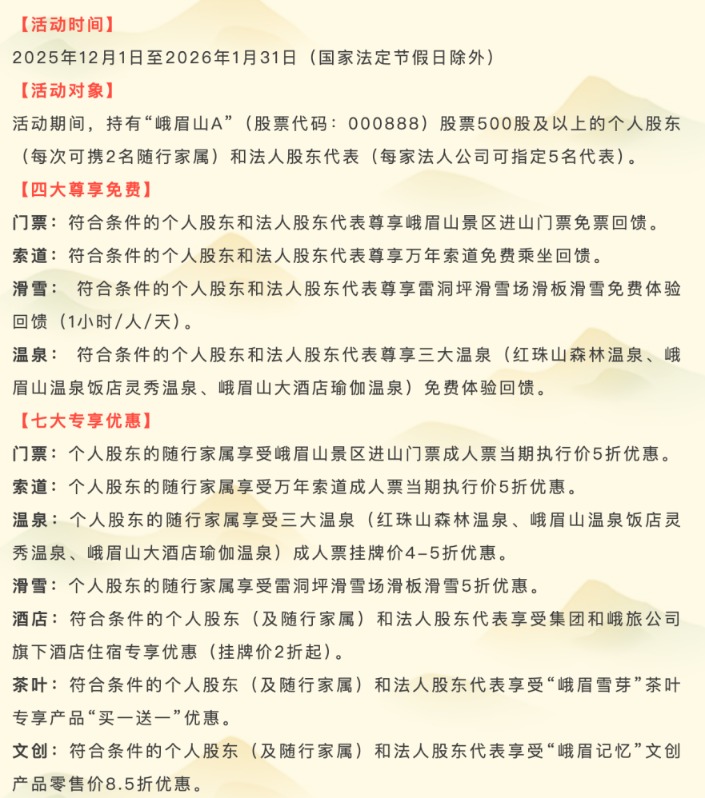
Core Viewpoint - The trend of "physical dividends" is gaining momentum in the A-share market, with over 30 companies offering unique shareholder rewards that integrate their business and products in 2025 [2] Group 1: Overview of Physical Dividends - Companies are increasingly engaging in shareholder reward activities, with examples including tickets, food items, and discounts, reflecting a wave of "creative rewards" in the capital market [2][5] - The concept of "physical dividends" is popular among investors, who refer to these stocks as "wool stocks" that can be passed down through generations [2] - Experts warn that while this trend can strengthen shareholder relationships if aligned with long-term strategies, it risks becoming a short-term marketing gimmick if it deviates from core business [2] Group 2: Examples of Shareholder Rewards - Emei Mountain A (000888.SZ) offers tickets, cable cars, hotels, hot springs, skiing, and tea as rewards for shareholders holding over 500 shares [4] - Qianwei Central Kitchen (001215.SZ) provides product gift packages for shareholders holding 100 shares or more [4] - Other companies like Hainan Airlines (600221.SH) and Xiangxiang Cultural Tourism (600576.SH) offer various discounts and free access to attractions for all shareholders [4][5] Group 3: Industry Trends and Patterns - The consumer sector, particularly food and beverage, remains the primary driver of "creative rewards," with companies like Wufangzhai (603237.SH) giving out rice dumpling gift boxes [5] - Many companies have established regular "physical dividend" mechanisms, such as Xiangyuan Cultural Tourism (600576.SH), which has been rewarding shareholders for three consecutive years [6] - Continuous rewards are seen in companies like Zhongjing Food (300908.SZ), which provides mushroom sauce annually, and Jiahua Food (605300.SH), which has been giving coffee products for five years [7] Group 4: Strategic Implications - The trend of "physical dividends" represents a shift in investor relations management from a focus on financial returns to a more interactive value creation approach [8][9] - This strategy allows companies, especially small to mid-cap consumer firms, to reduce financial pressure while enhancing shareholder loyalty and market reach [10] - However, the sustainability of this model is questioned, as it relies heavily on the event's popularity and lacks fundamental support, which may lead to stock price volatility [10]





超30家A股公司花式回馈股东
第一财经· 2025-12-09 14:43
Core Viewpoint - The trend of "material dividends" in the A-share market has surged in 2025, with over 30 listed companies offering unique shareholder rewards that integrate their business and products, covering various sectors such as tourism, consumption, healthcare, and technology [3][4]. Group 1: Overview of Material Dividends - The concept of "material dividends" has gained popularity among investors, with many referring to these stocks as "wool stocks" that can be passed down through generations [3][4]. - Companies are increasingly engaging in creative shareholder rewards, such as offering tickets, food products, and discounts, which are closely tied to their core business [3][4][6]. Group 2: Examples of Shareholder Rewards - Notable examples include Emei Mountain A (000888.SZ) offering tickets and discounts on various tourism services, and Qianwei Central Kitchen (001215.SZ) providing product gift packages [5][6]. - Other companies like Hainan Airlines (600221.SH) and Xiangyuan Cultural Tourism (600576.SH) have also introduced various discounts and free access to services for all shareholders [5][6]. Group 3: Industry Trends and Implications - The consumer sector, particularly the food and beverage industry, remains the primary driver of this "material dividend" trend, with companies like Wufangzhai (603237.SH) and Jiahua Food (605300.SH) actively participating [6][8]. - The trend has also seen participation from tourism and technology companies, indicating a broader acceptance of this practice across different industries [6][7]. Group 4: Strategic Considerations - Experts suggest that if this trend aligns with a company's long-term strategy, it can strengthen shareholder relationships; however, there is a risk of it becoming a short-term marketing gimmick [3][10]. - The practice of "material dividends" is viewed as an evolution in investor relations, moving from a focus on financial returns to a more interactive value creation approach [10][11]. Group 5: Sustainability and Risks - While "material dividends" can stimulate short-term stock price increases, their sustainability is questioned, as seen with Emei Mountain A's stock price fluctuations following its reward announcement [12][14]. - Analysts caution that these rewards should not replace fundamental business performance, emphasizing the importance of financial health and industry competitiveness [12][14].

A股“实物分红”持续升温,超30家公司花式回馈股东
Di Yi Cai Jing· 2025-12-09 13:09
Core Viewpoint - The trend of "physical dividends" is gaining momentum in the A-share market, with over 30 companies offering unique shareholder rewards that integrate their core business and products in 2025, reflecting a shift towards enhancing shareholder relationships through tangible benefits [1][2]. Group 1: Company Initiatives - Companies like Emei Mountain A (000888.SZ) and Qianwei Yangchun (001215.SZ) are leading the trend by offering tickets, discounts, and product gift packages to shareholders, showcasing a variety of rewards across different sectors including tourism, consumption, and technology [1][2][4]. - A significant number of companies have established regular "physical dividend" mechanisms, such as Xiangyuan Culture (600576.SH) and Jiangjing Food (300908.SZ), which have consistently provided rewards to shareholders over multiple years [5][6]. Group 2: Market Dynamics - The "physical dividend" trend is primarily driven by small to mid-cap consumer companies, which leverage their products for shareholder rewards, thereby reducing financial pressure while enhancing market reach and shareholder loyalty [8][9]. - The practice of offering physical rewards is seen as a novel approach to investor relations and brand marketing, allowing companies to create a "value co-creation" environment with shareholders [6][7]. Group 3: Investor Sentiment - Shareholders are increasingly attracted to stocks with "physical dividend" offerings, often referred to as "wool stocks," indicating a growing interest in tangible benefits over traditional cash dividends [1][2]. - However, experts caution that while these initiatives can temporarily boost stock prices, their sustainability is contingent upon the underlying business fundamentals and cash flow quality [8][9].


多家A股公司,“花式”宠股东!
Zhong Guo Zheng Quan Bao· 2025-12-08 04:41
Core Viewpoint - The trend of companies offering "physical dividends" to shareholders is increasing, with over 30 listed companies implementing various shareholder reward activities this year, particularly in the tourism and food sectors [1][3][10]. Group 1: Company Initiatives - Qianwei Yangchu announced a shareholder reward activity where shareholders holding 100 shares or more can receive a product gift package worth 200 yuan, while corporate shareholders can receive three packages [3]. - Emei Mountain A has launched a shareholder reward program allowing shareholders holding 500 shares or more to enjoy free admission to the scenic area and other benefits from December 1 to January 31, 2026 [5]. - Xiangyuan Cultural Tourism initiated the "Xiangyuan Cultural Tourism 2025 Shareholder Reward" program, offering multiple benefits including free access to key scenic spots and hotel stay discounts [6][8]. Group 2: Market Analysis - Market analysts suggest that these shareholder benefits serve as a marketing and communication innovation, emphasizing the importance of focusing on the company's long-term value rather than short-term rewards [10]. - The nature of these physical or rights-based rewards differs fundamentally from the ongoing cash dividends advocated by regulators, often leading to short-term stimulation effects [10]. - Investors are advised to maintain a rational perspective on these activities, as they may create emotional trading opportunities but lack sustainability in driving long-term company performance [10].
股票分红主要形式有哪些类型?
Sou Hu Cai Jing· 2025-12-07 19:11
Core Viewpoint - Stock dividends are a crucial method for listed companies to distribute profits to shareholders based on operational results, serving as a primary avenue for shareholder returns [1] Summary by Category Cash Dividends - Cash dividends are a common form of stock dividends where companies distribute a portion of current net profits or retained earnings to shareholders in cash, based on their shareholding [1] - According to the revised regulations in 2025, companies must clearly define their cash dividend policies in their articles of association, including conditions, minimum ratios, and intervals [1] - The cash dividend process requires a proposal from the board of directors and approval from the shareholders' meeting, adhering to corporate governance requirements [1] - Shareholders must pay personal income tax on cash dividends according to the 2025 Personal Income Tax Law and its supporting regulations [1] - Companies are required to disclose dividend amounts, payment dates, and tax information transparently to help shareholders understand their returns [1] Stock Dividends - Stock dividends involve companies converting retained earnings into shares, distributing them to shareholders without compensation, which increases the number of shares but does not change total equity [2] - The 2025 regulations stipulate that companies must have positive retained earnings and sufficient reserves to implement stock dividends, along with detailed disclosures on the impact on key financial metrics [2] - Shareholders are also required to pay personal income tax on stock dividends, with specific tax calculations following the latest tax department policies [2] Capital Increase - Capital increase is often viewed as a form of dividend but differs fundamentally from stock dividends, as it involves transferring from capital reserves to share capital without profit distribution [2] - According to the 2025 regulations, capital increases do not affect total equity, only changing the structure of equity, and typically do not require shareholders to pay personal income tax [2] Physical Dividends - Physical dividends are a unique form where companies distribute products, services, or other physical assets to shareholders [3] - The 2025 regulations require fair valuation of physical dividends by qualified appraisal agencies, along with detailed disclosures about the type, quantity, and valuation basis of the assets [3] - Due to complexity and valuation challenges, physical dividends are less common in market practice but must still comply with disclosure and fairness regulations [3] Overall Implications - Different forms of dividends reflect various financial strategies and return philosophies of listed companies, and shareholders should consider compliance, financial impact, and tax policies when evaluating dividend proposals [3]
上市公司花样宠粉 A股掀实物分红热潮
Sou Hu Cai Jing· 2025-12-04 23:18
Core Viewpoint - The A-share market is experiencing a trend of "physical dividends," where listed companies are offering various tangible benefits to shareholders, such as free admission to tourist attractions and consumer products, as a way to enhance shareholder engagement beyond traditional cash dividends [3][4]. Group 1: Physical Dividends Trend - Over 30 A-share listed companies have initiated shareholder reward activities since 2025, covering sectors like tourism, food and beverage, beauty, and home goods [3]. - Companies like Emei Mountain A are providing free admission to their scenic areas for shareholders, aiming to increase shareholder loyalty and stimulate secondary consumption in response to declining visitor numbers [4]. - Other tourism companies, such as Huangshan Tourism and Xiangyuan Cultural Tourism, have also introduced similar exclusive benefits for shareholders, including free tickets and discounts on various services [4]. Group 2: Consumer Goods Companies' Engagement - At least 18 companies in the food and beverage and beauty sectors have launched reward activities, such as skincare gift boxes and commemorative liquor for shareholders [5]. - The strategy of using self-owned products for shareholder rewards is cost-effective and allows companies to reach a consumer base with purchasing power, turning them into brand advocates [5]. Group 3: Innovative Reward Methods - Companies are expanding the forms of rewards, with examples including movie tickets and backstage visits for shareholders from Hengdian Film and Television, and high-value items like iPhones and drones offered through lotteries by biopharmaceutical firms [7]. - These innovative approaches aim to integrate shareholder rewards with core business operations, enhancing emotional connections and brand recognition [7]. Group 4: Market Dynamics and Long-term Value - While physical rewards are gaining popularity, they differ fundamentally from cash dividends, which reflect direct profit distribution [6][8]. - Investors are advised to focus on a company's core operational capabilities, profitability, and long-term growth potential, as short-term market attention may not sustain stock prices [8]. - Historical examples from mature markets, such as Japan, show that physical rewards can enhance shareholder loyalty and promote consumption, provided they adhere to fairness principles [8].

股东福利再升级!从门票到预制菜,上市公司花式宠粉正流行
Sou Hu Cai Jing· 2025-12-04 17:23
Core Insights - A new trend in the A-share market is emerging where companies are offering "physical dividends" to shareholders, enhancing the shareholder experience beyond traditional cash dividends and stock price appreciation [3][4][10] Group 1: New Trends in Investor Relations - The A-share market is witnessing a transformation in investor relations management, shifting from cash dividends to product-based rewards for shareholders [3] - Companies like Emei Mountain A and Qianwei Yangchun are leading this trend, with Emei Mountain A offering free admission to shareholders holding over 500 shares, and Qianwei Yangchun providing product gift packages worth 200 yuan to shareholders holding over 100 shares [3][4] Group 2: Strategic Considerations Behind Physical Dividends - The trend of physical rewards is not merely about providing benefits; it represents an upgrade in investor relations management to brand experience marketing, creating a low-cost yet innovative approach [4][5] - For tourism companies, offering free admission and discounts can lead to significant secondary consumption, enhancing overall revenue [4][10] Group 3: Industry-Specific Approaches to Shareholder Engagement - Different industries are adopting unique strategies to engage shareholders: - In the tourism sector, Emei Mountain A offers comprehensive benefits including free tickets and discounts on various services [7][10] - In the food industry, Qianwei Yangchun provides product gift packages, while other companies like Wufangzhai and Zhongjing Foods also offer food gifts without strict holding requirements [7][8] Group 4: Case Study of Qianwei Yangchun - Qianwei Yangchun's shareholder reward strategy aligns with its broader market expansion goals, allowing shareholders to experience products directly and potentially become loyal customers [8][9] - The company is strategically timing its rewards to coincide with its efforts to penetrate the consumer market [8] Group 5: Emei Mountain A's Unique Offerings - Emei Mountain A's rewards program is designed to counteract a 7.9% decline in visitor numbers, showcasing an innovative approach to attract more visitors [10] - The program includes not just free admission but also discounts for family members, creating a holistic consumer experience [10] Group 6: Balancing Aspirations and Realities - While the trend of physical dividends is gaining traction, companies must ensure product quality and sustainability of these initiatives to avoid damaging their reputation [13][15] - Market reactions to these initiatives can lead to short-term stock price increases, but without solid performance fundamentals, there may be risks of price corrections [15]
上市公司“花式送礼” 提质增利才是回报股东“王道”丨热点即阅
Sou Hu Cai Jing· 2025-12-04 09:01
Core Viewpoint - The article discusses the recent trend of companies offering physical gifts to shareholders as a form of "dividend," questioning whether this truly benefits shareholders or merely masks underlying business performance issues [1] Group 1: Company Actions - Qianwei Yangchun announced that individual shareholders holding over 100 shares can receive a gift package of prepared dishes valued at 200 yuan, while corporate shareholders can receive three packages [1] - This follows a similar initiative by Emei Mountain A, which offered free admission tickets to shareholders holding 500 shares, indicating a growing trend among listed companies to engage in "physical dividends" [1] Group 2: Market Reaction - The market responded positively to Emei Mountain A's announcement, resulting in a trading halt due to a surge in stock price, suggesting that investors are receptive to these creative promotional strategies [1] Group 3: Shareholder Expectations - The article argues that shareholders primarily seek capital appreciation through solid business growth, stable cash dividends, and sustained stock price increases, rather than small gifts [1] - It emphasizes that while occasional perks can enhance shareholder relations, relying on such tactics as a primary means to attract investors is misguided and detracts from core business performance [1]