家电智能化

Search documents
春节期间中国家电市场总体平稳,各地及各商家的销售情况冷热不均
Di Yi Cai Jing· 2026-02-28 01:11
Core Insights - The Chinese home appliance market remained stable during the Spring Festival promotion period, with varying sales performance across regions and retailers, highlighting smart products and rural markets as key growth areas [1][2][3] Group 1: Market Performance - Sales in Shanghai during the Spring Festival promotion reached 299 million yuan, driven by new subsidy policies and participation from 815 companies [1] - A retail chain in East China reported a 10% decline in sales compared to the same period last year, indicating a relatively weak market [1] - A retailer in South China noted a stable overall market without significant fluctuations, attributing this to the early release of demand due to national subsidy policies [1][2] Group 2: Product Trends - Smart water heaters and large-capacity smart refrigerators performed relatively well during the holiday season [1] - The market is evolving towards home-oriented, energy-efficient, smart, and personalized products [1] - GfK's data indicated that major appliance categories like refrigerators, washing machines, and TVs experienced robust growth during the promotion period, with both volume and revenue increasing [3] Group 3: Regional Insights - Sales in some western regions showed positive performance, with one retailer reporting a 42% increase in air conditioner sales [3] - Rural markets are gradually developing, influenced by returning migrant workers who bring new consumption concepts [3] - Growth rates in third and fourth-tier cities outpaced those in first and second-tier cities, reflecting a shift in consumer behavior [3]
家电智能化,迈入“合纵连横”时代
2 1 Shi Ji Jing Ji Bao Dao· 2025-10-14 12:04
Core Insights - The article discusses the recent strategic cooperation between Haier Group and Alibaba Group, focusing on AI collaboration to build a new digital industry ecosystem [2][8] - The increasing frequency of collaborations among major players in the home appliance industry is driven by the need for product development and ecosystem construction amid digitalization and globalization [3][10] Industry Trends - The home appliance industry is experiencing a shift from incremental expansion to stock competition, with significant market declines observed in 2020 and 2022 [4][7] - The introduction of the "trade-in" policy in 2024 is expected to shift the market focus from scale expansion to value reconstruction, emphasizing high-value segments like R&D and services [7][11] Strategic Collaborations - Major companies are forming partnerships to address challenges in product development and ecosystem building, with a focus on AI, advanced manufacturing, e-commerce, and globalization [8][9] - Collaborations extend beyond product upgrades to include B2B operations, infrastructure, and global market expansion, enhancing competitiveness and operational efficiency [9][10] Ecosystem Competition - The competition in the home appliance sector is evolving from individual brand competition to ecosystem-based competition, driven by consumer demand for integrated smart home solutions [12][13] - The emergence of AI and large models is transforming the competitive landscape, shifting focus from hardware to integrated smart home experiences [13][14] Future Outlook - The future of competition will center around open, collaborative, and intelligent ecosystems that create higher user value, rather than just manufacturing excellence [14]



小米与格力开撕,谁是空调线上销售的“二哥”
Guan Cha Zhe Wang· 2025-08-19 12:15
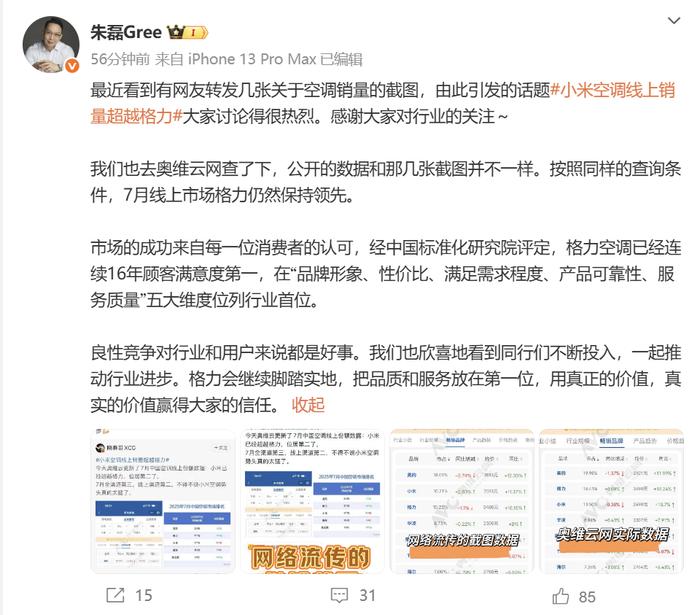
Core Viewpoint - The competition between Xiaomi and Gree in the air conditioning market has intensified, with Xiaomi claiming to surpass Gree in online sales for July, which Gree disputes, leading to a public debate over the accuracy of sales data [1][6][9]. Group 1: Sales Data Discrepancies - Xiaomi's online air conditioning market share reached 16.71% in July, placing it second behind Midea's 18.61%, while Gree claimed to maintain its second position in the market [6][9]. - Gree's market director, Zhu Lei, stated that the data circulating online was inaccurate and provided evidence from Aowei Cloud Network to support Gree's claim of being the second in online sales [5][9]. - A social media user suggested that discrepancies in the data might be due to Aowei changing its statistical methodology, calling for clarification from the data platform [9][10]. Group 2: Industry Dynamics - The rivalry between Xiaomi and traditional air conditioning manufacturers like Gree, Midea, and Haier has been anticipated, with Xiaomi aiming to rise from fourth to third place in the market this year and targeting a top two position by 2030 [13][14]. - In July, Xiaomi achieved a 53.9% year-on-year growth in air conditioning sales, making it the only brand among the top three to experience such rapid growth [13][14]. - Midea's chairman acknowledged the competitive threat posed by Xiaomi but expressed confidence in Midea's strategic position, viewing Xiaomi's entry as a positive development for the industry [13][14]. Group 3: Company Performance - Xiaomi's smart home appliance revenue surged by 113.8% year-on-year in Q1, with air conditioning shipments exceeding 1.1 million units, reflecting a growth of over 65% [14]. - Gree has historically defended its market position, with its chairperson, Dong Mingzhu, publicly criticizing Xiaomi's manufacturing practices and technology [14].


小米家电目标是进入前三!美的方洪波:小米进来对家电行业是好事,我们做了三份报告研究小米【附白色家电行业市场竞争分析】
Qian Zhan Wang· 2025-05-19 09:22
Core Insights - The competition between Midea and Xiaomi in the home appliance industry has garnered significant attention, with Midea's chairman Fang Hongbo acknowledging Xiaomi's ambitious goals in the sector [2] - Xiaomi's rapid growth in the home appliance market is evident from its financial reports, indicating that its appliance business has become a crucial growth driver [2][3] Group 1: Company Strategies and Market Position - Fang Hongbo expressed that while he respects Xiaomi's tactical moves, he is not afraid of their strategic entry into the home appliance market, viewing it as a positive development for the industry [2] - Xiaomi's recent financial data shows record high shipments in major appliance categories for 2024, with air conditioner shipments exceeding 6.8 million units (over 50% YoY growth), refrigerators over 2.7 million units (over 30% YoY growth), and washing machines over 1.9 million units (over 45% YoY growth) [2] - Xiaomi's president Lu Weibing has set a target for Xiaomi's air conditioners to rank among the top in the Chinese market by 2030, emphasizing the completion of a full product line and self-research capabilities [3] Group 2: Market Dynamics and Competitive Landscape - Traditional home appliance giants like Midea, Haier, and Gree have maintained significant market positions, with their white goods business revenues exceeding 100 billion [3][4] - In the refrigerator market, Haier leads with a 34.6% share in the online segment, while Midea holds 12.4% and Rongsheng 8.0%; in the offline market, Haier's share is 39.1%, with Midea at 9.8% [4] - In the air conditioning market, Midea and Gree dominate both online and offline sales, each holding 28.1% of the online market, while Midea leads offline with a 34.6% share [5] Group 3: Innovation and Industry Transformation - Lu Weibing criticized the lack of innovation in the home appliance industry, suggesting that Xiaomi's entry could disrupt the status quo and enhance commercial efficiency [7] - Lei Jun views the smart home appliance sector as a revolutionary upgrade, comparable to the proliferation of automobiles in the U.S. and washlet toilets in Japan, aiming to establish Xiaomi as a leading brand in smart appliances [7] - The competition between traditional giants and new entrants like Xiaomi highlights the need for continuous innovation and adaptation to changing market demands [7]