房地产下行周期

Search documents
万科20260319
2026-03-20 02:27
Summary of Vanke Conference Call Company and Industry Overview - **Company**: Vanke - **Industry**: Real Estate, specifically focusing on urban renewal and debt management in the context of the Chinese real estate market Key Points and Arguments Debt Management and Market Sentiment - Vanke's debt extension plan received overwhelming approval, reflecting a pragmatic market attitude, primarily influenced by the Shenzhen State-owned Assets Supervision and Administration Commission (SASAC) which aims to maintain credit stability due to reputation risks and performance assessments [2][3] - The new urban renewal policy in Shenzhen is expected to activate approximately 10 billion yuan in assets for Vanke, leading banks to adjust their optimistic expectations and reduce bad debt provisions [2][5] - Banks have prepared for long-term debt management strategies for state-owned real estate companies like Vanke, adopting a principle of "substance over form" by gradually recognizing about 10% of asset impairment annually to mitigate risks [2][3] Urban Renewal Policies and Financial Implications - The shift in urban renewal focus towards micro-renovations and upgrades for older neighborhoods is anticipated to attract funding, with major banks offering loan rates as low as LPR minus 11 to 12 basis points [2][6] - The new policies are expected to provide banks with a rationale to ease risk controls, potentially leading to a more favorable lending environment for Vanke [6][8] Risk Management and Loan Strategies - The tightening of mortgage loan risk controls has been exacerbated by layoffs in the tech sector, leading to increased instances of mortgage defaults [2][3] - Banks are currently focused on maintaining asset quality balance rather than aggressively expanding mortgage business, with a target of only sustaining current levels [2][12] Market Dynamics and Future Outlook - The acceptance of debt extensions by the market has shifted from viewing extensions as defaults to a more pragmatic approach, recognizing that some recovery is better than none [3][4] - The relationship between Vanke and Shenzhen Metro Group has strengthened, with the latter exerting significant control over Vanke, which may influence future support and collaboration [3][4] Challenges and Strategic Considerations - The primary challenge in advancing urban renewal projects lies in effective communication and coordination with residents, which can halt progress if not managed properly [7][8] - The recent policies from the Ministry of Natural Resources are seen as marginally positive but do not significantly alter the existing framework for urban renewal [8][9] Bank Strategies and Risk Assessment - Banks are expected to adopt a more cautious approach to real estate debt, particularly for weaker state-owned enterprises, while still providing necessary support to prevent defaults [11][12] - The focus remains on ensuring that state-owned enterprises do not face reputational damage, which is critical for banks in maintaining stability in the sector [4][11] Conclusion - The overall sentiment towards Vanke and the real estate sector is cautiously optimistic, with banks willing to cooperate as long as there is a clear path towards asset management and debt resolution [3][4][12]

浙江金交中心爆雷,金额超200亿,三家上市公司紧急回应
Xin Lang Cai Jing· 2025-12-08 12:31
Core Viewpoint - The financial products issued by the controlling shareholder, Xiangyuan Holdings, have defaulted, causing significant concern in the market despite the listed companies claiming no direct responsibility for the situation [1][10]. Group 1: Financial Crisis - Recent reports indicate that financial products on the Zhejiang Financial Assets Exchange have failed to pay out, with the total amount involved exceeding 200 billion yuan and potentially affecting over 10,000 investors [2][13]. - Xiangyuan Holdings, which operates in tourism, infrastructure, and real estate, reported revenues of 18.05 billion yuan and a net profit of 1.538 billion yuan in 2021, but has faced challenges due to a downturn in the real estate sector [2][13]. - The company has been issuing high-interest debt through the Zhejiang Financial Assets Exchange, with financing costs reaching 8%-9%, primarily backed by its real estate projects [4][15]. Group 2: Company Operations and Market Reaction - Three listed companies under Xiangyuan Holdings issued announcements stating that the overdue products are unrelated to their operations and that they bear no responsibility for repayment [10][21]. - Despite these assurances, the market reacted negatively, with stock prices for Xiangyuan Wenlv, Jiaojian Co., and Haichang Ocean Park dropping by approximately 4%, 10%, and 4% respectively [1][12]. - The operational performance of Xiangyuan Wenlv has been relatively stable, but its stock has declined by 17% over the past year, while Jiaojian Co. has seen consecutive declines in revenue and net profit [10][23]. Group 3: Regulatory and Legal Issues - Xiangyuan Holdings and its subsidiaries, including Xiangyuan Wenlv and Jiaojian Co., are under investigation by the China Securities Regulatory Commission for failing to disclose non-operating fund transactions in their financial reports [10][23]. - The investigation revealed that Xiangyuan Wenlv had provided 410 million yuan to Xiangyuan Holdings through prepayments for asset purchases, raising concerns about financial transparency [10][23]. Group 4: Founder Background - The founder of Xiangyuan Holdings, Yu Faxiang, has a compelling rags-to-riches story, having built his wealth through various ventures, including real estate, and was listed with a fortune of 13.5 billion yuan on the Hurun Global Rich List in 2024 [6][17][20].



李迅雷专栏 | 对当前经济热点的一点思考
中泰证券资管· 2025-12-03 11:35
Real Estate Cycle - The long-term upward phase of the real estate market from 2000 to 2020 led many to believe that housing prices would not decline, despite early warnings from analysts like Professor Zhu Ning [4] - Current average rental yield in core cities of China is estimated at around 2%, indicating a price-to-earnings ratio of 50 times, while Shanghai's rental yield is even lower, suggesting a need for adjustment to around 3% [5][6] - Real estate development investment in China has decreased by 14.7% year-on-year in the first ten months of the year, indicating a potential acceleration in the downward trend [5][6] Export Performance - China's export growth has exceeded expectations this year, with a 5.3% increase in the first ten months, despite concerns about negative growth earlier in the year [10] - The export price index has declined by 18% since 2023, indicating challenges in maintaining export value [10][13] - Future export growth is expected to slow down due to the diminishing "import grabbing" effect from the U.S. and high base effects from previous years [13] Consumer Contribution to GDP - Consumer spending is projected to contribute more than half of GDP growth this year, as capital formation's contribution declines [15] - The consumption growth has shown a pattern of being high in the first half of the year and lower in the second half, influenced by previous stimulus measures [17] - Long-term consumption growth will depend on rising household incomes and improved social security systems [19] Inflation and Price Recovery Challenges - The relationship between supply and demand, particularly in manufacturing investment, is crucial for price recovery, but manufacturing investment growth has significantly slowed [21] - The current economic environment presents challenges for inflation recovery, as high unemployment rates correlate with low inflation [25] - Effective measures to boost consumer demand are necessary for price recovery, including expanding social security and employment opportunities [25] GDP Growth Targets - The GDP growth target for 2026 is estimated to remain around 5%, with various uncertainties affecting this goal, including population changes and exchange rate fluctuations [26] - A more aggressive fiscal policy is anticipated to support this growth target, with an expected increase in the fiscal deficit [30] - The need for fiscal and monetary policy coordination is emphasized to address local government debt and stimulate economic growth [40] Stock Market Dynamics - The stock market has faced resistance around the 4000-point mark, with recent gains driven more by valuation increases than profit growth [41] - For a sustained bull market, corporate profits must grow faster than GDP, which has not been the case recently [41][44] - Structural bull markets are anticipated, particularly in the context of the AI revolution, but require supportive policies for corporate growth [46]

大越期货螺卷早报-20251030
Da Yue Qi Huo· 2025-10-30 01:29
Group 1: Investment Ratings - No specific industry investment rating is provided in the report. Group 2: Core Views - For螺纹, with weak demand, low - rising inventory, and a continued downward cycle in the downstream real - estate industry, it should be treated with a bearish - trending - with - fluctuations mindset. The main factors are weak real - estate demand, and the plan of domestic production capacity reduction [2]. - For热卷, due to weakening supply and demand, continued inventory reduction, export difficulties, and the plan of domestic production capacity reduction, it should also be treated with a bearish - trending - with - fluctuations mindset [7]. Group 3: Summary by Related Content 1. Fundamental Analysis - **螺纹**: Demand is poor, inventory is rising from a low level, and traders' purchasing willingness is weak. The downstream real - estate industry is in a downward cycle [2]. - **热卷**: Both supply and demand are weakening, inventory is decreasing, and exports are blocked, but domestic policies may play a role [7]. 2. Basis Analysis - **螺纹**: The spot price is 3240, and the basis is 107, which is bullish [2]. - **热卷**: The spot price is 3350, and the basis is 5, which is neutral [7]. 3. Inventory Analysis - **螺纹**: The inventory in 35 major cities across the country is 437.48 million tons, decreasing month - on - month and increasing year - on - year, which is neutral [2]. - **热卷**: The inventory in 33 major cities across the country is 337.57 million tons, decreasing month - on - month and increasing year - on - year, which is bearish [7]. 4. Disk Analysis - **螺纹**: The price is above the 20 - day line, and the 20 - day line is downward, which is neutral [2]. - **热卷**: The price is above the 20 - day line, and the 20 - day line is flat, which is bullish [7]. 5. Main Position Analysis - **螺纹**: The net position of the main contract is short, and the short position is decreasing, which is bearish [2]. - **热卷**: The net position of the main contract is short, and the short position is decreasing, which is bearish [7]. 6. Factors Analysis - **螺纹** - Bullish factors: Low production, spot premium, and domestic production capacity reduction expectation [4]. - Bearish factors: The downward cycle of the downstream real - estate industry continues, and terminal demand is weaker than the same period [4]. - **热卷** - Bullish factors: Fair demand, spot premium, and domestic production capacity reduction expectation [8]. - Bearish factors: Downstream demand enters the seasonal off - season, and the expectation is pessimistic [9].
大越期货螺卷早报-20250818
Da Yue Qi Huo· 2025-08-18 02:22
Report Industry Investment Rating - Not provided in the given content Core Viewpoints - For rebar, the fundamentals show weak demand, low - level inventory with a slight decrease, and weak purchasing willingness of traders. The downstream real - estate industry is in a downward cycle. With a positive basis, inventory in major cities shows a mixed trend (up环比, down同比), the price is below the 20 - day line, and the main position is net short with an increase in short positions. The market is expected to be in high - level oscillation considering the weak real - estate market and domestic capacity - reduction plans [2]. - For hot - rolled coils, both supply and demand have weakened, inventory continues to decrease, and exports are blocked. Domestic policies may play a role. It has a positive basis, inventory in major cities is decreasing both month - on - month and year - on - year, the price is below the 20 - day line with the line going up, and the main position is net short with an increase in short positions. The market is also expected to be in high - level oscillation due to supply - demand weakening, export issues, and capacity - reduction plans [6]. Summary by Related Catalogs Rebar - **Fundamentals**: Demand is poor, downstream real - estate is in a downward cycle, inventory is at a low level and slightly decreasing, and trader purchasing willingness is weak [2]. - **Basis**: The rebar spot price is 3320, and the basis is 132, which is positive [2]. - **Inventory**: The inventory in 35 major cities is 314.93 million tons, increasing month - on - month and decreasing year - on - year, which is positive [2]. - **Disk**: The price is below the 20 - day line, and the 20 - day line is flat, which is negative [2]. - **Main Position**: The main rebar position is net short, and short positions are increasing, which is negative [2]. - **Likely Influencing Factors**: Positive factors include low production and inventory, spot premium, and domestic capacity - reduction expectations; negative factors are the continuous downward cycle of the downstream real - estate industry and weak terminal demand [2][3]. Hot - Rolled Coils - **Fundamentals**: Both supply and demand have weakened, inventory is decreasing, exports are blocked, and domestic policies may play a role, with a neutral assessment [6]. - **Basis**: The hot - rolled coil spot price is 3460, and the basis is 21, which is positive [6]. - **Inventory**: The inventory in 33 major cities is 277.49 million tons, decreasing both month - on - month and year - on - year, which is positive [6]. - **Disk**: The price is below the 20 - day line, and the 20 - day line is going up, with a neutral assessment [6]. - **Main Position**: The main hot - rolled coil position is net short, and short positions are increasing, which is negative [6]. - **Likely Influencing Factors**: Positive factors are acceptable demand, spot premium, and domestic capacity - reduction expectations; negative factors are that downstream demand has entered a seasonal off - season and the outlook is pessimistic [6][7][8].
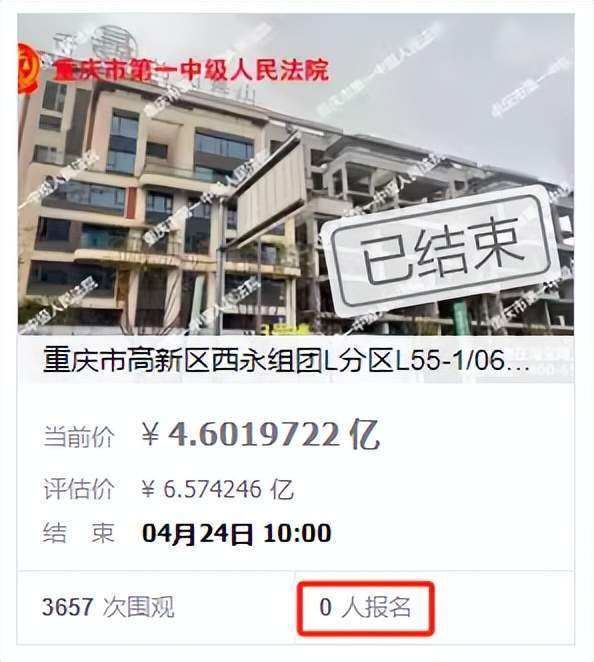
起拍价4.6个亿!重庆西区最美别墅惨遭流拍,为何无人问津?
Sou Hu Cai Jing· 2025-04-27 10:24
Core Viewpoint - The news highlights the downfall of a once-prominent real estate project, "Qianxun's Huaguoshan," which was auctioned with a starting price of 460 million yuan but failed to attract any bidders, reflecting the broader challenges facing the real estate market in Chongqing [1][3]. Group 1: Project Background - "Qianxun's Huaguoshan" was initially celebrated as "the most beautiful villa in Chongqing's western district," with a land acquisition price of 1.03 billion yuan and a floor price of 12,007 yuan per square meter [3][10]. - The project gained significant attention in October 2022, achieving a sales total exceeding 100 million yuan during the National Day holiday, with a peak daily registration of 20 million yuan [10]. Group 2: Current Status - The project is now in a state of abandonment, with construction halted and the site appearing deserted, as evidenced by closed sales offices and an empty construction site [12][18][21]. - The developer, Chongqing Huayou Real Estate Development Co., Ltd. (a subsidiary of Huayang Group), has accumulated a staggering debt of 985 million yuan and is currently listed as a dishonest entity, facing restrictions on high consumption [23]. Group 3: Developer's Background - The founder of Huayang Group, known as "Baoye," has a mysterious background and has been known for her unconventional approach to business, including a significant expansion strategy that coincided with a downturn in the real estate market [30][40]. - In May 2022, Huayang Group faced a liquidity crisis, failing to repay approximately 149 million USD in loans, leading to a court petition for liquidation [46]. Group 4: Market Implications - The project was not included in the "guaranteed delivery" program due to its limited actual sales data, which only accounted for 11 units sold, despite the initial hype [28]. - The financial struggles of Huayang Group and the failure of "Qianxun's Huaguoshan" reflect broader issues within the real estate sector, particularly regarding over-leveraging and market saturation [50].