
政策可信度

Search documents
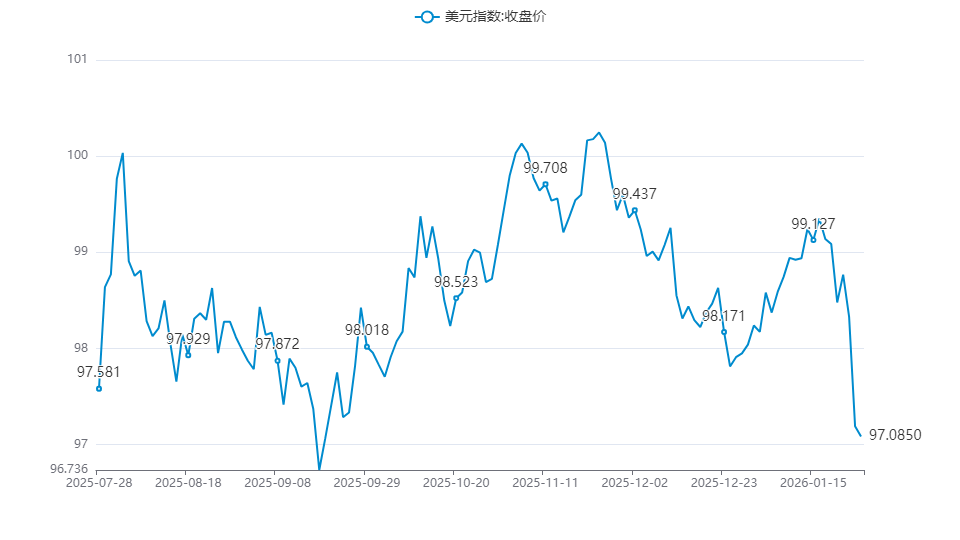
美元指数创四年新低 “抛售美国”交易加剧
Xin Hua Cai Jing· 2026-01-28 05:51
Core Viewpoint - The recent significant decline of the US dollar index is attributed to the incoherence of President Trump's policies, leading to increased market uncertainty and a sell-off of the dollar [3][4]. Group 1: Dollar Performance - The US dollar index has dropped 3.62% over seven trading days, with a notable overnight decline of 1.32%, reaching its lowest level since February 2022 [1]. - Market analysts link the dollar's decline to Trump's statements regarding the currency, which were interpreted as a sign of the government's acceptance of a weaker dollar [3][4]. Group 2: Market Reactions - The sell-off of the dollar has intensified amid concerns over Trump's inconsistent trade and currency policies, with a chief market strategist likening the dollar to a "falling chainsaw" that no one wants to catch [3]. - Despite rising US Treasury yields and expectations that the Federal Reserve will maintain interest rates, the dollar remains under pressure, indicating that policy credibility is a key factor influencing exchange rates [3]. Group 3: External Influences - The dollar's weakness is further exacerbated by external factors, including a significant rebound of the Japanese yen and expectations of coordinated intervention in the currency market [4]. - Trump's contradictory stance on currency manipulation and trade advantages has weakened foreign investors' confidence in dollar-denominated assets [4]. Group 4: Alternative Investments - As a result of the dollar's decline, there is a noticeable shift of funds towards alternative value storage tools, with spot gold prices surpassing $5,180 per ounce, marking a new historical high [5]. - Other non-US currencies have strengthened, with the euro rising 1.33% against the dollar, the British pound increasing 1.24%, and the dollar experiencing declines against the Japanese yen and the offshore Chinese yuan [5]. Group 5: Federal Reserve Outlook - Investors are closely monitoring the upcoming Federal Reserve meeting, with widespread expectations that interest rates will remain unchanged [5]. - Concerns arise that if Trump publicly opposes the Federal Reserve's decisions, it could accelerate the process of replacing the current chair, further disrupting the market [5].

达利欧称黄金为第二大储备货币 金市破位即加速
Jin Tou Wang· 2026-01-28 02:49
Group 1 - The core viewpoint is that global central banks and sovereign wealth funds are shifting from U.S. Treasuries to gold due to pressures from the debt cycle, geopolitical tensions, and policy credibility [2] - The debt cycle indicates that high debt levels will squeeze spending, leading to a decline in the attractiveness of U.S. Treasuries as market sell-offs and increased supply require higher real returns from holders [2] - Gold is emphasized as a "hard currency" and the second-largest reserve currency, with its price increase reflecting a shift towards safe-haven assets by central banks and sovereign funds [2] Group 2 - Recent gold market movements have shown a strong upward trend, with significant price fluctuations indicating a "breakout" pattern, where breaking key levels leads to accelerated price movements [3] - The current market is characterized by an extreme trend-following behavior, where traders can confidently follow price movements with minimal stop-loss settings [3] - Key technical levels for gold prices include support at approximately 5160 and 5126, with resistance around 5236, indicating potential future price targets [3]
美联储领导权将过渡纸白银大涨
Jin Tou Wang· 2025-12-26 06:36
Group 1 - The price of silver futures is currently trading above 16.659, with a significant increase of 5.77% from the opening price of 15.935, reaching a high of 16.926 and a low of 15.935, indicating a bullish short-term trend [1][3] - The overall market sentiment for silver remains strong, with the Bollinger Bands indicating sufficient upward momentum, and the price is expected to find support between 15.5 and 15.90, while resistance is noted between 16.90 and 17.50 [3] Group 2 - Federal Reserve Chairman Jerome Powell may be paving the way for his departure after May 2026, amidst ongoing political pressure, which could lead to greater policy uncertainty and structural pressure on the US dollar in the medium to long term [2] - The potential transition in leadership at the Federal Reserve is expected to have complex and far-reaching effects on the dollar's exchange rate, primarily driven by market expectations regarding the Fed's future independence and policy credibility [2]
日元快速贬值!日本发出“最强烈警告”
Zhong Guo Jing Ji Wang· 2025-11-23 08:39
Core Viewpoint - The Japanese yen has been rapidly depreciating against the US dollar, causing significant concern for the Japanese government, particularly regarding the impact on the economy and import costs [1][1]. Group 1: Currency Trends - The yen has recently fallen to around 157 yen per US dollar, which is exerting pressure on the Japanese economy, especially affecting the costs for importers and impacting households and small businesses [1][1]. - The Finance Minister, Katsunobu Kato, expressed that the current trend of the yen is "very one-sided and rapid," marking the strongest warning since the yen's depreciation began [1][1]. Group 2: Government Response - The Japanese government is closely monitoring the currency fluctuations and is prepared to intervene based on a previously signed joint statement with the US if the situation worsens [1][1]. - Analysts suggest that if the Kato administration loses policy credibility, it could lead to a sell-off of yen assets by investors [1][1]. Group 3: External Influences - There are concerns that potential travel or export restrictions from China could further impact the Japanese economy and increase downward pressure on the yen [1][1].
大摩:美元疲软和政策可信度在提振新兴市场前景
智通财经网· 2025-08-25 13:41
Group 1 - Emerging markets are gaining strong momentum as traditional boundaries with developed markets fade, presenting compelling investment opportunities in fixed income [1] - Emerging market assets, including sovereign credit, local currency bonds, and equities, are outperforming developed markets due to a weaker dollar and stronger emerging market currencies [1] - The tightening of U.S. credit spreads and declining U.S. Treasury yields are crucial for the continued strength of emerging market spreads and local bond performance [1] Group 2 - The credibility of emerging market central banks has improved post-COVID, demonstrating their ability to act independently and effectively in the face of shocks [2] - Fiscal conditions remain imbalanced, with developed markets still holding advantages in fiscal capacity, credibility, and lower currency risk [2] - Despite increasing cross-border capital inflows into emerging markets, global positioning remains cautious, with most investors maintaining moderate exposure to emerging market fixed income [2] Group 3 - Morgan Stanley is optimistic about local bonds in Brazil, Colombia, Hungary, and Turkey, as well as certain sovereign credits in Chile, Guatemala, Mexico, Morocco, South Africa, and Zambia [2]