政策独立性

Search documents
非农将于2月11日发布白银td强跌
Jin Tou Wang· 2026-02-05 03:56
Group 1 - The current trading price of silver TD is reported at 18,828 yuan per kilogram, down 16.11% from the opening price of 23,493 yuan per kilogram, with a daily high of 23,968 yuan and a low of 18,000 yuan, indicating a short-term sideways trend in the market [1] - The U.S. Bureau of Labor Statistics has rescheduled the release of the January non-farm payroll report to February 11 and the January CPI report to February 13, following delays due to a government shutdown [1] - Investors are adjusting their expectations regarding interest rate cuts, with a shift towards a more cautious outlook on rapid rate reductions, as the new leadership may emphasize policy independence and inflation control [1] Group 2 - The silver TD market experienced a brief recovery from previous declines, but the current price shows a significant drop of over 14%, indicating a strong bearish trend [2] - Technical indicators such as the MACD and DMI suggest that the bearish momentum remains, with the price facing support levels between 20,500 and 21,500, and resistance levels between 23,500 and 24,500 [2]
告别美联储看跌期权!Wedbush警告:沃什执掌下流动性红利将终结,未来数月美股或面临动荡
Sou Hu Cai Jing· 2026-02-02 03:51
Core Viewpoint - The report from Wedbush indicates that the U.S. stock market may face a period of volatility in the coming months as investors prepare for potential policy reforms under Kevin Warsh's leadership at the Federal Reserve [1]. Group 1: Market Outlook - Wedbush analysts expect market volatility to persist until Warsh officially takes office in May, as investors reassess their positions in light of a significant policy shift away from the framework established during Jerome Powell's tenure [1][2]. - The transition period is anticipated to be bumpy, with Wedbush suggesting that the downside risk in the stock market outweighs the upside risk as investors shift focus to companies with sustainable growth [2]. Group 2: Policy Changes - Under Warsh, the Federal Reserve is expected to shift its focus from interest rates to the size of the central bank's balance sheet, utilizing monetary supply as the primary tool against inflation through quantitative tightening [1][2]. - This change is seen as the end of the "Fed put," which refers to the market's assumption that the central bank would intervene to support asset prices in non-crisis situations [1]. Group 3: Warsh's Background and Views - Warsh, nominated by Trump, has a history of skepticism towards large-scale asset purchases and previously resigned from the Fed in 2011 due to his opposition to the second round of quantitative easing [2][4]. - His nomination signifies a potential ideological shift in U.S. monetary policy, emphasizing inflation control and policy independence, contrasting with Powell's consensus-driven approach [5]. Group 4: Market Implications - Warsh's hawkish stance and support for balance sheet reduction may negatively impact risk assets reliant on excess liquidity while benefiting U.S. Treasuries and the dollar, putting pressure on gold and silver [1][4]. - Analysts believe that while Warsh may implement 2-3 rate cuts this year to align with government expectations, he will also prioritize inflation control, indicating a more stringent approach compared to Powell [5].
格林期货早盘提示:铜-20260130
Ge Lin Qi Huo· 2026-01-30 11:37
1. Report Industry Investment Rating - The investment rating for the copper sector is "oscillating bullish" [1] 2. Core View of the Report - The core driver for copper prices breaking through historical highs is the concern about potential US tariffs on refined copper, which has led to a shift in global copper liquidity towards the US. Statements from the Fed Chair have also re - priced inflation and policy independence, benefiting metals with strong financial attributes like copper [1] 3. Summary by Relevant Catalogs Market Quotes - The night - session closing price of the main Shanghai copper contract CU2603 was 106,900 yuan/ton, a 4.38% increase from the previous night - session closing price. The second - main contract CU2604 closed at 107,170 yuan/ton, with a 4.34% increase. As of 06:00, the COMEX copper main contract HGH26E closed at 6.282 US dollars/pound (equivalent to 96,197 yuan/ton after exchange - rate conversion), up 4.75% from the previous trading day. The LME copper main contract CA03ME closed at 13,705 US dollars/ton (equivalent to 95,195 yuan/ton after exchange - rate conversion), with a 4.73% increase [1] Important Information - Southern Copper's CFO expects the company's copper production to be 91.14 million tons in 2026, slightly over 90 million tons in 2027, lower than the 95.43 million tons in 2025 due to declining ore grades at major Peruvian mines [1] - Zambia's copper production in 2025 was about 89.03 million tons, an 8% increase from 82.55 million tons in 2024, but it failed to reach the 100 - million - ton target [1] - Deutsche Bank predicts that copper prices will reach a peak of 13,000 US dollars per ton in the second quarter and then decline in the second half of the year as production at major mines may increase [1] - A CITIC Securities research report states that the upward trend of copper - clad laminate prices is clear, with a potential gross - margin increase of over 10 percentage points, and is optimistic about the performance and stock - price elasticity of related leading companies [1] Market Logic - The fear of US tariffs on refined copper has caused a change in global copper liquidity. LME copper inventory in Europe has dropped from nearly 7 million tons to less than 1.4 million tons since April, while COMEX copper inventory has risen from less than 100,000 short tons to over 570,000 tons since April. Fed Chair Powell's statements have led to a re - pricing of inflation and policy independence, benefiting metals with strong financial attributes [1] Trading Strategy - There is currently no trading strategy provided [1]
IC Markets平台:美联储维持利率,内部分歧显现
Sou Hu Cai Jing· 2026-01-30 03:54
Core Viewpoint - The Federal Reserve's decision to maintain the federal funds rate target range at 3.5% to 3.75% reflects a pause after three consecutive rate cuts, aligning with market expectations [2] Group 1: Federal Reserve Decision - The decision received majority support but revealed significant internal divisions, with two board members voting against it, advocating for a 25 basis point cut [2] - Christopher Waller, a potential candidate for the next Fed chair, was among those advocating for a rate cut, which has increased market speculation regarding his nomination [2] - The Fed's choice to hold rates steady is supported by a balanced economic outlook, with stable economic activity and signs of labor market resilience [2] Group 2: Economic Conditions - The U.S. economy is showing steady expansion, with unemployment stabilizing and inflation trends continuing to decline, although still above long-term targets [2] - Structural inflation pressures have not fully dissipated, prompting the Fed to adopt a cautious wait-and-see approach to assess the effects of previous rate cuts [2] Group 3: Policy Independence - The Fed's commitment to maintaining policy independence is a focal point, especially amid external pressures, with Chair Powell emphasizing the need for successors to remain politically detached [2] - This commitment is seen as a factor raising the threshold for future rate cuts, aiming to prevent short-term demands from compromising long-term economic stability [2] Group 4: Future Outlook - Market consensus indicates that the timing of future rate cuts has been pushed back, with many institutions predicting no further cuts during Powell's remaining term [3] - The uncertainty surrounding the next Fed chair candidate is a significant variable affecting market expectations, with Rick Riedel currently leading the candidate list [3] - The differing policy inclinations of potential candidates could influence market perceptions of the policy cycle moving forward [3]

全球风险溢价重估之下,中国资产的独特价值正在显现
私募排排网· 2026-01-30 03:35
Core Viewpoint - The article emphasizes the shift in global asset pricing logic from focusing on growth and policy to being influenced by conflicts and uncertainties, particularly in the context of rising geopolitical risks and their impact on investment strategies [3][4]. Group 1: Global Market Dynamics - Over the past decade, global asset pricing has primarily revolved around central bank policies, inflation trajectories, and economic growth, but this framework is changing due to prolonged geopolitical conflicts [4]. - The World Economic Forum's 2026 Global Risk Report identifies "geoeconomic confrontation" and "interstate conflict" as major long-term risks, indicating a heightened focus on tail risks among global investors [4][5]. Group 2: Impact of Geopolitical Risks - The changing landscape leads to three main impacts: asset prices becoming more sensitive to sudden events, increased risk premiums for safe and physical assets, and a decline in the effectiveness of relying solely on economic recovery and profit growth for asset allocation [6]. - The surge in gold prices above $5,000 per ounce and silver prices above $100 per ounce reflects the dominance of "conflict premium and safe-haven demand" in pricing, indicating a need for strategies that address both trends and uncertainties [6]. Group 3: China's Asset Advantages - China's assets are gaining recognition for their policy independence, which is particularly valuable in a high-uncertainty environment, as the country maintains a focus on stable growth and liquidity [9]. - This policy orientation suggests that Chinese assets are less exposed to external geopolitical conflicts, making them more attractive for long-term investors seeking stability and potential growth [9]. Group 4: Investment Reallocation - With the expiration of high-interest deposits and a low-interest environment, long-term funds are seeking new allocation directions, with potential flows into wealth management, insurance, public funds, and A-shares [10]. - The annualized return of the CSI 300 index at approximately 7.62% highlights the relative attractiveness of equity assets compared to other investment options, such as real estate and government bonds [10]. Group 5: Asset Allocation Strategy - A-shares are positioned as a core holding in investment portfolios due to their lower direct exposure to external conflicts and the potential for policy support [12]. - Satellite positions in portfolios should focus on commodities and macro strategies to enhance flexibility and mitigate risks associated with geopolitical uncertainties [12].

鲍威尔表态引爆商品市场,伦铜伦锡领涨!工业有色ETF万家(560860)大涨4%,突破160亿规模大关
Sou Hu Cai Jing· 2026-01-29 02:46
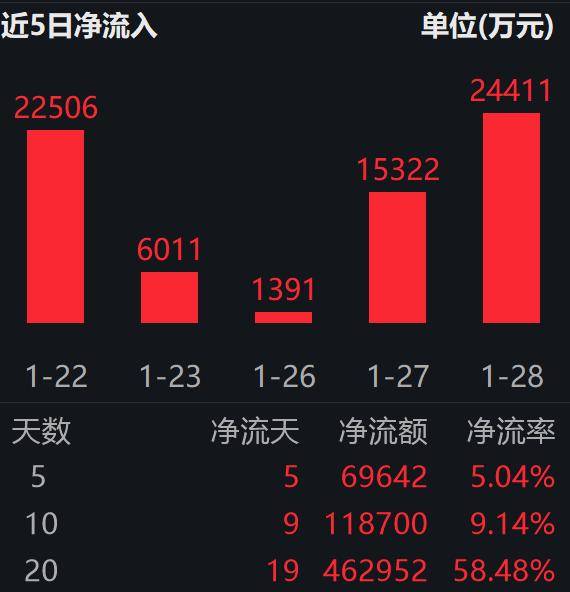
Group 1 - The domestic commodity futures market opened with most contracts rising, with notable increases in gold (over 7%), silver (over 4%), and fuel (nearly 3%) [1] - The industrial non-ferrous ETF WanJia (560860) saw a significant increase of 4.03%, reaching a historical high, with a trading volume of 290 million [1] - The ETF has attracted substantial capital inflows, with a total of over 6.9 billion yuan in net inflows over the past five days, and over 46 billion yuan in the last 20 days [1] Group 2 - Federal Reserve Chairman Jerome Powell indicated that inflation pressures are primarily due to tariffs rather than demand factors, leading to a significant rise in gold prices, which surpassed 5400 USD [3] - The London Metal Exchange (LME) saw most base metals rise, with tin increasing by 3.52% to 56,795 USD/ton, aluminum by 1.59% to 3,263.5 USD/ton, and copper by 0.74% to 13,120 USD/ton [3] - The metal industry is entering a weak supply cycle, with global mining supply expected to maintain strong rigidity until 2028, while demand is anticipated to increase due to green energy transitions and new production capabilities [3] Group 3 - The industrial non-ferrous ETF WanJia (560860) closely tracks the CSI Industrial Non-Ferrous Metals Theme Index, covering strategic resources such as copper, aluminum, and rare earths [4] - Investors can access this ETF through linked classes (A class: 018489; C class: 018490) to capitalize on cyclical and policy-driven opportunities [4]
IC Markets平台:下任美联储主席人选猜测升温?
Sou Hu Cai Jing· 2026-01-19 01:45
Core Viewpoint - The discussion surrounding the next chairperson of the Federal Reserve is gaining attention, with potential candidates being evaluated amid procedural investigations that may affect policy independence [1][4]. Group 1: Potential Candidates - Kevin Hassett, previously mentioned as a candidate, has indicated that his focus remains on his current role despite discussions with the administration [1]. - Other potential candidates include current Fed Governor Christopher Waller, former Fed official Kevin Walsh, and financial industry veteran Rick Riedel, with Riedel's cross-sector background seen as a potential advantage [3]. Group 2: Procedural Investigations and Market Reactions - Recent procedural investigations related to the Federal Reserve have added complexity to the leadership transition, raising discussions about policy independence [4]. - Current Chair Jerome Powell has stated that these investigations should not impact the long-term positioning of monetary policy, while Congress plans to carefully evaluate the nominees based on these procedures [4]. - The U.S. Treasury Secretary has expressed optimism about the orderly progression of the nomination and confirmation process, noting that financial markets are focused on policy continuity [4]. Group 3: Timeline and Dynamics - Powell's term is set to expire in May of this year, with the Treasury Department leading the selection process, although the Secretary has clarified that they are not a candidate [4]. - The selection of the next Federal Reserve chair remains in a dynamic evaluation phase, with interwoven procedural and policy considerations drawing significant attention from markets and policy researchers [4].
【UNFX财经事件】美元强势延续 英镑在美联储谨慎基调下面临上行压力
Sou Hu Cai Jing· 2026-01-16 04:23
Group 1 - The Federal Reserve officials are signaling a cautious approach to monetary policy, emphasizing that inflation remains above target and the labor market is resilient, indicating no immediate need for further rate cuts [1][2] - There is a growing consensus within the Fed for an "extended observation period," with officials like Chicago Fed President Goolsbee and Kansas City Fed President George opposing premature rate adjustments [1][3] - Recent economic data supports the Fed's stance, showing a slight decrease in unemployment to 4.4% and initial jobless claims dropping to 198,000, indicating stability in the job market despite high interest rates [2][3] Group 2 - The current inflation rate is hovering around 3%, significantly above the Fed's long-term target of 2%, which reinforces the decision to maintain a cautious policy [2][3] - The market's expectation for rate cuts has diminished, with futures pricing indicating a lower probability of rate reductions before June, suggesting a slowdown in the pace of monetary easing [2] - The strength of the US dollar is attributed to stable interest rate expectations, impacting non-US currencies like the British pound, which is facing resistance in its upward movement [2][3] Group 3 - The independence of the Federal Reserve remains a potential variable of concern, with officials expressing support for Chair Powell and emphasizing that policy decisions should be based on data rather than political pressure [3] - The foreign exchange market has largely priced in the scenario of a pause in rate cuts, with the dollar's strength reflecting the continuation of stable rate expectations rather than the beginning of a new trend [3] - In the absence of new policy signals or key data, major currency pairs are expected to remain within critical ranges, with market focus shifting towards upcoming inflation data and Fed officials' statements [3]
【UNFX财经事件】稳健软着陆路径成形 美联储降息立场趋于谨慎
Sou Hu Cai Jing· 2026-01-15 03:40
Group 1 - The latest Beige Book indicates a moderate recovery in the US economy expected to continue into late 2025 and early 2026, with overall growth described as "slight to moderate" [1] - The labor market remains stable, and consumer spending shows no significant signs of weakening, reinforcing the consensus on a robust soft landing for the US economy [1] - Economic activity has been gradually improving across most regions since mid-November, with no clear signs of recession observed [1] Group 2 - Eight out of twelve Federal Reserve districts reported stable employment conditions, with wage growth in a "moderate" range, suggesting a return to long-term equilibrium levels [1] - Price levels are rising at a moderate pace, with some businesses beginning to pass on previously absorbed cost pressures to end prices, indicating that while inflation is trending down, complete relief from price pressures will take time [1] - Market expectations for interest rate cuts in 2026 have become more cautious, with the anticipated number of cuts reduced from three to two, and the timing of the first cut pushed back to June [2] Group 3 - Federal Reserve officials' recent statements align with the Beige Book's tone, indicating that current interest rates may be close to a neutral zone, with future adjustments dependent on data changes [2] - The political environment poses additional uncertainties for policy stability, as President Trump has indicated no current plans to remove Fed Chair Powell despite ongoing investigations [2] - Overall, the Beige Book reinforces the narrative of a "moderate recovery and a likely soft landing" for the US economy, with resilient employment and consumption, while inflation remains above target, limiting the Fed's motivation to relax policies urgently [3]
TMGM:美联储人事变动引市场波动,利率独立性会受影响吗?
Sou Hu Cai Jing· 2025-12-09 05:40
Group 1 - The potential nomination of Kevin Hassett as the next Federal Reserve Chair has raised market concerns regarding the independence of interest rate decisions [1][3] - Following the news, the 10-year U.S. Treasury yield increased significantly, indicating market volatility and apprehension about political influence on monetary policy [3] - The Federal Reserve's long-standing policy independence is crucial for maintaining market trust and the perception of U.S. economic stability [3] Group 2 - The Federal Reserve's monetary policy is determined collectively by the committee, and historically, there has been no prolonged disagreement between the Chair and the majority of committee members [3] - Changes in the Federal Reserve Board may occur, with one current member's term under legal review, potentially affecting the board's composition [3] - The economic advisory team includes several individuals viewed as potential candidates for Federal Reserve positions, adding uncertainty to future personnel arrangements [3][4]