数字游民

Search documents
一人公司发展研究报告2.0版
清新研究团队· 2026-03-11 01:45
Investment Rating - The report does not explicitly provide an investment rating for the industry. Core Insights - The essence of business is to capture value through a streamlined loop, focusing on solving fundamental problems rather than surface symptoms [8][10]. - The traditional narrative of business growth, which emphasizes scaling and team expansion, is being challenged; growth should be a choice rather than an obligation [14][51]. - The report emphasizes the importance of individual resources such as time, energy, and attention as the only scarce resources in the value system [7][56]. Summary by Sections Business Paradigm Reconstruction - The report discusses the need to reconstruct traditional business narratives, moving away from outdated assumptions about growth and team size [4][5]. - It highlights that all elements of business (products, traffic, pricing) are merely parameters derived from fundamental truths [5][10]. Value Capture and Delivery - The core definition of business is to solve fundamental problems for others and capture part of the value created [10]. - A value delivery system must operate independently of the individual's time; if the individual disappears, the system should still create and deliver value [13]. Growth and Optimization - Growth should be viewed as an option, focusing on quality of profit and life rather than merely increasing output [14][41]. - The report introduces a core equation for one-person companies, emphasizing extreme leverage through automation and productization to capture sustainable value [15]. Leveraging AI and Automation - The report outlines various blueprints for leveraging AI in different business models, including content creation, digital products, and SaaS tools [21][24][27]. - It emphasizes the potential for individuals to operate as complete businesses using AI, reducing reliance on traditional team structures [43][44]. Structural Opportunities - The report identifies structural opportunities arising from reduced startup costs and the democratization of entrepreneurship through AI [43][73]. - It suggests that the barriers traditionally faced by entrepreneurs are dissolving, allowing individuals to achieve corporate-level productivity [44][45]. Future Predictions - The report predicts that the first billion-dollar one-person company will emerge soon, highlighting the shift in business dynamics towards individual empowerment [192]. - It emphasizes the importance of location and regulatory environments in determining the success of individual businesses [157][220].
昔格达来了群“捏泥巴”的年轻人
Xin Lang Cai Jing· 2026-02-19 21:59
Core Insights - The article highlights the transformation of Xigeda Village in Panzhihua City, where young entrepreneurs are revitalizing the local economy through innovative agricultural and tourism practices [2][3] - The village has seen a shift from traditional agriculture to a more diversified economy, including wellness tourism and local product sales, driven by the return of young people [2][3] Economic Development - Xigeda Village has a per capita annual net income of approximately 30,000 yuan, indicating a relatively stable economic condition for its residents [2] - The land transfer fees in Xigeda are reportedly higher than those in coastal areas, reflecting the increasing value of local agricultural land [2] - The village has developed a tourism industry that capitalizes on its warm climate and nearby hot springs, contributing to its economic growth [2] Entrepreneurial Initiatives - Young entrepreneurs are introducing new business models, such as product processing and marketing strategies, to enhance local agricultural products [2][3] - The establishment of businesses like a bakery and a craft workshop has diversified the local economy and attracted more visitors [3] - The concept of "digital nomads" is being targeted to boost local consumption and provide new opportunities for traditional industries [3] Community Engagement - There is a growing trend of young people returning to their hometowns to start businesses, which is fostering community cohesion and collaboration [3] - Local residents are increasingly participating in new economic activities, with many expressing a willingness to adapt to new business models [3] - The involvement of local youth in entrepreneurship is seen as a key factor in the village's development strategy, promoting a sense of ownership and innovation [3]


斯里兰卡正式推出数字游民签证,吸引远程专业人士长期居留
Shang Wu Bu Wang Zhan· 2026-02-11 17:36
Core Viewpoint - Sri Lanka has officially launched a Digital Nomad Visa (DNV) to attract remote professionals for long-term residency, aiming to enhance its appeal as a digital and lifestyle destination [1] Group 1: Visa Details - The Digital Nomad Visa is valid for one year and can be renewed annually [1] - Applicants must be foreign citizens aged 18 or older engaged in remote employment, freelancing, or owning a business registered outside Sri Lanka that serves international clients [1] - The visa requires proof of a minimum monthly remittance of $2,000, with an additional $500 for each dependent beyond two [1] Group 2: Application Requirements - Required application materials include a valid passport, medical examination, criminal record check, international health insurance, income and remittance proof, and a recommendation from the Ministry of Digital Economy [1] - The visa processing is handled by the Department of Immigration and Emigration, with an application fee of $500 per person per year [1] Group 3: Rights and Restrictions - Visa holders can legally reside in Sri Lanka for up to 12 months, open bank accounts, rent properties, and enroll children in international or private schools [2] - The visa prohibits local employment, requiring all income to originate from abroad, and mandates compliance with Sri Lankan immigration, tax, and legal regulations [2] - Holders must report any changes in employment, income, or family status within 30 days, and the visa may be revoked for non-compliance or legal risks [2]
有专家说出实话:为什么越来越多人卖掉城市房子,回农村生活了?
Sou Hu Cai Jing· 2026-02-10 10:05
Core Viewpoint - A growing trend of "reverse migration" is observed, where young people are selling their urban properties and returning to rural areas for a better quality of life and lower living costs [7][9]. Group 1: Reasons for Selling Urban Properties - The primary reason for this trend is the overwhelming stress associated with urban living, including high housing costs, long commutes, and intense work pressure [9][12]. - Many individuals calculate that the financial burden of urban living does not justify the benefits, as rural living offers significantly lower costs for housing and daily expenses [12][13]. - Improvements in rural infrastructure, such as better internet connectivity and healthcare, make returning to rural areas a viable option [17][19]. Group 2: Ways to Sustain Livelihood in Rural Areas - Digital nomadism is a common approach, where individuals work remotely in fields like programming and design, leveraging good internet access [19][21]. - Some young people are engaging in entrepreneurial activities, such as e-commerce and hospitality, to capitalize on local products and tourism [25][27]. - A hybrid model of living in rural areas while working in nearby towns is also emerging, allowing for lower living costs and a better work-life balance [29][31]. - Selling urban properties often provides capital for investment, reducing the pressure to secure high-paying jobs [33]. Group 3: Challenges of Rural Living - There are significant bureaucratic hurdles related to residency and property rights that can complicate the transition back to rural living [36]. - Access to quality education and healthcare remains a concern, as these resources are still predominantly located in urban areas [38]. - The social dynamics in rural areas can be challenging, as they often involve close-knit communities where personal matters are more scrutinized [40]. - Income stability and career advancement opportunities may be limited in rural settings, leading to potential dissatisfaction [42]. Group 4: Positive Aspects of Rural Living - Many individuals report a slower pace of life and reduced stress levels after moving to rural areas, allowing for a more fulfilling lifestyle [44]. - Increased family time and community engagement are significant benefits, fostering stronger relationships [46]. - The interaction between new residents and long-time villagers is creating vibrant communities, enhancing local culture and economy [48]. - Government support and improved infrastructure are making rural living more comfortable and accessible for newcomers [50]. Conclusion - The trend of young people selling urban properties to return to rural areas reflects a complex decision-making process, balancing lifestyle preferences and economic considerations [52].

政协会议举行大会发言 21位委员建言 胡文容朱忠明出席
Jie Fang Ri Bao· 2026-02-05 01:51
Group 1 - The meeting of the Municipal Political Consultative Conference focused on high-quality development and various industry innovations [1][2] - Multiple committee members presented on topics such as the integration of technology and finance, the core competitiveness of the biopharmaceutical industry, and breakthroughs in the integrated circuit innovation chain [2] - Discussions included enhancing the international financial center's service functions and promoting cultural consumption through innovative scenarios [2] Group 2 - The meeting was attended by key municipal leaders and chaired by the Vice Chairman of the Municipal Political Consultative Conference [3] - Various members addressed issues related to population development, artificial intelligence, and the integration of international digital nomads [2] - The conference aimed to foster a new ecosystem for high-quality development and support enterprises in expanding globally [2]
4000万人,60个国家:数字游民如何一边移动一边工作?
红杉汇· 2026-01-23 00:05
Core Insights - The article discusses the rise of digital nomads, a rapidly growing group redefining the concept of work, with over 17 million in the U.S. and an expected global count of 60 million by 2030 [5][6] - It highlights the "mobile worker paradox," where the desire for freedom conflicts with the need for a stable work environment [5][6] Group 1: The Paradox of Digital Nomads - Digital nomads seek the freedom of mobility but require a stable environment for efficient work, leading to a balancing act between these two needs [6][8] - Two primary modes of balancing this paradox are identified: the "cyclical mode," where individuals oscillate between movement and stability, and the "fusion mode," where they create a sense of home while on the move [6][8][10] Group 2: Cyclical and Fusion Modes - The cyclical mode involves staying in one location long enough to establish a rhythm before moving on, often driven by a strong desire for new experiences [9][10] - The fusion mode allows digital nomads to incorporate elements of stability into their mobile lifestyle, such as carrying personal items that provide comfort and familiarity [10][11] Group 3: Implications for Work Management - The experiences of digital nomads suggest that work efficiency is more about the atmosphere created than the physical location, challenging traditional views on office environments [11][12] - Companies should shift from time-based assessments to results-oriented evaluations, helping employees establish clear work boundaries while maintaining flexibility [12][13] Group 4: Future Work Trends - The number of digital nomads in the U.S. has increased by 133% in the past four years, driven by advancements in remote work technology and changing perceptions of work among younger generations [13][14] - The future of work is expected to be more diverse, with a blurred concept of workplaces, as companies adopt hybrid work models allowing for flexible work locations [13][14] Group 5: Urban and Technological Adaptations - Cities are increasingly creating "digital nomad-friendly" environments, with improved infrastructure such as high-speed internet and co-working spaces [14][15] - Technological advancements, including VR and AI, are anticipated to enhance remote collaboration and expand the geographical scope of work [14][15]

从“过客”到“新村民”福建武夷山打造数字游民聚落
Xin Lang Cai Jing· 2026-01-22 13:01
Group 1 - The core idea of the news is the transformation of digital nomads from transient visitors to "new villagers" in Wuyishan, Fujian, facilitated by local government initiatives and the establishment of a digital nomad community [1][2][3] - The Wuyishan Digital Nomad Commune has been developed to provide a conducive environment for young people to live and work, featuring 63 rooms and a capacity for 120 to 140 individuals, with a focus on creating a welcoming atmosphere for youth [1] - Since its soft launch in December 2025, the commune has attracted over 130 young individuals from 27 provinces in China and overseas, with an average stay of 35 days and an occupancy rate exceeding 90%, of which over 32% hold master's degrees [1] Group 2 - The commune aims to build a community ecosystem that supports digital nomads through entrepreneurship incubation, resource connection, and event organization, promoting a sustainable living and working environment [2] - Many digital nomads are integrating their work with local culture, such as content creators promoting local products and teams developing innovative projects like combat robots [2] - The environment fosters a sense of community among young people, allowing them to engage in various activities and discussions, making it a "spiritual habitat" for the youth [3]
青春“数”与“乡”的共舞!云浮新兴创新推出青年“数字游民”兴乡实践点
Nan Fang Nong Cun Bao· 2026-01-14 02:33
Core Viewpoint - The article discusses the innovative initiative by Xinxing County in Yunfu City to launch the first batch of 10 "digital nomad" practice points aimed at promoting rural revitalization through the integration of flexible work and digital skills [4][34]. Group 1: Initiative Overview - Xinxing County is the first in the city to release 10 practice points for young "digital nomads" to encourage their involvement in rural development [4][8]. - The initiative aims to create an open ecosystem that includes government support, village participation, market operations, and youth collaboration [5][6]. - Digital nomads are defined as individuals who work remotely using the internet, allowing them to choose their living locations freely [9][10]. Group 2: Benefits to Rural Areas - Digital nomads bring advanced digital skills, diverse business resources, and a broad external perspective to rural areas, contributing to industry upgrades through training, entrepreneurship, and collaboration [11][12]. - The initiative aims to transform rural areas from being mere resource exporters to developing a composite "self-sustaining" growth model [13]. Group 3: Practice Points and Support - The 10 practice points cover various business types, including family farms, national A-level scenic spots, boutique homestays, and professional live-streaming bases [15][16]. - Each practice point is equipped with clear industry interfaces and resource lists, facilitating the integration of digital nomads into local economies [17][19]. - Support services at these points include local living guides, resource connections, project cooperation, and policy consultation, significantly reducing initial costs and risks for young entrepreneurs [20][21]. Group 4: Training and Community Building - Prior to launching the practice points, Xinxing County held a training program for rural operations and youth engagement, featuring top experts in the field [22][26]. - The establishment of the Rural Operations Youth Academy and Youth Alliance aims to provide ongoing local intellectual support and collaborative networks for incoming digital nomads [29][30]. Group 5: Strategic Goals - The county's goal is to become a leading innovation and entrepreneurship hub comparable to the Guangdong-Hong Kong-Macao Greater Bay Area [34][36]. - The initiative is positioned as a strategic move to attract young talents engaged in digital work, enhancing the region's appeal as a destination for digital economic development [37][40].

中工网评丨劳动热词见证的温度与力量
Xin Lang Cai Jing· 2026-01-03 02:50
Core Viewpoint - The 2025 labor buzzwords reflect significant changes in labor dynamics, emphasizing the importance of hard work, unity, and resilience in the face of evolving challenges and opportunities in the modern era [1][2][3] Group 1: Labor Trends - The emergence of terms like "AI colleagues" and "digital nomads" indicates a profound transformation in labor forms, with human-machine collaboration becoming the norm [2] - The demand for high-quality applied talents is increasing as China undergoes industrial transformation and upgrading, highlighting the need for versatile professionals who are both theoretically knowledgeable and practically skilled [2] Group 2: Labor Rights and Protections - Recent initiatives such as breaking the 35-year age limit for national exams and the introduction of "family-friendly jobs" signal a commitment to employment fairness and the enhancement of labor rights [2] - The implementation of algorithmic negotiation allows new employment form workers to transition from being governed by rules to participating in rule-making, thereby improving their sense of security and stability [2] Group 3: Economic Context - The labor buzzwords not only showcase the robust foundation for China's high-quality economic development but also indicate a promising future for laborers [3] - As the "14th Five-Year Plan" concludes and the "15th Five-Year Plan" is set to begin, the commitment of laborers to their roles is expected to contribute significantly to national modernization and rejuvenation efforts [3]

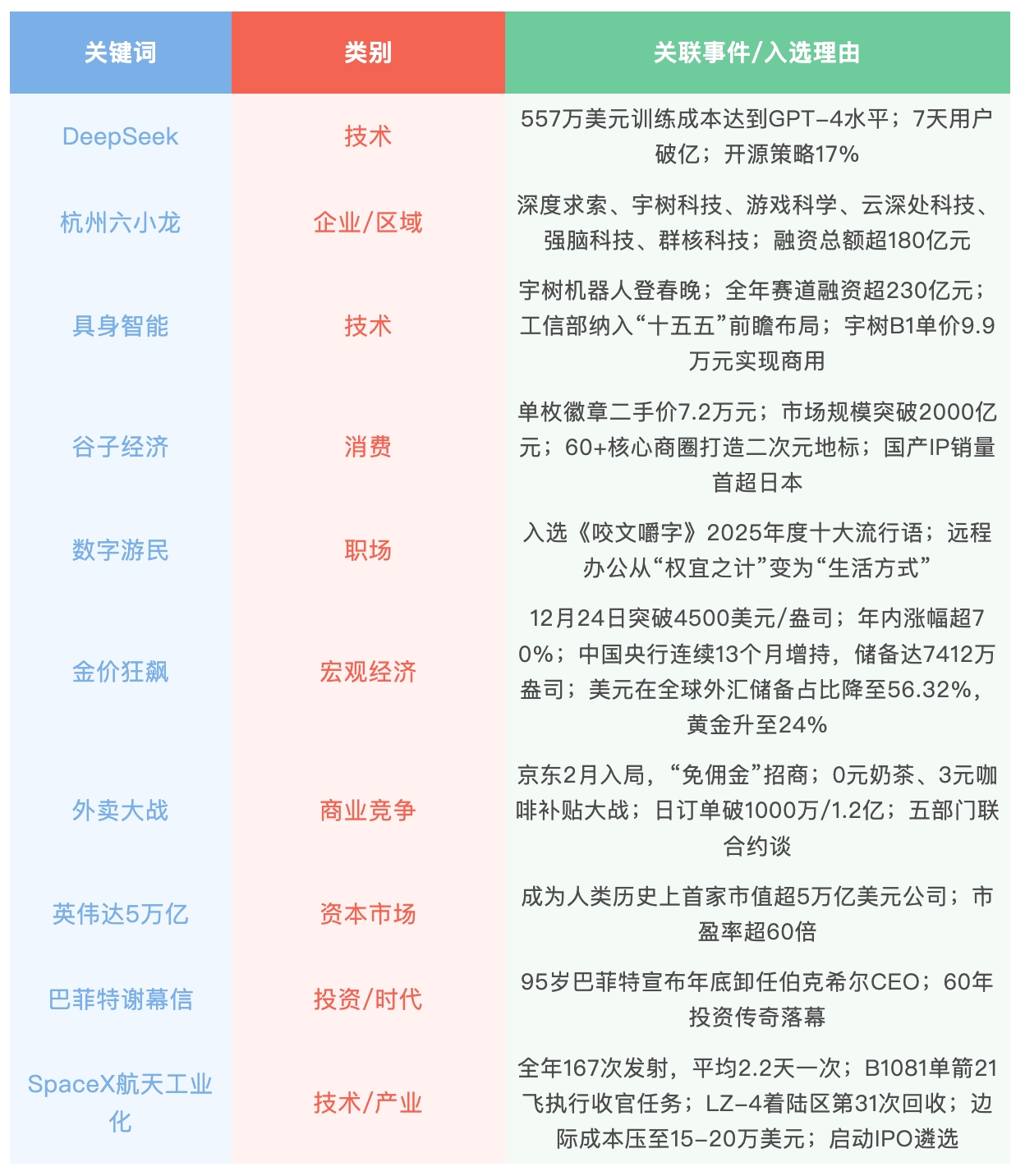
2025,商业世界的十大关键词
3 6 Ke· 2025-12-30 03:25
Group 1 - Nvidia's stock price plummeted 17% in a single day, resulting in a market value loss of nearly $600 billion, marking the largest single-day market loss in U.S. stock market history [1] - The emergence of DeepSeek, a Chinese company, has caused significant concern on Wall Street, as it achieved results comparable to OpenAI's GPT-4 with a training cost of only $5.57 million, compared to OpenAI's $100 million [2][9] - The media has referred to this event as an "Sputnik moment" in the AI field, indicating a significant shift in technological capabilities [3] Group 2 - DeepSeek's success challenges the notion that more computational power is necessary for better AI models, suggesting that smarter algorithms can achieve similar results with less resource investment [9] - The "Six Little Dragons" from Hangzhou, including DeepSeek and other tech companies, have collectively raised over 18 billion yuan, indicating a shift towards technology-driven growth in the region [12][13] - The concept of "embodied intelligence" is gaining traction, with significant investments in humanoid robots and AI that can interact with the physical world, marking a new frontier in AI development [16] Group 3 - The "Guzi economy," referring to the market for anime and gaming merchandise, has grown to a market size of 200 billion yuan, with over 667,000 related enterprises in China [19] - The rise of "digital nomads," who work remotely and travel, is reshaping workplace dynamics and challenging traditional office structures [20] - Gold prices surged by 70% in 2025, reaching over $4,500 per ounce, driven by a decline in the dollar's global reserve status and increased central bank purchases [23] Group 4 - The competition in the food delivery market intensified with JD's entry, leading to significant consumer benefits through aggressive pricing strategies [26] - Nvidia's market capitalization surpassed $5 trillion, making it the first company in history to reach this milestone, reflecting its dominance in the AI hardware market [28][29] - Warren Buffett announced his retirement as CEO of Berkshire Hathaway, raising questions about the future of value investing in the rapidly evolving tech landscape [32] Group 5 - SpaceX achieved a record 167 rocket launches in 2025, demonstrating the industrialization of space travel and significantly reducing launch costs [35] - The developments in AI, technology, and consumer behavior in 2025 indicate a transformative year, with implications for various industries and investment strategies [36]