新基建投资

Search documents
股指期货策略月报-20260302
Guang Da Qi Huo· 2026-03-02 09:21
Report Industry Investment Rating - Not mentioned in the provided content Core Viewpoints of the Report - The A-share market showed a strong performance after the Spring Festival, with the Wind All A index rising by 2.34% in February, approaching the high in late January. The overseas market also had a small increase during the Spring Festival, and the risk preference of the A-share market rebounded significantly [3]. - A-share technology themes currently have a premium compared to US stocks. The valuation of A-share hot themes is relatively high, and the dynamic PE of the CSI 500 index exceeds twice the standard deviation of the past 5 years. The A-share technology index represented by the STAR 50 has recently returned to last year's high, while the overseas China-themed technology index reached its peak in October 2025 and then declined [3]. - Inflation recovery may be the trading focus in the second half of the year. The PPI data has stabilized for four consecutive months, and the market is starting to discuss the trading logic of inflation recovery. Although the systematic opportunities in pro - cyclical industries need time to be verified, a trading window may appear in the second half of the year [3]. Summary According to the Directory 1. Monthly Data Tracking - **Index Performance**: In February, the Wind All A index fluctuated upwards with a monthly increase of 2.34% and an average daily trading volume of 2.31 trillion yuan. The CSI 1000 rose by 3.71%, the CSI 500 by 3.44%, the SSE 50 fell by 0.88%, and the SSE 300 rose by 0.09% [7]. - **Index Valuation**: The valuation of the CSI 500 index is relatively high, with its dynamic PE exceeding twice the standard deviation of the past 5 years [3]. - **Sector Rotation**: In February, sector rotation was obvious, and technology themes remained the main line [14]. - **Financing and Volatility**: The margin trading balance decreased by 48.5 billion yuan in February and increased by 77.4 billion yuan after the Spring Festival, indicating a significant recovery in risk preference. The implied volatility of the index dropped significantly, with 1000IV falling from 25.44% to 23.18%, 300IV from 19.49% to 15.83%, and 50IV from 19.19% to 15.45% [25]. - **Fund Issuance**: In the week before the Spring Festival, the issuance of equity funds and hybrid funds both increased. In February, new equity funds were established with 20.6 billion yuan, and new hybrid funds with 24.9 billion yuan, significantly higher than in the fourth quarter of 2025 [28]. - **Net Short Position**: At the end of February, the net short position of each index decreased slightly [29]. - **Exchange Rate**: The US dollar index fluctuated weakly, and the RMB appreciated by more than 2% since the beginning of the year. The spot exchange rate of the US dollar against the RMB closed at 6.84%. The 1 - year swap of the US dollar against the RMB did not rise synchronously and remained around - 1300. The central bank lowered the forward foreign exchange purchase risk reserve ratio from 20% to 2% on February 26, which is conducive to releasing forward foreign exchange purchase demand and balancing forward exchange rate expectations [32]. - **A - share Technology Index Premium**: A - share technology themes have been anchored to US stocks in the past year. The A - share technology index represented by the STAR 50 has recently returned to last year's high, while the overseas China - themed technology index reached its peak in October 2025 and then declined. The overall performance of Chinese technology giants has been weaker than that of the top 7 US companies since October 2025 [35]. 2. 2025 Third - Quarter Report Overview - **Revenue and Profit**: The cumulative year - on - year revenue of the entire A - share market excluding finance in Q3 was 0.74%. The cumulative year - on - year net profit was 1.89%, higher than 0.83% in Q2 but lower than 3.45% in Q1. The cumulative year - on - year profit of industrial enterprises above a designated size was 3.2%, reaching a high for the year [91][94]. - **Profit Share**: The profit share of the financial sector is still relatively high, with banks accounting for 33% and non - banks for 13%, totaling 46% [97]. - **Technology Theme Profit**: The technology theme has entered the profit realization period [98]. - **ROE**: ROE is still in the bottom - oscillating range [101]. - **ROE DuPont Analysis**: The report conducts a DuPont analysis of ROE, including indicators such as operating net profit margin, gross profit margin, asset turnover, and equity multiplier [104]. - **Index Financial Indicators**: All major indicators of each index closed up. After the adjustment of index components in December, the financial indicators of each index changed slightly [107][109].

月度前瞻 | 开年经济“新变化”?(申万宏观·赵伟团队)
申万宏源宏观· 2026-02-13 01:18
Economic Monthly Data - The economic indicators for November 2025 show a GDP growth of 4.8%, with a forecast of 5.2% for December 2025 and 5.4% for January-February 2026 [2] - Fixed asset investment is projected to decline by 2.6% in November 2025, with a further drop to -3.8% in December and -9.8% in January-February 2026 [2] - Real estate investment is expected to decrease significantly by 15.9% in November, 17.2% in December, and 31.1% in January-February 2026 [2] Production and Supply Chain Insights - Manufacturing PMI dropped to 49.3% in January 2026, indicating a contraction, likely influenced by the early return of workers during the Spring Festival [3][10] - The average PMI over the past two months shows a slight recovery trend, with a 0.5% increase from November 2025 [10] - The production in the metallurgical chain has improved, with a 2.2% increase in blast furnace operating rates compared to December 2025 [14] Demand and Consumption Trends - Export activities are expected to remain robust due to a delayed Spring Festival, extending the "export rush" window, with a 13.9% increase in foreign trade cargo volume in early January 2026 [5][25] - Domestic consumption is anticipated to see a slight recovery, with a projected increase of 1.9% in retail sales during January-February 2026, supported by extended holiday periods and local consumption stimulus policies [31] - Various regions are implementing consumption promotion measures, including issuing large amounts of consumer vouchers to boost spending during the Spring Festival [36] Investment Outlook - Investment is expected to improve moderately due to supportive policies and increased government bond financing, with a positive outlook for infrastructure investment [39] - The net financing of government bonds in January 2026 is projected to show positive performance, providing support for infrastructure investments [42] Price Trends and Inflation - PPI is expected to show weak recovery, with January 2026 PPI projected to remain low due to weak transmission of upstream prices to downstream sectors [46] - CPI is anticipated to exhibit a "V-shaped" trend in January-February 2026, influenced by the timing of the Spring Festival and changes in food prices [56] Summary of Economic Resilience - Overall, the economic pressure observed previously may ease slightly, with signs of resilience in early 2026, particularly in production and export indicators [66] - The delayed Spring Festival is expected to prolong the "rush for production and exports," contributing to a positive economic outlook for the beginning of the year [66]


数据点评 | 财政金融协同,蓄力“开门红”(申万宏观·赵伟团队)
Xin Lang Cai Jing· 2026-01-31 16:26
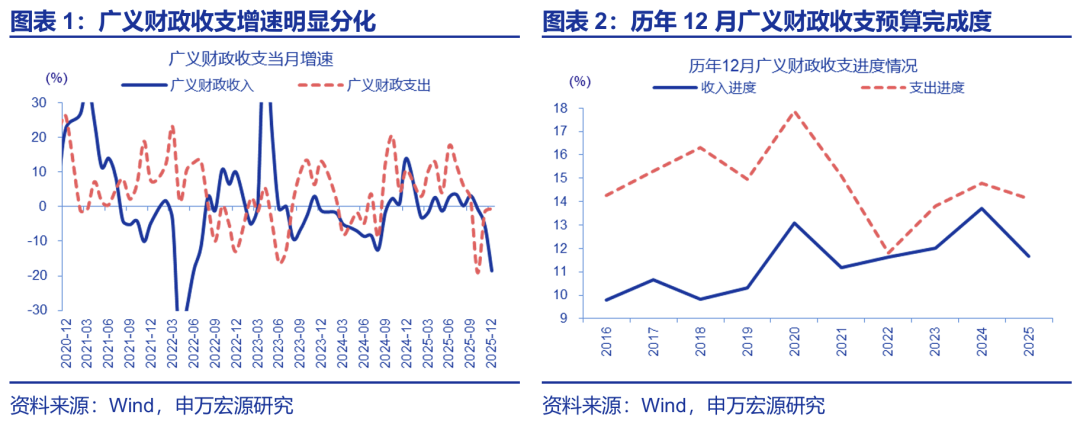
Core Viewpoint - The fiscal revenue and expenditure in 2025 show a significant divergence, indicating a potential shift in policy focus towards "fiscal and financial coordination" [1][4][5] Revenue Summary - In December 2025, the broad fiscal revenue decreased by 18.5% year-on-year, marking a decline of 13.3 percentage points from November, the lowest level of the year [1][3][5] - General fiscal revenue fell sharply by 25% year-on-year, influenced partly by a high base effect from the same period in 2024 [9][22] - Non-tax revenue saw a drastic decline of 47.9%, becoming the largest drag on overall revenue, likely due to stricter management regulations implemented in the second half of the year [9][22] - Government fund revenue decreased by 11.7% year-on-year, although the decline was less severe than in previous months, with land transfer revenue showing a slight improvement [9][17] Expenditure Summary - Despite revenue pressures, broad fiscal expenditure saw a smaller decline of 0.7% year-on-year in December, with a narrowing drop of 1 percentage point from November [2][3][31] - General fiscal expenditure decreased by 1.8% year-on-year, with a nearly 2 percentage point reduction in the decline compared to November [31] - Government fund expenditure increased by 1.5%, indicating a positive growth trend despite a slight slowdown from previous months [11][39] - Significant increases were noted in urban and rural community expenditures, which rose by 12.8%, reflecting a shift towards infrastructure and technological investments [11][33] Policy Outlook - The first quarter of 2026 may see a stronger reliance on fiscal and financial coordination to stimulate economic growth, with a focus on expanding interest subsidies and new infrastructure investments [2][13] - The upcoming fiscal policy is expected to emphasize increased total spending, with a focus on consumption and livelihood improvements, while maintaining necessary levels of deficit and debt [14]
12月财政数据点评:财政金融协同,蓄力“开门红”
Shenwan Hongyuan Securities· 2026-01-31 14:55
Revenue Insights - In December 2025, general public budget revenue decreased by 18.5% year-on-year, marking a significant drop of 13.3 percentage points compared to November, the lowest level of the year[2] - General fiscal revenue for 2025 was 216,045 billion yuan, a decline of 1.7% from the previous year[6] - Non-tax revenue plummeted by 47.9% year-on-year in December, becoming the largest drag on overall revenue[9] Expenditure Trends - General public budget expenditure increased by 1% year-on-year, totaling 287,395 billion yuan in 2025[6] - In December 2025, general fiscal expenditure fell by only 0.7% year-on-year, a narrowing of the decline by 1 percentage point from November[4] - Urban and rural community expenditure surged by 12.8% year-on-year in December, indicating a shift towards increased investment in infrastructure and community services[12] Budget Performance - The budget completion rate for general fiscal revenue in December 2025 was 11.7%, lower than the 13.7% completion rate in December 2024 and the five-year average of 12.3%[4] - General fiscal expenditure budget completion in December was 14.1%, below the five-year average of 14.7%[27] Future Outlook - The first quarter of 2026 is expected to rely on fiscal-financial collaboration to stimulate economic growth, with a focus on expanding interest subsidies and new infrastructure investments[13] - The government plans to enhance fiscal policies by broadening the scope of consumption loans and equipment renewal subsidies to boost domestic demand[13]
数据点评 | 财政金融协同,蓄力“开门红”(申万宏观·赵伟团队)
申万宏源宏观· 2026-01-31 14:49
Core Viewpoint - The article highlights the increasing divergence in fiscal revenue and expenditure, suggesting that future policy focus may shift towards "fiscal-financial coordination" [2][42]. Group 1: Fiscal Revenue and Expenditure Overview - In December, the broad fiscal revenue experienced a significant decline of 18.5% year-on-year, marking the lowest level of the year, while broad fiscal expenditure decreased by only 0.7%, indicating a relative resilience in spending [2][42]. - The general public budget revenue for 2025 was reported at 21,604.5 billion yuan, a decrease of 1.7% compared to the previous year, while expenditure was 28,739.5 billion yuan, reflecting a growth of 1% [7][41]. Group 2: Revenue Breakdown - The sharp decline in revenue was primarily driven by a 25% drop in general fiscal revenue, influenced by a high base effect from the previous year, with non-tax revenue plummeting by 47.9% [10][20][42]. - Government fund revenue saw a reduced decline of 11.7%, with land transfer revenue decreasing by 22.9%, indicating a slight improvement in the land market [10][18][42]. Group 3: Expenditure Insights - Despite revenue pressures, broad fiscal expenditure's decline continued to narrow, with urban and rural community spending increasing by 12.8%, marking a shift from negative to positive growth [12][43]. - The government fund expenditure maintained a positive growth rate of 1.5%, suggesting that the 500 billion yuan special bond limit is being accelerated [12][43]. Group 4: Future Policy Directions - Looking ahead, the first quarter's economic performance may rely on fiscal-financial coordination, with a focus on expanding interest subsidies and new infrastructure investments [14][43]. - The upcoming fiscal policy for 2026 is expected to emphasize increased total spending, improved structural efficiency, and enhanced economic momentum through various measures, including interest subsidies for small and medium enterprises [15][43].