
无感支付

Search documents
当支付宝遇上谷歌:一场关于“AI购物”的静默革命
Sou Hu Cai Jing· 2026-01-19 07:11
Core Insights - The collaboration between Ant International and Google to launch a "Universal Business Agreement" signifies a strategic move towards redefining commercial interactions in the AI era, aiming to transform purchasing behavior from active searching to passive interaction [1][11] Group 1: AI Integration Challenges - AI applications in business have been hindered by the "Babel Tower dilemma," where integration issues lead to increased costs and fragmented user experiences, with Gartner estimating that 40% of AI projects fail due to these integration challenges, resulting in a global economic loss of approximately $2.5 trillion [2] - A significant portion of enterprise AI projects, about 67%, is allocated to system integration rather than enhancing core AI capabilities, complicating collaboration across different platforms [2] Group 2: Universal Business Agreement - The "Universal Business Agreement" aims to address integration challenges by optimizing existing internet commercial protocols, focusing on standardized data exchange modules and unified identity verification mechanisms [3] - This agreement encapsulates commercial elements like product information and payment instructions into standardized data interfaces, allowing developers to implement cross-platform functionalities without needing separate integrations for each e-commerce platform [3] Group 3: Payment Experience Transformation - The collaboration introduces a payment revolution through Ant International's AntomEasySafePay technology, enabling seamless transactions via voice commands or simple prompts, enhancing user experience by eliminating the need to navigate away from conversation interfaces [4][5] - Early trials in Southeast Asia indicate that this simplified payment process can increase transaction conversion rates by 35% and reduce user abandonment rates by 25%-28%, demonstrating the commercial viability of this model [4] Group 4: Privacy and Trust Issues - The shift towards AI-driven purchasing raises significant trust concerns, as users may relinquish decision-making authority to AI, leading to potential privacy risks if AI systems are compromised [6] - The cross-border nature of data flow presents additional challenges, as varying privacy regulations across countries complicate compliance and data protection [6][7] Group 5: Market Dynamics and Challenges for SMEs - The collaboration has a global perspective, with Google holding a dominant market share in search engines and Ant International serving over a billion consumers, aiming to create an open AI commercial ecosystem [8] - However, geopolitical tensions and the complexity of cross-border data flow introduce uncertainties that could impact the agreement's implementation [8][9] - Small and medium-sized enterprises (SMEs) face challenges in adapting to the new AI systems due to high costs associated with technical upgrades, which can consume a significant portion of their annual revenue [9] Group 6: Sustainable Development and Regulatory Needs - For sustainable development, it is essential to establish a collaborative regulatory framework that addresses data flow and AI recommendation fairness, while also providing support to SMEs to prevent widening the digital divide [10][11] - Balancing efficiency with security and ensuring that the benefits of the AI revolution are distributed across all participants in the global business ecosystem is crucial for its success [11]
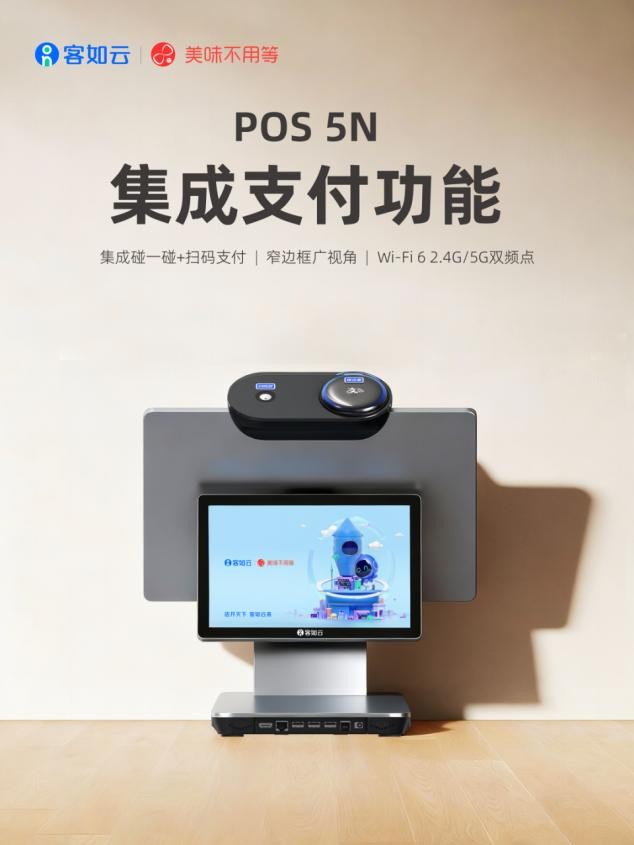
客如云POS 5N智能收银机正式发售:创新融合支付宝“碰一下”
Zhong Guo Shi Pin Wang· 2026-01-05 07:32
Core Insights - The traditional Chinese catering industry is at a critical transformation point due to rising labor and operational costs, despite a 3.3% year-on-year growth in revenue to 5.2 trillion yuan in the first 11 months of 2025 [1] - To address these challenges, the company KERUIYUN has partnered with Alipay to launch the new POS 5N smart cash register system in January 2026, aimed at enhancing operational efficiency through advanced digital solutions [1][12] Group 1: Payment Innovations - The new POS 5N system integrates "contactless payment" capabilities, allowing consumers to complete transactions simply by tapping their NFC-enabled phones on the terminal, enhancing user experience by eliminating the need to open apps or align QR codes [3][4] - The system also retains compatibility with traditional QR code payments, providing a comprehensive payment solution that caters to a wide range of consumer preferences [4] Group 2: Technical Features - The POS 5N is equipped with a Wi-Fi 6 dual-band network module, ensuring low latency and high stability during peak dining hours, effectively preventing order loss [7] - It features 4GB of RAM and 32GB of storage, allowing for efficient processing of large volumes of orders and data, while also accommodating future system upgrades [7] Group 3: Hardware Design - The POS 5N boasts a high-definition display with a narrow bezel and wide viewing angles, ensuring clarity even under bright light, which significantly improves ordering efficiency [9] - The device's all-metal body is designed to withstand common challenges in the catering environment, such as oil, moisture, and frequent impacts, ensuring durability and long-term use [9] Group 4: Strategic Vision - KERUIYUN aims to be a key driver of digital transformation in the catering industry, aligning with the urgent demand for intelligent and integrated solutions to help businesses build sustainable operational advantages in a competitive landscape [12]

AI浪潮下,支付催生新消费场景
Mei Ri Shang Bao· 2026-01-04 00:52
Core Insights - The rapid evolution of AI technology is significantly transforming the payment landscape, moving from cash payments to various advanced methods like "tap" and "AI payment" [1][2][3] Group 1: Payment Innovations - The introduction of "AI payment" by Alipay in September 2025 marks a significant milestone, enabling seamless ordering and payment through voice commands [2] - Meituan's AI Agent product "Xiao Mei" integrates AI payment with local services, attracting a large user base [2] - Rokid's smart glasses extend "AI payment" capabilities, allowing users to complete orders through voice commands while on the move [2] Group 2: Consumer Experience - In Hangzhou, the "tap" payment method has become ubiquitous, simplifying transactions across various locations, including convenience stores and street vendors [3] - The integration of "AI payment" enhances consumer experiences, allowing users to place orders without needing to interact with their phones [3] - The evolution of payment methods is shifting towards a more "invisible" experience, redefining the relationship between consumers and spending [3][4] Group 3: Future Outlook - "AI payment" is seen as a starting point for the industry's intelligent transformation, promoting smarter and more efficient consumer interactions [4] - The ongoing technological advancements and ecosystem improvements suggest that payments will evolve into a smart hub connecting people and goods, heralding a new era of consumption [4]
我们离“只带一部手机”游世界还有多远
2 1 Shi Ji Jing Ji Bao Dao· 2025-11-19 11:42
Core Insights - The article discusses the evolution of cross-border payment systems in China, highlighting the shift from outbound payments by Chinese consumers to facilitating inbound payments for foreign visitors and supporting Chinese enterprises in international transactions [1][3][5] - The growth of cross-border payment demand is driven by increased international exchanges, the rising recognition of Chinese goods and services abroad, and the feasibility of exporting domestic technological expertise [2][4] Group 1: Current Landscape of Cross-Border Payments - Chinese payment institutions are actively working to create a seamless payment experience for both outbound Chinese consumers and inbound foreign visitors [1][3] - In major cities like Shenzhen, Hong Kong, and Singapore, Chinese tourists can easily use local payment platforms, while foreign visitors can link their wallets or international cards to Chinese payment systems [1][2] - The current cross-border payment ecosystem is evolving to address the complexities of both individual and enterprise needs, with a focus on enhancing user experience and operational efficiency [3][4] Group 2: Innovations and Developments - Recent innovations include Tencent's launch of the "Global Cashier" service, which aims to streamline the payment process for foreign users in China by allowing them to use familiar payment methods [4][5] - The "Unified Cross-Border QR Code Gateway" is being developed to standardize payment processes across different countries, facilitating easier transactions for foreign visitors [6][8] - AI technology is being integrated into payment systems to enhance security and user experience, significantly reducing fraud rates and improving transaction efficiency [9] Group 3: Market Dynamics and Future Outlook - The market for cross-border payments is characterized by a competitive landscape where large state-owned banks primarily serve large enterprises, while third-party payment providers target small and medium-sized businesses [5][6] - The anticipated future of cross-border payments includes a reduction in the perception of cross-border transactions, making them as simple as domestic payments [2][7] - The collaboration among various payment platforms and institutions is essential for expanding the overall market and enhancing transaction volumes [7][8]

21现场|我们离“只带一部手机”游世界还有多远
2 1 Shi Ji Jing Ji Bao Dao· 2025-11-19 10:10
Core Insights - The article discusses the evolution of cross-border payment systems in China, highlighting the shift from outbound spending by Chinese consumers to facilitating inbound payments from foreign visitors and supporting Chinese businesses operating abroad [1][3][9] Group 1: Cross-Border Payment Developments - Chinese payment institutions are actively working to create a seamless cross-border payment experience, allowing both Chinese citizens abroad and foreign visitors in China to use familiar payment methods [1][2] - The People's Bank of China has been promoting initiatives such as binding foreign cards for domestic use and establishing a unified cross-border QR code gateway to enhance payment connectivity [2][11] - The total amount of RMB cross-border payments is projected to reach 52.3 trillion yuan in 2023 and 64.1 trillion yuan in 2024, with a year-on-year growth rate exceeding 20% [3] Group 2: User Experience and Pain Points - While cross-border payment options are expanding, challenges remain, such as foreign users wanting to use their domestic wallets in China without needing to download additional apps [1][5] - In Singapore, local consumers face issues with completing payments through WeChat mini-programs, indicating a gap in the payment process that needs to be addressed [5][10] - Tencent has launched the TenPay Global service to streamline the payment process for foreign users in Chinese establishments, aiming for a seamless order and payment experience [6][10] Group 3: Business Expansion and Competition - Chinese companies expanding overseas face complex payment needs, with considerations including security, transaction speed, service fees, and currency support [7] - Large state-owned banks dominate the cross-border payment market, primarily serving large foreign trade enterprises, while third-party payment providers target small and medium-sized businesses and cross-border e-commerce [7][8] - Tencent's Zhihui E-commerce service supports various overseas platforms, providing compliant fund collection, currency exchange, and withdrawal services for Chinese sellers [7] Group 4: Future Vision and Infrastructure - The vision for cross-border payments is to create a "no-sense" payment experience, where users can transact without feeling the complexities of cross-border transactions [9][12] - The establishment of a unified cross-border QR code gateway is seen as a crucial infrastructure development to facilitate smoother transactions for foreign visitors in China [11][12] - The collaboration among various payment institutions is essential for expanding the overall market scale and enhancing transaction volumes [13] Group 5: Role of AI in Cross-Border Payments - AI technology is being utilized to enhance security and user experience in cross-border payments, with Tencent employing deep learning for risk identification [15] - AI can also optimize payment processes, making them more user-friendly and efficient, potentially transforming consumer behavior in e-commerce transactions [15]
消费新场景再+1!愉秒充携手支付宝落地重庆九龙坡,开启“无感充电”新体验
Sou Hu Cai Jing· 2025-11-06 12:45
Core Points - The collaboration between Alipay and Yumiaochong marks a new phase in the development of smart and convenient charging solutions in response to China's "dual carbon" goals [1][18] - The launch of the "Tap to Charge" service aims to enhance user experience through innovative technology and payment processes [8][15] Company Overview - Yumiaochong is a leading enterprise in the charging sector in Chongqing, achieving rapid development with a presence in 23 cities across 6 provinces and a user base exceeding 450,000 [8] - The company plans to reach an annual charging volume of over 100 million kilowatt-hours by the end of the year, positioning itself among the top ten in the nation for charging station construction and maintenance [8] Technological Innovations - The "Tap to Charge" service integrates "contactless payment + smart scheduling" to improve user experience [8] - The payment process has been reduced to under 3 seconds, enhancing efficiency by 80% compared to traditional scanning methods [8] Industry Impact - The initiative is expected to cover over 90% of public charging stations with contactless payment, optimizing the charging experience for users [8] - The "Tap to Charge" service is seen as a model for the intelligent transformation of charging infrastructure nationwide [15][18] Recognition and Standards - Yumiaochong's flagship charging station received a "five-star station" certification from the China Electric Vehicle Charging Infrastructure Promotion Alliance, highlighting its commitment to high-quality service [13] - The alliance's certification serves as a quality benchmark, promoting user-centric service in the charging industry [9] Future Prospects - The collaboration aims to further enhance the charging network's layout and efficiency, providing more affordable and convenient services for residents in Chongqing [11][18] - The "Tap to Charge" service is anticipated to expand to more regions, contributing to the ongoing development of the new energy sector and supporting the achievement of carbon reduction goals [18]

金融工程日报:大盘低开高走,科创100领涨、军工股爆发-20250804
Guoxin Securities· 2025-08-04 15:02
- The report does not contain any quantitative models or factors for analysis[1][2][3]
“支付宝碰一下”概念股异动,复旦微电上涨超9%
Zheng Quan Zhi Xing· 2025-07-29 03:07
Group 1 - The core viewpoint of the news is that the launch of Alipay's innovative payment device "Tap" has led to significant stock price movements for related companies, particularly Fudan Microelectronics, which saw a 9.81% increase in stock price and a trading volume exceeding 1.12 billion yuan [1] - Alipay's "Tap" has been implemented in over 400 cities across China, with more than 100 million users, and it offers a streamlined payment process that reduces transaction time by approximately 70% compared to traditional QR code payments [1] - The technology behind "Tap" relies on near-field communication (NFC) and avoids biometric identification methods, thus addressing user concerns regarding privacy while enhancing payment efficiency [1] Group 2 - Fudan Microelectronics is a key technology partner for the "Tap" ecosystem, having developed a high-performance NFC control chip that has passed rigorous testing and is now in mass production with initial orders exceeding 10 million units [1] - The chip developed by Fudan Microelectronics not only meets the needs of payment scenarios but also has potential applications in access control, logistics, and anti-counterfeiting, indicating a potential market size in the tens of billions [1] - The rapid deployment of the "Tap" ecosystem signifies a transition in China's mobile payment technology from a "scan code era" to a "frictionless payment era," highlighting the technological breakthroughs of domestic semiconductor companies in the Internet of Things sector [2]
