
日元套利交易平仓

Search documents
汇丰警告:马来西亚、墨西哥将成日元套利交易平仓“最大受害者”
智通财经网· 2026-01-27 07:09
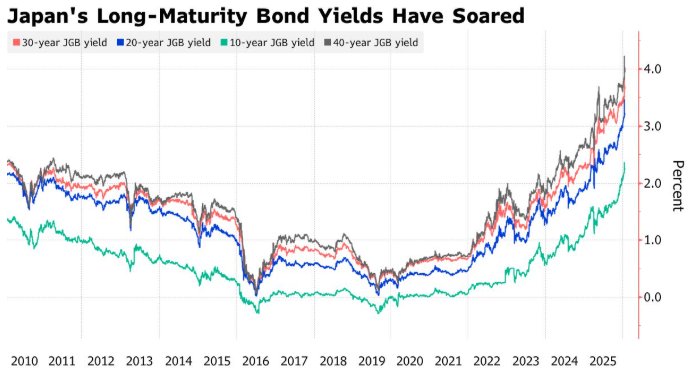
Group 1 - HSBC indicates that if Japanese bond yields rise further, Malaysian and Mexican bond markets will face the greatest risk [1] - The analysis shows that Malaysia, Chile, and Mexico have "excessive risk exposure" regarding emerging market bonds and stocks held by Japanese investors [1] - A significant sell-off of Japanese government bonds could lead to a repatriation of overseas equity investments, with India and South Africa appearing vulnerable [3] Group 2 - The report highlights that the potential for arbitrage trade unwinding poses the "greatest risk," although the likelihood of such an event occurring in the short term is limited [3] - Recent sharp declines in Japanese government bond prices have led to a surge in yields to historical highs, causing global market volatility [3] - Concerns about excessive fiscal expansion have arisen following Prime Minister Fumio Kishida's proposed tax cuts and increased spending plans [3]


日本央行加息至30年最高利率水平
Di Yi Cai Jing Zi Xun· 2025-12-19 05:08
Group 1 - The Bank of Japan unanimously decided to raise the benchmark interest rate to 0.75%, the highest level in 30 years, indicating a commitment to continue increasing rates if economic and inflation forecasts align with expectations [2] - The core consumer price index (CPI) in Japan rose by 3% year-on-year in November, marking the second consecutive month of stable core inflation at 3%, and remaining above the 2% target for 44 months [2] - Prime Minister Fumio Kishida faces challenges due to rising living costs, leading to the introduction of various measures to alleviate financial pressure on citizens, including winter electricity subsidies and one-time cash payments for children [2] Group 2 - Economists predict that the Bank of Japan will continue to raise interest rates, with over two-thirds expecting rates to reach at least 1.0% by September next year [3] - There is significant disagreement in the market regarding the timing and pace of future rate hikes, with some analysts suggesting a potential hike in June 2026, while others believe it may be delayed until October 2026 [3] - The Bank of Japan's Governor, Kazuo Ueda, emphasizes that even after the recent rate hike, real interest rates remain low, suggesting that further increases may be necessary if the economy recovers [3] Group 3 - The USD/JPY exchange rate hovered around 155.59, with concerns about Japan's fiscal situation and the potential for the Bank of Japan to lag behind the yield curve [5] - Analysts express skepticism that the recent rate hike will lead to a significant rebound in the yen, as the Bank of Japan maintains a vague stance on future rate increases, which could lead to further appreciation of the USD against the yen [5] - Rising import costs for oil and liquefied natural gas have been attributed to the yen's depreciation, contributing to overall price increases in Japan [5] Group 4 - The Bank of Japan's interest rate hike may exacerbate the country's debt burden, with government debt exceeding 1,333.6 trillion yen, representing over 260% of GDP [6] - Interest payments for the Japanese government are projected to account for 22.4% of the budget in the fiscal year 2024, with potential increases in borrowing costs if the 10-year government bond yield rises from approximately 2% to 2.5% [6] - The market has already priced in risks associated with the rate hike, leading to a sell-off in Japanese bonds and a decline in the Nikkei 225 index [7] Group 5 - Concerns arise that the Bank of Japan's rate hike could trigger a closure of yen carry trades, impacting global market liquidity, although the market has largely anticipated this move [7] - The response of the market to future rate hikes will depend on the Bank of Japan's communication strategy and its ability to maintain a delicate balance [7]
日本央行加息至30年最高利率水平
第一财经· 2025-12-19 04:56
Core Viewpoint - The Bank of Japan has raised its benchmark interest rate to 0.75%, the highest level in 30 years, indicating a shift towards tightening monetary policy amid persistent inflation pressures [3]. Group 1: Interest Rate Changes - The Bank of Japan unanimously decided to raise the benchmark interest rate for the first time since January, signaling a potential continuation of rate hikes if economic and inflation forecasts align [3]. - Economists predict that the interest rate may reach at least 1.0% by September 2024, with some forecasting a further increase to 1.5% by the end of 2027 [5]. - There is significant disagreement among analysts regarding the timing and pace of future rate hikes, with some expecting a hike as early as April 2026, while others suggest a delay until October 2026 [5]. Group 2: Inflation and Economic Impact - The core consumer price index (CPI) in Japan rose by 3% year-on-year in November, remaining above the 2% inflation target for 44 consecutive months, indicating ongoing inflationary pressures [3]. - The Japanese government has introduced measures to alleviate the cost of living, including winter electricity subsidies and cash payments for children, in response to rising public dissatisfaction with living costs [3]. Group 3: Currency and Debt Concerns - Following the interest rate hike announcement, the USD/JPY exchange rate increased, reflecting market concerns about Japan's fiscal situation and the potential for further currency depreciation [6]. - Japan's government debt stands at 1,333.6 trillion yen, exceeding 260% of GDP, with interest payments projected to consume 22.4% of the budget in the 2024 fiscal year [9]. - If the 10-year Japanese government bond yield rises from approximately 2% to 2.5%, the government's borrowing costs could double, significantly increasing future interest expenditures [9]. Group 4: Market Reactions - The anticipation of rate hikes has led to a sell-off in Japanese government bonds, with yields reaching an 18-year high, and foreign investors have been net sellers of Japanese stocks [10]. - The Nikkei 225 index has experienced a decline of about 3% recently, particularly affecting export-oriented stocks amid a stronger yen [10]. - Market participants are concerned that the rate hike could trigger a liquidation of yen carry trades, impacting global market liquidity, although the impact is expected to be less severe than previous unexpected rate hikes [10].

日本央行加息至30年最高利率水平,日元、日债难两全
Di Yi Cai Jing· 2025-12-19 04:10
Group 1 - The Bank of Japan (BOJ) unanimously decided to raise the benchmark interest rate to 0.75%, the highest level in 30 years, indicating a shift towards tightening monetary policy amid persistent inflation pressures [1][3] - The core consumer price index (CPI) in Japan rose by 3% year-on-year in November, remaining above the 2% inflation target for 44 consecutive months, signaling ongoing price pressures [1][3] - Prime Minister Fumio Kishida faces challenges due to rising living costs, leading to the introduction of various relief measures, including winter electricity subsidies and cash payments for children [1] Group 2 - Economists predict that the BOJ will continue to raise interest rates, with over two-thirds expecting rates to reach at least 1.0% by September next year, although there is significant disagreement on the timing and pace of future hikes [3] - The market anticipates that the next rate hike could occur as early as April 2026 if the yen weakens significantly, while others suggest a later date in October 2026 [3] - The BOJ's communication strategy will be crucial in managing market expectations and maintaining a delicate balance as it navigates the tightening cycle [6] Group 3 - The USD/JPY exchange rate fluctuated around 155.59, with concerns about Japan's fiscal situation and the potential for direct intervention to stabilize the currency [4] - Analysts suggest that while the BOJ's rate hike may provide some support for the yen, it could also exacerbate Japan's debt burden, with government debt exceeding 1,333.6 trillion yen, over 260% of GDP [5] - Rising interest rates could lead to increased borrowing costs for the Japanese government, with projections indicating that interest payments could rise significantly by 2028 [5] Group 4 - The market has already priced in the risks associated with the BOJ's rate hike, leading to a sell-off in Japanese bonds and a decline in the Nikkei 225 index [6] - Concerns exist that the BOJ's actions could reignite yen carry trade unwinding, impacting global market liquidity, although the anticipated impact is expected to be less severe than previous unexpected rate hikes [6]
分析师:日本央行构成套利交易风险
Xin Lang Cai Jing· 2025-12-10 14:49
Core Viewpoint - Analysts indicate that a potential interest rate hike by the Bank of Japan could lead to the unwinding of yen carry trades, which may result in downward pressure on the USD/JPY exchange rate and impact U.S. tech stocks such as Nvidia (NVDA), Meta (META), Microsoft (MSFT), and long-duration assets like QQQ and long-term bonds if the 10-year U.S. Treasury yield exceeds approximately 4.5% [1][2] Group 1 - A potential interest rate increase by the Bank of Japan may trigger the closure of yen carry trades [1][2] - A decline in the USD/JPY exchange rate could occur alongside a rise in the 10-year U.S. Treasury yield above 4.5% [1][2] - U.S. technology stocks and long-duration assets may face pressure as a result of these market movements [1][2]
日本发出“最强烈警告”!高市妄为之“祸”来了:日本将损失超2万亿日元,债券和日元遭抛售,大米鸡蛋价格涨不停,GDP负增长……
Mei Ri Jing Ji Xin Wen· 2025-11-23 09:10
Group 1 - Japan's Prime Minister Sanna Takashi's remarks regarding Taiwan have severely damaged the political foundation of Sino-Japanese relations, leading to a significant decline in the atmosphere for personnel exchanges between the two countries. Economic experts in Japan estimate that a sharp reduction in Chinese tourist numbers could result in losses exceeding 2 trillion yen for Japan [1] - If the current state of Sino-Japanese relations persists for over a year, it could lead to a reduction of more than 2 trillion yen in Chinese tourist spending, which would have a substantial impact on Japan's tourism industry and local economies [1] - The Japanese government has approved a 21.3 trillion yen economic stimulus plan, which is the first major fiscal initiative under Prime Minister Takashi's administration. This plan includes 17.7 trillion yen in general account expenditures, marking a 27% increase from the previous year [21][24] Group 2 - The Japanese economy has entered a negative growth phase for the first time in six quarters, with a 0.4% decrease in real GDP for the third quarter of 2025, translating to an annualized decline of 1.8% [5][10] - Exports have seen a decline for the first time in six quarters, with a 1.2% drop in goods and services exports, largely attributed to increased tariffs imposed by the United States on Japanese automotive and manufacturing products [10][11] - Domestic demand has also been adversely affected, with private residential investment plummeting by 9.4%, nearly erasing the recovery gains made post-pandemic [10] Group 3 - The depreciation of the yen against the dollar has raised concerns, with the Japanese Finance Minister expressing worries about the rapid and one-sided decline of the yen, which has increased the cost of imported goods for households and small businesses [3] - The recent economic data has led to a significant sell-off in Japanese assets, with the 30-year government bond yield reaching a historical high, and the Nikkei 225 index erasing all gains since the new Prime Minister took office [5][13] - The market is reacting to the economic outlook, with the yen depreciating approximately 6% since the new administration took office, raising concerns about the credibility of Japan's fiscal policies [14][17] Group 4 - The tourism sector is facing a severe downturn, with over 540,000 flight cancellations to Japan since mid-November, leading to potential losses in the tourism industry amounting to trillions of yen [19][20] - Chinese tourists are a significant contributor to Japan's tourism revenue, accounting for approximately 30% of the total foreign travel spending in Japan, making the current decline particularly impactful [19] - The Japanese government has acknowledged that the optimistic economic forecasts are no longer sustainable, revising the GDP growth expectation for the fiscal year 2025 down from 1.2% to 0.7% [10][11]

“抛售日本”交易浮现 股债汇“三杀” 21万亿日元经济刺激计划恐酿新风暴
Mei Ri Jing Ji Xin Wen· 2025-11-22 06:08
Economic Overview - Japan's GDP contracted by 1.8% on an annualized basis in Q3 2025, marking a return to negative growth after six consecutive quarters of recovery [1][2] - The decline in exports, particularly in the automotive sector due to increased U.S. tariffs, contributed to this downturn, with exports falling for the first time in six quarters [2][3] - Domestic demand also weakened, with private residential investment plummeting by 9.4%, erasing much of the recovery achieved post-pandemic [2][3] Market Reactions - The market reacted negatively to the economic data, leading to a "sell Japan" trend, with the 30-year Japanese government bond yield reaching a record high of 3.35% to 3.38% [5][6] - The yen depreciated significantly, nearing the intervention threshold of 160 yen per dollar, while the Nikkei 225 index erased all gains since the new Prime Minister's tenure began [5][6] Tourism Impact - The tourism sector faced severe challenges, with over 540,000 flight cancellations from China to Japan, leading to potential losses of up to 1 trillion yen [11][12] - The decline in Chinese tourists is expected to reduce Japan's tourism revenue by approximately 1.79 trillion yen, significantly impacting GDP growth [12] Government Response - In response to the economic pressures, the Japanese government announced a 21.3 trillion yen stimulus package, the largest since the pandemic, aimed at improving living standards rather than significantly boosting economic growth [13][14] - Concerns have been raised regarding the sustainability of Japan's fiscal situation, with potential parallels drawn to the UK's "Truss crisis" in 2022 [16][19]

日本长期债券遭抛售!日元套利交易若反转,恐殃及全球流动性
Di Yi Cai Jing· 2025-11-20 09:07
Core Viewpoint - The announcement of a $110 billion fiscal stimulus plan by the Japanese government has led to a significant sell-off of long-term Japanese bonds, resulting in the highest yields since the 2008 financial crisis, which may trigger a reversal of approximately $20 trillion in yen carry trades, posing a threat to global risk assets [1][3][6]. Group 1: Japanese Bond Market Reaction - The 10-year Japanese government bond yield rose to 1.78%, the highest level since June 2008, while the 30-year yield reached a historic high of 3.35% [3]. - A proposal for a supplementary budget exceeding 25 trillion yen (approximately $161 billion) was made to fund the stimulus plan, indicating a willingness to issue more bonds [3]. - Analysts suggest that the market's reaction reflects a lack of confidence in Japan's sovereign debt sustainability, with the debt burden at about 250% of GDP [4]. Group 2: Economic Implications - Japan's GDP contracted by 0.4% quarter-on-quarter and 1.8% year-on-year, marking a return to negative growth since Q1 2024 [4]. - The depreciation of the yen against the dollar, which fell below 155 yen for the first time since February, has raised concerns about rising import costs [5]. - The Japanese government is facing pressure to balance fiscal expansion with the need to support the yen, as further depreciation could exacerbate inflationary pressures [5]. Group 3: Global Market Impact - The potential unwinding of yen carry trades could lead to a tightening of global liquidity and a sell-off in risk assets, with correlations observed between carry trade unwinding and declines in the S&P 500 [6][7]. - Emerging market currencies may experience a 1% to 3% decline within 30 days due to the unwinding of these trades, while U.S. Treasury yields could rise by 15 to 40 basis points [7]. - The tightening of liquidity is expected to impact all risk assets, particularly technology stocks and cryptocurrencies, as investors begin to hedge against risks [7].
