
日本经济萎缩

Search documents
日本GDP降幅超预期
Sou Hu Cai Jing· 2025-12-16 22:27
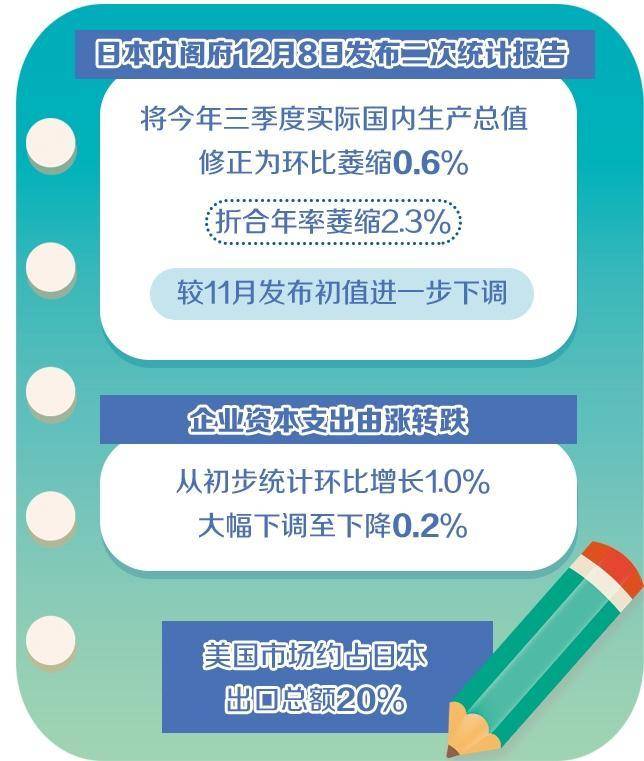
Economic Performance - Japan's GDP for Q3 has been revised to a contraction of 0.6% quarter-on-quarter, translating to an annualized decline of 2.3%, marking the first shrinkage in six quarters and indicating significant economic pressure [2] - The downward revision was primarily driven by a shift in corporate capital expenditure from a preliminary growth of 1.0% to a decline of 0.2%, reflecting corporate caution amid uncertainties from U.S. tariff policies [2] External Demand - External demand contributed negatively to economic growth by 0.2 percentage points, with the U.S. market accounting for approximately 20% of Japan's total exports [2] - The U.S. has imposed a 15% tariff on most goods imported from Japan, significantly higher than the previous 2% to 3% levels, leading to a continuous decline in Japan's exports to the U.S. for seven consecutive months, particularly affecting the automotive, semiconductor manufacturing equipment, and pharmaceuticals sectors [2] Internal Demand - Internal demand also negatively impacted Japan's economic growth by 0.4 percentage points, with personal consumption, which constitutes over half of the economy, only slightly increasing by 0.2% quarter-on-quarter, insufficient to support overall economic growth [3] - Despite nominal wage growth, real wages adjusted for inflation fell by 0.7% year-on-year in October, marking the tenth consecutive month of decline, as income growth has not kept pace with inflation [3] Monetary Policy Implications - The current economic data is unlikely to alter the Bank of Japan's interest rate hike trajectory, which could increase social funding costs, weaken corporate investment willingness, and further dampen economic vitality, leading to a less optimistic economic outlook for Japan [3]

刚刚,日本旅游、消费股大幅下挫
Zhong Guo Ji Jin Bao· 2025-11-17 02:16
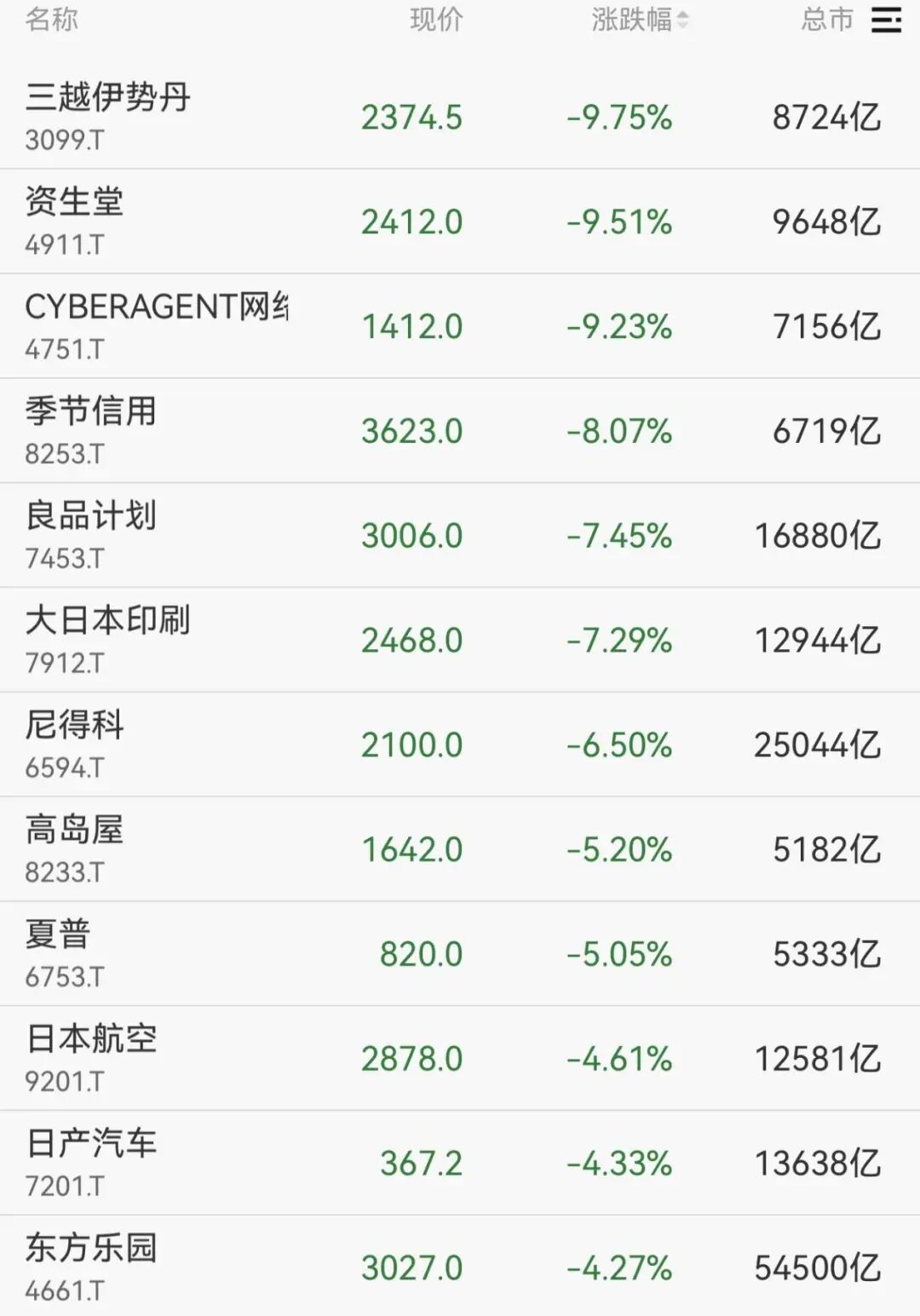
Group 1: Market Overview - On November 17, the Japanese stock market opened with a significant decline, with the Nikkei 225 index dropping over 1% [2] - Tourism-related stocks in Japan experienced substantial losses, with Shiseido's stock price falling by 11% and Japan Airlines dropping by 5% [2] - Other consumer goods and retail stocks also declined, with companies like Sanrio, Asics, and Fast Retailing all seeing drops exceeding 6% [2] Group 2: Stock Performance - Notable stock declines included: - Mitsukoshi Isetan: -9.75% [3] - Shiseido: -9.51% [3] - CyberAgent: -9.23% [3] - Ryohin Keikaku (Muji): -7.45% [3] - Japan Airlines: -4.61% [3] - The overall market sentiment reflects a bearish trend, particularly in the retail and tourism sectors [2][3] Group 3: Economic Context - Japan's GDP reported a year-on-year decline of 1.8% for Q3, marking the first negative growth in six quarters [5] - The GDP decreased by 0.4% compared to the previous quarter, influenced by external demand and a 9.4% drop in housing investment [5] - Analysts suggest that this economic contraction complicates the timeline for potential interest rate hikes by the Bank of Japan, with expectations leaning towards a delay in policy changes until next year [5]
刚刚,日本旅游、消费股大幅下挫
中国基金报· 2025-11-17 02:08
Market Overview - On November 17, the Japanese stock market opened with a significant decline, with the Nikkei 225 index dropping over 1% at one point [3] - The Nikkei 225 index opened at 50,282.39, down 171.35 points or 0.34% from the previous close of 50,376.53 [4] Tourism and Consumer Stocks - Japanese tourism-related stocks experienced a sharp decline, with Shiseido's stock price falling by 11% and Japan Airlines dropping by 5% [5] - Other consumer and retail stocks also saw declines, with companies like Sanrio, Asics, and Fast Retailing all dropping over 6% [5] - The stock price of the Japanese grocery brand Muji fell by 12%, marking its largest drop since August 2024 [5] Specific Stock Movements - Major declines were noted in various companies, including: - Isetan Mitsukoshi Holdings, which saw its stock price drop over 12% [8] - Shiseido at 2,412.0, down 9.51% [6] - CyberAgent at 1,412.0, down 9.23% [7] - Japan Airlines at 2,878.0, down 4.61% [7] Economic Context - Japan's GDP reported a decline of 1.8% on an annualized basis for the third quarter, marking the first negative growth in six quarters [11][12] - The GDP decrease was attributed to external demand and a significant drop in housing investment, which fell by 9.4% compared to the previous quarter [12] - Analysts suggest that this economic contraction complicates the timeline for potential interest rate hikes by the Bank of Japan, with expectations leaning towards no policy changes until next year [12]

每日机构分析:8月15日
Xin Hua Cai Jing· 2025-08-15 13:55
Group 1 - French Agricultural Credit Bank analysts indicate that Japan's corporate capital expenditure is expected to become cautious due to U.S. tariffs and concerns over global economic slowdown, potentially leading to a quarter-on-quarter contraction in Japan's economy in Q3 2025 [2] - Barclays Bank reports a surge in European high-yield bond issuance driven by refinancing needs and increased dividend payments, with issuance surpassing €80 billion since 2025, marking the second-highest level for the period [2] - ING analysts suggest that if geopolitical risks ease, the dollar may face downward pressure due to reduced safe-haven demand, while strong U.S. inflation data has led to a reassessment of Federal Reserve rate cut expectations, supporting the dollar [3] Group 2 - Analysts believe the Bank of England may maintain a cautious interest rate stance for the remainder of 2025, with expectations to pause rate cuts in September and December, providing key support for the pound [4]




法农银行:日本经济可能在第三季度萎缩
Xin Hua Cai Jing· 2025-08-15 08:13
Core Viewpoint - Japanese companies are expected to be more cautious about capital expenditures due to the impact of US tariffs and concerns over a global economic slowdown, potentially leading to a contraction in the Japanese economy in the third quarter [1] Economic Outlook - Analysts predict that the Bank of Japan may raise interest rates as early as January 2026, contingent on the belief that the global economy will not decline and that economic policies will be effective enough to restore real GDP to positive growth starting in the fourth quarter [1] Consumer Behavior - The extreme heat during the summer may cause hesitation among consumers to go out, which could limit the recovery of consumer spending [1]