
曲线陡峭化交易

Search documents
四位候选人引发万亿债券赌局!谁才是下一个美联储掌门?
Sou Hu Cai Jing· 2026-01-23 13:58
Core Viewpoint - The potential nomination of a successor to Federal Reserve Chairman Jerome Powell by President Trump raises concerns about the independence of the Fed and the implications for interest rates and inflation, particularly following the unexpected sidelining of leading candidate Hassett [1]. Group 1: Market Reactions and Candidate Profiles - Bond investors are under pressure as they bet on a successor who would lower borrowing costs, with short-term U.S. Treasury yields outperforming long-term yields based on this assumption [1]. - The market's reaction to Trump's reluctance to nominate Hassett, who was seen as a proponent of lower rates, led to a sell-off in U.S. Treasuries and reduced expectations for Fed rate cuts this year [1]. - Candidates for the Fed chair position are viewed as having varying degrees of dovishness, with differing opinions on their potential impact on the market [2]. Group 2: Candidate Analysis - Walsh is seen as a hawkish candidate whose appointment could raise yields, potentially pursuing a policy of rate cuts while selling Fed bond holdings, which may negatively affect long-term inflation-linked bonds [3][4]. - Reed is initially perceived as dovish due to his lesser-known policy stance, with potential for a weaker dollar and a steeper U.S. yield curve if appointed [5][6]. - Waller, a more traditional choice, is viewed as a safe option with minimal need for market re-pricing, likely leading to a slight decrease in long-term yields if appointed [8]. - Hassett's potential nomination is complicated by his perceived loyalty to Trump, which could lead to lower front-end rates and higher long-end rates, although his confirmation prospects have diminished due to political backlash [9].
非农数据掀波澜:美债收益率曲线交易热度飙升 利差扩至四年高位
智通财经网· 2025-12-16 23:38
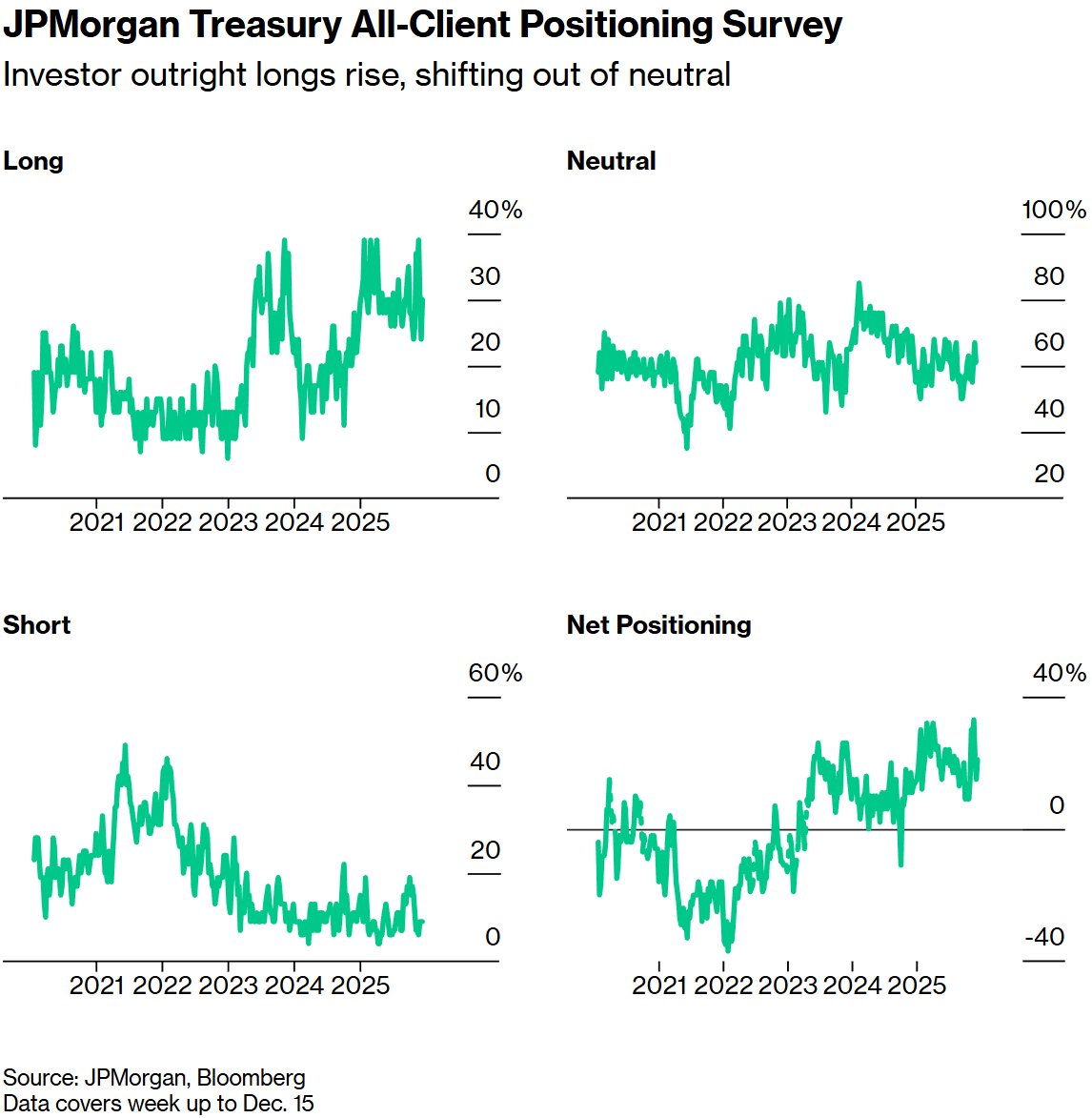
Group 1 - The unexpected rise in unemployment rate in November adds uncertainty to the mixed signals surrounding the U.S. economic outlook, leading bond traders to favor short-term U.S. Treasuries over long-term ones [1] - The yield spread between 2-year and 30-year U.S. Treasuries has widened to its largest extent in over four years, reflecting market expectations that the Federal Reserve will likely cut rates at least twice next year despite persistent inflation and strong economic growth [1] - The "curve steepening" trade is gaining traction, betting that the yield gap between short-term and long-term debt will continue to expand, with the upcoming release of November consumer price data set to further test this trade [1] Group 2 - A significant large-scale spread trade in the futures market aligns with the widening yield spread between 2-year and 30-year Treasuries, indicating a profit of $3 million within a day as the spread increased from 132 basis points to approximately 137 basis points [2] - As of the week ending December 15, investor direct long positions increased by 6 percentage points, shifting from neutral to long, while direct short positions remained unchanged [2] Group 3 - In the SOFR options market, there has been a notable increase in risk exposure for options expiring on March 26, June 26, and September 26, particularly for various call and put options, as traders hedge against potential dovish and hawkish policy scenarios from the Federal Reserve [5] - The largest open interest is observed at the 96.50 strike price for March 26 options, with significant positions also at the 96.375 strike price [7] Group 4 - The premium for put options used to hedge U.S. Treasury risks has continued to tilt towards bearish options, indicating strong demand for Treasuries amid expectations that long-term yields will underperform compared to short- and medium-term yields [10] - The steepness of the yield curve between 2-year and 30-year Treasuries reached its highest level since November 2021, exceeding 137 basis points [10]

华泰证券:短期债市仍处逆风,但利率大概率“上有顶”
Xin Lang Cai Jing· 2025-08-24 23:53
Core Viewpoint - The current bond market is characterized by weak coupon protection, heavy speculation, and strong sentiment-driven trading, leading to suboptimal investment experiences [1] Group 1: Market Conditions - The short-term bond market is still facing headwinds, but interest rates are likely to have an upper limit [1] - The upper limit for the ten-year government bond is around 1.8%, with a maximum position at 1.9%, indicating potential overshoot risks mainly from institutional behavior [1] Group 2: Future Outlook - After October, a "counterattack" opportunity may arise due to a supply off-season, sentiment turning point, and high base effects in consumption [1] - The risk of continued tightening in the funding environment is low, and a recommendation for a steepening curve trade is suggested [1] Group 3: Investment Recommendations - 30-year government bonds and perpetual bonds are likely to act as sentiment amplifiers, and it is advised to temporarily avoid these [1] - Bonds with maturities of 5-7 years and below possess defensive characteristics, with shallow leverage arbitrage suggested [1] - For credit bonds, a focus on the mid to short end is recommended, as 3-5 year ordinary credit bonds have become relatively attractive after recent declines [1] - Convertible bonds should maintain equity beta exposure [1]

“买2年期,卖10年期美债”!这是华尔街推荐的“对冲鲍威尔交易”
Hua Er Jie Jian Wen· 2025-07-21 08:36
Core Viewpoint - The financial markets are actively seeking "Powell hedge" strategies in response to Trump's threats to dismiss Federal Reserve Chairman Jerome Powell, indicating growing concerns over the independence of the Fed and potential inflation risks [1][4]. Group 1: Market Reactions - Wall Street is advised to buy 2-year Treasury bonds and sell 10-year Treasury bonds as a hedge against the risks associated with Powell's potential dismissal [1]. - The probability of Powell leaving office by 2025 has increased from 18% to 22% according to Polymarket [1]. - Long-term Treasury yields spiked following news of Trump's potential actions, with the 30-year Treasury yield rising by 11 basis points in less than an hour [1]. Group 2: Investment Strategies - The "Powell hedge" strategy focuses on the potential shift in Federal Reserve policy, with expectations that a new chair could favor rate cuts under White House pressure, leading to a steepening yield curve [1][2]. - Investors are also considering inflation expectations as a more effective hedge, with Bank of America strategists highlighting the importance of inflation-linked securities [2]. Group 3: Internal Fed Dynamics - There is increasing uncertainty within the Federal Reserve, with one-third of respondents in a survey indicating that Governor Waller is a preferred successor to Powell [3]. - Waller has suggested that he would oppose a vote to maintain interest rates if the FOMC decides to do so in the upcoming meeting [4]. Group 4: Future Outlook - The upcoming quarterly refinancing announcement from the Treasury on July 30 will be a key focus for investors, as it may impact the effectiveness of the steepening yield curve strategy [4].