
收益率曲线

Search documents
关注凸点骑乘,二永供给或下行
East Money Securities· 2026-03-16 02:36
1. Report Industry Investment Rating There is no mention of the industry investment rating in the provided report. 2. Core Viewpoint of the Report - This week (March 9 - March 13), credit bond yields declined, but the repair amplitude was smaller than that of interest - rate bonds, and credit spreads widened passively. The February inflation and January - February import and export data released this week disturbed market expectations. Due to the rebound in February CPI and January - February import and export data, market concerns about inflation pressure increased, and bond market sentiment weakened temporarily. Meanwhile, the overall capital environment was stable, the fluctuation of money market interest rates was limited, which provided a certain buffer for the bond market. The equity market is still in a volatile range, and the overall risk preference has not changed much, so its impact on the bond market is relatively limited [2][11]. - Currently, the yield curve forms a relatively obvious convex point around the 4 - year term. Institutions with relatively stable liability ends can pay attention to the riding value of 4 - year bonds. In the scenario where the yield curve rises by 20BP, 4 - year AA - rated medium - short notes, 4 - year AA and AA(2) - rated urban investment bonds, and 4 - year AAA - and AA + - rated bank perpetual bonds are expected to maintain positive returns or only have small drawdowns during the holding period, with relatively strong anti - volatility ability. For 7 - year urban investment bonds, caution should be exercised, and for 7 - year secondary perpetual bonds, allocation - type funds can choose the opportunity to layout after market adjustments [13][14]. - The issuance of secondary capital bonds and perpetual bonds has obvious seasonal characteristics. Although there is still a high maturity and redemption scale of secondary perpetual bonds this year, and the renewal demand still exists, in the context of the continuous expansion of capital replenishment channels, commercial banks' dependence on secondary perpetual bonds has decreased, and the overall future supply scale may decline [17][18]. 3. Summary According to the Directory 3.1. Focus on Convex Point Riding, and the Supply of Secondary Perpetual Bonds May Decline - Market situation: This week, credit bond yields declined, but the repair amplitude was smaller than that of interest - rate bonds, and credit spreads widened passively. The February inflation and January - February import and export data disturbed market expectations, and bond market sentiment weakened temporarily. The equity market was in a volatile range, and its impact on the bond market was relatively limited [2][11]. - Investment strategy: The current yield curve forms a convex point around the 4 - year term. In the case of a 3 - month holding period and the curve shape remaining unchanged, the holding - period returns of 4 - year bonds are generally higher than those of 5 - year bonds of the same rating. Institutions with relatively stable liability ends can pay attention to their riding value. In the scenario where the yield curve rises by 20BP, 4 - year AA - rated medium - short notes, 4 - year AA and AA(2) - rated urban investment bonds, and 4 - year AAA - and AA + - rated bank perpetual bonds have relatively strong anti - volatility ability. For 7 - year urban investment bonds, caution should be exercised, and for 7 - year secondary perpetual bonds, allocation - type funds can choose the opportunity to layout after market adjustments [13][14]. - Supply situation: The issuance of secondary capital bonds and perpetual bonds has obvious seasonal characteristics. This year, secondary perpetual bonds are still in a peak maturity stage, with an expected annual maturity and redemption scale of about 1.18 trillion yuan, and banks still have a certain renewal demand. However, in the long - term, the net financing scale of secondary perpetual bonds has been declining in recent years. With the diversification of bank capital replenishment channels, the dependence of commercial banks on secondary perpetual bonds has decreased, and the future supply scale may decline [17][18]. 3.2. Review of the Quantity and Price of Inter - bank Liquidity - This week (March 9 - March 13), the volume of the inter - bank pledged repurchase market decreased and the price increased. The median daily trading volume of inter - bank pledged repurchase was 8.51 trillion yuan, a decrease of 260.2 billion yuan from last week, and the trading volume was in the top 2.9% of the range since 2020. The median R001 was 1.39%, an increase of 4bp from last week, and the repurchase interest rate was in the bottom 21% of the range since 2020. The median spread between R001 and DR001 was 6.7bp, a decrease of 0.6bp from last week; the median spread between GC001 and R001 was 11.0bp, an increase of 20.3bp from last week, and the exchange financing cost was higher than that of the inter - bank [38][40]. - In terms of interest rate swaps, the 1 - year FR007 IRS interest rate increased this week. The median 1 - year FR007 IRS was 1.50%, an increase of 2.1bp from last week, and the interest rate was in the bottom 5% of the range since 2020. The median 1 - year SHIBOR 3 - month IRS was 1.56%, and the interest rate was in the bottom 4% of the range since 2020 [43]. 3.3. Review of the Inter - bank Certificate of Deposit Market - On March 13, SHIBOR overnight, 7 - day, 1 - month, 3 - month, 6 - month, 9 - month, and 1 - year quotes were 1.32%, 1.46%, 1.53%, 1.54%, 1.56%, 1.57%, and 1.58% respectively. Compared with March 6, the overnight and above - term quotes changed by 0bp, 5bp, - 1bp, - 1bp, - 1bp, - 1bp, - 1bp respectively. The yields to maturity of 1 - month, 3 - month, 6 - month, 9 - month, and 1 - year inter - bank certificates of deposit of AAA - rated commercial banks were 1.5%, 1.5%, 1.51%, 1.52%, 1.53% respectively. Compared with March 6, the 1 - month and above - term yields changed by 1bp, 0bp, - 1bp, - 1bp, - 2bp respectively [44]. - This week, the total primary issuance volume of inter - bank certificates of deposit was 842.5 billion yuan (excluding those whose actual raised amounts have not been disclosed as of March 13), an increase of 125.2 billion yuan from last week. In terms of issuance terms, the proportions of 6 - month and 9 - month terms increased, while the proportions of 1 - month, 3 - month, and 1 - year terms decreased [48]. - On March 13, the 1 - year FR007 IRS interest rate was 1.50%, an increase of 3.11bp from last week. The yield of 1 - year AAA - rated inter - bank certificates of deposit decreased by 1.75bp from last week, and the spread between the two was 3bp, a narrowing of 5bp from last week [50]. 3.4. Credit Bond Issuance Situation 3.4.1. Issuance Volume and Net Financing - This week (March 9 - March 13), the supply of credit bonds increased both month - on - month and year - on - year. The issuance of credit bonds was 350.333 billion yuan, a month - on - month increase of 18.21% and an increase of 96.211 billion yuan compared with the same period last year. The net financing of credit bonds decreased by 36.707 billion yuan month - on - month and increased by 61.262 billion yuan year - on - year. In terms of types, the net financing of urban investment bonds, industrial bonds, and financial bonds decreased by 43.783 billion yuan, 21.115 billion yuan, and increased by 28.190 billion yuan respectively month - on - month [55]. 3.4.2. Issuance Cost - The average issuance interest rate of credit bonds decreased this week. The average issuance interest rate of credit bonds was 2.81%, a decrease of 6bp from last week. In terms of types, the average issuance interest rates of industrial bonds, urban investment bonds, and financial bonds decreased by 13bp, 6bp, and increased by 2bp respectively month - on - month; in terms of ratings, the average issuance interest rates of AA, AA +, and AAA decreased by 16bp, 2bp, and 11bp respectively month - on - month [66]. 3.4.3. Issuance Term - The average issuance term of credit bonds increased this week. The average issuance term of credit bonds was 2.97 years, an increase of 0.02 years from last week. In terms of types, the issuance terms of industrial bonds, urban investment bonds, and financial bonds increased by 0.29 years, decreased by 0.46 years, and increased by 0.24 years respectively month - on - month [68]. 3.4.4. Cancellation of Issuance - This week, the number of cancelled credit bond issuances was the same as last week, and the scale decreased. A total of 12 credit bonds were cancelled for issuance, the same as last week, and the total cancelled issuance scale was 7.5 billion yuan, a decrease of 0.46 billion yuan from last week [69]. 3.5. Credit Bond Transaction and Valuation Situation 3.5.1. Transaction Volume - This week (March 9 - March 13), the total transaction volume of credit bonds was 1,435 billion yuan, a decrease of 1.3 billion yuan from last week. In terms of categories, commercial bank bonds and non - bank financial bonds in financial bonds traded 455.4 billion yuan and 90 billion yuan respectively. Medium - term notes, short - term financing bills, directional instruments, enterprise bonds, and corporate bonds traded 333 billion yuan, 122.2 billion yuan, 55.4 billion yuan, 18.4 billion yuan, and 360.8 billion yuan respectively. Compared with last week, the trading volumes of various varieties showed mixed trends. The trading volume of urban investment bonds decreased the most, by 15.8 billion yuan. The trading volume of industrial bonds decreased by 10.3 billion yuan, while the trading volumes of bank perpetual bonds and bank secondary capital bonds increased by 7.6 billion yuan and 7.4 billion yuan respectively; the trading volumes of securities firm sub - bonds and insurance sub - bonds decreased slightly by 1.1 billion yuan and 0.3 billion yuan respectively [74]. - In terms of remaining terms, the transaction term structure of urban investment bonds shifted to the medium - long term, the proportion of transactions within 1 year decreased by 4.58pct, while the proportions of 1 - 2 years, 2 - 3 years, 3 - 5 years, and over 5 years increased by 0.83pct, 2.69pct, 0.18pct, and 0.88pct respectively; the term structure of industrial bonds concentrated on 1 - 3 years, the proportion within 1 year decreased by 1.10pct, the proportion of 1 - 2 years increased by 2.93pct, the proportion of 2 - 3 years increased by 0.13pct, the proportion of 3 - 5 years decreased by 1.44pct, and the proportion of over 5 years decreased by 0.51pct; the term structure of bank secondary capital bonds was generally stable, the proportion within 1 year increased by 0.04pct, the proportion of 1 - 2 years decreased by 0.15pct, and the proportion of over 5 years increased by 0.11pct; the term of bank perpetual bonds shifted to the short - end, the proportion within 1 year increased by 3.05pct, the proportion of 1 - 2 years increased by 0.49pct, the proportion of 2 - 3 years increased by 1.72pct, and the proportion of 3 - 5 years decreased by 5.25pct; the term structure of securities firm sub - bonds concentrated on 3 - 5 years, the proportion within 1 year increased by 1.59pct, the proportion of 1 - 2 years decreased by 5.03pct, the proportion of 2 - 3 years decreased by 9.28pct, and the proportion of 3 - 5 years increased by 12.72pct; the term of insurance sub - bonds concentrated on the short - term, the proportion within 1 year increased by 12.94pct, and the proportion of over 5 years decreased by 12.94pct [75]. - In terms of implied ratings, the rating structure of urban investment bonds concentrated on lower ratings, AAA decreased by 0.90pct, AAA - decreased by 0.01pct, AA + remained unchanged (0.00pct), AA increased by 0.14pct, AA(2) decreased by 0.06pct, and AA - increased by 0.85pct; the rating structure of industrial bonds showed differentiation, AAA increased by 1.16pct, AAA - increased by 0.34pct, AA + decreased by 2.02pct, AA increased by 1.13pct, AA(2) decreased by 0.12pct, and AA - increased by 0.12pct; the ratings of bank secondary capital bonds were differentiated, AAA - increased by 4.78pct, AA + decreased by 4.39pct, AA decreased by 0.42pct, and AA - increased by 0.06pct; the ratings of bank perpetual bonds tilted towards AAA -, the proportion of AAA remained unchanged (0.00pct), AAA - increased by 9.07pct, AA + decreased by 7.99pct, AA decreased by 2.40pct, and AA - increased by 1.10pct; the ratings of securities firm sub - bonds concentrated on AA +, AAA - decreased by 8.36pct, AA + increased by 11.03pct, AA decreased by 2.88pct, and AA - increased by 0.14pct; the proportions of various ratings of insurance sub - bonds showed differentiation, AA + increased by 3.55pct, AA increased by 11.64pct, and AA - decreased by 13.17pct [76]. 3.5.2. Spread Tracking - The yields of credit bonds showed differentiation at various levels and terms. This week, except for the yields of 5 - year bonds at all levels, 3 - year and 4 - year AAA - rated bonds, which generally increased, the others generally decreased. Among them, the yields of 1 - year bonds at all levels decreased slightly by 1.73BP. The yield of 5 - year AA - rated bonds decreased the most, by 2.15BP. The current yield percentile levels of all levels are relatively low, the percentiles of the medium - short end are generally lower than those of the long end, the 1 - year AA is at an extremely low percentile of 0.3% since 2025, the 4 - year AA yield percentile is at 24.4%, and the 5 - year AAA is at a percentile of 22.0%. - The credit spreads of 1 - year bonds at all levels, 4 - year AA + and AA - rated bonds narrowed, while the others widened. Among them, the spread of 4 - year AA - rated bonds narrowed the most, by 1.73BP, the narrowing amplitude of 1 - year bonds at all levels was 0.09BP, and the spread of 3 - year AAA - rated bonds widened by 2.48BP. In terms of spread percentiles, the spreads of all levels are generally in a relatively low range, among which the spread percentiles of 1 - year bonds at all levels are relatively low, all between 0.3% - 0.6% [79]. - The yields of urban investment bonds showed differentiation at various levels and terms. The 1 - year yields generally decreased, while the 2 - year, 4 - year, and 5 - year yields generally increased. Among them, the yields of 1 - year bonds at all levels decreased significantly, with AAA decreasing by 1.59BP, and AA + and AA decreasing by 1.58BP. The yields of 5 - year bonds at all levels increased synchronously, with AAA increasing by 0.90BP, AA + increasing by 1.60BP, and AA increasing by 0.6BP. This week, except for the yields of 2 - year, 3 - year AA, 4 - year, and 5 - year bonds at all levels, which increased, the yields of 1 - year bonds at all levels, 3 - year AAA, and 3 - year AA + at all levels decreased, and the short - end decline was relatively significant. The current yield percentile levels of all levels are relatively low, the percentiles of the medium - short term are generally lower than those of the long term, the 1 - year bonds at all levels are at an extremely low percentile of 0.3% since 2025
利率债周报:上周长债震荡上行,收益率曲线转而陡峭化-20260309
Dong Fang Jin Cheng· 2026-03-09 07:57
Report Summary 1. Report's Industry Investment Rating No information provided. 2. Core Viewpoints - Last week, long - term bonds fluctuated upwards, and the yield curve became steeper. The bond market was strong in the first half of the week due to factors such as the US - Iran conflict, stock market volatility, loose liquidity at the beginning of the month, and weak PMI data in February. However, it weakened in the second half due to the government work report, profit - taking, stock market rebound, and unfulfilled expectations of interest rate and reserve requirement ratio cuts [3]. - This week, the bond market will remain in a volatile pattern, and the yield curve is expected to continue to be steep. Inflation concerns may increase, but the impact of inflation expectations on the bond market may be limited. Long - term bond yields are likely to remain weakly volatile, while short - term yields will be supported by loose liquidity [3]. 3. Summary by Directory a. Last Week's Bond Market Review - **Secondary Market**: The bond market was overall volatile and slightly stronger last week. The 10 - year Treasury bond futures main contract rose 0.13%. The 10 - year Treasury bond yield rose 0.57bp compared to the previous Friday, and the 1 - year Treasury bond yield fell 3.10bp. The term spread widened significantly. The daily performance of the bond market varied due to different factors each day [4][5]. - **Primary Market**: 60 interest - rate bonds were issued last week, 14 more than the previous week. The issuance volume was 606.5 billion yuan, 180.9 billion yuan less than the previous week, and the net financing was 117.3 billion yuan, 261 billion yuan less than the previous week. The subscription demand for interest - rate bonds was generally acceptable. The average subscription multiples for Treasury bonds, policy - bank bonds, and local government bonds were 4.06, 4.64, and 19.75 times respectively [15][16]. b. Last Week's Important Events - The manufacturing PMI in February decreased to 49.0%, mainly due to the Spring Festival holiday. The service PMI rose to 49.7%, in line with seasonal patterns. The real - estate industry's business activity index was low, indicating possible policy support in the future [18]. - The government work report set the GDP growth target for 2026 at 4.5% - 5%, the fiscal deficit rate at about 4%, planned to issue 1.3 trillion yuan of ultra - long - term special Treasury bonds and 4.4 trillion yuan of local government special bonds. The monetary policy will remain "moderately loose", with room for reserve requirement ratio and interest rate cuts [18]. c. Real Economy Observation - On the production side, the blast furnace operating rate and daily hot - metal output declined, while the asphalt plant operating rate and semi - steel tire operating rate increased. On the demand side, the BDI index slightly decreased, and the CCFI index slightly increased. The sales area of commercial housing in 30 large and medium - sized cities increased significantly. In terms of prices, pork prices continued to fall, while most commodity prices rose, with oil and rebar prices increasing and copper prices falling [21]. d. Last Week's Liquidity Observation - The central bank's open - market operations had a net withdrawal of 156.34 billion yuan last week. The R007 and DR007 rates declined. The inter - bank certificate of deposit issuance rate of joint - stock banks continued to fall, and the national - share direct discount rates of all tenors decreased. The volume of pledged repurchase transactions increased significantly, and the inter - bank market leverage ratio first increased and then decreased, with an overall significant increase [33][34][35].
A spike in energy prices should really prompt the Fed to cut rates, says Ironsides' Barry Knapp
Youtube· 2026-03-03 15:07
Group 1 - The current economic situation is characterized by a K-shaped recovery, where small banks and businesses face tighter monetary conditions while long-term fixed-rate borrowers benefit from looser conditions [6][7] - The correlation between the dollar and oil prices has flipped, with both rising simultaneously, which exacerbates the energy cost problem for major oil importers like Japan and Korea [4][5] - A significant increase in energy prices is viewed more as a disinflationary shock rather than an inflationary one, indicating a potential slowdown in consumption and economic growth [8][9] Group 2 - The Federal Reserve's current policy is seen as too tight for small businesses and households, suggesting that a rate cut could be a more appropriate response to rising energy prices [6][7] - There is resistance within the Federal Reserve to implement necessary changes, such as cutting rates and deregulating banks, which could stimulate lending and economic activity [10][11][12] - Global capital flows are expected to be impacted by changes in trade dynamics, which could affect demand for U.S. treasuries and overall economic conditions [19]


美国国债收益率上涨,收益率曲线继续趋陡
Sou Hu Cai Jing· 2026-02-18 12:04
Group 1 - The core viewpoint of the article highlights the rise in U.S. Treasury yields, particularly in long-term bonds, as the market anticipates the Federal Reserve's January meeting minutes and a $16 billion auction of 20-year bonds [1] - The yield curve for 2-year and 10-year Treasury bonds continues to steepen, with short-term bond yields experiencing smaller increases, as the meeting minutes may signal the timing of future interest rate cuts [1] - According to Eric Chia from Exness, the market is in a wait-and-see mode ahead of the Federal Reserve's meeting minutes, which could set the tone for the coming days [1] Group 2 - Data from Tradeweb indicates that the 2-year U.S. Treasury yield rose by 1.4 basis points to 3.450% [1] - The 10-year U.S. Treasury yield increased by 2.1 basis points to 4.075% [1]
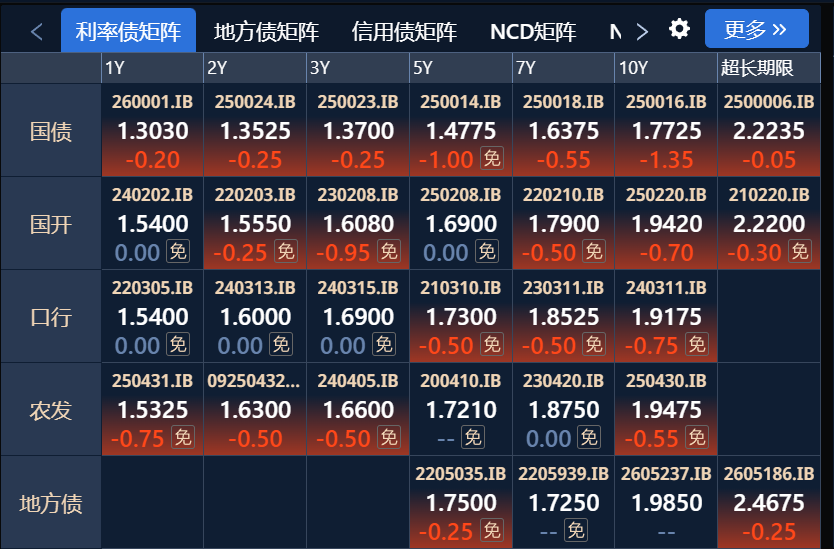
债市节前暖意回归:收益率下破1.8%后企稳,大行成买入主力
2 1 Shi Ji Jing Ji Bao Dao· 2026-02-12 10:05
Group 1 - The bond market is experiencing a bullish trend supported by ample liquidity and institutional demand, with yields dropping below the critical 1.8% level as investors prefer bonds over other assets ahead of the holiday [1][3] - Major banks have become the primary buyers in the bond market, driven by a "deposit-loan mismatch" phenomenon, which has led to increased bond allocations since December [2][6] - The central bank's recent actions, including a net injection of 448 billion yuan into the market, have contributed to a favorable environment for bonds, with interbank liquidity remaining abundant [3][6] Group 2 - As of February 12, 2026, the yield on the 10-year government bond has decreased to around 1.77%, reflecting a broader trend of declining yields across various maturities [3][4] - A significant majority of bond funds have delivered positive returns since the beginning of 2026, with 3523 out of 3574 medium to long-term pure bond funds achieving positive returns [4][5] - The current market sentiment is optimistic, with expectations for a relatively mild bond market environment in 2026, as banks are likely to continue favoring long-term bonds due to improved cost structures and ample liquidity [7][8]
贵金属:喧嚣后的中场休息: 黄金步入节前“冷静期”
Sou Hu Cai Jing· 2026-02-10 10:51
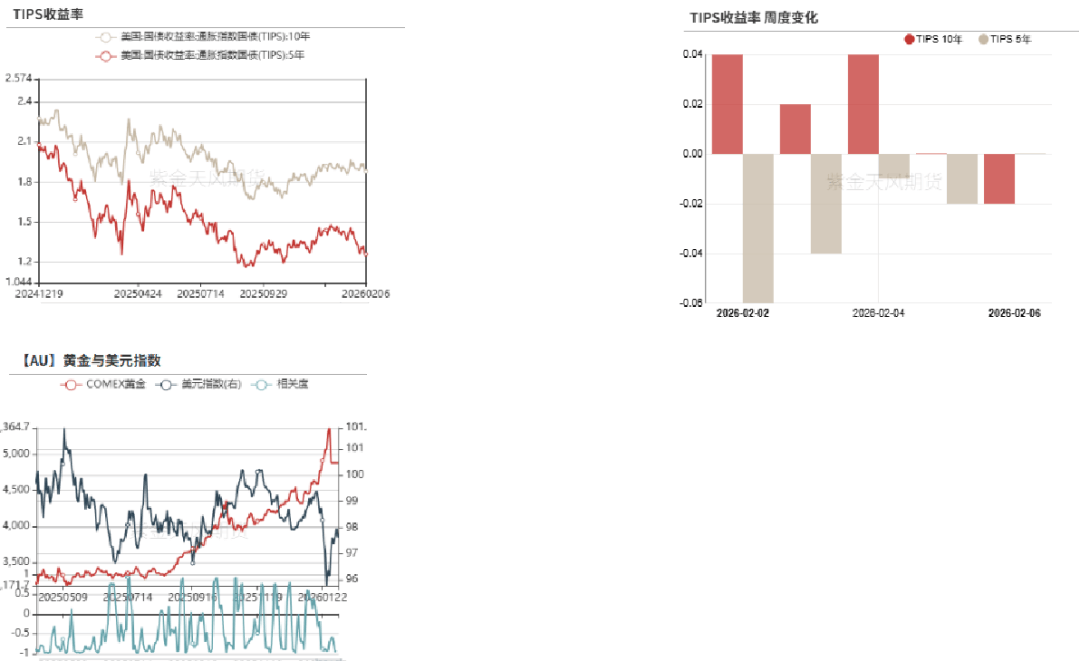
Group 1 - The core viewpoint of the articles indicates a shift in market expectations towards potential interest rate cuts by the Federal Reserve, driven by weak labor market data and changes in monetary policy outlook [1][3] - The labor market data showed a significant drop in job openings, with December's JOLTS vacancies falling to 6.54 million from 6.93 million in November, marking the lowest level since 2020 [1] - The yield curve has steepened following the nomination of a new Federal Reserve chair, with expectations of a dovish monetary policy stance influencing short-term rates while long-term rates are affected by liquidity concerns [3] Group 2 - Gold prices increased by 1.6% over the week, recovering from previous declines, but the market is expected to take time to rebuild confidence and structure [2] - The upcoming Federal Reserve chair's proposal to shorten the average maturity of the Fed's balance sheet may delay the issuance of long-term bonds, providing limited support for gold prices [2] - Chinese demand for precious metals is a key driver, but may weaken temporarily due to the upcoming Lunar New Year, potentially reducing volatility in the global precious metals market [2] Group 3 - The U.S. Treasury yields across various maturities declined, with the 30-year UST down 2 basis points to 4.85%, and the 10-year UST down 3 basis points to 4.2% [3] - The usage of overnight reverse repurchase agreements (ONRRP) fell to $3.11 billion, a decrease of $7.31 billion from the previous week [3] - The net short positions in 2-year and 10-year UST futures increased, indicating a bearish sentiment among non-commercial investors [3] Group 4 - The U.S. dollar index rose by 0.5% to 97.6, moving in tandem with gold prices, which suggests an increasing correlation between the two [7] - The total holdings of the dollar index decreased, with non-commercial long positions down by 1,335 contracts to 17,000 contracts, while short positions decreased by 4,888 contracts to 17,000 contracts [10] - Offshore dollar liquidity costs have risen, as indicated by the decline in the 3-month Basis Swaps for both the yen and euro [13] Group 5 - The copper-to-gold ratio fell to 2.63, indicating a marginal decline in global demand momentum as copper prices dropped while gold prices rose [16] - The gold-silver ratio increased due to the rise in gold prices and the decline in silver prices, reflecting market dynamics [19] - Gold premiums increased after a price correction, indicating strong domestic buying support [28] Group 6 - COMEX gold inventory decreased by 331,000 ounces to 35.294 million ounces, while silver inventory fell by 1.523 million ounces to 39.0466 million ounces [34] - SPDR gold ETF holdings decreased by 7.44 tons to 1,079.7 tons, remaining near the lower median of the past decade [39] - COMEX gold total positions fell by 78,769 contracts to 489,000 contracts, with a notable increase in short positions, indicating a growing bearish sentiment [39]
双利差走阔:曲线陡峭化延续,定价逻辑分化
LIANCHU SECURITIES· 2026-02-06 09:08
1. Report Industry Investment Rating No information provided in the content. 2. Core Viewpoints of the Report - The current 10Y - 1Y and 30Y - 10Y spreads are continuously widening, reaching a ten - year high. The report analyzes the driving mechanisms and characteristics of these two key spreads, revealing the differences in dominant forces and structural change trends of different term spreads [1]. - In 2026, the steepening of the yield curve will continue, and the 10Y - 1Y and 30Y - 10Y spreads will generally widen marginally. The 10Y - 1Y spread will be steepened by monetary easing and may widen, while the 30Y - 10Y spread will be repaired by supply and rise in an oscillatory manner [3][4]. 3. Summary According to the Directory 3.1 10Y - 1Y Spread: Short - end Dominant, Long - end Amplifying - **Driving Factors: Policy Anchor, Growth Expectation, and Supply - demand Structure** - The 10Y - 1Y spread reflects the relative changes among short - term policy interest rates, medium - and long - term growth and inflation, and bond supply - demand structure. Short - term interest rates are more sensitive to monetary policy and the money market, while long - term interest rates reflect future growth trends, inflation expectations, and economic cycle changes. Bond supply - demand structure differences and investor behavior also affect the spread [9]. - **Pricing Logic: A Stable Negative Dynamic Equilibrium Relationship between 1Y and 10Y - 1Y** - Short - term interest rates determine the core direction of the 10Y - 1Y spread. After removing the influence of interest rate central migration, the 1 - year Treasury yield and the spread show a clear negative correlation. Long - term interest rates have a limited and unstable impact on the 10Y - 1Y spread [10][13]. - **Periodic Deviation: Structural Disturbance under Short - end Dominance** - The short - term interest rate and the 10Y - 1Y spread generally show a strong negative correlation, but there are also periodic changes in their correlation during the interest rate central switching stage. The 1 - year yield dominates the spread direction, and the negative correlation between the spread and the 1 - year yield may deviate or weaken in the short term. The correlation between the spread and the 10 - year Treasury yield is weak [17]. 3.2 30Y - 10Y Spread: The Dominance Shifting to the Ultra - long End, Spread Repricing - **Driving Factors of the 30Y - 10Y Spread: Differentiation in Supply - demand, Expectation, and Term Sensitivity** - The 30Y - 10Y spread reflects the differences in supply - demand structure, long - term expectations, and policy sensitivity between long - term and medium - long - term Treasuries. Its core drivers include supply - demand structure differences, differences in long - term economic growth and inflation expectations, and the impact of policy uncertainty and term sensitivity differences [25]. - **Core Pricing Logic: The Ultra - long End is Becoming the Dominant Force of the Spread** - The correlation between the 10 - year Treasury yield and the 30Y - 10Y spread is generally weak. The 30 - year Treasury yield has a more stable positive linkage with the spread, indicating that the ultra - long - end interest rate is playing an increasingly prominent role in driving the 30Y - 10Y spread [26][27]. - **Stage Switching: Multiple Combination Forms of Interest Rate Central Changes** - The pricing center of the 30Y - 10Y spread is gradually shifting to the ultra - long end. In different macro - economic and policy environments, the spread may show multiple combination forms, and the mid - term trend shows that the ultra - long end is gradually becoming the core anchor of spread pricing [34][43]. 3.3 Outlook: The Steepening of the Curve Continues, and the Double Spreads Widen - **10Y - 1Y Spread: Steepened by Easing, May Widen** - In the first half of 2026, the 10Y - 1Y spread may widen. The strengthening of the interest rate cut expectation will lower the short - term interest rate, and the front - loaded fiscal policy will increase the supply pressure, with the long - term pressure being higher [44][45]. - **30Y - 10Y Spread: Repaired by Supply, Rise in an Oscillatory Manner** - In 2026, the supply premium will replace the liquidity premium as the dominant factor of the 30Y - 10Y spread. In the first half of 2026, the 30Y - 10Y spread will remain high and oscillate, and the center may widen further [46].
纽约汇市:美元上涨 贵金属延续跌势
Xin Lang Cai Jing· 2026-02-05 22:27
Group 1 - The core viewpoint of the articles indicates that the US dollar has strengthened against most G-10 currencies due to a decline in precious metals, despite weak employment data from the US labor market [1][8][11] - The initial jobless claims in the US rose to 231,000, exceeding the forecast of 212,000, while companies announced 108,435 layoffs in January, marking the highest level for that month since 2009 [9][10] - The Bank of England maintained its current stance but adopted a dovish tone, leading to a continued decline in the British pound, which fell 0.8% to 1.3544, the lowest since January 23 [2][11] Group 2 - The euro against the dollar decreased by 0.2% to 1.1783, with the European Central Bank holding interest rates steady for the fifth consecutive meeting [3][11] - The Australian dollar fell by 0.7% to 0.6947, following a significant drop in silver prices by 16%, erasing gains from the previous two days [3][11] - The yield curve for short-term US Treasury bonds steepened, with the 2-year Treasury yield dropping by 7 basis points to 3.48% [10]
每日投行/机构观点梳理(2026-02-03)
Jin Shi Shu Ju· 2026-02-03 12:53
Group 1: Federal Reserve and Monetary Policy - Morgan Stanley reports that under Kevin Warsh's leadership, changes in the Federal Reserve are likely to manifest through balance sheet policies rather than interest rates, indicating a gradual reduction in the Fed's balance sheet will lower banks' demand for reserves [1] - The report suggests that a Federal Reserve with a smaller "presence" in communication and balance sheet size could lead to a steeper yield curve [1] - Capital Economics highlights that Warsh's primary challenge will be convincing the Federal Open Market Committee (FOMC) members to accept his view on lower interest rates, as he only holds one vote among twelve [5] Group 2: Gold Market Analysis - JPMorgan Private Bank views the recent decline in gold prices as a healthy technical correction, with a year-end price target raised to $6,150 per ounce, reflecting a range of $6,000 to $6,300 [2] - Deutsche Bank maintains a bullish outlook on gold, expecting prices to reach $6,000 per ounce, citing ongoing positive factors such as central bank buying [3] - Sucden Financial analysts assert that despite recent price drops due to speculative position liquidations, the long-term structural support for precious metals remains intact, predicting a mild rebound in the near term [4] Group 3: Market Reactions and Economic Indicators - Following the announcement of Warsh's nomination, U.S. Treasury yields fell, with the 2-year yield down 1.3 basis points to 3.512% and the 10-year yield down 2.5 basis points to 4.215% [6] - The market's risk sentiment has deteriorated significantly, contributing to a flight to safe-haven assets, including U.S. Treasuries [6] Group 4: Industry Insights and Future Projections - Morgan Stanley projects that the South Korean composite index (Kospi) could reach 7,500 points by 2026, driven by rising chip prices and ongoing reforms in corporate governance and taxation [8] - Citic Securities anticipates rapid growth in domestic energy storage installations, supported by new national pricing mechanisms, and sees investment value in leading firms within the energy storage industry [9] - Zhongtai Securities forecasts a continued recovery in the TMT sector, driven by supportive policies and strong market interest in technology stocks, particularly in AI [12]
摩根士丹利:沃什治下的美联储变化将先体现在缩表上
Sou Hu Cai Jing· 2026-02-02 15:39
Core Viewpoint - Morgan Stanley indicates that under the leadership of Powell at the Federal Reserve, any substantial changes are more likely to manifest through balance sheet policy rather than interest rates [1] Group 1 - The reduction of the Federal Reserve's balance sheet size implies a decrease in banks' demand for reserves, a process that requires time and adjustments to the regulatory framework [1] - Morgan Stanley adds that, all else being equal, a Federal Reserve that adopts a smaller 'presence' in both communication and balance sheet size should lead to a steeper yield curve [1]
