棉花减产预期

Search documents
基本面有所支撑,棉价表现偏强
Yin He Qi Huo· 2026-02-27 05:08
1. Report Industry Investment Rating - No relevant content provided 2. Core Viewpoints of the Report - The fundamentals of cotton provide some support, and cotton prices are showing a relatively strong performance. The cotton futures prices in February were mainly oscillating upwards. There are rumors of a potential production cut in the new season, which supports cotton prices. Although the downstream market has not fully resumed work, there are expectations for the "Golden March and Silver April" period, and downstream sectors may replenish inventory as they gradually resume operations, providing support to the market [5][6]. - The overall trend of cotton prices still has upward potential. It is recommended to build long positions on dips, and it is not advisable to chase the upward trend. For arbitrage and options, it is recommended to adopt a wait - and - see approach [7]. 3. Summary by Directory 3.1 First Part: Preface Summary 3.1.1 Market Review - In February, cotton futures prices were mainly oscillating upwards. The supply side changed little, and there were rumors of a production cut in the new season, which supported cotton prices. The downstream market had not fully resumed work, and although there were expectations for the "Golden March and Silver April" period, inventory replenishment was still cautious. US cotton rebounded in February, with expected production cuts according to the USDA annual meeting, and recent contract signings improved. It is expected to maintain an oscillating and slightly upward trend [5][12]. 3.1.2 Market Outlook - Fundamentally, the supply side for this season is basically determined, but there are rumors of a production cut in the new season. In 2026, the cotton - planting area in Xinjiang is expected to decrease by 2660000 mu to 36210000 mu, a reduction of 7%, which supports the market. The current commercial inventory is lower than that of the previous year, which is bullish for cotton prices. The downstream market has not fully started, but yarn prices have increased recently. Considering the upcoming "Golden March and Silver April" period, downstream sectors may replenish inventory as they gradually resume operations, providing support to the market [6]. 3.1.3 Strategy Recommendation - Unilateral: The fundamentals of cotton are still strong, and there is still upward potential in the long - term trend. It is recommended to build long positions on dips and not to chase the upward trend. - Arbitrage: Wait and see. - Options: Wait and see [7]. 3.2 Second Part: Fundamental Situation 3.2.1 Market Review - Similar to the content in the preface summary, in February, cotton futures prices were mainly oscillating upwards. The supply side changed little, and there were rumors of a production cut in the new season, which supported cotton prices. The downstream market had not fully resumed work, and although there were expectations for the "Golden March and Silver April" period, inventory replenishment was still cautious. US cotton rebounded in February, with expected production cuts according to the USDA annual meeting, and recent contract signings improved. It is expected to maintain an oscillating and slightly upward trend [12]. 3.2.2 International Market - In the 25/26 season, the global cotton production changed little, demand decreased, and the ending inventory increased. In the 26/27 season, the global cotton production is expected to decrease by 3.9 million bales to 116 million bales, slightly higher than the five - year average. The production in China, Brazil, the US, the Francophone Africa, and Greece is expected to decline, while that in Australia, Turkey, Mexico, Central Asia, and Egypt is expected to increase slightly, and India and Pakistan are expected to remain unchanged. According to the latest USDA global cotton production and sales forecast, in February, the 25/26 season's cotton production increased slightly compared to the previous month, with a decrease of 90000 tons to 26.09 million tons (China's production increased by 110000 tons), total demand decreased by 44000 tons to 25.85 million tons, and the ending inventory increased by 136000 tons to 16.35 million tons [13]. 3.2.3 United States - The US cotton production in the 25/26 season changed little, and there is a slight reduction in the new season. The new - cotton contract - signing progress is poor and at a low level compared to the same period in previous years. As of February 12, the cumulative US cotton contract - signing volume was 1.9279 million tons, a year - on - year decrease of 6.9%, and the cumulative shipment volume was 0.8941 million tons, a year - on - year increase of 6.13%. Currently, China's cumulative contract - signing volume of US cotton is 91500 tons, a year - on - year decrease of 44.35%, and the cumulative shipment volume is 117000 tons, a year - on - year decrease of 65.87%. The US Department of Agriculture will conduct a planting intention survey in early March 2026 and release the results on March 31. The 2026 US cotton planting area is expected to reach 9.4 million acres (a year - on - year increase of 1.3%), the harvested area is about 7.6 million acres, a 2% decrease from 2025. The national cotton abandonment rate is expected to reach 19%. The spring and summer weather conditions will have a significant impact on cotton planting and the total US cotton production [16][17]. 3.2.4 Other Countries - India: The cotton production in the 2026/27 season is expected to be 23.5 million bales, the same as in the 2025/26 season. Due to continuous pest problems, low prices, and insufficient precipitation, farmers have converted low - yield plots to competitive crops in the past two years. The cotton - planting area is expected to increase by 3% to 11.5 million hectares. The cotton yield per unit area in India has been stable in the past 8 years, and the 2026/27 season's yield per unit area is expected to be 445 kg per hectare, a 3% decrease from the 2025/26 season but slightly higher than the five - year average. As of January 31, 2026, compared with the previous year, the beginning inventory increased by 360000 tons, production increased by 80000 tons, imports increased by 150000 tons, domestic demand decreased by 150000 tons, exports decreased by 50000 tons, and the ending inventory increased by 800000 tons. As of January 31, 2025, the cumulative market volume of Indian cotton in the 2025/26 season was 3.75 million tons, with a market progress of 70%, a year - on - year increase of 17% [19][21]. - Brazil: As of February 21, the 2025/26 season's cotton planting in Brazil was 99.9% complete, a month - on - month increase of 3.4 percentage points, the same as the previous year and basically the same as the average of the past three years [24]. 3.2.5 Domestic Market - Supply side: As of mid - February, the national commercial cotton inventory was 5.5 million tons, a decrease of 285000 tons from half a month ago, at a high level compared to the same period in previous years and similar to the previous year. The commercial inventory in Xinjiang was 4.12 million tons, the inventory in the inland areas was 940000 tons, and the bonded - area inventory was 430000 tons. As of February 12, the cumulative sales volume of lint cotton was 4.991 million tons, a year - on - year increase of 1.881 million tons and an increase of 2.412 million tons compared to the average of the past four years. In December 2025, the imported cotton volume was 177300 tons, a year - on - year increase of 41500 tons and a month - on - month increase of 58600 tons. From January to December 2025, the cumulative imported cotton volume was 1.0659 million tons, a year - on - year decrease of 59.2%. From the 2025/26 season to date, the cumulative imported cotton volume was 480100 tons, a year - on - year increase of 2.8% [29]. - Price difference between domestic and foreign cotton: In February, the price difference between domestic and foreign cotton widened, and it is currently around 3000 yuan per ton. Currently, imported cotton has a certain advantage, but the Zhengzhou cotton price has been relatively strong recently, and it is expected that the price difference will remain at the current level in the short term [30]. - Demand side: After the Spring Festival, the downstream market gradually resumed work. The cotton price increased significantly at the beginning of the year, and the yarn price also increased, but the downstream sectors were relatively cautious. There are expectations for orders during the "Golden March and Silver April" period, which provides some support to the market. As of mid - February, the cotton industrial inventory of cotton textile enterprises was 1.0292 million tons, a month - on - month increase of 28200 tons; the yarn inventory of cotton textile enterprises was 21.32 days, and the grey - fabric inventory was 32.88 days. In December, domestic demand was fair, at a medium - to - high level compared to the same period in previous years, while external demand was average. The retail sales of clothing, footwear, and textiles in December were 166.1 billion yuan, a year - on - year increase of 0.6%. The export value of textiles and clothing was 25.992 billion US dollars, a year - on - year decrease of 7.4%. From January to December 2025, the cumulative export value of textiles and clothing was 293.767 billion US dollars, a decrease of 2.44% [31][32]. 3.3 Third Part: Future Outlook and Strategy Recommendation - Global cotton production in the 25/26 season is expected to remain around 25 - 26 million tons, at a relatively neutral level compared to previous years. In the new season, the cotton production in India in the 2026/27 season is expected to be 23.5 million bales, the same as in the 2025/26 season. The recent contract signings have improved but are still at a low level compared to the same period in previous years, and it is expected that the short - term boost to US cotton will be relatively limited. It is expected that US cotton will mostly maintain an oscillating and slightly upward trend. - In China, on the supply side, the cotton production in the 25/26 season is basically determined, and the supply is expected to remain sufficient in the short term. However, the cotton sales progress this year is relatively fast, and the imported cotton volume in the past year has been relatively small. In June, July, and August, the market may still trade on factors such as low inventory. There are rumors that the cotton - planting area in the new season will decrease. If there is no extreme climate, the yield per unit area will probably remain stable, and it is expected that the cotton production in the 26/27 season will probably decrease. On the demand side, the downstream market has not fully started, and although the yarn price has increased recently, the overall attitude is relatively cautious. Considering the upcoming "Golden March and Silver April" period, the downstream sectors may replenish inventory as they gradually resume operations, providing support to the market [57].
美棉价格历史深度复盘:美国、巴西25/26产量预期双降,美棉安全边际显现
GUOTAI HAITONG SECURITIES· 2026-01-21 00:42
Report Industry Investment Rating - Not provided in the given content Core View of the Report - The global cotton supply side is experiencing a "double reduction" in exports from Brazil and the United States. The bottom characteristics of US cotton prices are clear under the dual signals of cost inversion and basis repair, and an upward channel for cotton prices is expected to open [2]. Summary by Relevant Catalogs 1. Supply - side Contraction Expectation Continues to Strengthen - **Brazil**: As the world's largest cotton exporter, it ends a 5 - year capacity expansion. The CONAB report on January 15 predicts a 6.3% year - on - year decrease in cotton production in 25/26, with continuous downward revisions since October 2025. The core producing state of Mato Grosso is expected to have a more radical production cut of 14.5% [3]. - **United States**: The latest WASDE report on January 12 significantly revises down the 25/26 cotton yield per unit by 7.8%, reduces production by 2.5%, and the inventory - to - consumption ratio drops, significantly alleviating inventory pressure [3]. 2. Hard Logic Behind the Production Cut - **Brazilian farmers' profit situation**: Brazilian cotton farmers face a loss with a cost - return rate of - 15.5%, while the competing second - season corn still has an 8.4% return, and the operating cost of corn is only one - third of that of cotton [4]. - **Sowing progress**: Brazil's current sowing rate is only 8.1% (compared to 14.2% in the same period last year). Missing the best growth period for cotton will further strengthen the production cut expectation [4]. 3. Clear Bottoming of US Cotton Prices - **Cost inversion**: The current price (~65 cents/pound) is significantly lower than the average US planting cost (~80 cents/pound) and approaches the policy mortgage interest rate (54.4 cents/pound), with very limited downward space [5]. - **Basis signal**: The basis of basic - grade cotton is at a historical low. High - quality cotton in January has shown a positive basis, which is judged as a leading signal for a medium - term upward price movement [5]. - **Investment advice**: With the implementation of the production cut expectation and the stricter traceability of clothing exports to the United States, the procurement concentration of US cotton is expected to increase. It is recommended to focus on [Bailong Eastern Co., Ltd.], and related target [Texhong International Group]. The low - cost cotton inventory held by these companies will release significant profit elasticity during the upward cycle of cotton prices, and the gross profit margin is expected to be repaired in a positive basis environment [5]. Historical US Cotton Price Analysis - The historical US cotton price has fluctuated greatly due to various factors such as events, policies, and climate. For example, in 2011, the cotton price reached a new high due to factors such as China's cotton purchase and storage policy, India's export ban, and Pakistan's floods [8]. Global Cotton Production and Export Situation - **24/25 Global Top Ten Cotton - Producing Countries**: The top four cotton - producing countries (China, India, Brazil, and the United States) account for about 73% of the total global output. China and India mainly consume their output domestically, while Brazil and the United States export their output [19]. - **24/25 Global Top Ten Cotton - Exporting Countries**: Brazil and the United States together account for nearly 60% of the global cotton export volume. The change in Brazil's supply - demand structure will have a significant impact on the trend of US cotton prices [22]. - **Production Growth of Top Ten Cotton - Exporting Countries**: From 20/21 - 24/25, the production growth rates of different countries vary. For example, Mali has a 257% growth rate, while India has a - 16% growth rate [24]. US Cotton Situation - **25/26 Production Forecast**: Despite the expected increase in the harvested area of US 25/26 cotton, the yield per unit is significantly reduced by 7.8%, resulting in a 2.5% decrease in production compared to the December forecast and a 3.4% decrease compared to 2024/25. The inventory - to - consumption ratio decreases [27]. - **Export Market Change**: In 2018, affected by the Sino - US trade friction, Vietnam became the largest importer of US cotton. In 2024, China regained the top position. It is expected that Southeast Asian countries may increase their procurement of US cotton [29]. Brazilian Cotton Situation - **25/26 Supply and Demand Forecast**: The CONAB report on January 15, 2026, predicts that Brazil's 25/26 cotton planting area will decrease by 2.8% compared to 2024/25, and the output is expected to be 3.82 million tons, a 6.3% decrease from the October 2025 forecast [31]. - **Sowing and Yield**: The sowing rate and yield of Brazilian cottonseeds in 25/26 are lower than last year. The sowing rate is 31.9%, 1.6 percentage points lower than 24/25, and the expected output of cottonseeds in 25/26 is down 6.3% year - on - year and 3.6% month - on - month [34]. - **Mato Grosso State**: The IMEA has significantly reduced the 25/26 planting area in Mato Grosso State by 7.3%, and the total lint output is expected to decrease by 14.5% due to area reduction and yield per unit returning to the average [38]. - **Profit Analysis**: Brazilian cotton planting in the 25/26 season has a cost - return rate of - 15.5%. Competing second - season corn has a better profit situation, and there is a possibility of farmers switching to corn planting. In addition, the current price of Brazilian lint is lower than the US cotton futures price, and the basis decline is widening [40].

单月每吨上涨近千元!强预期下 棉花行情能走多远?
Qi Huo Ri Bao· 2025-12-31 00:22
Core Viewpoint - The cotton futures market is experiencing a strong rally, with the main contract in Zhengzhou breaking through key resistance levels, showing a nearly 1,000 yuan per ton increase since December, significantly outperforming U.S. cotton and becoming a focal point in the commodity market [2] Group 1: Market Dynamics - The recent price increase in Zheng cotton is driven by strong expectations of reduced cotton production in the new year, which has been gradually confirmed by recent developments [2] - The Xinjiang Cotton Association indicated that the cotton planting area in Xinjiang may face structural reductions in 2026, which is expected to influence the domestic cotton supply landscape long-term [2] - The current supply-demand balance in the cotton market is tight, with a notable decrease in import ratios and low carryover stocks, maintaining a robust long-term fundamental outlook [3] Group 2: Demand Factors - The resilience of demand in the cotton market is a significant driver of the current price trend, supported by retail sales data and operational rates of midstream textile enterprises [3] - In November, retail sales of clothing, shoes, hats, and textiles reached 154.2 billion yuan, reflecting a year-on-year increase of 3.5%, indicating stable demand in the cotton textile industry [3] Group 3: Price Pressures and Market Sentiment - The market is characterized by a coexistence of strong expectations and weak realities, with rising cotton prices exceeding processing costs for ginning factories, leading to some hedging pressure [4] - The seasonal off-peak period is affecting downstream cotton yarn prices, which are struggling to keep pace with rising cotton prices, potentially impacting profit margins for yarn manufacturers [4] - The price disparity between Zheng cotton and U.S. cotton is widening, with U.S. cotton prices remaining stagnant due to a lack of sufficient drivers, although there are concerns about indirect impacts from imported cotton yarn on domestic consumption [4] Group 4: Future Outlook - The cotton import volume remains at historical lows, with a 67.5% year-on-year decrease expected for the 2024/2025 season, which is unlikely to alter the domestic supply structure significantly [5] - Short-term cotton futures are expected to maintain a strong oscillating trend, driven by a combination of strong expectations and realities, reducing the likelihood of a shift to bearish sentiment [5] - The cotton subsidy policy is increasingly favoring high-quality cotton, with expectations for adjustments in the target price subsidy policy in 2026, which could further support cotton prices [5] - Overall, short-term market optimism is likely to persist, with medium to long-term projections indicating potential upward price movement supported by supply reduction expectations and resilient demand [5]

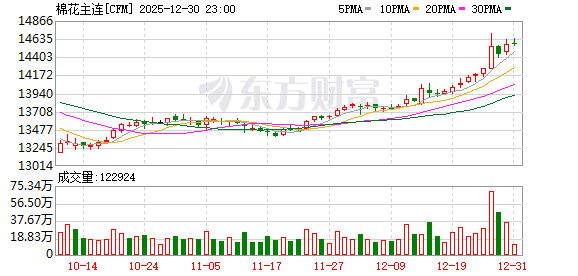
单月每吨上涨近千元!强预期下,棉花行情能走多远?
Qi Huo Ri Bao· 2025-12-30 23:37
Core Viewpoint - The cotton futures market is experiencing a strong rally, with Zheng cotton futures breaking through key resistance levels, driven by strong expectations of reduced cotton production and supported by supply-demand fundamentals [1][2]. Group 1: Price Movement and Market Dynamics - Zheng cotton futures have seen a price increase of nearly 1,000 yuan per ton since December, outperforming U.S. cotton [1]. - The market's bullish sentiment is largely due to expectations of a reduction in cotton planting area in Xinjiang, confirmed by a recent meeting of the Xinjiang Cotton Industry Development Leadership Group [1]. - The current supply-demand balance in the cotton market is tight, with a significant reduction in import ratios and low carryover stocks, preventing a loose supply situation [2]. Group 2: Demand Factors - The demand side remains resilient, with retail sales of clothing and textiles reaching 154.2 billion yuan in November, a year-on-year increase of 3.5% [2]. - Despite a slight decrease in operating rates among midstream textile enterprises, the demand for yarn remains strong, indicating manageable inventory pressures [2]. Group 3: Market Challenges and Comparisons - The market is characterized by a coexistence of strong expectations and weak realities, with rising cotton prices exceeding processing costs for ginning factories, leading to some hedging pressures [3]. - The seasonal off-peak period is affecting downstream cotton yarn prices, which are struggling to keep pace with rising cotton prices, potentially impacting profit margins for yarn manufacturers [3]. - In contrast to Zheng cotton's strength, U.S. cotton prices remain stagnant due to a lack of sufficient driving factors, leading to an expanding price gap between domestic and international cotton [3]. Group 4: Future Outlook - Short-term cotton futures are expected to maintain a strong oscillating trend, driven by a combination of strong expectations and realities, reducing the likelihood of a reversal into bearish territory [4]. - There are expectations for favorable policy adjustments, particularly regarding cotton subsidies aimed at enhancing quality, with the target price subsidy policy set to undergo changes in 2026 [4]. - Overall, the market sentiment remains optimistic in the short term, with medium to long-term projections indicating potential upward price movement supported by supply reduction expectations and resilient demand [4].