
强预期与弱现实

Search documents
多晶硅期货狂飙,空头遭逼仓后巨亏
经济观察报· 2026-01-03 04:20
Core Viewpoint - The article discusses the significant rise in the price of polysilicon futures, which increased over 85% from around 31,000 yuan/ton to a peak of 63,000 yuan/ton, despite a perceived oversupply in the physical market, raising questions about the underlying drivers of this trend [2][18]. Group 1: Market Dynamics - The polysilicon futures market experienced a dramatic turnaround starting in July 2025, with prices rising sharply from 31,000 yuan/ton to approximately 55,000 yuan/ton within a month, marking a more than 70% increase [7]. - The "anti-involution" movement, which began gaining traction in mid-2024, aimed to curb excessive competition and promote industry self-discipline, significantly altering market expectations and contributing to the price surge [5][6]. - By late 2025, the market faced a structural shortage of deliverable polysilicon, as most available products did not meet delivery standards, leading to increased pressure on short sellers and supporting higher futures prices [14]. Group 2: Investor Sentiment and Behavior - Many investors entered the polysilicon futures market amid rising prices, but those betting against the trend faced significant losses, with one investor reporting a total loss of 13 to 15 million yuan due to the extreme volatility [12]. - The market saw a mix of optimism and fear, with some investors believing that the establishment of a polysilicon storage platform would provide price support, while others remained skeptical due to high inventory levels [17]. - The futures market's volatility was exacerbated by rumors of production limits and the establishment of a storage platform, which created a challenging environment for short sellers [9][10]. Group 3: Regulatory and Structural Changes - The Guangzhou Futures Exchange implemented stricter risk control measures, including increasing margin requirements and transaction costs, to manage the volatility in the polysilicon futures market [15]. - The establishment of a polysilicon production integration and acquisition platform by major industry players was seen as a potential stabilizing factor for prices, although concerns about high inventory levels persisted [17]. - Analysts predict that the polysilicon industry will continue to face a supply-demand imbalance in 2026, with supply growth expected at 3.7% and demand potentially decreasing by 10% due to shifts in policy focus [18].


单月每吨上涨近千元!强预期下 棉花行情能走多远?
Qi Huo Ri Bao· 2025-12-31 00:22
Core Viewpoint - The cotton futures market is experiencing a strong rally, with the main contract in Zhengzhou breaking through key resistance levels, showing a nearly 1,000 yuan per ton increase since December, significantly outperforming U.S. cotton and becoming a focal point in the commodity market [2] Group 1: Market Dynamics - The recent price increase in Zheng cotton is driven by strong expectations of reduced cotton production in the new year, which has been gradually confirmed by recent developments [2] - The Xinjiang Cotton Association indicated that the cotton planting area in Xinjiang may face structural reductions in 2026, which is expected to influence the domestic cotton supply landscape long-term [2] - The current supply-demand balance in the cotton market is tight, with a notable decrease in import ratios and low carryover stocks, maintaining a robust long-term fundamental outlook [3] Group 2: Demand Factors - The resilience of demand in the cotton market is a significant driver of the current price trend, supported by retail sales data and operational rates of midstream textile enterprises [3] - In November, retail sales of clothing, shoes, hats, and textiles reached 154.2 billion yuan, reflecting a year-on-year increase of 3.5%, indicating stable demand in the cotton textile industry [3] Group 3: Price Pressures and Market Sentiment - The market is characterized by a coexistence of strong expectations and weak realities, with rising cotton prices exceeding processing costs for ginning factories, leading to some hedging pressure [4] - The seasonal off-peak period is affecting downstream cotton yarn prices, which are struggling to keep pace with rising cotton prices, potentially impacting profit margins for yarn manufacturers [4] - The price disparity between Zheng cotton and U.S. cotton is widening, with U.S. cotton prices remaining stagnant due to a lack of sufficient drivers, although there are concerns about indirect impacts from imported cotton yarn on domestic consumption [4] Group 4: Future Outlook - The cotton import volume remains at historical lows, with a 67.5% year-on-year decrease expected for the 2024/2025 season, which is unlikely to alter the domestic supply structure significantly [5] - Short-term cotton futures are expected to maintain a strong oscillating trend, driven by a combination of strong expectations and realities, reducing the likelihood of a shift to bearish sentiment [5] - The cotton subsidy policy is increasingly favoring high-quality cotton, with expectations for adjustments in the target price subsidy policy in 2026, which could further support cotton prices [5] - Overall, short-term market optimism is likely to persist, with medium to long-term projections indicating potential upward price movement supported by supply reduction expectations and resilient demand [5]
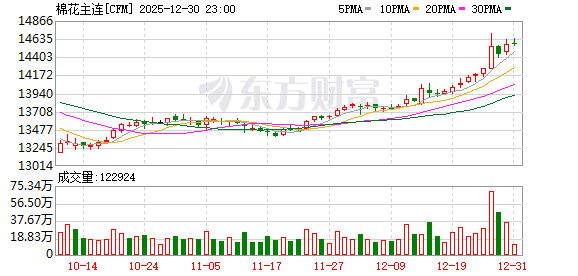
单月每吨上涨近千元!强预期下,棉花行情能走多远?
Qi Huo Ri Bao· 2025-12-30 23:37
Core Viewpoint - The cotton futures market is experiencing a strong rally, with Zheng cotton futures breaking through key resistance levels, driven by strong expectations of reduced cotton production and supported by supply-demand fundamentals [1][2]. Group 1: Price Movement and Market Dynamics - Zheng cotton futures have seen a price increase of nearly 1,000 yuan per ton since December, outperforming U.S. cotton [1]. - The market's bullish sentiment is largely due to expectations of a reduction in cotton planting area in Xinjiang, confirmed by a recent meeting of the Xinjiang Cotton Industry Development Leadership Group [1]. - The current supply-demand balance in the cotton market is tight, with a significant reduction in import ratios and low carryover stocks, preventing a loose supply situation [2]. Group 2: Demand Factors - The demand side remains resilient, with retail sales of clothing and textiles reaching 154.2 billion yuan in November, a year-on-year increase of 3.5% [2]. - Despite a slight decrease in operating rates among midstream textile enterprises, the demand for yarn remains strong, indicating manageable inventory pressures [2]. Group 3: Market Challenges and Comparisons - The market is characterized by a coexistence of strong expectations and weak realities, with rising cotton prices exceeding processing costs for ginning factories, leading to some hedging pressures [3]. - The seasonal off-peak period is affecting downstream cotton yarn prices, which are struggling to keep pace with rising cotton prices, potentially impacting profit margins for yarn manufacturers [3]. - In contrast to Zheng cotton's strength, U.S. cotton prices remain stagnant due to a lack of sufficient driving factors, leading to an expanding price gap between domestic and international cotton [3]. Group 4: Future Outlook - Short-term cotton futures are expected to maintain a strong oscillating trend, driven by a combination of strong expectations and realities, reducing the likelihood of a reversal into bearish territory [4]. - There are expectations for favorable policy adjustments, particularly regarding cotton subsidies aimed at enhancing quality, with the target price subsidy policy set to undergo changes in 2026 [4]. - Overall, the market sentiment remains optimistic in the short term, with medium to long-term projections indicating potential upward price movement supported by supply reduction expectations and resilient demand [4].

综合晨报-20251230
Guo Tou Qi Huo· 2025-12-30 02:08
Industry Investment Ratings No information provided in the reports about industry investment ratings. Core Views - Geopolitical conflicts such as the US - Ukraine meeting and Saudi's air - strikes in Yemen bring geopolitical premiums to oil prices, while the short - term cease - fire is difficult, which restricts Russia's oil production and export [1]. - Precious metals have a significant decline recently. Although supported by the Fed's easing prospects and geopolitical risks, the large increase driven by funds has accumulated risks, and exchanges have adjusted margins and trading restrictions [2]. - Different metals and energy products have their own supply - demand situations and price trends. For example, copper shows tight supply in 2026 Q1, while aluminum's follow - up rise lacks fundamental drive [3][4]. - Agricultural products' prices are affected by factors like weather, supply, and demand. For instance, South American weather impacts soybean prices, and domestic policies and procurement affect domestic soybean prices [34][37]. - Building materials and chemical products' prices are also influenced by supply - demand relationships and policies. For example, PVC has a high - supply and low - demand pattern, and polypropylene's demand is weak [27][26]. Summary by Categories Metals - **Copper**: Overnight, LME copper decreased in position to 96,000. It has priced in the tight supply of copper concentrates in 2026, especially Q1. The domestic spot discount has widened, and the SMM social inventory has increased to 214,800 tons. Hold an option combination of selling a call option with a strike price of 104,000 and buying a put option with a strike price of 98,000 [3]. - **Aluminum**: Overnight, precious metals' sharp decline led to a fall in non - ferrous metals. Shanghai aluminum mainly followed the rise, with weak fundamental drive, poor apparent demand and spot feedback. Long positions should be held with the 40 - day line as support, and the trend may adjust if it breaks [4]. - **Zinc**: TC continues to decline, refineries' production cuts continue, and the SMM zinc social inventory has decreased by 13,000 tons to 111,900 tons. The supply - side pressure has weakened, but consumption is in the off - season. The price of Shanghai zinc may fluctuate between 22,800 - 23,800 yuan/ton [6]. - **Nickel**: The price of Shanghai nickel has adjusted. The quota of Indonesian nickel mines in 2026 will be reduced to 2.5 billion tons, and the mineral benchmark price formula will be modified. The short - term market is dominated by policy sentiment, and it is advisable to wait and see [8]. - **Tin**: Overnight, the weighted position of Shanghai tin decreased, and it may continue to fall towards the long - term moving average. It is recommended to hold a call option with a strike price of 350,000 and observe the adjustment range [9]. - **Lithium Carbonate**: It has a limit - down. The futures price is in a strong - side shock, but above 120,000 yuan, it deviates from the fundamentals, and it is short - term bearish [10]. Energy - **Fuel Oil & Low - Sulfur Fuel Oil**: Geopolitical factors support prices in the short term, but do not change the supply - surplus situation. Low - sulfur supply is affected by overseas refinery operations, and the demand for ship fuel is weak. It is expected to maintain a weak - side operation [20]. - **Asphalt**: Since December, the weekly shipment has been below 400,000 tons. The geopolitical conflict may bring a phased rebound, but it will eventually return to the price - pressured pattern due to supply - demand looseness [21]. Building Materials - **Steel (including rebar and hot - rolled coil)**: The night - session steel prices fluctuated. Rebar's apparent demand decreased in the off - season, while hot - rolled coil's demand recovered. The supply pressure is gradually relieved, and the price may fluctuate in a range [13]. - **Iron Ore**: The global shipment has increased, and the domestic arrival volume may increase in the future. With the iron - making water production likely at the bottom, there is support for the short - term price, but it is expected to fluctuate [14]. - **Coke and Coking Coal**: The prices of both fluctuated downward. The supply of carbon elements is abundant, and the downstream demand has some resilience, but the pressure on raw material prices remains. The price may face fundamental pressure after correcting the premium or discount [15][16]. Chemicals - **Methanol**: The methanol market is strong. The port inventory increased last week, but it is expected to enter a de - stocking cycle in the medium - term. It is advisable to pay attention to the 5 - 9 spread positive arbitrage [23]. - **Pure Benzene**: The night - session oil price rebounded, and the pure benzene price slightly declined. The port inventory is high, but the supply - demand pressure may ease in the future. It is advisable to consider the spread positive arbitrage in the medium - term [24]. - **Polypropylene, Plastic, and Propylene**: The demand support for the market is weak. The supply of polyethylene is expected to increase, and the demand for polypropylene is also weak [26]. Agricultural Products - **Soybeans and Related Products**: South American weather improves, and the market is worried about US soybean exports. Domestic soybean and soybean meal inventories are high. The price of soybean meal is expected to oscillate at the bottom [34]. - **Corn**: The spot price of corn in Northeast China and North Ports is strong. The cold weather makes farmers reluctant to sell. The price of Dalian corn futures may oscillate strongly in the short - term [38]. - **Pigs**: The spot price of pigs increased over the weekend. The short - term price may remain strong, but there is a high probability of a second bottom - probing in the first half of next year [39]. - **Eggs**: The spot price of eggs is in a low - level oscillation. The 2 - month contract may be weak, while the 4 - and 5 - month contracts in the first half of next year may be relatively strong [40]. - **Cotton**: Zhengzhou cotton decreased yesterday. Although the new cotton production increased this year, the commercial inventory is low, and the sales progress is fast. The price shows an oscillating and strong trend [41]. - **Sugar**: The international sugar supply is sufficient, and the US sugar faces pressure. The production progress in Guangxi is slow, and the Zhengzhou sugar has rebounded, but the rebound may be limited [42]. - **Apples**: The futures price oscillates. The cold - storage trading is scarce, and the market demand is in the off - season. It is advisable to maintain a bearish view [43]. Others - **Shipping (Container Freight Index - Europe Line)**: The current spot freight rate is around $2900/FEU. Before the Spring Festival, the freight rate may first rise and then fall. The market will become clearer after the release of the opening - cabin price in mid - January [19]. - **Paper Pulp**: The paper pulp price dropped significantly yesterday. The short - term rise is limited by weak downstream demand. The port inventory has been decreasing for five consecutive weeks [45]. - **Stock Index**: A - share indices were mixed yesterday, and stock index futures closed down. In a loose liquidity and strong - RMB environment, A - shares are expected to oscillate strongly, and it is advisable to track the rotation opportunities of different sectors [46]. - **Treasury Bonds**: Treasury bond futures generally closed down on December 29, 2025. The short - end has strong certainty, and it is advisable to participate in the curve - steepening strategy in the short - term [47].
强预期与弱现实交织下 纸浆期货盘面追多需谨慎
Jin Tou Wang· 2025-12-22 07:03
Group 1 - The main contract for pulp futures experienced a rapid increase, reaching a peak of 5650.00 yuan, with a current price of 5620.00 yuan, reflecting a rise of 2.33% [1] - The market sentiment is mixed, with strong expectations on the supply side due to high overseas prices and shutdown plans of foreign pulp mills, while the demand side shows weak transmission of price increases in downstream paper products [2] - The current market is driven by funds and expectations, but the actual fundamentals may not support high prices, indicating a risk of price correction if demand weakens or funds withdraw [2] Group 2 - According to customs data, the import volume of bleached softwood pulp in October 2025 was 691,000 tons, a month-on-month increase of 0.1% and a year-on-year increase of 6.0%, with a total import volume of 7.122 million tons for the year, up 2.7% year-on-year [3] - The profit margins for paper mills are low, leading to a primary focus on demand-based procurement of pulp, with overall demand weakening as indicated by declines in production rates for various paper types [3] - As of December 18, 2025, the inventory of mainstream pulp at Chinese ports was 1.993 million tons, showing a decrease of 43,000 tons from the previous period, marking a 2.1% decline, and indicating a continued trend of inventory reduction over four weeks [3]

刚刚,开盘大跳水!
中国基金报· 2025-07-28 02:20
Core Viewpoint - The domestic commodity futures market opened with widespread declines, particularly in the black series and new energy materials, indicating a bearish trend in the market [1]. Group 1: Market Performance - The black series, including coking coal, saw significant declines, with coking coal dropping over 7%, and other materials like polysilicon, coke, lithium carbonate, soda ash, alumina, and industrial silicon also experiencing declines exceeding 5% [2]. - Specific futures prices included coking coal at 1145.0, down 91.5 or 7.40%, and polysilicon at 49155, down 3315 or 6.32% [4]. - The overall trading volume for coking coal reached 273 million, with a total open interest of 41.76 million [4]. Group 2: Market Sentiment and Trends - Market sentiment was initially bullish due to policies encouraging production, leading to a significant increase in coking coal prices, with a weekly increase of 36% for JM2509 [5]. - However, the market is now facing a cooling effect due to exchange interventions and a more rational outlook on crude steel demand, which may negatively impact price trends [5]. - The industrial silicon market is experiencing upward pressure, but resistance is expected as prices exceed 9500 yuan per ton, suggesting a potential for wide fluctuations [5]. Group 3: Agricultural Futures - In the agricultural sector, red date futures saw a daily increase of 6%, reaching 11150 yuan per ton, while other commodities like rapeseed, peanuts, and apples also experienced price increases [6]. - The Ministry of Agriculture and Rural Affairs, along with nine other departments, issued a plan to promote agricultural product consumption, aiming to inject new momentum into the agricultural market through financial support [6].

【期货热点追踪】大商所铁矿石期货周线五连涨,但钢厂、港口库存双双回升,当“强预期”遭遇“弱现实”,铁矿石这波行情还能走多远?
news flash· 2025-07-25 09:22
Core Viewpoint - The Dalian Commodity Exchange's iron ore futures have experienced five consecutive weeks of gains, but both steel mills and port inventories are rising, leading to concerns about the sustainability of the current bullish sentiment in the iron ore market [1] Group 1: Market Performance - Iron ore futures on the Dalian Commodity Exchange have shown a strong upward trend with five consecutive weekly increases [1] - The current market sentiment is characterized by strong expectations, but this is being challenged by rising inventories at steel mills and ports [1] Group 2: Inventory Trends - Steel mill inventories are increasing, indicating a potential oversupply situation [1] - Port inventories are also on the rise, which may further impact the demand dynamics for iron ore [1]