
欧佩克+产量政策

Search documents
中东地缘风险扰动 原油价格五日上涨10%
Xin Lang Cai Jing· 2026-01-16 02:44
Core Viewpoint - The geopolitical risks in the Middle East have led to a significant increase in oil prices, with a five-day cumulative rise exceeding 10% due to concerns over oil supply disruptions [3][9]. Geopolitical Developments - Protests erupted in a Middle Eastern country at the end of 2025 due to dissatisfaction with currency devaluation and rising living costs, escalating into violent conflicts and political protests by early 2026 [3][9]. - U.S. President Trump has threatened military intervention in response to the unrest, which has heightened geopolitical risks and contributed to rising oil prices [3][9]. Oil Price Movements - As of January 14, WTI oil prices reached $62.02 per barrel, with a five-day increase of $6.03 per barrel (10.77% rise), while Brent oil prices were at $66.52 per barrel, up $6.56 (10.94% rise) [3][9]. - On January 15, oil prices opened lower, declining by approximately 3%, following reports that the Middle Eastern country had ceased violence against protesters, suggesting a potential de-escalation of military responses [4][10]. Market Outlook - The oil market is expected to face downward pressure in 2026 due to macroeconomic challenges and oversupply, despite potential short-term support from geopolitical tensions and U.S. oil demand [6][14]. - The geopolitical situation remains the largest uncertainty affecting the oil market, with ongoing tensions in the Middle East and Eastern Europe, as well as developments in South America impacting supply outlooks [6][12][13]. - The anticipated continuation of U.S. Federal Reserve interest rate cuts may boost market sentiment, but uncertainties regarding the rate path could limit positive impacts [12][13]. Supply and Demand Dynamics - Global oil demand growth is expected to remain slow, providing limited support to the oil market, while U.S. oil demand is projected to strengthen by mid-year [12][13]. - OPEC+ is expected to pause production increases in the first quarter, which may alleviate some supply pressure, but significant production increases from 2025 and expectations of U.S. and other oil-producing countries' output will continue to exert pressure on the market [12][14].


宏观压力与产业过剩的双重压力下 2026年原油价格仍面临较大的下行压力
Xin Hua Cai Jing· 2026-01-08 15:11
Group 1 - OPEC+ reaffirmed its decision to pause production increases for January, February, and March 2026 due to seasonal reasons, which aligns with market expectations and has a limited impact on the oil market [1] - The decision to pause production increases in Q1 2026 helps alleviate the pressure of rapid supply growth, slightly improving market sentiment, although the potential increase of 1.24 million barrels per day will not be implemented until at least Q2 [1] - The oil market in 2026 will be influenced by international trade disputes, Federal Reserve monetary policy, U.S. oil demand, OPEC+ production policies, and geopolitical situations [3] Group 2 - The global oil demand growth is expected to be moderate, providing limited support to the oil market, while U.S. oil demand is anticipated to remain robust until mid-year, which may offer some sustained support [3] - OPEC+'s decision to pause production increases in Q1 2026 will moderately ease supply-side pressures, but the cumulative production increase from 2025 remains significant, alongside expectations of increased production from the U.S. and other oil-producing countries [3] - Geopolitical tensions, particularly regarding the Russia-Ukraine situation and uncertainties in the Middle East, continue to pose risks to the oil market, with potential disruptions in supply [3][4] Group 3 - The oil market is expected to face significant downward pressure on prices in 2026 due to macroeconomic pressures and industry oversupply, with high volatility anticipated [4] - Oil prices in Q1 2026 are projected to stabilize around $60 per barrel for Brent and $56 per barrel for WTI, with a gradual downward shift in price levels [4] - Key risk factors for the market include geopolitical issues and systemic economic and financial risks [4]
欧佩克12月产量维持平稳 伊拉克增产对冲委内瑞拉缺口
智通财经网· 2026-01-08 13:25
Core Viewpoint - Despite Venezuela's crude oil production dropping to a two-year low, increased output from some OPEC members like Iraq has offset this shortfall, keeping OPEC's overall production stable as of December last year [1][2]. Group 1: OPEC Production Data - OPEC's average daily crude oil production slightly exceeded 29 million barrels in December, remaining stable compared to the previous month [1]. - Venezuela's daily production fell approximately 14% to 830,000 barrels due to U.S. sanctions and the seizure of oil tankers [1]. - Iraq was the largest contributor to OPEC's production increase, raising its daily output by 80,000 barrels to 4.37 million barrels, exceeding its OPEC+ quota [2]. Group 2: Geopolitical Challenges - OPEC+ faces multiple geopolitical challenges, including record oversupply expectations, domestic unrest in Iran, and the ongoing Russia-Ukraine conflict affecting Kazakhstan's oil exports [2]. - The current Brent crude oil price hovers just above $60 per barrel, nearing a five-year low, increasing financial pressure on OPEC+ member countries [2]. Group 3: Future Production Plans - OPEC+ has agreed to freeze production in the first quarter of this year, pausing a large-scale production recovery plan initiated last year [2]. - A video meeting is scheduled for February 1 among Saudi Arabia and seven other core OPEC+ members to review future production policies [3].
原油:产油国重申一季度暂停增产 余量增产仍存变数
Xin Lang Cai Jing· 2026-01-08 02:54
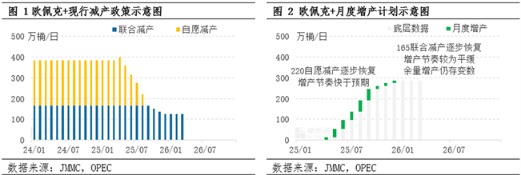
Core Viewpoint - OPEC+ has decided to pause production increases for the first quarter of 2026 due to seasonal reasons, which aligns with market expectations and has a limited impact on the oil market [2][10]. Group 1: OPEC+ Production Policy - OPEC+ is the primary organization influencing oil supply, and its production policies have undergone several adjustments in recent years [3][11]. - Starting in 2025, OPEC+ initiated a gradual recovery plan for voluntary production cuts, which is perceived as an increase in production, negatively impacting the oil market [3][11]. - The first phase of this recovery plan began in April 2025, with a total of 2.2 million barrels per day (bpd) in voluntary cuts, leading to significant increases in production over the following months [3][11]. - By September 2025, OPEC+ had completed the first phase ahead of schedule, resulting in a cumulative increase of nearly 2.5 million bpd, which exceeded market expectations and exerted downward pressure on oil prices [3][11]. Group 2: Market Dynamics and Economic Factors - The second phase of production recovery, starting in October 2025, was more moderate, with an increase of 137,000 bpd over three months, leaving 1.24 million bpd yet to be reduced [4][12]. - The pause in production increases for the first quarter of 2026 is expected to alleviate some supply-side pressures and improve market sentiment [5][12]. - The oil market is facing dual pressures from macroeconomic factors and industry oversupply, with significant downward pressure on oil prices anticipated in 2026 [14][15]. - Key market concerns include international trade disputes, U.S. Federal Reserve monetary policy, and geopolitical tensions, which are likely to continue affecting oil prices [14][15]. Group 3: Price Projections - Oil prices are expected to remain volatile in 2026, with projections suggesting that Brent and WTI prices will stabilize around $60 and $56 per barrel, respectively, in the first quarter [15].
8个欧佩克+产油国将于北京时间今日19:00召开会议讨论产量政策
news flash· 2025-08-03 07:22
Group 1 - OPEC+ oil-producing countries will hold a meeting today at 19:00 Beijing time to discuss production policies [1]
欧佩克+将于17点开会决定产量政策 4-7月已增加137万桶/日的产量
news flash· 2025-07-05 08:19
Core Viewpoint - OPEC+ is set to hold an online meeting to decide on production policies for August, following a significant increase in production from April to July 2023 [1] Group 1: Production Policy - OPEC's eight member countries, including Saudi Arabia, Russia, UAE, Kuwait, Oman, Iraq, Kazakhstan, and Algeria, will meet to determine the production policy for August [1] - Since April, OPEC+ has increased production by 1.37 million barrels per day, which accounts for 62% of the 2.2 million barrels per day reduction that was previously in place [1] Group 2: Market Impact - The additional supply from OPEC+ has led to a decrease in crude oil prices, prompting the organization to accelerate production increases in May, June, and July [1] - The total ongoing production cuts amount to 3.66 million barrels per day, indicating that while some production is being increased, significant cuts are still in effect [1]
百利好早盘分析:关税风险降温 金价短期回调
Sou Hu Cai Jing· 2025-05-28 01:43
Gold Market - The probability of the Federal Reserve maintaining interest rates in June is 94.4%, and in July, it is 74.9%, indicating a low likelihood of short-term rate cuts, which may pressure gold prices [2] - The EU plans to accelerate trade negotiations with the US under pressure, while Japan is set to hold the fourth round of tariff talks with the US on the 30th, suggesting a cooling of trade tensions [2] - Analysts warn of further risks of gold price declines due to reduced safe-haven demand and the recent bearish market trend, with key resistance at $3328 and support at $3285 [2] Oil Market - OPEC+ has not yet discussed increasing oil production by 410,000 barrels per day ahead of their upcoming meetings, which may impact oil prices negatively [3] - Geopolitical uncertainties remain, with Germany lifting restrictions on military aid to Ukraine and Iran preparing for potential actions against Israel, which may limit the downside for oil prices [3] Copper Market - Recent trading shows a decline from high levels, with a warning of further potential drops; support may be found at the 62-day moving average [7] Nikkei 225 Index - The index has shown strong upward movement, closing positively, and has regained its position above the 20-day moving average, indicating potential for further gains [8]

受欧佩克+供应担忧影响,油价本周料收跌
news flash· 2025-05-23 08:16
Core Viewpoint - Oil prices are expected to decline this week due to concerns over OPEC+ supply increases amidst an already oversupplied market [1] Group 1: OPEC+ Supply Concerns - There are growing worries about OPEC+'s potential significant increase in production levels for July, which is putting pressure on the oil market [1] - Analysts from ING indicate that the oil market is facing new pressures as rumors circulate regarding OPEC+'s handling of its production levels [1] - A larger scale supply increase following May and June will solidify OPEC's policy shift from defending prices to defending market share [1] Group 2: Geopolitical Factors - Traders are closely monitoring geopolitical developments, particularly concerns about a broader conflict in the Middle East [1] - The upcoming negotiations between the U.S. and Iran scheduled for Friday are also a point of concern for market participants [1]