民航反内卷

Search documents
行业洞察丨南航海航扭亏,春运“量价齐升”初显,民航业盈利拐点要来了?
Xin Hua Cai Jing· 2026-02-08 15:41
Core Viewpoint - The Chinese civil aviation industry is experiencing a significant turnaround after years of operational pressure, with major airlines like China Southern Airlines and Hainan Airlines expected to return to profitability by 2025, indicating substantial improvement in the industry's fundamentals [1][2]. Group 1: Airline Performance - China Southern Airlines is the first among major airlines to achieve profitability, projecting a net profit of 0.8 to 1 billion yuan for 2025, a significant recovery from a loss of 1.696 billion yuan the previous year [2]. - Hainan Airlines is also expected to turn profitable, forecasting a net profit of 1.8 to 2.2 billion yuan for 2025, compared to a loss of 0.921 billion yuan in the prior year [2]. - China Eastern Airlines and Air China are not expected to achieve profitability in 2025, with projected net losses of 1.3 to 1.9 billion yuan and 1.3 to 1.9 billion yuan respectively, despite improvements in core operational metrics [3]. Group 2: Market Trends - The 2026 Spring Festival travel season is anticipated to see a record high in passenger volume, with an expected 95 million travelers, reflecting a year-on-year increase of approximately 5.3% [4]. - The travel demand is driven by a longer holiday period, with new travel patterns emerging, including a trend of "returning home first, then traveling" [5][6]. - The aviation market is showing signs of "volume and price rising together," with a notable increase in flight operations and ticket prices during the early days of the Spring Festival travel period [6]. Group 3: Industry Dynamics - The civil aviation industry is undergoing a "de-involution" process, with measures being implemented to control excessive competition and improve profitability [7]. - The supply of new aircraft is limited, with a backlog of over 15,000 global aircraft orders and an extended delivery cycle of 6.8 years, which is expected to constrain supply in 2026 [8]. - International routes are becoming increasingly important for profitability, with airlines focusing on expanding international services to enhance revenue [8].



未知机构:兴证交运今日航空调整简析反内卷松动油价反弹扰动为主今日-20260129
未知机构· 2026-01-29 02:25
Summary of Key Points from the Conference Call Industry Overview - The focus is on the aviation industry, specifically regarding recent adjustments in pricing and oil prices affecting airline operations [1][2]. Core Insights and Arguments - The aviation sector has experienced significant adjustments primarily due to two factors: 1. The "anti-involution" trend in civil aviation has shown signs of easing, with routes such as Chengdu-Hangzhou, Chengdu-Wuxi, and Changchun-Nanjing witnessing ticket prices dropping below 400/540 yuan [1][2]. 2. There has been a phase of rebound in international oil prices, with WTI and Brent crude oil prices increasing by approximately 3% in a single day. This increase is attributed to uncertainties surrounding the situation in Iran, disturbances from a cold wave in the U.S., and a weakening dollar. The overall sentiment is leaning towards a risk premium return rather than a reversal in supply-demand dynamics, keeping the price levels within a manageable range for airlines [2][3]. - Feedback from the Spring Festival travel season indicates a generally optimistic outlook, with rapid booking progress and rational ticket price discounts. The recovery pace of supply is also deemed controllable, supporting a positive market sentiment [3]. - The current adjustments in the aviation sector are viewed as a re-pricing of policy expectations and a resonance with macro commodity sentiments. The logic of the industry "emerging from deflation" is still unfolding, and it is recommended to dynamically track Spring Festival data alongside the subsequent trends in oil price declines [3]. Other Important but Potentially Overlooked Content - The call invites further discussions regarding Spring Festival volume and pricing, indicating an openness to engage with stakeholders for deeper insights [4].
五亿人上天后,三百元机票正在被围剿
首席商业评论· 2026-01-12 04:08
Core Viewpoint - The Chinese civil aviation industry is experiencing a significant shift, with a projected increase in air travel population to 500 million by the end of 2025, while also facing challenges such as rising ticket prices and the need to combat internal competition among airlines [4][8]. Group 1: Industry Growth and Challenges - By the end of 2025, China is expected to have 500 million people who have flown, making it the largest air travel population globally, but this also means that approximately 900 million people have never flown [4]. - The civil aviation industry reported a profit of 6.5 billion yuan in the previous year, with major airlines like Air China, China Eastern, and China Southern showing profitability [8]. - Despite the profitability, there is a growing concern about the sustainability of low-cost tickets, as the industry is moving towards a potential price increase, with the lowest ticket prices disappearing [8][9]. Group 2: Regulatory Measures and Market Dynamics - The Civil Aviation Administration of China has reiterated the need to curb "internal competition," suggesting that ticket prices should not fall below cost, indicating a potential shift towards higher fares [4][9]. - The push against internal competition reflects a broader trend in the Chinese economy, where various sectors are being urged to avoid price wars that could harm overall cash flow [9][10]. - The administrative measures to control pricing may help airlines maintain ticket prices but could also risk losing market share to high-speed rail, which offers competitive pricing and convenience [17][18]. Group 3: Consumer Behavior and Market Perception - The perception of air travel as expensive remains a barrier for many potential travelers, with a significant portion of the population associating airfares with the cost of train tickets [20]. - As business travelers reduce their travel budgets and opt for more cost-effective solutions like virtual meetings, airlines may struggle to maintain profitability without the support of high-paying customers [15][20]. - The shift in consumer behavior, combined with rising operational costs, poses a dilemma for the civil aviation industry, as higher ticket prices could deter new customers and limit growth [15][20].


五亿人上天后,低价机票正在被围剿
虎嗅APP· 2026-01-11 09:52
Core Viewpoint - The Chinese civil aviation industry is experiencing a significant shift, with a projected increase in air travel population to 500 million by the end of 2025, while still having around 900 million people who have never flown. This indicates a potential for growth but also highlights the challenges of pricing and competition in the industry [4][9][42]. Group 1: Industry Trends - The Civil Aviation Administration of China has announced measures to curb "internal competition" in the industry, specifically stating that ticket prices should not be sold below cost, which suggests a potential price increase for airfares [4][5][12]. - Since early 2025, there has been a noticeable absence of tickets priced below 200 yuan, indicating a shift in pricing strategies among airlines [6][7]. - The civil aviation industry reported a profit of 6.5 billion yuan in 2025, with major airlines like China Eastern and Air China showing positive earnings, contrasting with consumer perceptions of rising ticket prices [9][10]. Group 2: Economic Context - The call for anti-internal competition reflects broader economic concerns in China, where various industries are facing pressure to avoid price wars that could lead to financial instability [13][25]. - The profitability of airlines in 2025 is seen as precarious, with increasing operational costs and potential market pressures expected in 2026 [14][24]. - The loss of business travelers due to cost-cutting measures in companies is impacting airlines' ability to subsidize lower ticket prices, which could lead to a decrease in overall passenger numbers [21][23]. Group 3: Competitive Landscape - The domestic airline industry faces stiff competition from high-speed rail, which offers a more convenient and often cheaper alternative for travelers, particularly in densely populated regions [27][30]. - The pricing strategies of airlines may inadvertently push consumers towards high-speed rail, especially if airfares rise significantly [28][30]. - The historical context of air travel in China shows rapid growth in the number of air travelers, but the perception of air travel as expensive remains a barrier for many potential customers [41][42].

低价机票正在被围剿
3 6 Ke· 2026-01-09 02:19
Core Insights - The Chinese civil aviation industry is projected to have 500 million air travelers by the end of 2025, making it the largest aviation population globally, but this also means that approximately 900 million people in China have never flown [1][24]. - The Civil Aviation Administration of China (CAAC) has reiterated its commitment to curbing "involution" in the industry, specifically by prohibiting airlines from selling tickets below cost [2][3]. Industry Trends - The media interprets the CAAC's stance as a signal that airfares may enter a rising trend, as discussions about price limits have been ongoing since early last year [3][6]. - Despite the CAAC's efforts, low-cost tickets below 200 yuan have not completely disappeared due to online travel agencies (OTAs) subsidizing fares to attract users [4][6]. - The civil aviation industry reported a profit of 6.5 billion yuan in 2025, with major airlines like Air China, China Eastern, and China Southern showing profitability, while private carriers like Spring Airlines have experienced significant growth [6][8]. Market Dynamics - The current situation presents a paradox where airlines are becoming profitable, yet consumers feel the pinch as low-cost tickets become scarce, raising concerns about the future of affordable air travel [7][26]. - The CAAC's push against involution reflects broader economic pressures in China, aiming to prevent companies from engaging in destructive price wars that could jeopardize cash flow across industries [8][9]. - The profitability of international routes, particularly to Japan, has been threatened by geopolitical uncertainties, leading to an oversupply of domestic flights and increased operational costs for airlines [9][12]. Competitive Landscape - The high-speed rail system in China poses a significant competitive threat to the aviation industry, as it offers a more convenient and often cheaper alternative for travelers, especially as airfares rise [15][22]. - The psychological pricing of air tickets is influenced by the cost of train tickets, and if airfares rise significantly, it may deter potential travelers who perceive flying as too expensive [25][26]. - The operational efficiency of airlines, such as Shandong Airlines, is increasingly driven by the need to compete with the extensive high-speed rail network in densely populated regions [17][18].
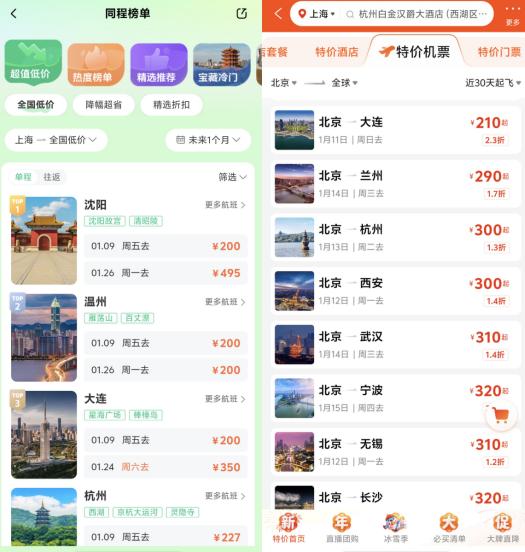
港股异动 航空股早盘再度走高 11月航司淡季客座率表现亮眼 机场客流量仍健康增长
Jin Rong Jie· 2025-12-17 02:29
Group 1 - The core viewpoint of the articles highlights the positive performance of major Chinese airlines in terms of passenger load factors during the off-peak season, indicating a recovery in demand [1][2] - Eastern Airlines reported a passenger load factor of 87.37%, an increase of 3.04 percentage points year-on-year [1] - Southern Airlines achieved a load factor of 86.29%, up by 1.36 percentage points year-on-year [1] - Air China recorded a load factor of 83.3%, which is a 4 percentage point increase year-on-year [1] - Citic Securities noted that the load factors for the airlines during the off-peak season are high, ranging from 85.3% to 93.2%, suggesting a potential for improved pricing power as demand recovers [1] Group 2 - Morgan Stanley reported that despite adjustments to Japanese routes, the airport passenger traffic in mainland China showed healthy growth in November, with Beijing Capital International Airport, Shanghai Pudong, Hongqiao International Airports, and Guangzhou Baiyun International Airport experiencing year-on-year growth rates of 9%, 11%, and 13% respectively [2] - The growth in non-domestic passenger traffic was approximately 20% in November [2] - Overall, the non-domestic airline capacity remained stable, while there was an increase in capacity for routes to Australia, Southeast Asia, Hong Kong, and Macau [2]
航空股早盘再度走高 11月航司淡季客座率表现亮眼 机场客流量仍健康增长
Zhi Tong Cai Jing· 2025-12-17 01:52
Group 1 - The core viewpoint of the articles highlights the strong performance of major Chinese airlines in terms of passenger load factors during the off-peak season, indicating a recovery in demand and potential profitability improvements [1][2] Group 2 - Eastern Airlines reported a passenger load factor of 87.37% in November, an increase of 3.04 percentage points year-on-year [1] - Southern Airlines achieved a load factor of 86.29%, up by 1.36 percentage points year-on-year [1] - Air China recorded a load factor of 83.3%, which is a 4 percentage point increase year-on-year [1] Group 3 - Citic Securities noted that the load factors for the airlines during the off-peak season are high, ranging from 85.3% to 93.2%, suggesting a positive trend in the aviation sector [1] - The recovery in business travel demand is expected to resonate with a mild appreciation of the currency, potentially leading to a significant reduction in airline losses in Q4 2025 [1] Group 4 - Despite adjustments in flight capacity to Japan, the overall airport passenger traffic in mainland China showed healthy growth in November, with Beijing Capital International Airport, Shanghai Pudong, Hongqiao International Airports, and Guangzhou Baiyun International Airport experiencing year-on-year growth rates of 9%, 11%, and 13% respectively [2] - Non-domestic passenger traffic increased by approximately 20% in November [2] - There was a 10% to 20% decrease in airline capacity to Japan compared to four weeks prior, while capacity to Australia, Southeast Asia, Hong Kong, and Macau saw an increase [2]
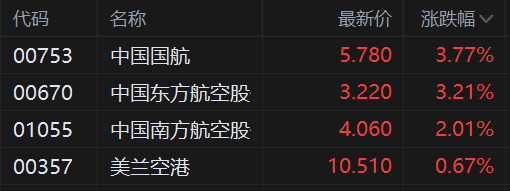
航空股普涨 中国国航涨近4% 国庆中秋假期航空出游需求旺盛
Ge Long Hui· 2025-09-30 03:41
Core Viewpoint - The Hong Kong aviation stocks have generally risen, with China National Aviation increasing by nearly 4%, China Eastern Airlines by 3.2%, and China Southern Airlines by 2%, indicating a positive market sentiment towards the aviation sector [1][2]. Industry Summary - According to a report from CITIC Securities, there is expected strong demand for air travel during the 2025 National Day and Mid-Autumn Festival holidays, which may lead to better-than-expected performance in terms of volume and pricing, signaling a positive outlook for the industry [1]. - The civil aviation sector is gradually implementing measures to reduce competition, which may include price stabilization, schedule control, and regulatory oversight on agency sales, potentially providing support for industry pricing [1]. - The low introduction of new aircraft and engine maintenance is expected to continue the trend of low growth in effective supply, with new orders having a limited impact on industry supply, suggesting that there is no need for excessive concern [1]. - The fourth quarter may see a turning point in industry volume and pricing performance, highlighting the importance of strategic positioning during the off-peak season [1].
中信证券:淡季关注因公需求改善 重视航司利润拐点
智通财经网· 2025-09-30 01:05
Core Viewpoint - The report from CITIC Securities indicates a recovery in civil aviation public business demand since mid-September, with high passenger load factors translating into ticket price increases, and anticipates a 6.4% year-on-year growth in daily passenger volume during the National Day holiday in October [1][2] Group 1: Demand and Pricing - Public business demand has shown continuous improvement since mid-September, with high load factors reflecting demand recovery impacting ticket prices positively [2] - Data from the flight management platform indicates that the average pre-sale ticket price for domestic flights during the National Day holiday has increased by 7.9% year-on-year [2] - The expectation is that the improvement in public business demand will support sustained positive growth in overall ticket prices in Q4 2025 [2] Group 2: Industry Regulation and Supply Constraints - The civil aviation industry is undergoing a "de-involution" initiative aimed at addressing excessive competition, with potential regulatory measures including price floor controls, flight schedule management, and stricter oversight of online travel agencies (OTAs) [3][4] - The industry is expected to maintain strict supply controls, with a focus on optimizing the structure of flight schedules based on profitability and competition levels [4] - The introduction of new aircraft is limited, with a net increase of only 60 aircraft among the three major airlines this year, reflecting a low growth trend in effective supply [6] Group 3: Future Outlook - The upcoming National Day and Mid-Autumn Festival holidays are anticipated to see strong demand for air travel, with potential for better-than-expected performance in terms of volume and pricing [8] - The ongoing "de-involution" efforts are expected to provide support for industry pricing, enhancing the earnings elasticity of airlines [5][8] - The combination of low aircraft introduction rates and ongoing engine maintenance is likely to result in continued low growth in effective supply, with limited impact from new orders on overall supply dynamics [6][8]

民航局将规范低于成本价卖票
第一财经· 2025-09-27 05:21
Core Viewpoint - The Civil Aviation Administration of China (CAAC) is addressing the issue of "involution" in the aviation industry, where excessive low pricing and capacity deployment have led to low profitability despite market growth. The CAAC aims to regulate market pricing and monitor fare dynamics to prevent predatory pricing practices [3][4]. Group 1: Market Conditions - Despite the CAAC's efforts, there has not been a significant increase in ticket prices, with average domestic economy class fares in July and August 2024 down by 6.4% year-on-year and 8.6% compared to 2019 [3]. - The CAAC is currently collecting data from airlines to assess cost structures on different routes, which will inform future pricing regulations and monitoring [4]. Group 2: Competitive Dynamics - Some airlines are engaging in "stealth" low pricing during off-peak times, leading to a competitive cycle where one airline's price drop prompts others to follow suit, resulting in significant variations in passenger load factors [5]. - The aviation industry faces more challenges in curbing "involution" compared to the express delivery sector, as there are 65 passenger airlines competing for domestic routes, leading to oversupply and competition from high-speed rail [6]. Group 3: Industry Structure and Strategy - There is a need to establish a mechanism for airlines to exit the market to alleviate price competition, as many airlines have been operating at a loss since the pandemic without going bankrupt, unlike their foreign counterparts [6]. - The value of existing airline licenses has increased due to the CAAC's moratorium on new airline approvals, making it difficult for underperforming airlines to exit the market [6]. - Airlines must shift from a growth strategy based on capacity and resource input to one that focuses on understanding diverse passenger needs and innovating their service offerings [6].