
电网投资

Search documents
理工能科20230331
2026-04-01 09:59
Company and Industry Summary Company Overview - The company is involved in the power software, intelligent instruments, and environmental protection sectors, with a focus on high-margin operations and strategic shifts in business models. Key Financial Performance - In 2025, the company achieved a revenue of over 1 billion yuan, a year-on-year increase of 0.92% - The net profit attributable to shareholders was 215 million yuan, a decline of 22.6% year-on-year - The net profit excluding non-recurring gains and losses was also 215 million yuan, down 18.66% year-on-year - The decline in net profit was primarily due to a reduction in non-operating income, including a drop in government subsidies and bank dividends, totaling approximately 35 million yuan [2][4][3] Business Segment Performance Software Information Technology - Revenue growth of 6.22% in the software information technology segment, with power software products and projects growing by 1.39% - The segment's revenue structure shifted, with information technology projects surpassing software products for the first time - The company aims for a compound annual growth rate of 20% in this segment, which has been achieved for three consecutive years [3][5] Intelligent Instruments - The intelligent instruments and operations segment generated revenue of 225 million yuan, a year-on-year increase of 14.42% - The gross margin for this segment was 57.16%, up 0.41 percentage points year-on-year - The growth was attributed to an increase in high-voltage online monitoring products, with a significant rise in average selling prices [3][7] Environmental Protection - Revenue in the environmental protection segment decreased by 17.43%, primarily due to a nearly 80% decline in environmental instrument integration business - The company is shifting focus towards high-margin operation and maintenance services, with a pilot project for intelligent water stations already completed [3][11] Strategic Developments - The company has made breakthroughs in expanding its client base with the Southern Power Grid, securing high-priced framework agreements that could significantly contribute to performance if executed at 60%-70% in 2026 [2][9] - The company plans to adjust its growth target for software business in 2026 to 10%-15% due to the cautious investment climate from the State Grid [6] Market Trends and Future Outlook - The market for replacing existing high-voltage substations is estimated to be around 10 billion yuan, with significant growth expected in 2026 and 2027 [18] - The company anticipates a strong performance in the transformer monitoring business, with new contracts in Q1 2026 showing a fourfold increase compared to Q1 2025 [14][16] - The company is also exploring opportunities in the high-energy consumption sectors and has made progress in partnerships for new energy storage solutions [19][20] Challenges and Risks - The company faces rising operational costs due to increased social insurance contributions mandated by local regulations, which may impact net profit [15] - The environmental protection segment's decline is attributed to both industry-wide factors and strategic shifts within the company [11][12] Conclusion - Overall, the company is positioned for potential growth in 2026, driven by strategic shifts in business focus, anticipated increases in market demand, and successful execution of existing contracts. However, it must navigate rising costs and market challenges to achieve its financial targets.

建筑业高频略有修复
HTSC· 2026-03-23 09:21
1. Report Industry Investment Rating No information provided in the given content. 2. Core Viewpoints of the Report - In the third week of March, the second - hand housing market was hotter than the new housing market, but the trends of listing prices and the Iceberg Index were fluctuating, with Shanghai showing relatively leading performance in terms of volume and price. In the production sector, freight volume was stronger than the seasonal average, and the daily coal consumption increased year - on - year. After the Spring Festival, the industry start - up rates were differentiated, with coking, refinery, and blast furnace operations showing marginal strength, while the chemical chain declined. In the construction industry, the supply - demand situation of cement and black metals improved marginally, and the asphalt start - up rate decreased. In terms of external demand, throughput remained resilient, freight rate indicators were strong recently, the year - on - year decline of container freight rates continued to narrow, and the exports of South Korea and Vietnam remained resilient. In the consumption sector, the travel enthusiasm remained at a high level, but the year - on - year growth of automobile consumption decreased compared with the previous value. In terms of prices, crude oil prices rose due to geopolitical factors, black metals fluctuated strongly, and copper prices declined [1]. 3. Summary According to Relevant Catalogs Consumption - Travel: The overall travel enthusiasm remained at a high level, but the year - on - year growth of flight execution volume decreased. The subway passenger volume of 9 key cities had a week - on - week increase of 0.1% (previous value: 3.4%) and a year - on - year increase of 1.5% (previous value: 2.3%) as of the week ending March 19. The congestion delay index as of March 15 showed a year - on - year decrease of - 3.8% (previous value: - 5.8%). The year - on - year growth of domestic (excluding Hong Kong, Macao, and Taiwan) and international flight execution volume was 3.2%/3.6% (previous value: 8.8%/6.0%), and the flight execution rates were 87.2%/82.0% (previous value: 83.5%/81.8%, and the same period last year: 88.8%/84.0%) as of the week ending March 13 [4][5]. - Commodity consumption: The year - on - year growth of automobile consumption decreased, while the year - on - year growth of express delivery collection increased. The movie box office had a week - on - week decrease of - 54.6% (previous value: - 69.4%) and a year - on - year decrease of - 33.8% (previous value: - 32.9%) as of the week ending March 19. The retail and wholesale of passenger cars from March 1 - 15 had a year - on - year decrease of - 21%/- 19% (previous value: 54%/46%). The sales volume of the Light Textile City had a year - on - year decrease of - 9.4% (previous value: - 32.2%) as of the week ending March 15, and the express delivery collection volume had a year - on - year increase of 4.5% (previous value: 1.0%) as of March 15 [4][6]. - Policy: Last week, China's consumption - promotion policies continued to be advanced in depth. At the national level, nine departments including the Ministry of Commerce issued policies to promote travel service exports and expand inbound consumption. At the local level, Jiangsu, Shanghai, and Xuancheng in Anhui introduced characteristic measures to protect consumer rights and optimize the consumption environment [6]. Real Estate - New housing: The transaction enthusiasm of new housing decreased slightly. Structurally, second - tier cities were relatively leading. As of March 19, the weekly transaction area of commercial housing in 30 cities decreased by - 3.1% year - on - year (previous value: 5.7%), and the transaction areas in first, second, and third - tier cities decreased by - 6.7%/6.0%/- 16.4% year - on - year (previous value: 8.3%/6.0%/0.4%). The combined transaction of new housing in the first three weeks of March decreased by - 7.80% year - on - year (previous value: - 9.62%) [7]. - Second - hand housing: The transaction of second - hand housing improved. Structurally, third - tier cities > first - tier cities > second - tier cities. As of March 20, the weekly transaction area of second - hand housing in 26 cities decreased by - 10.7% year - on - year (previous value: - 26.4%), and the transaction areas in first, second, and third - tier cities decreased by - 5.7%/- 15.0%/- 4.2% year - on - year (previous value: - 21.9%/- 25.0%/- 32.9%). The combined transaction of second - hand housing in the first three weeks of March decreased by - 20.95% year - on - year (previous value: - 27.10%). The transaction enthusiasm of new and second - hand housing in high - level cities such as Beijing, Shanghai, Shenzhen, and Chengdu increased year - on - year [7]. - Listing volume and price: The listing volume and price of second - hand housing both decreased. As of March 15, the weekly index of the listing price and volume of second - hand housing for sale decreased by - 0.1%/- 10.3% week - on - week, and the indexes of all tiers of cities decreased week - on - week [7]. - Land: The land market premium rate decreased compared with the previous value, and the land transaction volume remained at a low level. As of March 15, the weekly transaction area of land in 100 cities increased by 4.54% week - on - week and 35.55% year - on - year, the supply area decreased by - 10.86% year - on - year, the land premium rate decreased by - 10.17 pct year - on - year, the total land transaction price decreased by - 35.62% week - on - week and increased by 6.05% year - on - year [8]. - Policy: Last week, real estate policies continued to exert force on both the supply and demand sides. On the demand side, Shanghai adjusted the mortgage policy for commercial and residential - commercial properties, reducing the minimum down - payment ratio to no less than 30% from March 16, 2026. On the supply side, Jiangsu issued an action plan for high - quality urban development [8]. Production - Electricity: The daily coal consumption increased year - on - year, the hydropower generation decreased year - on - year, and the coal price increased. As of March 19, the daily coal consumption of 25 provincial power coal terminal users increased by 6.0% year - on - year (previous value: - 0.2%). As of March 20, the weekly year - on - year growth of the daily average outflow of the Three Gorges Reservoir was 3.3% (previous value: 13.6%). As of March 20, the coal price increased by 0.1% week - on - week (previous value: - 0.3%) [9]. - Construction industry: The funds available for construction increased week - on - week, and the supply - demand situation of cement and black metals improved. The funds available for construction increased week - on - week. As of March 18, the funds available for sample construction sites was 50.7%, with a week - on - week increase of 7.90 pct and a year - on - year decrease of - 6.83 pct (previous value: - 14.42 pct). The supply - demand situation of cement improved marginally, the inventory decreased year - on - year, and the price increased. The supply - demand situation of black metals improved, the inventory increased year - on - year, and the price decreased. The asphalt start - up rate decreased, and the price increased. The PVC start - up rate increased compared with the previous value, and the styrene start - up rate decreased [10][11][12]. - Freight: The railway and highway freight volume increased year - on - year, and the industry start - up rates were differentiated. As of March 15, the railway freight volume and highway truck traffic increased by 4.3%/0.6% year - on - year (previous value: - 0.3%/- 9.3%). The coking start - up rate increased, and the refinery start - up rate decreased slightly. The start - up rates of PTA, polyester, and Jiangsu and Zhejiang looms decreased, while the start - up rates of semi - and full - steel tire production increased [13]. External Demand - Volume: As of March 15, the cumulative cargo throughput and container throughput of ports increased by 9.5%/9.3% week - on - week (previous value: - 0.4%/1.4%) and 2.3%/11.1% year - on - year (previous value: - 2.1%/- 1.7%), maintaining a high year - on - year level [14]. - Freight rate: The RJ/CRB index increased by 18.8% year - on - year (previous value: 17.6%). The Baltic Dry Index (BDI) increased by 3.3% week - on - week on average as of March 20 (previous value: - 8.3%), and the year - on - year growth was 24.5% (previous value: 28.1%). The China Containerized Freight Index (CCFI) and Shanghai Containerized Freight Index (SCFI) increased by 4.5%/- 0.2% week - on - week (previous value: 1.7%/14.9%). Most routes of CCFI improved both week - on - week and year - on - year, while the week - on - week data of the US West and US East routes were weak. In Shanghai Port, the freight market showed a differentiated trend, and the freight rates of most ocean routes except the European and Persian Gulf routes declined [14]. - Exports of South Korea and Vietnam: South Korea's export volume in the first 10 days of March increased by 55.60% year - on - year (previous value: 29.00%), and Vietnam's export volume in February increased by 6.26% year - on - year (previous value: 43.91%) [14]. - Overseas economy: The US announced that the industrial output in February increased by 0.2% month - on - month, the PPI in February increased by 3.4% year - on - year, and the core PPI increased by 3.9% year - on - year, both exceeding expectations. The number of initial jobless claims decreased to 205,000, and the existing home sales in February increased by 1.7% month - on - month. The Eurozone announced that the ZEW economic sentiment index in March was - 8.5, the CPI in February increased by 1.9% year - on - year, and the core CPI increased by 2.4% year - on - year. The ECB kept interest rates unchanged, raised the inflation forecast for 2026 to 2.6%, and lowered the GDP growth forecast to 0.9% [15]. - Import freight rate: The domestic import freight rate (CDFI) increased by 8.4% week - on - week (previous value: 9.7%). As of March 17, the weekly average of the coal, grain, and iron ore freight rate indexes increased by 2.33%/0.71%/1.06% week - on - week (previous value: 1.79%/1.17%/2.03%) [15]. Prices - Comprehensive index: The external RJ/CRB index and the internal Nanhua Industrial Products Index both increased. - Sub - items: Crude oil prices increased, non - ferrous metal prices decreased, black metal prices increased, pork prices decreased, and vegetable prices decreased. As of March 21, the weekly average of the agricultural product wholesale price 200 index decreased by 0.9%. The average wholesale prices of pork, beef, mutton, and white - striped chicken decreased by - 2.4%/0.0%/- 0.0%/- 0.4% week - on - week, the prices of vegetables and fruits decreased by - 2.4%/- 1.1% week - on - week, and the price of eggs increased by 0.7% week - on - week [16][17].
电网投资高景气,两网固定资产投资同比大幅增长
Caixin Securities· 2026-03-17 07:25
Investment Rating - The industry investment rating is "Leading the Market" and the rating has been maintained [2][6]. Core Insights - The investment in the power grid is experiencing high growth, with significant increases in fixed asset investments by both the State Grid and Southern Grid. In the first two months of 2026, the State Grid's fixed asset investment reached 75.7 billion yuan, a year-on-year increase of 80.6%, while the Southern Grid's investment was 25.08 billion yuan, up 95.3% year-on-year [6]. - The State Grid is steadily advancing its main network investments, with upgrades and distribution network investments increasing by over 150%. The company is managing multiple high-voltage projects and has initiated 160,000 projects with an investment of 33.73 billion yuan, also reflecting a growth of over 150% year-on-year [6]. - The Southern Grid is focused on stabilizing growth and expanding investments, with a planned fixed asset investment of 180 billion yuan for the year. The company is accelerating project implementation and has increased procurement amounts by 30% year-on-year [6]. - The report suggests focusing on manufacturers of ultra-high voltage equipment, distribution network equipment, and those with leading export shares in the power grid equipment sector, given the large-scale investment plans and supportive policies [6]. Summary by Sections - **Investment Growth**: The State Grid and Southern Grid have shown remarkable growth in fixed asset investments, with the State Grid achieving 75.7 billion yuan and the Southern Grid 25.08 billion yuan in the first two months of 2026 [6]. - **Project Management**: The State Grid is managing various high-voltage projects effectively, with significant investments in upgrades and distribution networks, while the Southern Grid is enhancing project implementation and procurement processes [6]. - **Investment Recommendations**: The report recommends attention to specific equipment manufacturers in light of the substantial investment plans and supportive government policies [6].
铜:地缘政治冲突引发金银大幅波动,铜价韧性凸显
Fang Zheng Zhong Qi Qi Huo· 2026-03-09 06:31
1. Report Industry Investment Rating - Not provided in the content 2. Core Viewpoints of the Report - In 2026, the global copper market will shift from a supply surplus to a supply shortage, with an expected supply gap of 150,000 tons. The price of copper is expected to rise, and the volatility will increase, with the price center moving upward [91][120]. - The supply of copper concentrates is tightening, and the competition for global copper concentrates will become more intense. The supply of electrolytic copper is expected to decline, while the demand from the power grid, new energy, and AI fields is expected to maintain a high - growth rate [31][43][82]. - Geopolitical conflicts have increased the risk premium of copper, and copper is expected to become an important asset for macro - funds to hedge against the credit risk of the US dollar [24][120]. 3. Summary by Directory 3.1 Global Macro and Copper Market - **Domestic Policy**: The "Two Sessions" in 2026 maintained a stable and progressive tone. The GDP growth target was lowered to 4.5% - 5%, and the CPI target increase was 2%. The fiscal stimulus was slightly lower than expected, and the monetary policy was moderately loose. The policy was favorable for copper demand in new energy, power grid investment, and AI data center construction [10][12]. - **US Economy**: The US manufacturing industry is in an expansion cycle, with strong growth in new orders and production. The US is expected to enter a cycle of dual monetary and fiscal easing, and the capital expenditure in the technology industry will continue to be high, increasing the demand for copper [17][21]. - **Geopolitical Conflicts**: The conflict in the Middle East has escalated, causing significant fluctuations in the gold and silver markets. Copper prices are supported by strong fundamentals and have shown resilience. High oil prices have pushed up the US dollar index in the short term, but in the long term, they are beneficial for copper prices [24][28]. 3.2 Copper Supply Situation Analysis - **Mine - end Supply**: Global major mining companies have lowered their future production expectations. The supply of copper concentrates is expected to be further tightened, and the shortage situation is difficult to ease in the short term. The long - term supply of copper concentrates is affected by factors such as low growth rate, declining ore grade, and geopolitical risks [31][33][35]. - **Domestic Smelting**: In 2025, China's electrolytic copper production reached a record high. In 2026, the production is expected to decline slightly. The supply shortage of copper concentrates has not significantly restricted domestic smelting operations for the time being, but the long - term impact may gradually appear [40]. - **Processing Fees**: The long - term processing fees for copper concentrates have dropped to zero, indicating a tight supply situation. The competition for global copper concentrates will become more intense, and the supply shortage will gradually affect domestic smelting operations [43]. - **Recycled Copper**: The import and domestic production of recycled copper raw materials have increased. The proportion of recycled copper raw materials flowing to the smelting end has continued to rise, and the substitution effect on copper concentrates is expected to further increase in 2026 [46]. - **Import and Export**: In 2025, China's electrolytic copper import volume decreased, and the export volume increased. In 2026, the adjustment trend of the import and export structure is expected to continue, and the net import volume may continue to decline [49]. 3.3 Copper Demand Situation Analysis - **Domestic Copper Products**: In 2026, China's copper products output is expected to achieve double - digit growth. The output of refined copper rods is expected to increase by more than 10%, and the demand for copper foil is expected to continue to grow at a high rate. However, the demand for copper in the real estate and home appliance sectors is expected to be weak [54]. - **New Energy and AI**: The new energy field, including new energy vehicles, photovoltaics, and wind power, will maintain high - speed growth, driving the demand for copper. The demand for copper in the AI field is expected to explode, and the combined demand for copper in new energy and AI is expected to account for 22% by 2030 [82]. - **Power Grid Investment**: In 2026, as the starting year of the "14th Five - Year Plan", the power grid investment is expected to achieve double - digit growth, with a total investment scale approaching one trillion yuan, which will strongly support the demand for copper [73]. 3.4 Copper Inventory Change Analysis - **Global Inventory**: In 2026, the global copper inventory has continued to increase, and the structural contradiction has been alleviated. The inventory accumulation is mainly due to the seasonal off - peak demand and the increase in supply. The market may be stocking up in advance in anticipation of future shortages, so the inventory increase will not have a negative impact on prices [87]. - **Domestic Inventory**: The domestic electrolytic copper social inventory has reached the highest level since 2019. The domestic destocking cycle is expected to start from late March to April [87]. 3.5 Global Copper Supply - Demand Balance - In 2025, the global refined copper market had a supply surplus of about 410,000 tons. In 2026, the market is expected to shift from a supply surplus to a supply shortage, with an expected supply gap of 150,000 tons [91]. 3.6 Copper Position Analysis - **CFTC Position**: As of March 3, the total position of COMEX copper futures and options decreased, and the net long position increased passively in February, indicating a resurgence of bullish sentiment in the futures market [99]. - **LME Position**: As of February 27, the long - position of LME copper investment funds decreased, and the bullish sentiment became more cautious [99]. 3.7 Arbitrage Analysis - **Shanghai - London Ratio**: In January, the Shanghai - London ratio of copper decreased, and it remained stable in February. In 2026, the Shanghai - London ratio is expected to further decline [104]. - **Copper - Zinc Ratio**: The copper - zinc ratio has continued to rise in 2025 and 2026, and it is expected to continue to rise in 2026 [104]. 3.8 Copper Option Market - **Volatility Analysis**: In January, the historical volatility of copper options rose to a nearly three - year high, and it was suitable to sell options. In February, the volatility decreased, and it was suitable to buy options. In the future, the volatility of copper prices is expected to increase, and it is recommended to construct strategies such as buying slightly out - of - the - money call options or buying straddles [109]. - **PCR Ratio**: The trading volume PCR and position PCR of copper options showed a downward trend in February and an upward trend at the beginning of March, indicating a relatively pessimistic expectation of the option market for copper prices [111]. 3.9 Copper Market Outlook and Operation Suggestions - **Technical Analysis**: Technically, copper has broken through a nearly 20 - year shock range, and a 20 - year cup - and - handle pattern has formed, indicating a high probability of a bullish trend [118]. - **Market Outlook**: In March 2026, the global copper market may experience a turning point, with increased volatility and an upward - moving price center. - **Operation Suggestions**: Downstream demanders are recommended to conduct long - hedging operations in the far - month contracts. Option strategies can consider buying slightly out - of - the - money call options or constructing buying straddles to bet on increased volatility. The short - term support range for the main Shanghai copper contract is expected to be 98,000 - 99,000 yuan/ton, and the pressure range is expected to be 108,000 - 110,000 yuan/ton [120].
赛道牛股频出,下一个千亿龙头是它?
格隆汇APP· 2026-03-08 07:55
Core Viewpoint - The article discusses the ongoing wealth creation myth surrounding AI in the A-share market, highlighting the significant rise in market capitalization of companies involved in AI infrastructure since the advent of ChatGPT [2]. Group 1: AI and Energy Supply - The logic of computing power extends to upstream energy supply, with power grid equipment becoming a core investment theme, resulting in numerous stocks doubling in value over the past year [3]. - Major tech companies, including Microsoft, Google, and Amazon, have committed to self-supplying or purchasing the electricity needed for AI data centers, indicating a shift in responsibility for energy supply [7]. - The competition for AI dominance is evolving into an energy race, which has activated the power grid equipment sector, supporting its recent price increases [10]. Group 2: Investment Trends - Domestic investments in power grids are projected to exceed 5 trillion yuan during the 14th Five-Year Plan, providing a solid demand foundation for high-voltage and smart grid sectors [12]. - In the U.S., power grid operators are pushing for a $75 billion transmission expansion plan, focusing on building high-voltage AC lines [12]. - The EU has announced a plan to invest 1.2 trillion euros by 2040 for comprehensive grid modernization [13]. Group 3: AI Model Performance and Cost Structure - China's AI model invocation surged by 127% in early 2026, surpassing the U.S. for the first time, with Chinese models capturing 85.7% of the global market [20]. - The cost structure of AI token production shows that electricity and hardware depreciation account for over 70% of the total cost, emphasizing the importance of energy supply in AI commercial viability [24]. - The price of tokens for Chinese AI models is significantly lower than that of U.S. models, providing a competitive advantage in the global market [28]. Group 4: Power Supply Challenges in the U.S. - The U.S. faces significant challenges in power supply, including long interconnection wait times averaging over 8 years and regulatory hurdles that delay new high-voltage transmission lines [30][31]. - The aging infrastructure and lengthy approval processes hinder the ability to meet the rapidly increasing demand for electricity from AI data centers [31]. - In contrast, China's power supply system is more stable and efficient, supporting the rapid deployment of AI computing power [33]. Group 5: Company Performance and Market Opportunities - Companies like Suyuan Electric have benefited from both domestic smart computing expansion and overseas demand for power equipment, with revenue reaching 21.205 billion yuan, a 37.18% increase [40]. - Jinpan Technology reported a net profit of 659 million yuan, driven by sales growth in the AI data center sector [41]. - The high-voltage equipment sector is expected to maintain high demand over the next 5-10 years, with companies possessing core technological advantages poised for growth [53].



华明装备(002270):2026年春季投资峰会速递:出海高速迈进,经营稳健向好
HTSC· 2026-03-06 07:59
Investment Rating - The investment rating for the company is maintained as "Buy" with a target price of RMB 40.18 [5]. Core Insights - The company has experienced rapid growth in overseas business, particularly in the export of tap changers, which reached RMB 714 million in 2025, a year-on-year increase of 47% [2]. - The maintenance business is also showing strong growth, with revenue growth close to 30% in 2025, and order growth exceeding revenue growth [2]. - The CNC business has made significant strides in overseas markets, with revenue of RMB 244 million in 2025, a 40% increase year-on-year, and overseas revenue growing by 230% [2]. Summary by Sections Overseas Business - The export scale of tap changers reached RMB 714 million in 2025, with direct exports at RMB 367 million (up 34%) and indirect exports at RMB 347 million (up 64%) [2]. - Europe accounts for over half of direct exports, while Asia contributes about 30%, and the Americas and Africa together make up around 20% [2]. Maintenance Business - The maintenance business for on-load tap changers is expected to grow close to 30% in 2025, with order growth outpacing revenue growth [2]. - The maintenance business has a stronger profitability profile, with a gross margin higher than the company's overall margin, which is expected to further enhance overall profitability [2]. CNC Business - The company plans to adjust its equity structure and introduce a new team by the end of 2024, focusing on higher-margin overseas markets [2]. - Revenue from the CNC business is projected to reach RMB 244 million in 2025, with overseas revenue at RMB 112 million (up 230%) and domestic revenue at RMB 132 million [2]. Profitability and Cost Structure - The company's pricing strategy is stable, and the cost structure is diversified, minimizing the impact of any single raw material price increase [3]. - The average gross margin for overseas tap changers is 5-10 percentage points higher than domestic margins, indicating a positive trend in profitability as overseas revenue increases [3]. Capacity and Delivery - Domestic capacity for tap changers is 20,000 units, with additional capacities in Turkey and Indonesia [3]. - The current delivery cycle for overseas tap changers is 2-3 months, with potential for capacity expansion through increased shifts and automation [3]. Financial Forecast and Valuation - The company is expected to benefit from a global upturn in power grid investments, with projected net profits of RMB 879 million, RMB 1.089 billion, and RMB 1.346 billion for 2025, 2026, and 2027 respectively [4]. - The estimated EPS for the same years is projected to be RMB 0.98, RMB 1.22, and RMB 1.50 [4].

无惧中东冲突,持续独立走强的中美共振方向
格隆汇APP· 2026-03-04 10:11
Core Viewpoint - The article emphasizes the resilience and growth potential of the power grid equipment sector amidst global market disturbances, particularly due to geopolitical tensions and the rising demand for electricity driven by AI and data centers [5][6]. Group 1: Market Dynamics - The ongoing geopolitical conflicts, particularly in the Middle East, have heightened market volatility, leading to a preference for sectors with stable performance and rigid demand, such as power grid equipment [12]. - The AI industry's rapid development is creating a rigid increase in electricity demand, with data centers experiencing a significant rise in power consumption, outpacing overall societal electricity usage [10]. - The North American power transformer supply gap has reached 30%, indicating a pressing need for power grid upgrades to meet the demands of the AI era [10]. Group 2: Investment Opportunities - The "14th Five-Year Plan" in China anticipates fixed asset investments in the power grid to exceed 4 trillion yuan, focusing on ultra-high voltage, smart distribution networks, and renewable energy integration [11]. - Global investments in power grids are projected to reach $12 trillion from 2025 to 2030, suggesting sustained industry growth [11]. - The demand for power grid equipment is further supported by significant investment approvals in the U.S., totaling $75 billion for transmission expansion projects [11]. Group 3: Sector Specifics - Ultra-high voltage (UHV) technology is crucial for addressing power supply and demand mismatches, with plans to operate 15 UHV direct current projects during the "14th Five-Year Plan," enhancing cross-province transmission capacity by 35% [14]. - The smart grid, described as the "brain" of the power grid, is expected to see rapid market expansion, with the smart meter market projected to exceed 80 billion yuan by 2030 [16]. - The replacement market for aging power equipment, such as transformers and switchgear, is valued at over 200 billion yuan, driven by increasing environmental and energy efficiency standards [17]. Group 4: Investment Logic - The investment opportunities in the power grid equipment sector are centered around "demand explosion, domestic substitution, and overseas expansion" [19]. - The upstream supply chain, including materials like copper and silicon steel, is influenced by price fluctuations, but leading companies can mitigate these effects through long-term contracts and economies of scale [19]. - The downstream market is bolstered by procurement from major state-owned enterprises and increasing overseas infrastructure demands, particularly in Southeast Asia, the Middle East, and Europe [20]. Group 5: Key Companies - Companies like Siyi Electric and TBEA are capitalizing on overseas demand, with Siyi Electric reporting a 72.7% year-on-year increase in overseas revenue for the first three quarters of 2025 [22]. - Leading domestic firms such as Pinggao Electric and China XD Electric are well-positioned to benefit from domestic power grid investments, with stable market shares and robust order books [28].

威胜信息20260228
2026-03-01 17:22
Summary of Conference Call Notes Company and Industry Overview - **Company**: 威胜信息 (Weisheng Information) - **Industry**: Power and Water Management, Smart City Solutions Key Points and Arguments Investment Trends - The State Grid and Southern Grid are expected to allocate 40%-45% of their investments to distribution networks over the next five years, with digital investments accounting for 10%-15% [2][3] - The total investment in distribution networks is projected to exceed 2 trillion yuan, with over 600 billion yuan dedicated to digital and intelligent upgrades [2][3] International Market Strategy - The company is focusing on high-value markets in Europe and North America, targeting advanced power terminals, low-carbon energy management solutions, and water management solutions [2][5] - North American technical certification is set to begin in October 2025, while European water management certification is expected to start in June 2025, with full product certification anticipated by mid-2026 [2][5] Product Development and Market Opportunities - The company is developing a comprehensive solution for AIDC (Artificial Intelligence Data Center) that includes intelligent PDU and AI server integration, with a planned value of approximately 5 billion yuan, representing about 5% of the market [2][7] - The company aims to capture over 5% market share in a target market estimated at 500 billion yuan, translating to an expansion opportunity of 40-50 billion yuan [4] Revenue Projections - The company anticipates a 33.98% year-on-year growth in overseas revenue by 2025, contributing approximately 19.6% to total revenue [5] - AI-related revenue is projected to reach 737 million yuan in 2025, marking an 89.7% increase, with expectations of similar growth in 2026 [3][14] Regional Market Developments - The Indonesian factory is expected to become the fastest-growing and largest market for the company by 2026, with a projected growth of at least 2.5 times compared to 2025 [9] - The Saudi technical center is set to launch a customized ultrasonic metering solution, with significant market potential in the region [9][10] Digital Transformation and AI Integration - The company is investing in AI-related solutions, including intelligent monitoring and AI fault recovery, which are expected to drive significant growth in the digital transformation of the power grid [3][14] - The integration of AI with traditional power management systems is seen as a key growth driver, with a focus on enhancing operational efficiency and monitoring capabilities [14] Future Outlook - The company aims for overall revenue growth of 20%-30% in 2026, with international business growth expected to exceed 100% [16] - The focus will be on new product development, international expansion, and leveraging data center opportunities to drive future growth [16] Chip Development - The company has made significant advancements in power MMI communication chips, with a focus on developing a SOC chip for sensing and communication integration by 2026 [17] Additional Important Information - The company has established seven overseas subsidiaries, covering Southeast Asia, the Middle East, and Africa, with a strong emphasis on localizing supply chains to enhance efficiency and cost-effectiveness [5] - The company is actively participating in the development of the "Electric Hong Operating System" in collaboration with Southern Grid, aiming to support the digital transformation of the power sector [12]

国内外需求共振带动电网行业高景气发展,电网ETF、电网设备ETF广发、电网设备ETF涨超3%
Ge Long Hui A P P· 2026-02-26 05:19
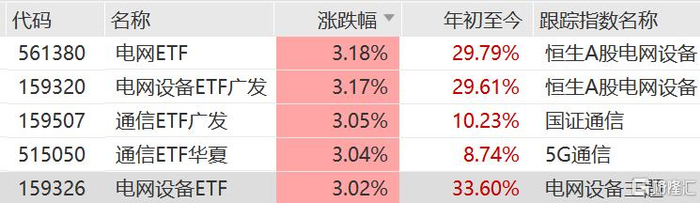
Core Viewpoint - The electric grid ETFs and related sectors are experiencing significant growth, with year-to-date increases of nearly 30% for both the electric grid ETF and the electric grid equipment ETF, driven by rising demand and investment in the electric power infrastructure [1][2]. Group 1: ETF Performance - The electric grid ETF has increased by 3.18% recently and has a year-to-date growth of 29.79%, tracking the Hang Seng A-share Electric Grid Equipment Index [2]. - The electric grid equipment ETF from GF Securities has risen by 3.17% and has a year-to-date increase of 29.61%, also tracking the same index [2]. - The electric grid equipment ETF focuses on the power equipment sector, covering areas such as transmission and transformation equipment, ultra-high voltage industries, and smart grid construction [2]. Group 2: Market Demand and Investment - Goldman Sachs has raised its forecast for global data center electricity demand growth from 175% to 220% by 2030, indicating a significant shift in investment towards the power supply chain due to AI developments [3]. - The U.S. government is convening major tech companies to discuss commitments regarding the electricity costs of high-energy data centers, highlighting the increasing need for reliable power sources [3]. - The State Grid Corporation of China has announced a fixed asset investment plan of 4 trillion yuan during the 14th Five-Year Plan, with expectations for high investment in ultra-high voltage and smart grid sectors [4]. Group 3: Industry Outlook - The electric grid industry is experiencing high demand due to both domestic and international factors, with expectations for investment to exceed market forecasts [4]. - The aging U.S. electric grid infrastructure, built primarily in the 1950s to 1970s, is entering a replacement cycle, creating a bottleneck for AI development [4]. - The surge in renewable energy installations in Europe is driving demand for electric grid support, alongside strong needs for upgrades and renovations in power equipment [4].
电网板块景气上行,电网ETF(561380)大涨超2%,近20日净流入超9亿元
Mei Ri Jing Ji Xin Wen· 2026-02-26 05:16
Group 1 - The core viewpoint is that the State Grid has announced a fixed asset investment of 4 trillion yuan during the 14th Five-Year Plan period, with expectations for high voltage planning to reach new heights [1] - During 2025, domestic grid investment is expected to show structural differentiation, with the State Grid's investment in transmission and transformation equipment increasing by 25.2% year-on-year, while the investment in ultra-high voltage equipment and electric meters is projected to decline [1] - Strong performance in the export of primary equipment is noted, with liquid transformers and high-voltage switches seeing year-on-year export increases of 48.6% and 31.5%, respectively [1] Group 2 - The Electric Grid ETF (561380) tracks the Hang Seng A-share Electric Grid Equipment Index (HSCAUPG), which covers listed companies in the electric grid equipment sector within the Chinese A-share market, focusing on power transmission, distribution systems, and related services [1] - The index constituents are primarily concentrated in manufacturing, supplemented by information technology and research services, reflecting the overall performance of securities in the electric grid equipment industry [1]