
白银工业需求

Search documents
白银史诗级暴涨,有人一觉醒来赚18万
21世纪经济报道· 2025-12-27 15:00
Core Viewpoint - The global precious metals market experienced a historic surge, with silver rising by 10% to a peak of $79.405 per ounce, marking an annual increase of over 170%, while gold reached a new high of $4549 per ounce [1]. Price Movements - Platinum prices increased by 10.39% to $2459.50 per ounce, with a year-to-date rise of 172.07% [1]. - Lithium gold rose by 11.69% to $1925.00 per ounce [1]. - London silver reached $79.329, up 10.47%, with a year-to-date increase of 163.59% [1]. - London gold was priced at $4532.505, reflecting a 1.19% increase and a 72.72% rise for the year [1]. - NYMEX platinum surged by 11.84% to $2513.90, with a year-to-date increase of 176.13% [1]. - NYMEX lead rose by 14.04% to $2060.50, with a year-to-date increase of 126.55% [1]. - COMEX gold was priced at $4562.00, up 1.31% with a year-to-date increase of 72.85% [1]. Market Dynamics - The recent surge in silver prices is attributed to a combination of factors, including a loose monetary environment, geopolitical risks, and increased industrial demand, particularly from the solar energy and electric vehicle sectors [1][18]. - The World Silver Association reported a continuous supply shortage in the market, with a projected cumulative shortfall of approximately 25,500 tons from 2021 to 2025 [18]. - The dual logic of short-term liquidity driving prices and long-term structural shortages, alongside rising gold prices, has contributed to the current bullish sentiment in the silver market [18]. Investor Behavior - There has been a notable increase in retail investor activity, with reports of significant profits from silver investments, indicating a speculative frenzy [14][16]. - Some investors are expressing concerns about the sustainability of the current price levels, suggesting that the rapid increases may lead to demand suppression and potential price corrections [18].


宏源期货王文虎:全球债务膨胀支撑金价,贵金属易涨难跌
Qi Huo Ri Bao· 2025-12-17 00:21
Core Viewpoint - The precious metals market is gaining attention due to the deep adjustments in the global economic landscape and the shift in major central banks' monetary policies, with rising debt expectations providing solid support for gold and silver prices, highlighting their safe-haven and anti-inflation properties in the current environment [1] Monetary Policy Shift - The direction of the Federal Reserve's monetary policy is a core variable affecting global asset prices. Current complex economic data in the U.S. shows manufacturing PMI below the growth line for several months, while the job market shows signs of volatility. Inflation, although down from its peak, remains sticky, reinforcing market expectations for future rate cuts and a "technical expansion" of the balance sheet [2] - The Federal Reserve plans to end balance sheet reduction by December 2025 and initiate a monthly "Reserve Management Purchase" plan of approximately $40 billion to address liquidity pressures in April 2026, interpreted by the market as a signal of easing [2] Fiscal Expansion and Debt Growth - Global trends toward fiscal expansion support precious metals. The U.S. government debt ceiling has been raised again, with significant projected deficits due to the "big beautiful" plan from the Trump administration, leading to concerns about the long-term value of the dollar [3] - The European Union is loosening fiscal discipline in response to geopolitical pressures, allowing member states to increase defense spending, while the UK plans to increase investments despite rising net debt [3] Correlation with Sovereign Debt - Japan's recent announcement of an economic stimulus plan exceeding 21 trillion yen, partially funded by new bonds, indicates a strong positive correlation between gold prices and the total outstanding debt of major economies like the U.S., EU, UK, and Japan. The expansion of sovereign debt erodes currency purchasing power, enhancing gold's value as a safe-haven asset [4] Multi-layered Support for Precious Metals - In addition to macroeconomic factors, other elements provide multi-layered support for precious metal prices. Central banks have been increasing gold reserves since 2023, reflecting diversification needs and long-term strategic considerations for a diversified international monetary system [5] - Geopolitical risks, including the ongoing Russia-Ukraine conflict and Middle East tensions, continue to create uncertainty, potentially driving safe-haven buying [5] - Industrial demand for silver is expected to grow due to advancements in green technology and AI, with the World Silver Association predicting a widening supply-demand gap by 2026, enhancing price elasticity [5] Market Outlook - Overall, the precious metals market is expected to see upward price movement supported by global debt expansion, a shift toward monetary easing, central bank gold purchases, and geopolitical uncertainties, leading to a scenario where prices are likely to rise but difficult to fall [6]
白银又暴涨了!
Guo Ji Jin Rong Bao· 2025-09-01 13:21
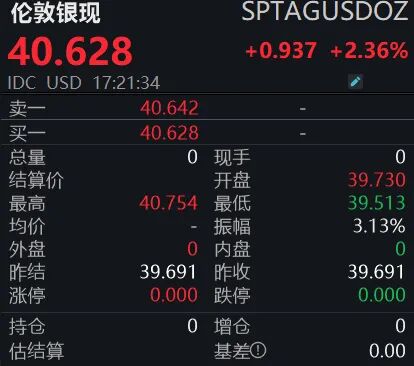
Core Viewpoint - The silver market is experiencing a significant surge, with prices surpassing $40 per ounce for the first time since 2011, reflecting a year-to-date increase of over 40% [1][4]. Price Movement - As of September 1, the spot silver price reached $40.628 per ounce, marking a daily increase of 2.36% [1][2]. - The highest price recorded during the day was $40.754, with a trading range of 3.13% [2]. - In comparison, gold prices also hit a new high since April, with spot gold reaching $3489.852 per ounce, reflecting a daily increase of over 1% [2][3]. Market Drivers - The recent surge in silver prices is attributed to multiple factors, including macroeconomic conditions, policy influences, and the inherent volatility of the commodity [4]. - Expectations of interest rate cuts by the Federal Reserve, driven by softening U.S. employment data and dovish remarks from Fed officials, have bolstered the precious metals sector [4]. - Concerns regarding potential U.S. tariffs on silver imports, following the U.S. Geological Survey's inclusion of silver in its critical minerals list, have also contributed to market tension [4]. Geopolitical and Economic Factors - The questioning of the Federal Reserve's independence and ongoing geopolitical conflicts have further triggered increases in gold and silver prices [5]. - The ongoing military rearmament in Europe and the U.S. re-industrialization efforts are expected to boost industrial demand for silver [5]. - Data indicates that silver ETFs have seen net inflows for seven consecutive months, the longest streak since 2020, reflecting strong investor confidence in silver's future [5]. Future Outlook - Analysts predict that after breaking the $40 per ounce barrier, silver may test resistance levels between $44 and $45 per ounce, maintaining a strong upward trend [6]. - Despite the positive long-term outlook, the rapid price increase has raised caution among some institutions, suggesting potential profit-taking and volatility in the near term [6].
白银行业深度报告:工业需求与金融属性双轮驱动
Dongguan Securities· 2025-08-28 05:33
Group 1 - Silver is recognized as both an industrial metal and a precious metal, with a significant role in wealth storage and monetary transactions due to its stable physical and chemical properties [12][64] - The silver industry consists of three main segments: upstream mining and recycling, midstream smelting and processing, and downstream applications, with approximately 70% of silver sourced as a byproduct from lead-zinc and other non-ferrous metal mining [14][64] - The global silver supply is projected to be approximately 25,000 tons in 2024, with Mexico, China, and Peru being the top producers [17][25] Group 2 - Industrial demand for silver is expected to account for 59% of total consumption in 2024, with significant contributions from the photovoltaic sector, which alone is projected to require about 197.6 million ounces [30][66] - The overall global silver demand is forecasted to decrease by 3% to 1,160 million ounces in 2024, primarily due to weakened physical investment demand, although industrial demand in China is anticipated to grow by 7% [30][66] - The demand for silver in the photovoltaic industry is expected to remain strong, driven by the increasing adoption of TOPCon solar cells, which have a higher silver consumption compared to PERC cells [34][35][66] Group 3 - The financial attributes of silver are becoming more pronounced, serving as a hedge against inflation and a reserve asset, with COMEX silver prices rising by 33.87% year-to-date as of August 26 [41][65] - The silver market is sensitive to macroeconomic conditions and monetary policies, with expectations of a potential interest rate cut by the Federal Reserve, which could further boost silver prices [41][65] - The current gold-silver ratio is above historical averages, suggesting potential upward movement for silver prices if the ratio continues to normalize [44][65] Group 4 - Key companies in the silver industry include Xingye Silver Lead (000426), Jiangxi Copper (600362), and Shengda Resources (000603), all of which have significant silver reserves and production capabilities [67][68] - Xingye Silver Lead has the largest silver reserves in Asia and is expected to increase its silver production significantly following recent acquisitions [51][52] - Jiangxi Copper is a major player in the silver market, with a silver production capacity of 1,000 tons and a strong focus on resource efficiency and technological innovation [56][57] - Shengda Resources has a substantial silver output, with silver sales accounting for a significant portion of its revenue, and is expected to benefit from rising silver prices due to increased industrial demand [60][61]