私域经营

Search documents
腾讯:视频号家居消费趋势洞察与人设营销指南(2026版)
Sou Hu Cai Jing· 2026-02-26 10:28
Core Insights - The report highlights a shift in the home furnishing industry from incremental expansion to quality enhancement, with consumers becoming more rational in their decision-making and prioritizing quality and trust [1][2][28] - The industry faces challenges such as trust deficits, ineffective traditional marketing, and low-price homogenization, while persona marketing combined with the video platform ecosystem is seen as a key solution [1][2][49] Group 1: Industry Trends - The home furnishing market is transitioning from a focus on new construction to improving existing properties, with consumers increasingly seeking quality and sustainability [28][30] - Consumers are more cautious and rational in their purchasing decisions, often requiring over two weeks to make a decision and comparing multiple brands [32][41] - The industry is experiencing a significant shift from product promotion to building trust and relationships with consumers [2][49] Group 2: User Insights - Video platform users in the home furnishing sector tend to have higher incomes, larger living spaces, and greater purchasing power, showing a willingness to pay for quality and trust [1][2][14] - Users are increasingly influenced by social recommendations, with trust in content significantly enhanced through familiar social connections [2][12][59] - The report indicates that over 80% of users are willing to engage further with brands after being introduced to them through social recommendations [15][59] Group 3: Marketing Strategies - Persona marketing is identified as a critical pathway for building trust, driving growth, and creating long-term brand assets, focusing on creating relatable personas such as founders and designers [1][2][49] - The report outlines a three-step method for persona development: defining the persona based on altruistic thinking, building a structured content production system, and creating a closed-loop for user engagement [1][20] - The video platform is positioned as an ideal space for persona marketing due to its ability to facilitate deep content engagement and social trust [1][2][53] Group 4: Commercialization Paths - Home furnishing accounts on the video platform can achieve effective commercialization through three main models: lead generation, live streaming sales via WeChat stores, and collaborative content marketing [2][21] - The report emphasizes the importance of leveraging both organic and paid traffic strategies to enhance marketing efficiency [2][21] - Successful case studies demonstrate that authentic and professional personas, altruistic content, and the video platform's ecosystem are key to achieving sustainable growth in the home furnishing sector [2][22]



极光推送助力小鹅通提升互动效率,支持私域经营生态健康发展
Ge Long Hui· 2026-01-09 08:16
Group 1 - The core idea of the articles emphasizes the importance of stable message delivery in enhancing user experience and supporting merchant operations in the private domain management sector [1][3] - Xiaoe Network Technology Co., Ltd. (Xiaoe Tong) recognizes that timely service reminders and updates are crucial for maintaining user engagement and service coverage [1] - The integration of JPush by Xiaoe Tong aims to improve message push efficiency and stability, thereby enhancing the overall service capability of the platform [2][3] Group 2 - JPush provides multi-channel coverage, supporting various platforms such as Android, iOS, HarmonyOS, and Web, which helps reduce message interception and delays [2] - The user segmentation feature of JPush allows merchants on the Xiaoe Tong platform to conduct more precise operations, improving the relevance of information sent to users and enhancing marketing conversion rates [2] - The collaboration between Xiaoe Tong and JPush is focused on optimizing user interaction and operational efficiency, contributing to the stability and development of the private domain ecosystem [3]

11月份,法律行业沉寂了!市场瞬间哑火。
Sou Hu Cai Jing· 2025-12-27 09:43
Group 1 - The legal consulting industry is facing significant challenges, with many firms shutting down and lawyers canceling their licenses due to regulatory crackdowns and market pressures [4][25][27] - Recent regulations from the Guangdong Bar Association have led to a sudden halt in market activities, prompting law firms to sever ties with legal consulting companies [3][4] - The crackdown includes the revocation of licenses for some law firms in major cities like Beijing, Shanghai, and Foshan, as authorities encourage reporting of illegal activities [4][5] Group 2 - The cost of acquiring legal clients is rising, with some firms reporting costs exceeding 800 yuan per lead, indicating a competitive and challenging environment [10][19][43] - Many law firms are adapting by focusing on maintaining relationships with existing clients through innovative methods, such as providing gifts to encourage referrals [31][33] - The legal industry is experiencing a shift towards localized services, with various platforms like Douyin and Xiaohongshu enforcing stricter regulations on legal content, impacting unqualified individuals [36][38][22] Group 3 - The overall number of lawyers in major cities has decreased significantly, with over 6,000 lawyers in cities like Beijing and Shanghai canceling their licenses, reflecting a broader industry contraction [25][27] - The legal market is expected to continue its contraction into lower-tier cities, prompting firms to seek transformation and adaptability to survive [29] - The integration of AI in the judicial process is anticipated to improve efficiency, potentially alleviating some pressures faced by lawyers and courts [45]
视频号家居消费趋势洞察与人设营销指南(2026版)
Sou Hu Cai Jing· 2025-12-17 14:36
Core Insights - The report highlights a significant shift in the home furnishing industry from a "transaction-oriented" approach to "relationship building," emphasizing the importance of trust and long-term value creation over short-term conversions [6][7][46]. - The rise of video platforms, particularly WeChat's video feature, is identified as a key opportunity for brands to engage with high-value consumers through personalized marketing strategies [6][49]. Industry Trends - The home furnishing market is transitioning from new construction to renovation and upgrades, with consumers becoming more discerning and cautious in their purchasing decisions [33][40]. - Online information acquisition has surpassed offline methods, with nearly 90% of consumers preferring online channels for gathering information before making purchases [35][36]. Consumer Behavior - Consumers are increasingly rational and require more time for decision-making, with over 57% needing more than two weeks to finalize their home furnishing purchases [33][34]. - The preference for high-quality, eco-friendly, and aesthetically pleasing products is growing, with consumers willing to pay a premium for these attributes [16][19]. Marketing Strategies - The report advocates for "personality marketing," which involves transforming abstract brand images into relatable personas, thereby enhancing consumer trust and engagement [11][46]. - A structured content production system is recommended, focusing on high-frequency, quality content that emphasizes professional expertise and altruism to build trust [16][24]. Video Platform Advantages - WeChat's video platform is highlighted as an ideal space for home furnishing marketing due to its ability to connect social trust and facilitate seamless transitions between public and private domains [49][52]. - The platform attracts a high-income demographic, making it a valuable source for brands targeting affluent consumers [49][50]. Case Studies - Successful examples include brands like Dream Lily and Gold Mantis, which have effectively utilized strong founder personas and structured content strategies to achieve both brand recognition and sales growth [16][26].

S2B2C私域会员电商如何重构企业经营逻辑
Sou Hu Cai Jing· 2025-12-17 03:11
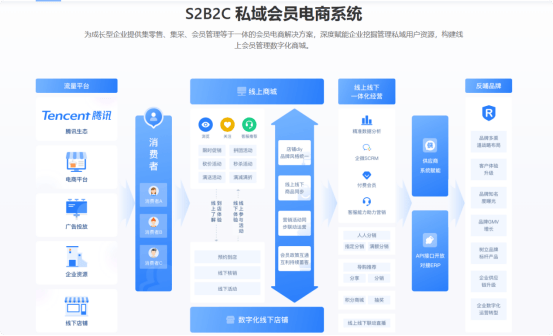
Core Insights - The article discusses the shift of growth-oriented companies towards "private domain operations" due to high public traffic costs and declining user stickiness, with S2B2C private domain membership e-commerce systems like CRMEB serving as a new infrastructure connecting "traffic, conversion, and retention" [1] Group 1: S2B2C Core Concept - The essence of S2B2C is to integrate links to address operational pain points, unifying the "traffic end, transaction end, and service end" into a cohesive system [3] - The traffic end connects multiple channels such as Tencent ecosystem, e-commerce platforms, and offline stores to convert public advertising into private user pools [3] - The transaction end supports various online activities and allows seamless transitions between online and offline experiences for users [3] - The service end synchronizes membership policies and marketing activities across online and offline platforms to avoid user confusion [3] Group 2: Private Domain Membership - The core of private domain operations is membership, with CRMEB's management system going beyond simple "points + discounts" [3] - The system employs SCRM and a paid membership structure to segment users, offering exclusive activities to high-value members and enabling users to act as "channels" through distribution [3] - Membership policies are integrated with both online and offline experiences, allowing users to accumulate points and benefits across platforms, transforming them from "consumers" to "participants" [3] Group 3: Adapting CRMEB to Business Needs - For growth-oriented companies, system flexibility is prioritized over having numerous features [4] - The system can integrate with supplier systems and ERP tools to resolve issues like product synchronization and inventory chaos [4] - Offline stores can undergo digital transformation, enabling features like "online ordering + offline pickup" and "online couponing + offline redemption" [4] Group 4: Reconstructing Operational Logic - The transition from viewing "online stores" and "offline stores" as separate channels to a unified system through CRMEB represents a shift from "selling products" to "managing users" [5] - This system acts as an "operating system" for private domain operations, allowing every user to become a "long-term asset" for the company [5]
健康消费新浪潮下,仙妮蕾德如何走出持续增长路径?
财联社· 2025-06-12 04:38
Core Insights - The article highlights the transformation of China's health industry from "quantity" to "quality," with herbal health consumption emerging as a significant choice for consumers [1] - Sunrider, a multinational company with over 30 years in the Chinese market, is experiencing steady growth, having opened over 40 franchise stores since 2024 and achieving a year-on-year revenue increase of over 15% [1][3] - The "Healthy China 2030" strategy is driving the health industry, with predictions that the market size will exceed 15 trillion yuan by 2025 [1] Group 1: Market Environment and Company Strategy - The health consumption sector is becoming a crucial driver of domestic demand, but there are still gaps in service quality and health knowledge dissemination [4] - Sunrider has established a value ecosystem centered around "herbal health," focusing on product development, consumer experience, membership systems, and distribution networks [3][4] - The company has opened experience centers in major cities to create new health consumption scenarios, responding to the growing demand for health services [4][6] Group 2: Experience Centers and Consumer Engagement - The experience centers serve as immersive health education platforms, enhancing consumer trust in herbal health concepts [6] - These centers act as a hub for brands, distributors, and consumers, improving operational efficiency and establishing a strong brand identity [6][8] - Sunrider plans to open a third experience center within the year, indicating a commitment to expanding its health consumption landscape [8] Group 3: Digital Integration and User Engagement - Sunrider launched the "Xian Ni Hui" mini-program to enhance its digital strategy, integrating physical stores and experience centers into a cohesive operational model [9][10] - The mini-program facilitates a closed-loop system for brand experience, user conversion, and repurchase mechanisms, enhancing customer engagement [10][11] - The platform has seen over 10,000 registered members within six months, with a repurchase rate of 40% and an average transaction value 50% higher than the company average [11] Group 4: Long-term Commitment and Local Adaptation - Sunrider has been deeply rooted in the Chinese market for over 30 years, with two factories supporting its supply chain [12] - The company emphasizes a "self-built R&D + long-termism" approach, continuously expanding its product and service ecosystem [12][14] - The strategic upgrade involves expanding store networks, enhancing consumer experience through centers, and leveraging digital tools to create a sustainable private domain asset [14]